


11 Aug Kerala HC Stays SIC Order on PSC Mark Disclosure: RTI & Privacy Clash
✎ The Kerala High Court's interim stay on the State Information Commission's order underscores the need to balance the Right to Information with privacy rights under Article 21, particularly in the context of large-scale…
Subject Relevance — Where This Topic Fits
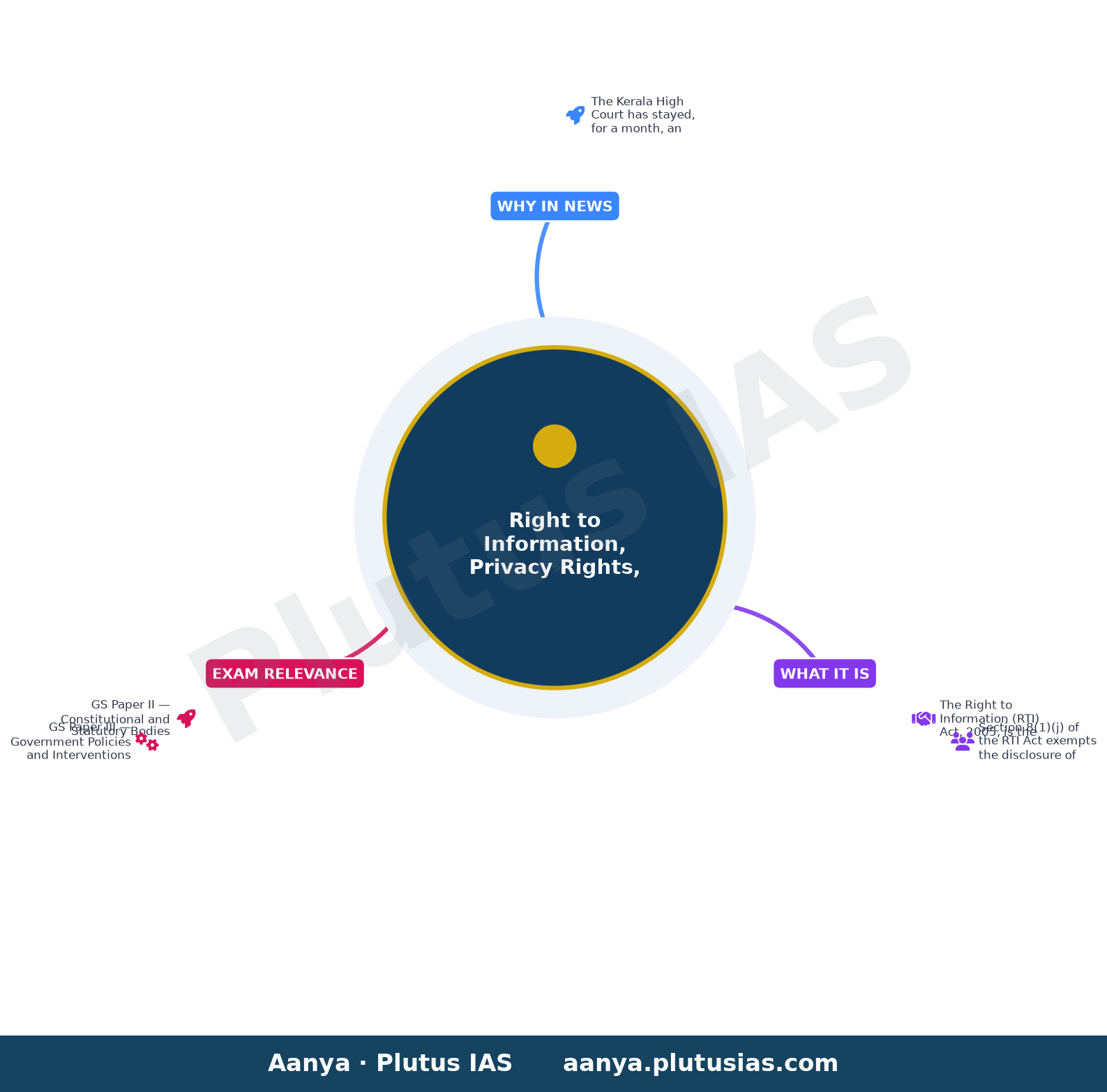
- GS Paper II — Constitutional and Statutory Bodies (State Information Commission, Public Service Commission) | GS Paper III — Government Policies and Interventions for Development in Various Sectors (Transparency and Accountability in Governance)
- Prelims: Right to Information Act, 2005, Article 21 (Right to Privacy), Constitution of India, Public Service Commission (PSC), State Information Commission (SIC), Kerala High Court, RTI exemptions under Section 8(1)(j), Third-party information, Recruitment examination transparency
- Essay: Transparency vs. Privacy: Balancing Public Interest and Individual Rights in Governance, The Role of Judiciary in Upholding Constitutional Values in Administrative Processes
Quick Revision: The Kerala High Court’s interim stay on the State Information Commission’s order underscores the need to balance the Right to Information with privacy rights under Article 21, particularly in the context of large-scale recruitment examinations where third-party information is involved.
Why is this in the news?
The Kerala High Court has stayed, for a month, an order of the State Information Commission (SIC) directing the Kerala Public Service Commission (PSC) to disclose personal and examination-related information of candidates, including marks and experience certificates. The case raises critical questions about the intersection of the Right to Information (RTI) Act, 2005, privacy rights under Article 21 of the Constitution, and the practical challenges of disclosing third-party information in large-scale recruitment processes. The outcome of this case will have significant implications for transparency in public sector recruitment and the protection of candidates’ personal data.
Background
- The Kerala Public Service Commission (PSC) conducts recruitment examinations for over 1.25 crore candidates, making it one of the largest recruitment bodies in India.
- The Right to Information (RTI) Act, 2005, empowers citizens to seek information from public authorities, subject to certain exemptions, including those related to personal privacy and third-party information.
- The State Information Commission (SIC) is the appellate authority under the RTI Act, tasked with ensuring compliance with transparency norms and adjudicating disputes between applicants and public authorities.
- The PSC argued that disclosing such information would violate the privacy rights of candidates and third parties, and that the volume of data made it impractical to comply with the SIC’s order.
- The Kerala High Court’s interim stay on the SIC’s order highlights the need for a judicial resolution of the conflict between transparency and privacy in the context of large-scale recruitment examinations.
What is the Legal and Institutional Framework Governing Disclosure of Examination Records?
- The Right to Information (RTI) Act, 2005, is the primary legislation governing the right of citizens to access information held by public authorities. It balances the right to information with exemptions to protect privacy, national security, and third-party interests.
- Section 8(1)(j) of the RTI Act exempts the disclosure of personal information, including information that would cause unwarranted invasion of privacy, unless a larger public interest is established.
- The State Information Commission (SIC) is a statutory body established under the RTI Act to adjudicate disputes between applicants and public authorities and ensure compliance with transparency norms.
- The Kerala Public Service Commission (PSC) is a constitutional body responsible for conducting recruitment examinations for state government services. It operates under the provisions of the Constitution of India and state-specific legislation.
- The Kerala High Court, as the highest judicial authority in the state, has the power to stay orders of quasi-judicial bodies like the SIC and adjudicate disputes involving constitutional and statutory rights.
- The conflict in this case arises from the tension between the right to transparency (RTI Act) and the right to privacy (Article 21 of the Constitution), which the Supreme Court has recognized as a fundamental right.
- The PSC’s argument that disclosing marks and experience certificates of top-ranked candidates would invade the privacy of third parties (e.g., employers providing experience certificates) is rooted in the principle of data minimization and protection of personal data.
UPSC Value Addition
Keywords for Mains Answer-Writing
Right to Information Act 2005 · Privacy rights and RTI · Public Service Commission transparency · State Information Commission · Judicial review of RTI orders · Balancing transparency and privacy · Exemptions under Section 8 of RTI Act · Public interest override in RTI · Kerala Public Service Commission · Constitutional protection of personal data
Prelims Practice Questions
Q1. Consider the following statements regarding the Right to Information (RTI) Act, 2005:
1. The RTI Act mandates disclosure of all information sought by citizens without exception.
2. Section 8 of the RTI Act provides for certain exemptions to disclosure.
3. The State Information Commission can direct public authorities to disclose information even if it involves personal data of third parties.
How many of the above statements are correct?
- Only one
- Only two
- Only three
- None
Answer: Only two — Statement 1 is incorrect as the RTI Act provides for exemptions under Section 8. Statement 2 is correct as Section 8 lists specific exemptions. Statement 3 is incorrect as disclosure of personal data of third parties requires a larger public interest justification.
Q2. Assertion (A): The Kerala High Court stayed an order of the State Information Commission directing the Kerala Public Service Commission to disclose marks and personal information of candidates.
Reason (R): The RTI Act, 2005, prohibits disclosure of personal information of third parties unless larger public interest is established.
- Both A and R are true, and R is the correct explanation of A
- Both A and R are true, but R is not the correct explanation of A
- A is true, but R is false
- A is false, but R is true
Answer: Both A and R are true, but R is not the correct explanation of A — Both the assertion and reason are true. The RTI Act permits disclosure of personal information only if larger public interest is established, which the High Court considered in its order.
Mains Practice Question
✍ The Kerala High Court’s interim stay on the State Information Commission’s order directing the Kerala Public Service Commission to disclose marks and personal information of candidates raises critical questions about the balance between transparency and privacy under the RTI Act. Critically examine the legal and constitutional dimensions of this issue. Also, analyse the implications of such disclosures for public institutions and candidates. (15 Marks)
Approach: MODEL-ANSWER SKELETON:
1. **RTI Act Framework**:
– Purpose and scope of the RTI Act, 2005.
– Provisions under Section 8 (exemptions) and Section 11 (third-party information).
– Concept of ‘larger public interest’ as a ground for disclosure.
2. **Judicial Precedents**:
– Supreme Court judgments on RTI vs. privacy (e.g., *Canara Bank v. C.S. Shyam* (2013), *Gujarat State Information Commission v. Bhaskeracharya Institute of Space Applications and Geo-Informatics* (2014)).
– High Court rulings on disclosure of examination-related information (e.g., *Rajasthan High Court in Ajay Kumar v. State Information Commission* (2019)).
3. **Public Service Commission Perspective**:
– Role of PSC in recruitment and its duty of confidentiality.
– Practical challenges in disclosing marks and personal data of 1.25 crore candidates.
– Transparency measures already in place (e.g., publication of rank lists).
4. **Balancing Transparency and Privacy**:
– Arguments for transparency: Ensuring fairness, accountability, and public trust in recruitment processes.
– Arguments for privacy: Protecting candidates from misuse of personal data and maintaining confidentiality.
– Role of the judiciary in interpreting the RTI Act’s provisions.
5. **Implications**:
– Impact on recruitment processes and institutional autonomy.
– Potential for misuse of disclosed information.
– Need for a nuanced approach to disclosure under RTI.
6. **Conclusion**:
– Reiterate the need to balance transparency and privacy.
– Suggest measures such as anonymising data or providing redacted information where possible.
Source: The Hindu
Generated by AanyaAi for educational purpose.

- Gurugram’s groundwater extraction exceeds limit by 212%; HC seeks ban - October 4, 2026
- स्वतंत्रता सेनानी श्यामजी कृष्ण वर्मा की जन्म जयंती पर पीएम का श्रद्धांजलि - October 4, 2026
- KWML’s Feasibility Reports for Water Metro in 18 Cities: UPSC & PCS Insights - October 3, 2026

No Comments