


08 Aug Kerala HC to CBI: Respond on Cashew Scam Accused in Govt Posts
Kerala High CourtCBIState governmentKSCDCPIL✎ The Kerala cashew import scam exemplifies the critical need for stringent adherence to procurement norms, transparency in governance, and the ethical disqualification of accused individuals from holding public office during…
Subject Relevance — Where This Topic Fits
- GS Paper II — Role of Civil Services in a Democracy | GS Paper III — Issues relating to Transparency and Accountability in Governance | GS Paper III — Prevention of Corruption
- Prelims: Public Interest Litigation (PIL), Central Bureau of Investigation (CBI), Vigilance and Anti-Corruption Bureau, Tendering Process, Conflict of Interest, Sanction for Prosecution, Khadi and Village Industries Board, RUTRONIX
- Essay: Ethical Governance: The Bedrock of Public Trust, Transparency and Accountability in Public Institutions
Quick Revision: The Kerala cashew import scam exemplifies the critical need for stringent adherence to procurement norms, transparency in governance, and the ethical disqualification of accused individuals from holding public office during ongoing corruption trials.
Why is this in the news?
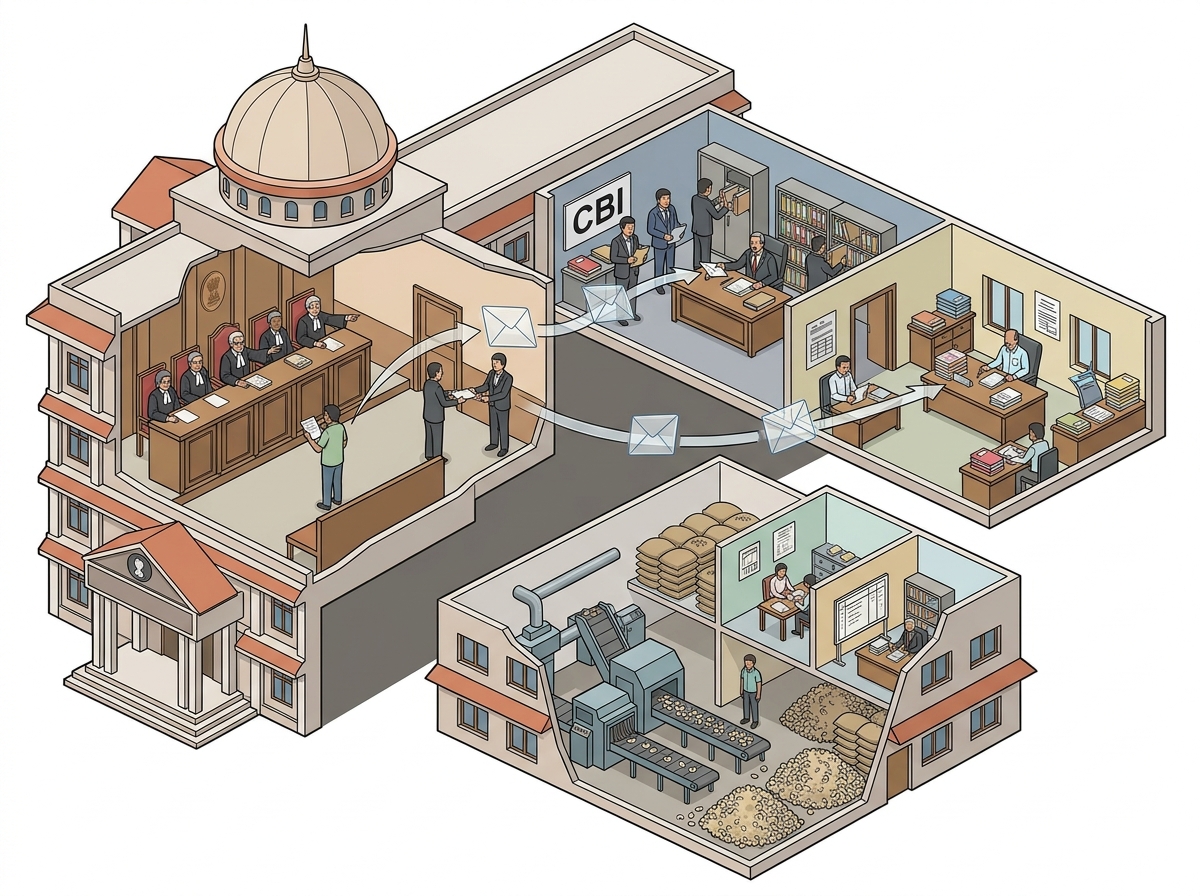
The Kerala High Court has sought responses from the Central Bureau of Investigation (CBI) and the State government regarding a Public Interest Litigation (PIL) filed against K.A. Ratheesh, a former accused in the ₹600-crore cashew import scam. The petition challenges Ratheesh’s continued holding of key government posts despite being chargesheeted and facing prosecution sanction in a major corruption case. This case underscores the critical importance of institutional integrity, transparency, and the ethical obligations of public servants in governance.
Background
- The Kerala State Cashew Development Corporation (KSCDC) is a state-owned enterprise engaged in the import and processing of raw cashew nuts.
- Between 2006 and 2015, allegations surfaced regarding financial irregularities in the import of raw cashew by KSCDC, involving inflated tender awards and violations of procurement norms.
- The alleged misappropriation is estimated at ₹600 crore, with charges including dishonest tendering, bypassing procurement rules, and collusion with private suppliers.
- Ratheesh, despite being chargesheeted and facing prosecution sanction, continues to hold multiple key government positions, including Secretary of the Kerala Khadi and Village Industries Board and Managing Director of RUTRONIX.
- The PIL filed by K.M. Shajahan, a former Additional Private Secretary to former Chief Minister V.S. Achuthananthan, highlights violations of public integrity norms and seeks to bar Ratheesh from holding government posts during the ongoing corruption case.
What is the Kerala Cashew Import Scam?
- The scam pertains to alleged financial irregularities in the import of raw cashew nuts by the Kerala State Cashew Development Corporation (KSCDC) between 2006 and 2015.
- Key allegations include the awarding of tenders to private suppliers at inflated rates, thereby causing financial losses to the exchequer.
- The CBI has charged former KSCDC officials, including K.A. Ratheesh and R. Chandrasekharan, with criminal conspiracy, cheating, and misappropriation of public funds.
- Prosecution sanction has been granted against Ratheesh, indicating prima facie evidence of involvement in the scam.
- The scam reflects systemic failures in procurement processes, lack of transparency in tendering, and inadequate oversight mechanisms within public sector undertakings.
- The case also highlights the ethical dilemma of allowing an accused individual to hold influential government positions while facing ongoing legal proceedings.
- The Kerala High Court’s intervention underscores the judiciary’s role in ensuring accountability and upholding constitutional principles of governance.
Key Features
| Feature | Significance |
|---|---|
| CBI chargesheet in ₹600-crore cashew import scam | Establishes prima facie evidence of systemic corruption in public procurement, highlighting vulnerabilities in tender processes and financial oversight. |
| Alleged violation of procurement norms by KSCDC | Demonstrates circumvention of standardised tendering procedures, leading to inflated costs and potential kickbacks in a critical agricultural commodity supply chain. |
| Petition seeking bar on accused holding government posts | Raises constitutional and ethical questions about the eligibility of individuals facing serious corruption charges to hold public office. |
| Ongoing judicial scrutiny of post-retention by accused | Illustrates the role of the judiciary in ensuring accountability and preventing conflict of interest in public administration. |
| Alleged substandard procurement by Khadi Board | Links corruption in one sector (agriculture) to potential malfeasance in another (handloom and village industries), indicating systemic governance failures. |
Why it Matters
Economic Governance
- Exposes systemic inefficiencies in public procurement mechanisms, particularly in agricultural commodity imports, leading to fiscal leakage and resource misallocation.
- Highlights the economic cost of corruption in a key export-oriented sector (cashew), undermining India’s competitiveness in global markets.
- Demonstrates the ripple effects of corruption across interconnected sectors, such as the Khadi and Village Industries Board, where substandard procurement further erodes public trust.
Institutional Integrity
- Underscores the need for robust internal audits and vigilance mechanisms within public sector undertakings to prevent financial irregularities.
- Raises questions about the efficacy of existing anti-corruption frameworks, including the Prevention of Corruption Act, 1988, in deterring and penalising malfeasance.
- Illustrates the role of the judiciary in upholding public accountability, particularly in cases where executive action may be compromised by political or administrative pressures.
Ethical Governance
- Reinforces the principle that individuals facing serious corruption charges should not hold positions of public trust, as enshrined in Articles 14 and 16 of the Constitution.
- Highlights the conflict between political expediency and administrative probity, particularly when accused individuals report directly to elected officials.
- Emphasises the importance of transparency in postings and transfers within government institutions to prevent cronyism and favouritism.
Judicial Oversight
- Demonstrates the judiciary’s proactive role in ensuring that corruption cases are not sidelined, even when they involve high-profile accused individuals.
- Shows how public interest litigation (PIL) can be used to challenge administrative decisions that compromise public integrity.
- Reinforces the need for timely disposal of vigilance and anti-corruption cases to prevent accused individuals from occupying key posts.
Challenges
1. Systemic Corruption in Public Procurement
- Lack of stringent compliance with procurement norms, such as the General Financial Rules (GFR), 2017, leading to irregularities in tender processes.
- Collusion between officials and private entities to inflate costs and bypass standardised procurement procedures.
- Inadequate financial oversight and audit mechanisms within public sector undertakings, allowing malfeasance to go undetected for years.
UPSC Link: GS-II: Governance, Transparency & Accountability
2. Conflict of Interest in Postings
- Appointment of individuals facing serious corruption charges to key government posts, raising ethical and constitutional concerns.
- Direct reporting lines between accused individuals and elected officials, creating potential for political interference in administrative decisions.
- Lack of clear guidelines on the eligibility of accused individuals to hold public office, leading to ambiguity in administrative actions.
UPSC Link: GS-II: Ethics in Governance
3. Judicial Delays and Administrative Inertia
- Prolonged delays in the disposal of corruption cases, allowing accused individuals to retain positions of power.
- Inadequate coordination between investigative agencies (CBI) and administrative bodies, leading to delays in prosecution and recovery of losses.
- Overburdened judicial system, which struggles to prioritise corruption cases amidst a high volume of pending litigation.
UPSC Link: GS-II: Judiciary & Governance
4. Erosion of Public Trust
- Widespread perception of corruption in key sectors undermines citizen confidence in government institutions.
- Allegations of substandard procurement in allied sectors (e.g., Khadi Board) further damage the credibility of public administration.
- Media scrutiny and PILs highlight governance failures, but lack of swift corrective action exacerbates public disillusionment.
UPSC Link: GS-IV: Ethics, Integrity & Aptitude
5. Intersectoral Corruption Risks
- Corruption in one sector (e.g., cashew imports) can spill over into related sectors (e.g., Khadi and Village Industries), creating a web of malfeasance.
- Lack of integrated vigilance mechanisms across departments, allowing corrupt practices to persist unchecked.
- Need for cross-sectoral audits and collaborative investigations to identify and dismantle systemic corruption networks.
UPSC Link: GS-III: Economic Development & Corruption
Challenges — UPSC Perspective
| Issue | Concern |
|---|---|
| Appointment of accused individuals to key posts | Violation of public trust and ethical governance norms |
| Prolonged judicial delays in corruption cases | Undermines deterrence and allows malfeasance to persist |
| Collusion between officials and private entities | Leads to inflated costs and resource misallocation |
| Substandard procurement in allied sectors | Erodes public confidence in government institutions |
| Lack of integrated vigilance mechanisms | Allows corruption to spread across interconnected sectors |
Way Forward
- Strengthen compliance with the General Financial Rules (GFR), 2017, and other procurement norms to prevent irregularities in tender processes.
- Implement a ‘cooling-off period’ for accused individuals in corruption cases, barring them from holding public office until charges are resolved.
- Enhance coordination between investigative agencies (CBI) and administrative bodies to expedite prosecution and recovery of losses.
- Introduce mandatory third-party audits for high-value public procurement to detect and deter financial irregularities.
- Establish a dedicated anti-corruption cell within the Department of Personnel and Training (DoPT) to monitor postings and transfers in sensitive sectors.
- Promote transparency in procurement processes by mandating e-tendering and real-time monitoring of tender awards.
- Conduct sector-specific training for procurement officers on ethical governance and conflict-of-interest management.
- Encourage whistleblower protection mechanisms to facilitate the reporting of corruption without fear of retaliation.
UPSC Value Addition
Keywords for Mains Answer-Writing
Corruption in public procurement · Public Integrity and Transparency · CBI and suo motu powers · Vigilance mechanism in India · Prosecution sanction under the Code of Criminal Procedure · Public Trust Doctrine · Constitutional morality · Government post eligibility for accused officials · Whistleblower protection · KSCDC cashew import scam · Vigilance Director · Kerala High Court jurisdiction · Public office and fiduciary duty
Constitutional & Policy Linkages
- [‘Article 14’, ‘Equality before law’]
- [‘Article 16’, ‘Equality of opportunity in public employment’]
- [‘Article 23’, ‘Prohibition of human trafficking and forced labour’]
- [‘Article 300A’, ‘Right to property’]
Concept Flow
Alleged misappropriation in cashew imports by KSCDC (2006–2015) → CBI chargesheet and prosecution sanction → Accused retained in key government posts → PIL filed to bar accused from holding office → Judicial scrutiny of administrative decisions → Allegations of substandard procurement in allied sectors (Khadi Board) → Systemic governance failures exposed → Demand for reform in procurement and vigilance mechanisms.
Prelims Practice Questions
Q1. Consider the following statements regarding the prosecution sanction under the Code of Criminal Procedure, 1973:
1. Prosecution sanction is required for the prosecution of a public servant for any offence alleged to have been committed by him while acting or purporting to act in the discharge of his official duties.
2. The sanctioning authority is the Central or State Government, as the case may be.
3. The sanction must be granted or refused within a statutory time limit of 30 days from the date of receipt of the request.
How many of the above statements are correct?
- Only one
- Only two
- All three
- None
Answer: Only two — Statement 1 is correct (Section 197 CrPC). Statement 2 is correct (Section 197(1) CrPC). Statement 3 is incorrect as there is no statutory time limit prescribed for granting or refusing sanction under Section 197 CrPC.
Q2. Assertion (A): The Central Bureau of Investigation (CBI) is a statutory body established under the Delhi Special Police Establishment Act, 1946.
Reason (R): The CBI derives its powers of investigation from Section 4 of the Delhi Special Police Establishment Act, 1946, which empowers it to investigate offences notified by the Central Government.
Options:
A. Both A and R are true, and R is the correct explanation of A.
B. Both A and R are true, but R is not the correct explanation of A.
C. A is true, but R is false.
D. A is false, but R is true.
Answer: ? — Assertion (A) is correct as the CBI is a statutory body under the Delhi Special Police Establishment Act, 1946. Reason (R) is also correct and directly explains the assertion as the Act empowers the CBI to investigate notified offences.
Q3. Match the following constitutional provisions with their correct descriptions:
Column I (Provisions)
A. Article 14
B. Article 19
C. Article 21
D. Article 311
Column II (Descriptions)
1. Protection of life and personal liberty
2. Equality before law and equal protection of laws
3. Protection of certain rights regarding freedom of speech, etc.
4. Dismissal, removal or reduction in rank of persons employed in public services
- A-2, B-3, C-1, D-4
- A-1, B-2, C-3, D-4
- A-2, B-1, C-4, D-3
- A-3, B-2, C-1, D-4
Answer: A-2, B-3, C-1, D-4 — Article 14 guarantees equality before law and equal protection of laws. Article 19 protects freedom of speech and expression. Article 21 protects life and personal liberty. Article 311 protects civil servants from arbitrary dismissal or reduction in rank.
Mains Practice Question
✍ The appointment of persons facing serious corruption charges to key government posts undermines the foundational principles of public integrity and constitutional morality. Critically analyse this proposition with reference to the recent Kerala High Court directive in the cashew import scam case. (15 Marks)
Approach: MODEL-ANSWER SKELETON:
1. **Introduction**: Define public integrity and constitutional morality (B.R. Ambedkar’s vision of a ‘Republic of equals’).
2. **Constitutional and Legal Framework**:
– Articles 14, 16, and 21 (equality, equal opportunity, life and liberty).
– Public Trust Doctrine (Ram Jawaya Kapur v. State of Punjab, 1955).
– Section 197 CrPC (prosecution sanction for public servants).
– Vigilance Commission guidelines and All India Services (Conduct) Rules, 1968.
3. **Recent Judicial Precedents**:
– Supreme Court rulings on disqualification of legislators under the Representation of the People Act, 1951 (Lily Thomas v. Union of India, 2013).
– Kerala High Court’s directive in the cashew scam case: balance between administrative continuity and probity.
4. **Institutional Mechanisms**:
– Role of the Vigilance Director and CBI in ensuring probity.
– Whistleblower protection (Whistle Blower Protection Act, 2014).
5. **Counterarguments and Challenges**:
– Administrative exigency vs. moral turpitude.
– Delay in judicial proceedings and its impact on appointments.
6. **Conclusion**: Emphasise the need for zero-tolerance policy in appointments to sensitive posts, citing the Public Interest Disclosure and Protection to Persons Making the Disclosure Bill, 2010.
Source: The Hindu
Generated by AanyaAi for educational purpose.

- मद्रास हाईकोर्ट का बड़ा फैसला: रिटायरमेंट के बाद भी जाती प्रमाण पत्र की जांच संभव - August 8, 2026
- Madras HC: Caste Certificate Verification Permissible Even After Retirement - August 8, 2026
- 13 वर्ष से कम उम्र के बच्चों को सोशल मीडिया, गेमिंग प्लेटफॉर्म पर प्रतिबंध लगाने वाला विधेयक संसद में प्रस्तावित - August 8, 2026

No Comments