


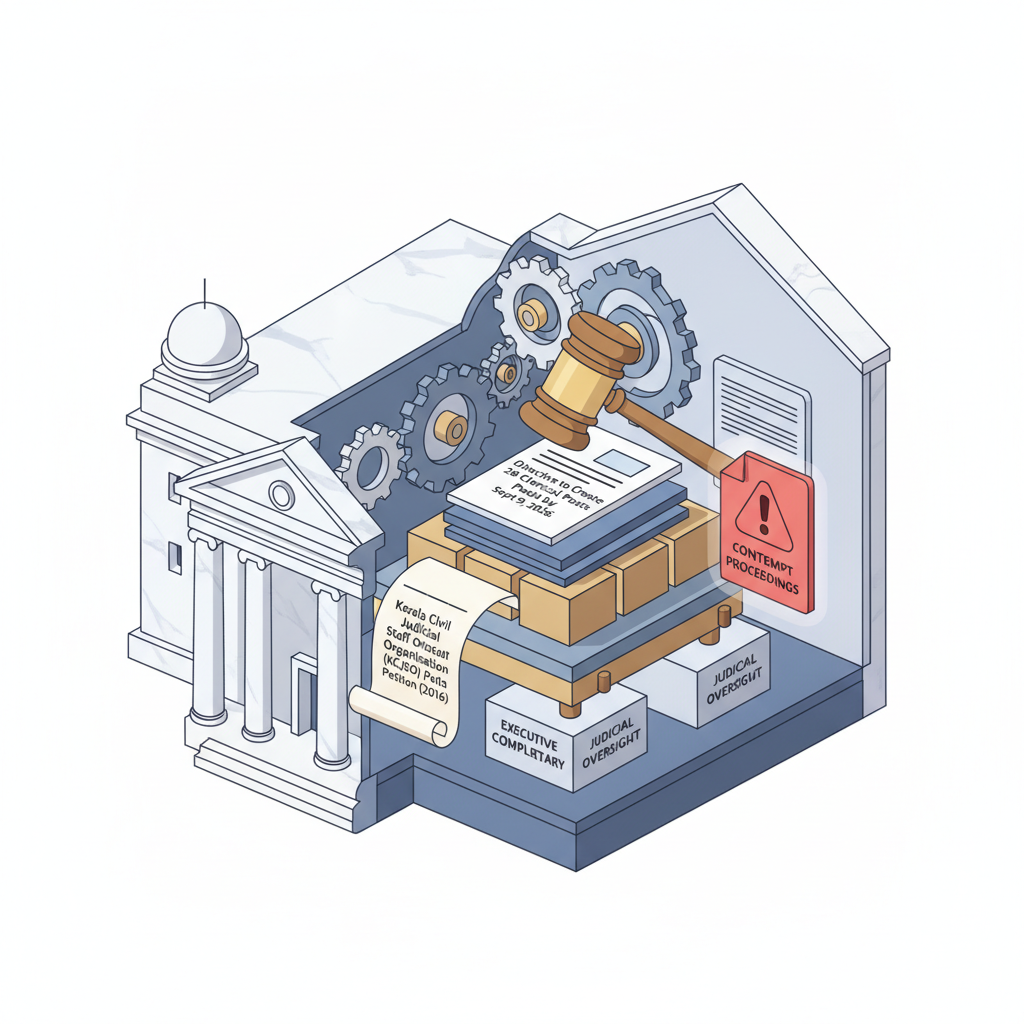
04 Sep Kerala HC warns Chief Secretary over contempt for unfilled district judiciary posts
✎ Contempt of court proceedings are a judicial tool to enforce compliance with court orders, particularly in cases involving administrative failures in sectors under judicial oversight, such as judicial infrastructure.
Subject Relevance — Where This Topic Fits
- GS Paper II — Judiciary and Constitutional Framework | GS Paper III — Public Administration and Governance
- Prelims: Judicial Infrastructure, Contempt of Court, Kerala High Court, District Judiciary, Judicial Staff Recruitment, Administrative Compliance, Organisation and Method Works Study Committee
- Essay: Judicial reforms and administrative efficiency in India, The role of the judiciary in ensuring good governance
Quick Revision: Contempt of court proceedings are a judicial tool to enforce compliance with court orders, particularly in cases involving administrative failures in sectors under judicial oversight, such as judicial infrastructure.
Why is this in the news?
The Kerala High Court has issued a warning to the State’s Chief Secretary, Biswanath Sinha, threatening contempt proceedings for non-compliance with its directives to create and sanction 28 clerical posts in the district judiciary by September 9, 2026. This development stems from a long-standing petition by the Kerala Civil Judicial Staff Organisation (KCJSO), which highlights systemic delays in addressing infrastructure deficiencies in subordinate courts despite judicial directives. The case underscores the interplay between judicial oversight and executive compliance in governance, particularly in the context of judicial infrastructure and administrative reforms.
Background
- The Kerala Civil Judicial Staff Organisation (KCJSO) filed a petition in 2016 seeking the appointment of a work study team to assess infrastructure deficiencies in Kerala’s subordinate courts, including clerical staff shortages.
- The Kerala High Court, in its 2019 order, directed the State government to constitute an Organisation and Method Works Study Committee to evaluate and address these deficiencies.
- The Committee’s findings led the High Court’s administrative department to request the creation of 80 clerical posts as an interim measure to mitigate identified gaps.
- The State government initially committed to creating 29 posts by mid-January 2026 and the remaining 51 posts by the end of March 2026, but no substantive action has been taken as of September 2026.
- The contempt proceedings arise from the State’s failure to comply with the High Court’s repeated directives, raising questions about the efficacy of judicial-legislative-executive coordination in governance.
- Kerala’s district judiciary, like other States, faces challenges in judicial infrastructure, including staff shortages, which impact case disposal rates and judicial efficiency.
Clerical Posts in the District Judiciary: Legal and Administrative Framework
- The district judiciary in India operates under the supervision of the High Courts, with administrative control vested in the State governments under Article 235 of the Constitution, which empowers High Courts to oversee subordinate judiciary.
- Clerical staff in district courts perform critical functions such as record-keeping, case management, and administrative support, directly impacting judicial efficiency and case disposal timelines.
- The creation and sanctioning of posts in the district judiciary are governed by the State’s administrative rules, budgetary allocations, and the recommendations of judicial committees, including the Organisation and Method Works Study Committee.
- Judicial infrastructure, including staffing levels, is a critical component of the ‘access to justice’ framework under Article 21 of the Constitution, ensuring timely and efficient justice delivery.
- Contempt of court proceedings serve as a legal mechanism to enforce judicial orders when executive or administrative authorities fail to comply with directives, ensuring the rule of law and separation of powers.
- The Kerala High Court’s warning reflects the judiciary’s role in holding the executive accountable for governance failures, particularly in sectors under judicial oversight.
- Administrative delays in sanctioning posts can lead to systemic inefficiencies, including backlogs, delayed justice, and erosion of public trust in the judiciary.
- The case highlights the need for proactive administrative reforms, including timely budgetary allocations, staffing audits, and inter-departmental coordination to address judicial infrastructure gaps.
Key Features
| Feature | Significance |
|---|---|
| Contempt jurisdiction of High Court | Empowers courts to enforce compliance with their orders, ensuring the rule of law and judicial authority are upheld against executive inaction. |
| Clerical posts in district judiciary | Essential for administrative efficiency, timely disposal of cases, and reducing pendency in subordinate courts. |
| Kerala Civil Judicial Staff Organisation (KCJSO) | Represents administrative staff in civil judiciary; acts as a watchdog for infrastructure and staffing deficiencies in district courts. |
| Organisation and Method Works Study Committee (2019) | Institutional mechanism to study and recommend administrative reforms in the judiciary, including staffing and infrastructure gaps. |
| Judicial pendency and case backlog | Chronic understaffing exacerbates delays, undermining access to justice and eroding public confidence in the judicial system. |
Why it Matters
Judicial Administration
- Highlights the constitutional principle of separation of powers, where the judiciary asserts its authority to ensure executive compliance with judicial directions.
- Demonstrates the judiciary’s proactive role in addressing systemic deficiencies in judicial infrastructure and staffing.
- Reinforces the doctrine of judicial accountability, ensuring that executive actions align with judicial orders for effective governance.
Governance and Public Administration
- Exposes gaps in inter-departmental coordination within the State government, particularly between the judiciary and the executive.
- Underscores the need for timely implementation of judicial directives to prevent administrative bottlenecks in critical public services.
- Illustrates the challenges in translating judicial recommendations into executive action, despite formal mechanisms like the Works Study Committee.
Access to Justice
- Underlines the direct correlation between staffing levels in district judiciary and the efficiency of case disposal, impacting citizens’ right to timely justice.
- Raises concerns about the quality of judicial services in subordinate courts due to chronic understaffing, particularly in clerical roles.
- Emphasises the role of administrative staff in ensuring smooth judicial functioning, which is often overlooked in judicial reforms.
Challenges
1. Judicial Pendency and Case Backlog
- Chronic understaffing in district judiciary directly contributes to delays in case disposal, exacerbating judicial pendency.
- Pendency undermines the fundamental right to speedy justice guaranteed under Article 21 of the Constitution.
- Delays disproportionately affect marginalised groups, including women, the elderly, and economically weaker sections, who depend on timely judicial remedies.
UPSC Link: Judicial Pendency and Reforms
2. Executive-Judiciary Coordination Deficit
- Lack of synchronisation between judicial directives and executive implementation leads to non-compliance with court orders.
- Bureaucratic inertia and procedural delays hinder the creation of sanctioned posts, despite clear judicial directions.
- Absence of a robust monitoring mechanism to track progress on judicial directives, resulting in repeated contempt proceedings.
UPSC Link: Separation of Powers
3. Infrastructure and Staffing Gaps in Subordinate Judiciary
- Inadequate clerical staff in district courts impedes administrative efficiency, case management, and judicial productivity.
- Infrastructure deficiencies, including lack of office space and equipment, compound the challenges faced by judicial staff.
- Failure to address staffing gaps despite multiple judicial interventions reflects systemic neglect of subordinate judiciary.
UPSC Link: Judicial Infrastructure
4. Accountability Mechanisms in Governance
- Contempt jurisdiction, while a strong tool, is often a reactive measure rather than a preventive one.
- Lack of institutionalised accountability frameworks to ensure timely compliance with judicial orders across departments.
- Need for a dedicated mechanism, such as a judicial-executive coordination committee, to monitor and expedite implementation of court directives.
UPSC Link: Judicial Accountability
5. Resource Allocation and Fiscal Constraints
- State governments often face fiscal constraints, leading to delays in sanctioning posts despite judicial orders.
- Prioritisation of posts in district judiciary may be deprioritised in favour of other sectors, such as health or education.
- Need for a balanced approach to resource allocation, ensuring that judicial infrastructure is not neglected.
UPSC Link: Fiscal Federalism
Challenges — UPSC Perspective
| Issue | Concern |
|---|---|
| Non-compliance with judicial orders | Erosion of judicial authority and undermining of the rule of law. |
| Chronic understaffing in district judiciary | Delays in case disposal, increased pendency, and compromised access to justice. |
| Bureaucratic inertia | Procedural delays and lack of urgency in implementing court directives. |
| Lack of inter-departmental coordination | Gaps in translating judicial recommendations into executive action. |
| Fiscal constraints | Delayed sanctioning of posts due to competing priorities in resource allocation. |
| Absence of monitoring mechanisms | Repeated contempt proceedings without systemic improvements in compliance. |
Way Forward
- Constitute a high-powered committee comprising representatives from the judiciary, executive, and finance department to expedite the creation and sanctioning of clerical posts in district judiciary.
- Establish a real-time monitoring dashboard to track the progress of judicial directives, with periodic reports to the High Court and State government.
- Strengthen the Organisation and Method Works Study Committee to include representatives from the KCJSO for continuous feedback on staffing and infrastructure needs.
- Introduce time-bound action plans for the State government to comply with judicial orders, with clear milestones and accountability measures.
- Allocate dedicated funds in the State budget for judicial infrastructure and staffing, ensuring that judiciary is not deprioritised due to fiscal constraints.
- Conduct periodic reviews of the subordinate judiciary’s administrative efficiency, with a focus on reducing pendency and improving case management.
- Explore public-private partnerships or outsourcing models for administrative tasks in district courts to alleviate staffing shortages.
- Sensitise the executive and legislature on the critical role of judicial staff in ensuring access to justice, fostering a culture of compliance with judicial directives.
UPSC Value Addition
Keywords for Mains Answer-Writing
Judicial administration · contempt of court · district judiciary · judicial staff · judicial infrastructure · judicial reforms · Kerala High Court · civil judicial staff · judicial posts · judicial governance · separation of powers · judicial accountability · judicial administration in India · judicial staff welfare · judicial infrastructure deficiencies
Constitutional & Policy Linkages
- Article 21: Right to speedy justice as part of the right to life and personal liberty.
- Article 225: Jurisdiction of High Courts over subordinate courts.
- Article 227: Power of superintendence over all courts by the High Court.
Concept Flow
Petition by KCJSO (2016) → High Court directs creation of Works Study Committee (2019) → Committee identifies staffing gaps → State government delays sanctioning posts → KCJSO files contempt petition (2026) → High Court warns Chief Secretary of contempt proceedings → Executive inaction persists → Judicial pendency worsens → Access to justice compromised.
Prelims Practice Questions
Q1. Consider the following statements regarding the contempt jurisdiction of the High Courts in India: 1. The High Courts derive their contempt jurisdiction from Article 215 of the Constitution of India. 2. Civil contempt includes wilful disobedience of any judgment, decree, direction, order, writ or other process of a court. 3. The power to punish for contempt is absolute and cannot be subjected to judicial review. 4. The Supreme Court has the power to transfer contempt cases from one High Court to another. How many of the above statements are correct?
- Only one
- Only two
- Only three
- All four
Answer: Only three — Statements 1 and 2 are correct. Statement 3 is incorrect as the power to punish for contempt is not absolute and is subject to judicial review. Statement 4 is incorrect as the Supreme Court does not have the power to transfer contempt cases from one High Court to another under the Contempt of Courts Act, 1971.
Q2. Assertion (A): The Chief Secretary of a State is not personally liable for contempt of court for non-compliance with judicial directions. Reason (R): Contempt proceedings against a public servant are governed by the Contempt of Courts Act, 1971, which provides for vicarious liability of the State.
- Both A and R are true, and R is the correct explanation of A.
- Both A and R are true, but R is not the correct explanation of A.
- A is true, but R is false.
- A is false, but R is true.
Answer: ? — Assertion (A) is false as the Chief Secretary, being the administrative head of the State, can be held personally liable for contempt of court for wilful disobedience of judicial directions. Reason (R) is true as the Contempt of Courts Act, 1971, does not absolve public servants of personal liability for contempt.
Q3. Match the following provisions of the Constitution of India with their respective articles: Column I Column II A. Jurisdiction of High Courts 1. Article 124 B. Appointment of judges of High Courts 2. Article 217 C. Contempt of Courts 3. Article 215 D. Original jurisdiction of Supreme Court 4. Article 131
- A-3, B-2, C-1, D-4; A-3, B-2, C-4, D-1; A-2, B-3, C-1, D-4; A-1, B-2, C-3, D-4
- answer_explaination_map_indexed_list_of_pairs_to_match_correctly
- answer_explaination_map_indexed_list_of_pairs_to_match_correctly
- answer_explaination_map_indexed_list_of_pairs_to_match_correctly
Answer: A-3, B-2, C-1, D-4; A-3, B-2, C-4, D-1; A-2, B-3, C-1, D-4; A-1, B-2, C-3, D-4 — The correct match is: A-3 (Article 215: Jurisdiction of High Courts), B-2 (Article 217: Appointment of judges of High Courts), C-1 (Article 124: Contempt of Courts is not explicitly mentioned but is inherent in the jurisdiction of the Supreme Court under Article 129), D-4 (Article 131: Original jurisdiction of the Supreme Court).
Mains Practice Question
✍ The principle of judicial independence is intricately linked to the efficient functioning of the judiciary. In this context, critically examine the role of judicial staff in ensuring the effective delivery of justice, with particular reference to the recent directive of the Kerala High Court regarding the creation of clerical posts in the district judiciary. Also, analyse the constitutional and legal framework governing the accountability of the executive in implementing judicial directions. (15 Marks)
Approach: MODEL-ANSWER SKELETON:
1. **Introduction (2 Marks)**:
– Define judicial independence and its constitutional basis (Articles 50, 124, 215, 217).
– State the importance of judicial staff in maintaining judicial efficiency and independence.
2. **Role of Judicial Staff (4 Marks)**:
– Explain the functions of clerical staff in the district judiciary: record-keeping, case management, administrative support, and ensuring timely disposal of cases.
– Discuss the impact of staff shortages on judicial delays, pendency of cases, and access to justice (cite data from the Supreme Court’s ‘Judicial Statistics’ or reports like the ‘National Judicial Data Grid’).
– Highlight the Kerala High Court’s directive (2026) as a case study: creation of 28 clerical posts to address infrastructure deficiencies identified in 2016.
3. **Constitutional and Legal Framework (5 Marks)**:
– **Separation of Powers**: Discuss the doctrine and its application to the executive’s obligation to comply with judicial directions (Articles 124, 215, 217; judicial review under Article 32/226).
– **Contempt of Court**: Define civil contempt under the Contempt of Courts Act, 1971 (Section 2(b)), and its purpose in ensuring compliance with judicial orders.
– **Executive Accountability**: Explain the liability of the Chief Secretary and the State government for non-compliance (case law: *T.N. Godavarman Thirumulpad v. Union of India* (2002) on judicial directions and executive accountability).
– **Judicial Reforms**: Mention the role of the Organisation and Method Works Study Committee (2019) in identifying deficiencies.
4. **Challenges and Way Forward (4 Marks)**:
– **Challenges**: Bureaucratic delays, lack of political will, resource constraints, and inter-departmental coordination issues.
– **Way Forward**:
– Strengthening the implementation of judicial directions through time-bound action plans.
– Periodic review by High Courts and the Supreme Court (e.g., *Prakash Singh v. Union of India* (2006) on police reforms as a model for judicial reforms).
– Institutional mechanisms for monitoring compliance, such as the creation of a dedicated cell in the State Secretariat for judicial administration.
– Public interest litigation (PIL) as a tool for ensuring accountability.
5. **Conclusion (1 Mark)**:
– Reiterate the symbiotic relationship between judicial staff, judicial independence, and the rule of law.
– Emphasise the need for a collaborative approach between the judiciary and the executive to uphold constitutional values.
Source: The Hindu
Kerala PCS (Kerala PSC (KAS)) — State PCS Practice
Prelims: The Kerala High Court recently issued a warning to the Chief Secretary of Kerala regarding the non-filling of clerical posts in the district judiciary. Under which legal provision can the High Court initiate contempt proceedings against the Chief Secretary for such non-compliance?
- Article 215 of the Constitution of India
- Article 296 of the Constitution of India
- Contempt of Courts Act, 1971
- Kerala Civil Services (Classification, Control and Appeal) Rules, 1960
Answer: Contempt of Courts Act, 1971 — The Contempt of Courts Act, 1971 empowers courts to initiate contempt proceedings against any authority, including the Chief Secretary, for willful disobedience of court orders or non-compliance with judicial directives.
Mains: Critically analyze the role of the Kerala High Court in ensuring judicial efficiency through the timely filling of clerical posts in the district judiciary. Suggest measures to prevent such administrative delays in the future, with a focus on Kerala’s governance framework.
Generated by AanyaAi for educational purpose.
Related guides on our sites
- Best PSIR optional coaching for upsc
- Best PSIR optional teacher for upsc
- Best teacher of PSIR optional for upsc
- Best PSIR optional coaching in delhi for UPSC

- Kerala HC rules delay cannot quash Domestic Violence Act proceedings - September 20, 2026
- नासा-इसरो सहयोग: अंतरिक्ष अनुसंधान में नया मोड़, जानिए क्या है अगला कदम? - September 20, 2026
- NASA highlights ISRO partnership for future space missions in UPSC focus - September 20, 2026

No Comments