


16 Sep Kerala HR Panel Urges Early Warning Systems for Human-Wildlife Conflict Mitigation
✎ Early Warning Systems (EWS) for human-wildlife conflict management must prioritise real-time monitoring, community engagement, and region-specific technological interventions to prevent conflicts proactively, rather than relying…
Subject Relevance — Where This Topic Fits
- GS Paper III — Environment, Ecology, Biodiversity and Climate Change | GS Paper II — Governance, Transparency and Accountability
- Prelims: Human-Wildlife Conflict (HWC), Wildlife corridors, Early Warning Systems (EWS), Forest Rights Act, 2006, Wildlife Protection Act, 1972, Kaziranga National Park Model, Compensatory Afforestation Fund Management and Planning Authority (CAMPA), National Wildlife Action Plan (2017-2031), Kerala State Human Rights Commission (KSHRC)
- Essay: Human-Wildlife Coexistence: Balancing Conservation and Livelihood Security, Technological Innovations in Governance: Early Warning Systems for Sustainable Development
Quick Revision: Early Warning Systems (EWS) for human-wildlife conflict management must prioritise real-time monitoring, community engagement, and region-specific technological interventions to prevent conflicts proactively, rather than relying on post-conflict measures.
Why is this in the news?
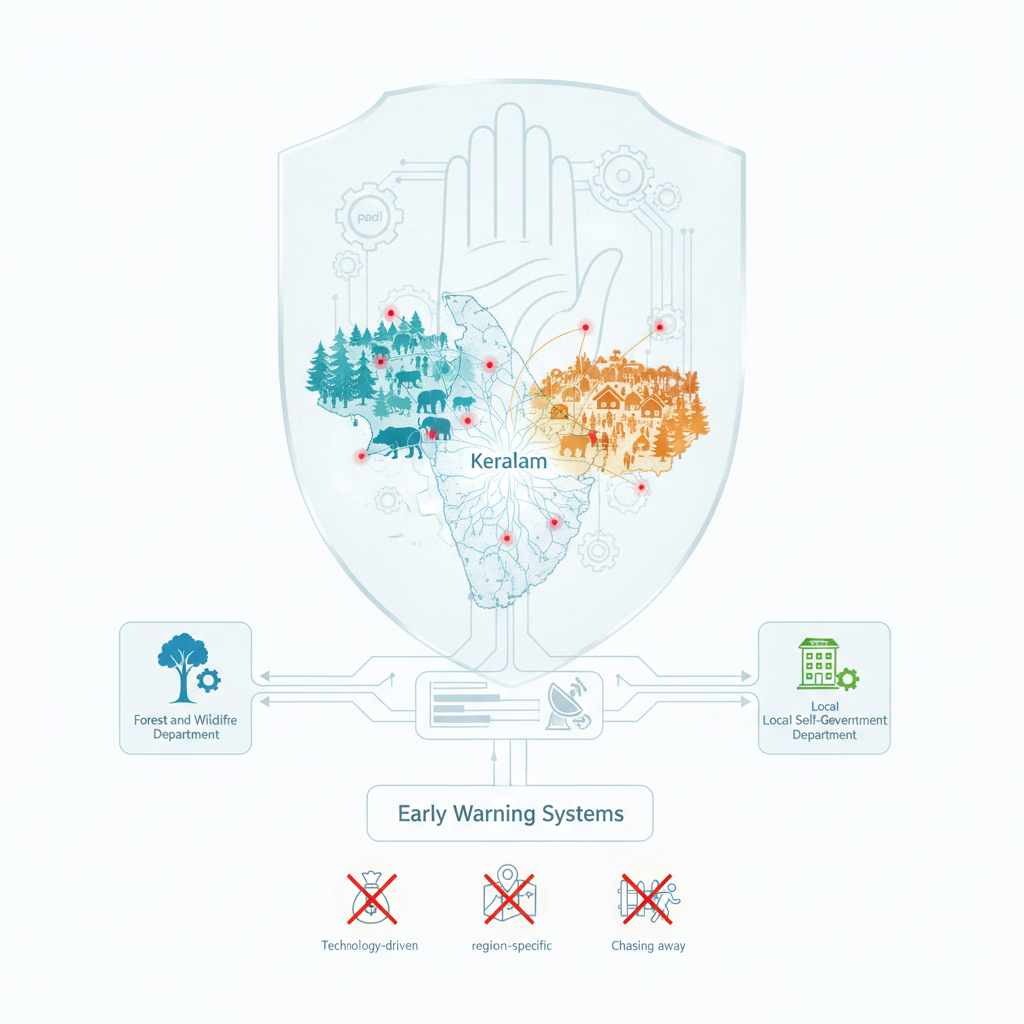
The Kerala State Human Rights Commission (KSHRC) has issued a suo motu directive to the Forest and Wildlife Department and Local Self-Government Department, emphasising the urgent need for robust early warning systems to mitigate human-wildlife conflict (HWC) in Keralam. The order underscores the limitations of reactive measures such as compensation disbursement, fencing, and chasing away wildlife, advocating instead for proactive, technology-driven, and region-specific interventions to prevent conflict before it occurs.
Background
- Human-wildlife conflict (HWC) is a global challenge, particularly acute in regions with high biodiversity and dense human settlements, such as Keralam.
- Keralam, with its extensive forest cover (nearly 29% of its geographical area) and high population density, has witnessed a rise in HWC incidents, including crop raids, livestock predation, and human casualties, due to habitat fragmentation and encroachment into wildlife corridors.
- Existing HWC mitigation strategies in Keralam have largely relied on post-conflict measures, including compensation for losses, construction of physical barriers, and ad hoc wildlife deterrence tactics, which have proven insufficient.
- The Wildlife Protection Act, 1972, and the Forest Rights Act, 2006, provide the legal framework for wildlife conservation and human-wildlife coexistence, but their implementation requires coordination among multiple stakeholders.
- The National Wildlife Action Plan (2017-2031) highlights the need for proactive HWC management through early warning systems, habitat restoration, and community engagement.
- The directive by the KSHRC aligns with the constitutional mandate of the State under Article 48A (Directive Principles of State Policy) to protect and improve the environment and safeguard forests and wildlife.
What are Early Warning Systems (EWS) for Human-Wildlife Conflict?
- Early Warning Systems (EWS) are proactive governance mechanisms designed to detect, assess, and communicate potential threats from wildlife to human settlements before conflicts occur.
- EWS integrate technological tools such as camera traps, sensor-based warning systems, drones, mobile alerts, and GIS mapping to monitor wildlife movement routes and conflict hotspots in real time.
- The primary objective of EWS is to enable timely evacuation, deterrence, or habitat management interventions, thereby reducing human casualties, economic losses, and retaliatory killings of wildlife.
- EWS must be tailored to regional variations, considering factors such as topography, wildlife species involved (e.g., elephants, tigers, wild boars), and socio-economic conditions of affected communities.
- Community participation is critical for the success of EWS, as local knowledge of wildlife behaviour and traditional practices can enhance the effectiveness of technological interventions.
- EWS operate on the principles of the ‘precautionary approach’ and ‘adaptive management,’ ensuring flexibility to incorporate new technologies and lessons from field experiences.
- Globally, successful EWS models include the ‘Elephant Response Units’ in Sri Lanka and the ‘Early Warning Systems for Tiger Reserves’ in India, which utilise community-based monitoring and rapid response teams.
- The integration of EWS with existing legal and institutional frameworks, such as the Wildlife Protection Act and the National Wildlife Action Plan, ensures compliance and scalability.
Key Features
| Feature | Significance |
|---|---|
| Suo motu intervention by Kerala State Human Rights Commission | Demonstrates proactive governance by constitutional bodies to address systemic failures in human-wildlife conflict mitigation. |
| Mapping of wildlife movement routes and conflict hotspots | Enables data-driven resource allocation and targeted interventions in high-risk zones. |
| Continuous surveillance mechanisms (camera traps, drones, sensors) | Facilitates real-time threat detection and reduces reliance on reactive measures. |
| Early warning systems (mobile alerts, solar fencing, trenches) | Shifts focus from post-conflict compensation to preemptive risk communication. |
| Balanced approach to human-wildlife coexistence | Aligns with constitutional directives to balance fundamental rights (Article 21) with environmental protection (Article 48A). |
Why it Matters
Environmental Governance
- Highlights the need for integrated wildlife management policies that transcend departmental silos, particularly between Forest and Local Self-Government Departments.
- Underscores the role of human rights institutions in environmental justice, ensuring that mitigation measures do not disproportionately burden marginalised communities.
- Emphasises the integration of modern technology (AI, IoT, GIS) in ecological monitoring, aligning with India’s National Mission for a Green India.
Legal and Institutional Framework
- Demonstrates the functional role of State Human Rights Commissions under the Protection of Human Rights Act, 1993, in addressing ecological governance failures.
- Reinforces the constitutional obligation of the State (Article 48A) to protect and improve the environment and wildlife.
- Illustrates the principle of cooperative federalism in environmental management, with the Chief Secretary coordinating inter-departmental efforts.
Technological and Methodological Innovation
- Advocates for adaptive, region-specific solutions (e.g., sensor-based fencing in tea plantations vs. drone surveillance in forests) rather than one-size-fits-all approaches.
- Promotes the use of participatory GIS mapping, engaging local communities in identifying conflict zones and validating data.
- Aligns with the National Wildlife Action Plan (2017-2031) emphasis on community-based conservation and conflict resolution.
Challenges
1. Institutional Coordination Gaps
- Fragmented implementation across Forest, Revenue, and Panchayati Raj departments leads to delayed or ineffective responses.
- Lack of a unified data-sharing platform hinders real-time threat assessment and resource deployment.
- Top-down directives often fail to incorporate grassroots insights from forest-dwelling communities.
UPSC Link: GS-III: Environmental Governance
2. Technological and Financial Constraints
- High initial costs for deploying advanced surveillance systems (drones, IoT sensors) in remote or densely forested areas.
- Maintenance and operational challenges in ensuring 24/7 monitoring, especially during monsoon seasons.
- Limited funding allocation for preventive measures compared to post-conflict compensation schemes.
UPSC Link: GS-III: Science & Technology in Governance
3. Socio-Economic Vulnerabilities
- Marginalised communities in conflict zones (e.g., Adivasi settlements) bear disproportionate risks due to limited access to early warnings.
- Economic dependence on forest-adjacent livelihoods (agriculture, NTFP collection) exacerbates human-wildlife interactions.
- Cultural and psychological barriers may hinder acceptance of technological solutions among local populations.
UPSC Link: GS-I: Social Empowerment
4. Ecological Trade-offs
- Physical barriers (fences, trenches) may disrupt wildlife corridors, leading to unintended ecological consequences.
- Over-reliance on deterrents (e.g., chasing elephants) can habituate wildlife to human presence, increasing long-term risks.
- Balancing habitat protection with human safety requires nuanced, context-specific strategies.
UPSC Link: GS-III: Biodiversity Conservation
Challenges — UPSC Perspective
| Issue | Concern |
|---|---|
| Data Silos | Lack of inter-departmental data integration impedes comprehensive risk mapping. |
| Community Disengagement | Top-down approaches often exclude local knowledge, reducing solution efficacy. |
| Resource Allocation | Preventive measures compete with competing priorities, leading to underfunding. |
| Technology Adoption | High-tech solutions may be impractical in remote or resource-constrained areas. |
| Legal Ambiguities | Unclear liability frameworks for wildlife-related damages hinder compensation disbursement. |
Way Forward
- Establish a State-level Inter-Departmental Task Force for Human-Wildlife Conflict Resolution, chaired by the Chief Secretary, to oversee coordination and resource allocation.
- Develop a GIS-based Early Warning System (EWS) integrating forest department data, community inputs, and satellite imagery for dynamic risk mapping.
- Pilot region-specific technological interventions (e.g., solar-powered sensor networks in Wayanad, drone surveillance in Periyar) with measurable KPIs for scalability.
- Institute a participatory monitoring framework, training local youth as ‘Wildlife Conflict Mitigation Volunteers’ to bridge institutional and community gaps.
- Revise compensation schemes to include preventive measures (e.g., subsidised solar fencing) alongside post-attack relief, ensuring equitable access for marginalised groups.
- Conduct bi-annual ‘Conflict Hotspot Audits’ to reassess wildlife corridors and adjust mitigation strategies based on ecological and demographic changes.
- Leverage CSR funds and international partnerships (e.g., with WWF-India or UNEP) to supplement State resources for high-cost technological deployments.
UPSC Value Addition
Keywords for Mains Answer-Writing
Human-Wildlife Conflict · Early Warning Systems · Kerala State Human Rights Commission · Wildlife Conservation · Forest and Wildlife Department · Local Self-Government Institutions · Human-Wildlife Coexistence · Camera Traps and Drones · Solar Fencing and Trenches · Preventive Governance Mechanisms · Constitutional Protection of Wildlife · Sustainable Development Goals (SDG 15)
Constitutional & Policy Linkages
- Article 48A: Directive Principle of State Policy on protection and improvement of environment and wildlife.
- Article 21: Right to Life and Personal Liberty, including protection from environmental hazards.
Concept Flow
Human-wildlife conflict escalates due to habitat encroachment and resource competition. → Reactive measures (chasing elephants, compensation) prove inadequate, leading to recurring casualties. → State Human Rights Commission identifies systemic gaps and directs proactive governance. → Mapping and surveillance technologies enable early threat detection and targeted interventions. → Balanced approach ensures coexistence by safeguarding human lives and ecological integrity. → Institutional coordination and community participation institutionalise long-term solutions.
Prelims Practice Questions
Q1. Consider the following statements regarding human-wildlife conflict in India:
1. The Kerala State Human Rights Commission has directed the deployment of camera traps and sensor-based warning systems as part of early warning mechanisms.
2. The Forest Rights Act, 2006, is the primary legal framework for addressing human-wildlife conflict in India.
3. The Wildlife (Protection) Act, 1972, empowers the State governments to declare wildlife corridors as protected areas.
How many of the above statements are correct?
- Only one
- Only two
- All three
- None
Answer: Only two — Statement 1 is correct as per the Kerala State Human Rights Commission’s directive. Statement 2 is incorrect because the Forest Rights Act, 2006, primarily addresses forest-dwelling communities’ rights, not human-wildlife conflict resolution. Statement 3 is correct as Section 36A of the Wildlife (Protection) Act, 1972, empowers the State governments to declare wildlife corridors as protected areas.
Q2. Assertion (A): The Kerala State Human Rights Commission has recommended the use of solar fencing as a measure to mitigate human-wildlife conflict.
Reason (R): Solar fencing is a cost-effective and eco-friendly solution that does not harm wildlife but deters their entry into human settlements.
Options:
A. Both A and R are true, and R is the correct explanation of A.
B. Both A and R are true, but R is not the correct explanation of A.
C. A is true, but R is false.
D. A is false, but R is true.
Answer: ? — Assertion (A) is true as the Kerala State Human Rights Commission’s order explicitly mentions solar fencing as one of the suggested measures. Reason (R) is also true and correctly explains A, as solar fencing is indeed a non-lethal deterrent that aligns with the commission’s emphasis on balancing human safety and wildlife conservation.
Q3. Match the following measures suggested by the Kerala State Human Rights Commission for mitigating human-wildlife conflict with their respective objectives:
Column I (Measures) | Column II (Objectives)
1. Camera traps | A. Real-time monitoring of wildlife movement
2. Mobile phone alerts | B. Immediate dissemination of threat information to local communities
3. Hanging fences | C. Physical deterrence without harming wildlife
4. Solar fencing | D. Non-invasive surveillance to track animal presence
Options:
A. 1-D, 2-B, 3-C, 4-C
B. 1-A, 2-B, 3-D, 4-C
C. 1-D, 2-A, 3-B, 4-C
D. 1-A, 2-B, 3-C, 4-D
- A
- B
- C
- D
Answer: A — 1-D: Camera traps are used for non-invasive surveillance to track animal presence. 2-B: Mobile phone alerts are for immediate dissemination of threat information. 3-C: Hanging fences serve as physical deterrents without harming wildlife. 4-C: Solar fencing also acts as a physical deterrent without harming wildlife. Thus, the correct match is A.
Mains Practice Question
✍ The Kerala State Human Rights Commission has underscored the necessity of a preventive governance framework to address human-wildlife conflict. Critically examine the constitutional, statutory, and institutional mechanisms available in India to mitigate such conflicts, with reference to the directive issued by the commission. Also, discuss the role of local self-government institutions in ensuring sustainable coexistence between humans and wildlife. (15 Marks)
Approach: MODEL-ANSWER SKELETON:
1. **Constitutional and Statutory Framework:**
– **Directive Principles of State Policy (DPSP):** Article 48A (Protection and improvement of environment and safeguarding of forests and wildlife) and Article 51A(g) (Fundamental Duty to protect and improve the natural environment).
– **Wildlife (Protection) Act, 1972:** Provisions for declaring protected areas (Sections 18-38), wildlife corridors (Section 36A), and offences related to human-wildlife conflict (Section 9).
– **Forest Rights Act, 2006:** Recognition of forest-dwelling communities’ rights and provisions for conservation of biodiversity (Section 5).
– **Scheduled Tribes and Other Traditional Forest Dwellers (Recognition of Forest Rights) Act, 2006:** Balancing conservation with community rights.
2. **Institutional Mechanisms:**
– **National Board for Wildlife (NBWL):** Advisory body under the Wildlife (Protection) Act, 1972, for policy formulation and project approvals.
– **State Wildlife Boards:** Role in declaring wildlife corridors and protected areas.
– **Forest and Wildlife Departments:** Implementation of conservation measures and conflict mitigation strategies.
– **Human Rights Commissions:** Constitutional bodies under Article 338A (National Commission for Scheduled Castes) and state commissions (e.g., Kerala State Human Rights Commission) for monitoring and directing remedial measures.
3. **Kerala State Human Rights Commission’s Directive:**
– **Early Warning Systems:** Emphasis on mapping wildlife movement routes, continuous surveillance, and deployment of technology (camera traps, drones, sensor-based systems).
– **Balanced Approach:** Safeguarding human lives and livelihoods while protecting wildlife habitats.
– **Role of Chief Secretary:** Coordination among departments and submission of action-taken reports.
4. **Role of Local Self-Government Institutions (LSGIs):**
– **Panchayati Raj Institutions (PRIs) and Urban Local Bodies (ULBs):** Implementation of early warning systems, community awareness programs, and participatory conservation initiatives.
– **Gram Sabhas:** Role in identifying conflict-prone areas and suggesting mitigation measures under the Forest Rights Act, 2006.
– **Community-Based Conservation:** Integration of traditional knowledge and modern technology for sustainable coexistence.
5. **Challenges and Way Forward:**
– **Inter-departmental Coordination:** Need for seamless collaboration between forest departments, LSGIs, and human rights bodies.
– **Technological Integration:** Scaling up the use of AI, GIS, and IoT for real-time monitoring and early warnings.
– **Community Participation:** Empowering local communities in decision-making processes to ensure long-term sustainability.
– **Legal and Policy Reforms:** Strengthening the legal framework to address emerging challenges in human-wildlife conflict mitigation.
Source: The Hindu
Generated by AanyaAi for educational purpose.
Related guides on our sites
- Current affairs for upsc 2026
- How to prepare for GS paper 1 for UPSC CSE mains exam
- Best UPSC coaching for IFOS exam
- Best geography optional coaching

- Kerala HR Panel Urges Early Warning Systems for Human-Wildlife Conflict Mitigation - September 16, 2026
- एनजीटी का आदेश: पुणे-पिंपरी में साइलेंस जोन में लाउडस्पीकर पर पूर्ण प्रतिबंध लागू करें सरकार - September 16, 2026
- NGT Directs Strict Silence Zone Compliance in Pune & Pimpri-Chinchwad - September 16, 2026

No Comments