


15 Oct Kerala SARAL Bill: Key Features, Concerns & UPSC Relevance
✎ The SARAL Keralam Bill, 2026, proposes a unified statutory authority for industrial approvals under the OSAD framework, but its compatibility with environmental safeguards and local governance powers requires careful scrutiny.
Subject Relevance — Where This Topic Fits
- GS Paper II — Functions and Responsibilities of the Union and the States | GS Paper III — Industrial Policy and Growth, Environmental Impact Assessment
- Prelims: Single Window Clearance System, Environmental Impact Assessment (EIA), Concurrent List (7th Schedule), Powers of State Legislatures, Regulatory Approvals for Industries, Local Self-Government (73rd and 74th Constitutional Amendments), Kerala Conservation of Paddy Land and Wetland Act, 2008
- Essay: Economic Development vs. Environmental Conservation: The Imperative of Sustainable Industrialisation, The Role of State Legislatures in Balancing Growth and Governance
Quick Revision: The SARAL Keralam Bill, 2026, proposes a unified statutory authority for industrial approvals under the OSAD framework, but its compatibility with environmental safeguards and local governance powers requires careful scrutiny.
Why is this in the news?
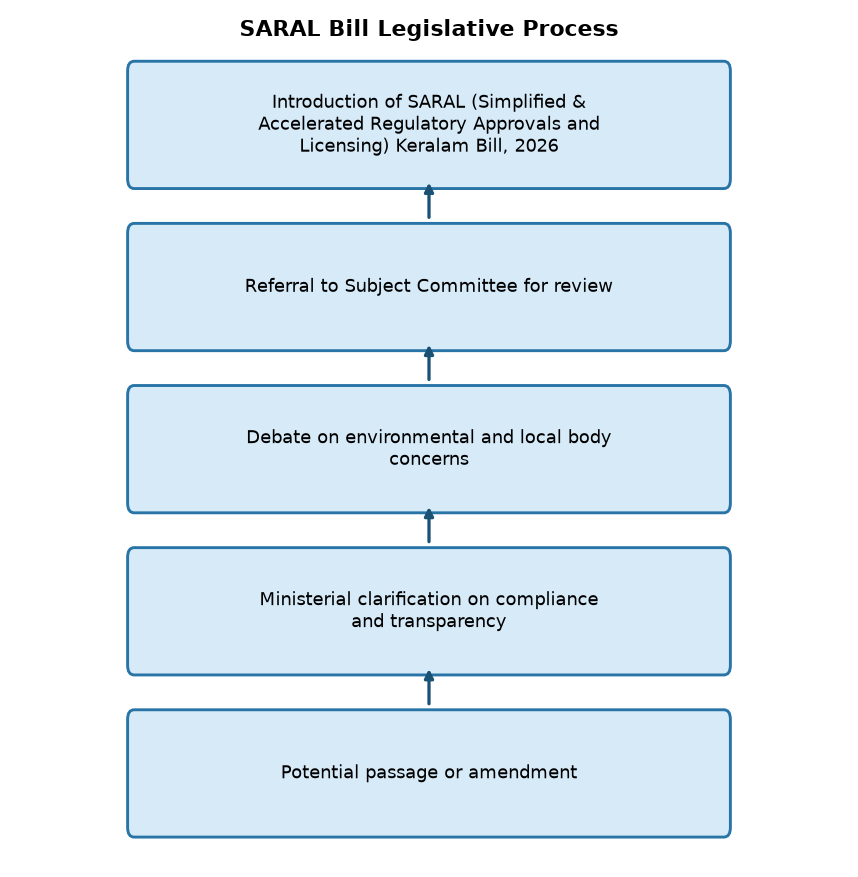
The Kerala Legislative Assembly referred the SARAL (Simplified & Accelerated Regulatory Approvals and Licensing) Keralam Bill, 2026, to its Subject Committee on October 15, 2026. The Bill seeks to establish a unified statutory authority for granting industrial licences and permits under the ‘One-State-One-Approval-One-Document’ (OSAD) framework, aiming to expedite approvals for industrial ventures. The referral follows concerns raised by legislators regarding potential bypassing of environmental safeguards and the dilution of local governance powers, necessitating a detailed scrutiny of the Bill’s provisions.
Background
- Kerala’s industrial policy has historically relied on decentralised approval mechanisms, including the Kerala Industrial Single Window Clearance Boards (KISWCB) established under the Kerala Industrial Single Window Clearance Boards and Industrial Township Area Development Act, 1999 (amended in 2025).
- The state has witnessed a gradual shift towards a single-window clearance system to attract investment and reduce bureaucratic delays, aligning with the ‘Ease of Doing Business’ reforms advocated by the Centre.
- Environmental governance in Kerala is governed by multiple statutes, including the Kerala Conservation of Paddy Land and Wetland Act, 2008, the Kerala River Protection Act, 2009, and the provisions of the Environment (Protection) Act, 1986, which are implemented by state agencies and local bodies.
- The OSAD concept, while aimed at simplifying approvals, raises questions about the integration of environmental and local governance norms within a unified framework.
- Kerala’s economy is transitioning from agrarian dominance to a more diversified industrial base, necessitating a balance between rapid industrialisation and environmental sustainability.
- The referral to the Subject Committee underscores the need for inter-departmental coordination and stakeholder consultations before legislative passage.
What is the SARAL Keralam Bill, 2026?
- Objective: The Bill aims to establish a ‘Single Statutory Authority’ for granting all necessary licences, permits, and approvals for industrial ventures in Kerala under the ‘One-State-One-Approval-One-Document’ (OSAD) framework, replacing the existing decentralised and multi-tiered clearance system.
- Scope: The Bill covers approvals related to land use, environmental clearances, water and electricity connections, labour and industrial safety, and other statutory permissions required for setting up and operating industries.
- Mechanism: The proposed authority will function as a unified nodal agency, integrating the functions of existing bodies such as the Kerala Industrial Single Window Clearance Boards (KISWCB) and other regulatory departments.
- Timeline: The Bill mandates time-bound clearances, with a stipulated maximum period for processing applications to enhance investor confidence and reduce bureaucratic delays.
- Environmental Safeguards: The Bill asserts that all applications will undergo scrutiny under existing environmental laws, including the Kerala Conservation of Paddy Land and Wetland Act, 2008, and the Environment (Protection) Act, 1986, before reaching the authority for final approval.
- Local Governance: Concerns have been raised about the potential usurpation of powers vested in local bodies (Panchayats and Municipalities) under the 73rd and 74th Constitutional Amendments, particularly in matters related to land use and environmental regulation.
- Transparency and Accountability: The Bill includes provisions for grievance redressal and appeals, though the exact mechanisms remain to be detailed in the draft rules.
- Investment Incentive: The Bill is positioned as a tool to attract investment by reducing regulatory bottlenecks, aligning with Kerala’s broader economic development strategy.
Key Features
| Feature | Significance |
|---|---|
| Simplified & Accelerated Regulatory Approvals and Licensing (SARAL) Bill, 2026 | Aims to streamline and expedite the issuance of licences and permits for industrial ventures in Kerala by establishing a unified approval mechanism. |
| Single Statutory Authority (SSA) | Proposed to consolidate approvals under the ‘One-State-One-Approval-One-Document’ (OSAD) concept, replacing fragmented multi-tier processes. |
| ‘One-State-One-Approval-One-Document’ (OSAD) concept | Ensures a single-window clearance system where all approvals are integrated into a unified document, reducing procedural delays. |
| Scrutiny under existing laws | Industries Minister clarified that applications will undergo scrutiny under all applicable environmental and local body regulations before reaching the SSA. |
| Investment facilitation focus | Bill framed as a response to Kerala’s emergence as an investment destination, prioritising timely clearances to attract industrial projects. |
Why it Matters
Economic
- Potential to enhance Kerala’s industrial competitiveness by reducing bureaucratic bottlenecks in project approvals.
- May accelerate economic growth by attracting investments in manufacturing, infrastructure, and allied sectors.
- Aligns with national efforts to improve ease of doing business, particularly in states with high industrial potential.
Administrative
- Introduces a paradigm shift from fragmented to unified regulatory processes, improving governance efficiency.
- Centralises authority under a single entity, which could reduce inter-departmental coordination delays.
- Raises questions about the balance between speed and regulatory oversight in environmental and local governance.
Legal and Regulatory
- Tests the compatibility of state-level reforms with existing environmental and land-use laws, such as the Kerala Conservation of Paddy Land and Wetland Act, 2008.
- May necessitate amendments to existing single-window clearance mechanisms to avoid duplication or conflict.
- Highlights the need for robust grievance redressal and transparency mechanisms in the proposed SSA.
Environmental
- Raises concerns about the potential dilution of environmental safeguards in the pursuit of expedited clearances.
- Emphasises the need for stringent pre-approval scrutiny to ensure compliance with ecological norms.
- Underscores the challenge of balancing industrial growth with sustainable development in Kerala’s ecologically sensitive regions.
Challenges
1. Regulatory Coherence and Legal Compliance
- Risk of conflicting approvals between the proposed SSA and existing statutory bodies, such as the Kerala Industrial Single Window Clearance Boards.
- Potential legal conflicts with environmental laws like the Kerala Conservation of Paddy Land and Wetland Act, 2008, if not harmonised.
- Need for clear delineation of powers between the SSA and local self-governments to avoid jurisdictional disputes.
UPSC Link: GS II: Government Policies and Interventions
2. Environmental Safeguards vs. Industrial Growth
- Challenge of ensuring that expedited clearances do not compromise environmental protection standards.
- Requirement for robust Environmental Impact Assessment (EIA) mechanisms within the SARAL framework.
- Need to address concerns raised by stakeholders about the bypassing of critical ecological regulations.
UPSC Link: GS III: Environmental Conservation
3. Administrative Capacity and Transparency
- Risk of over-centralisation leading to bureaucratic inefficiencies if the SSA lacks adequate staffing or expertise.
- Importance of transparent processes to prevent corruption and ensure equitable treatment of applicants.
- Need for grievance redressal mechanisms to address disputes arising from approval denials or delays.
UPSC Link: GS II: Governance
4. Local Governance and Decentralisation
- Potential erosion of local bodies’ autonomy if their approval powers are subsumed under the SSA.
- Challenge of ensuring that local concerns, particularly in rural and ecologically sensitive areas, are adequately represented.
- Requirement for structured consultation mechanisms with panchayats and municipalities in the approval process.
UPSC Link: GS II: Federalism
5. Stakeholder Consensus and Implementation
- Need for broad-based consensus among political parties, industry, and civil society to ensure smooth implementation.
- Risk of policy reversals if the Bill faces legal challenges or political opposition post-enactment.
- Importance of pilot testing or phased implementation to identify and address implementation gaps.
UPSC Link: GS II: Government Policies and Interventions
Challenges — UPSC Perspective
| Issue | Concern |
|---|---|
| Fragmentation of approvals | Existing multi-tier clearance systems may lead to duplication or delays despite the SARAL Bill. |
| Environmental compliance | Risk of expedited clearances undermining laws like the Kerala Conservation of Paddy Land and Wetland Act, 2008. |
| Local body autonomy | Proposed centralisation of powers may usurp the functions of panchayats and municipalities. |
| Legal conflicts | Potential conflicts between the SARAL Bill and existing single-window clearance mechanisms. |
| Administrative capacity | SSA may lack the resources or expertise to handle the volume of approvals efficiently. |
| Transparency and accountability | Need for robust mechanisms to prevent corruption and ensure fair treatment of applicants. |
Way Forward
- Conduct a comprehensive legal review to identify and resolve conflicts between the SARAL Bill and existing environmental and local governance laws.
- Establish a multi-stakeholder committee comprising industry representatives, environmentalists, and local governance bodies to oversee the implementation framework.
- Develop a phased rollout plan with pilot projects in select districts to assess the Bill’s efficacy and address implementation challenges.
- Strengthen the Environmental Impact Assessment (EIA) process within the SARAL framework to ensure no dilution of ecological safeguards.
- Create a dedicated grievance redressal mechanism to address disputes arising from approval denials or delays, ensuring transparency.
- Enhance the administrative capacity of the proposed Single Statutory Authority through adequate staffing, training, and digital infrastructure.
- Incorporate provisions for periodic reviews and amendments to the SARAL framework based on feedback and performance metrics.
- Ensure structured consultations with local self-governments to integrate their concerns and maintain decentralised governance.
UPSC Value Addition
Keywords for Mains Answer-Writing
SARAL Bill, 2026 · Simplified & Accelerated Regulatory Approvals and Licensing · One-State-One-Approval-One-Document (OSAD) · Single Statutory Authority · Kerala Legislative Assembly · Subject Committee · environmental safeguards · industrial licensing · investment facilitation · subordinate legislation · delegated authority · regulatory convergence · Ease of Doing Business · single-window clearance · local self-government · constitutional federalism
Constitutional & Policy Linkages
- [‘Article 243G’, ‘Empowers panchayats to function as institutions of self-government.’]
- [‘Article 243W’, ‘Empowers municipalities to function as institutions of self-government.’]
- [‘Seventh Schedule’, ‘Distributes legislative powers between the Union and States, relevant for industrial and environmental laws.’]
Concept Flow
Kerala’s industrial growth aspirations → Recognition of bureaucratic delays in approvals → Proposal of SARAL Bill to streamline processes → Establishment of Single Statutory Authority under OSAD concept → Potential centralisation of approval powers → Concerns over environmental compliance and local governance → Legal and administrative challenges → Need for harmonisation with existing laws → Implementation framework with stakeholder consultations → Phased rollout with pilot testing → Continuous monitoring and amendments.
Prelims Practice Questions
Q1. Consider the following statements about the SARAL Keralam Bill, 2026:
1. The Bill aims to establish a Single Statutory Authority for granting all industrial approvals under the ‘One-State-One-Approval-One-Document’ (OSAD) concept.
2. The Bill seeks to replace the existing single-window mechanism as per the Kerala Industrial Single Window Clearance Boards and Industrial Township Area Development (Amendment) Bill, 2025.
3. The Bill mandates that all applications will be scrutinised under existing laws before reaching the authority.
How many of the above statements are correct?
- Only one
- Only two
- All three
- None
Answer: All three — Statements 1 and 3 are correct as per the Bill’s provisions. Statement 2 is incorrect because the Bill does not replace but rather supplements the existing single-window mechanism.
Q2. Assertion (A): The SARAL Keralam Bill, 2026, introduces a parallel regulatory authority that may bypass environmental safeguards.
Reason (R): The Bill establishes a ‘Single Statutory Authority’ to grant all approvals under the OSAD framework, which critics argue could dilute environmental compliance.
In the context of the above two statements, which one of the following is correct?
- Both A and R are true, and R is the correct explanation of A.
- Both A and R are true, but R is not the correct explanation of A.
- A is true, but R is false.
- A is false, but R is true.
Answer: A is true, but R is false. — A is true as the Bill introduces a unified authority, but R is not the correct explanation of A since the Bill explicitly states that applications will be scrutinised under existing laws before approval.
Q3. Match the following provisions of the SARAL Keralam Bill, 2026, with their correct descriptions:
Column I (Provision) | Column II (Description)
1. One-State-One-Approval-One-Document (OSAD) | A. A statutory body to grant all industrial approvals
2. Single Statutory Authority | B. A unified framework for streamlining approvals
3. Subject Committee | C. A legislative committee reviewing the Bill before passage
4. Kerala Conservation of Paddy Land and Wetland Act, 2008 | D. An environmental protection law potentially affected by the Bill
- 1-B, 2-A, 3-C, 4-D; 1-A, 2-B, 3-C, 4-D; 1-B, 2-A, 3-D, 4-C; 1-A, 2-B, 3-D, 4-C
- answer_string_array_indexed_by_options_array_indexes_above_0_based_0_is_first_option
- answer_index_in_options_array_above_0_based_0_is_first_option
- explain_match_the_following_correct_pairs_only
Answer: 1-B, 2-A, 3-C, 4-D; 1-A, 2-B, 3-C, 4-D; 1-B, 2-A, 3-D, 4-C; 1-A, 2-B, 3-D, 4-C —
Mains Practice Question
✍ Critically examine the constitutional and governance implications of the SARAL Keralam Bill, 2026, with particular reference to its proposed ‘One-State-One-Approval-One-Document’ (OSAD) framework and the establishment of a ‘Single Statutory Authority’. Also, analyse the concerns raised regarding the potential dilution of environmental safeguards and the impact on local self-governance. (15 Marks)
Approach: MODEL-ANSWER SKELETON:
1. **Introduction (2 marks)**
– Briefly state the objective of the SARAL Keralam Bill, 2026: to expedite industrial approvals and enhance the ease of doing business in Kerala.
– Mention the OSAD framework and the proposed Single Statutory Authority.
2. **Constitutional and Governance Implications (5 marks)**
– **Delegation of Legislative Power**: Discuss Article 246(3) and the 7th Schedule (State List) vis-à-vis the Bill’s delegation of authority to a statutory body. Cite *Subhash Kumar v. State of Bihar* (1991) on delegation limits.
– **Federalism**: Examine the impact on cooperative federalism (7th Schedule, Entry 20: Economic and Social Planning) and the role of local bodies (73rd and 74th Constitutional Amendments).
– **Single Window Mechanism**: Compare with the Kerala Industrial Single Window Clearance Boards and Industrial Township Area Development (Amendment) Bill, 2025.
3. **Environmental Safeguards and Regulatory Convergence (4 marks)**
– **Potential Dilution**: Discuss concerns regarding bypassing environmental laws like the Kerala Conservation of Paddy Land and Wetland Act, 2008.
– **Statutory Safeguards**: Highlight the Bill’s statement that applications will be scrutinised under existing laws before approval.
– **Judicial Precedents**: Reference *Vellore Citizens Welfare Forum v. Union of India* (1996) on the precautionary principle and *T.N. Godavarman Thirumulpad v. Union of India* (1997) on environmental protection.
4. **Local Self-Governance and Democratic Accountability (3 marks)**
– **Impact on Panchayati Raj Institutions (PRIs)**: Discuss the potential usurpation of powers of local bodies under the 73rd and 74th Amendments.
– **Transparency and Accountability**: Evaluate the Bill’s provisions for public consultation and grievance redressal.
5. **Conclusion (1 mark)**
– Balance between economic growth and regulatory safeguards.
– Suggest measures for harmonising the OSAD framework with environmental and local governance norms.
Source: The Hindu
Generated by AanyaAi for educational purpose.
Related guides on our sites
- Best PSIR optional coaching for upsc
- Best PSIR optional teacher for upsc
- Best teacher of PSIR optional for upsc
- Best PSIR optional coaching in delhi for UPSC

- RBI Hikes Repo Rate by 25 bps: MPC Minutes Reveal Inflation Concerns - October 21, 2026
- आरबीआई की 63वीं बैठक: रेपो रेट में 25 आधार अंकों की बढ़ोतरी, जानें पूरा विवरण - October 21, 2026
- Pakistan Army’s Plan to Redraw Provincial Map: UPSC Security Analysis - October 21, 2026

No Comments