


27 Sep Kerala’s Child Rights Panel Probes Measles Deaths in Malappuram: Vaccination Lapses Examined
✎ Measles is a WHO-classified vaccine-preventable disease; under India’s UIP, children receive two doses of the MR/MMR vaccine at 9–12 months and 15–18 months, with elimination targets set for 2027.
Subject Relevance — Where This Topic Fits
- GS Paper II — Governance, Transparency and Accountability | GS Paper III — Science and Technology (Public Health)
- Prelims: Measles-Rubella vaccination, Universal Immunization Programme, National Commission for Protection of Child Rights, Kerala State Commission for Protection of Child Rights, Vaccine-preventable diseases, Public Health Surveillance
- Essay: Public Health Governance: Balancing Individual Rights and Community Welfare
Quick Revision: Measles is a WHO-classified vaccine-preventable disease; under India’s UIP, children receive two doses of the MR/MMR vaccine at 9–12 months and 15–18 months, with elimination targets set for 2027.
Why is this in the news?
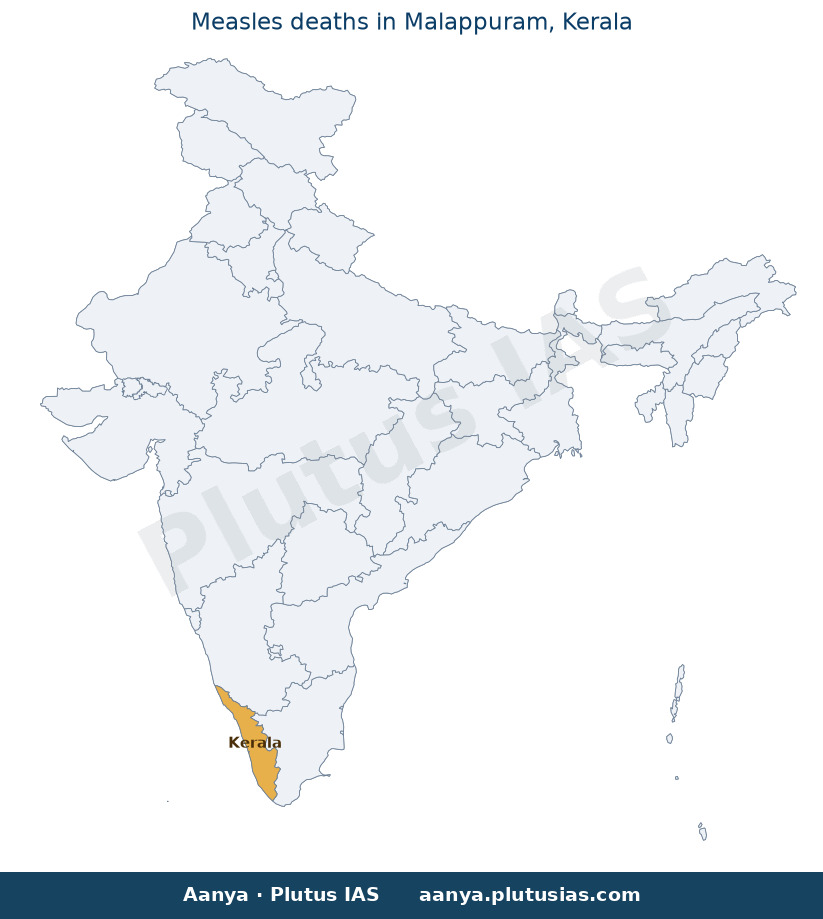
The Kerala State Commission for Protection of Child Rights has initiated a suo motu inquiry into the deaths of two children from measles in Malappuram district, raising critical questions about vaccination coverage, surveillance gaps, and the efficacy of public health interventions under the Universal Immunization Programme. The incident underscores the intersection of child rights governance with epidemiological surveillance and highlights systemic vulnerabilities in vaccine delivery mechanisms.
Background
- Measles is a highly contagious viral disease targeted for elimination in India under the National Strategic Plan for Measles and Rubella Elimination (2023-2027).
- Kerala has historically maintained high vaccination coverage, but recent data indicate declining trends in certain districts, including Malappuram.
- The National Commission for Protection of Child Rights (NCPCR) and State Commissions are statutory bodies under the Commissions for Protection of Child Rights Act, 2005, mandated to safeguard child rights and investigate violations.
- The outbreak in Malappuram coincides with a broader resurgence of measles in India, attributed to vaccine hesitancy, misinformation, and operational gaps in immunization services.
- Kerala’s Health Department has intensified surveillance and vaccination drives in response to the outbreak, including targeted interventions in high-risk areas.
Measles: Epidemiology, Prevention, and Public Health Governance
- Measles is caused by the measles virus (genus Morbillivirus) and spreads via respiratory droplets or direct contact. It is characterized by fever, cough, coryza, conjunctivitis, and a maculopapular rash.
- Complications include pneumonia (leading cause of measles-related deaths), encephalitis, and subacute sclerosing panencephalitis (a rare, late-onset neurological disorder).
- The measles vaccine (live attenuated) is administered as part of the MMR (measles, mumps, rubella) or MR (measles, rubella) vaccine under the UIP. The first dose is given at 9–12 months, and the second at 15–18 months.
- Vaccine effectiveness is approximately 97% after two doses, but herd immunity requires coverage of at least 90–95% of the population to prevent outbreaks.
- Vaccine hesitancy, driven by misinformation, religious beliefs, or logistical barriers, poses a significant threat to elimination efforts and necessitates targeted community engagement and communication strategies.
- Public health surveillance systems, including the Integrated Disease Surveillance Programme (IDSP), monitor measles cases and trigger outbreak response measures such as vaccination campaigns and health education.
- The role of Child Rights Commissions includes ensuring accountability in service delivery, investigating lapses, and recommending corrective measures to protect vulnerable populations.
Key Features
| Feature | Significance |
|---|---|
| Suo Motu Registration by Child Rights Commission | Demonstrates proactive institutional oversight of child welfare, ensuring accountability in public health emergencies. |
| Focus on Vaccination Lapses | Highlights the critical role of timely immunisation in preventing measles outbreaks and child mortality. |
| District-Level Health Alert | Indicates rapid response mechanisms to contain infectious disease spread within specific geographical clusters. |
| Symptom Surveillance and Isolation | Shows the integration of epidemiological tracking with public health interventions to mitigate transmission. |
| Community Engagement in Vaccination Drives | Emphasises the necessity of grassroots-level awareness to address vaccine hesitancy. |
Why it Matters
Public Health Governance
- Illustrates the operationalisation of the Right to Health as a component of child rights under the Constitution of India.
- Demonstrates the role of statutory bodies (e.g., State Child Rights Commissions) in monitoring compliance with health policies.
- Underscores the importance of inter-departmental coordination between Women and Child Development, Health, and local authorities.
Vaccination Policy Implementation
- Exposes gaps in the Universal Immunisation Programme (UIP) in achieving coverage targets, particularly in high-risk districts.
- Highlights the need for real-time monitoring of vaccination coverage to identify and address under-immunised populations.
- Reinforces the principle of equity in public health, ensuring no child is left unvaccinated due to socio-economic or geographic barriers.
Infectious Disease Management
- Shows the application of the Integrated Disease Surveillance Programme (IDSP) in detecting and responding to measles outbreaks.
- Demonstrates the use of epidemiological tools (e.g., symptom tracking, case isolation) to prevent secondary transmission.
- Emphasises the role of primary healthcare systems in early diagnosis and management of vaccine-preventable diseases.
Challenges
1. Vaccine Hesitancy and Misinformation
- Identification of reluctance to vaccination in specific blocks (e.g., Vengara, Tanur) necessitates targeted behavioural interventions.
- Misinformation campaigns, often amplified through social media, undermine trust in immunisation programmes.
- Cultural and religious beliefs may contribute to vaccine hesitancy, requiring culturally sensitive communication strategies.
UPSC Link: GS2: Health – Issues relating to development and management of Social Sector/Services
2. Healthcare Accessibility Gaps
- Low vaccination coverage in rural and tribal areas reflects barriers such as distance to health centres, lack of transport, and workforce shortages.
- Inadequate cold chain infrastructure may compromise vaccine efficacy in remote regions.
- Limited awareness among marginalised communities about the benefits and safety of vaccines.
UPSC Link: GS2: Health – Issues relating to poverty and human development
3. Surveillance and Reporting Deficiencies
- Underreporting of measles cases due to asymptomatic infections or lack of diagnostic facilities delays outbreak response.
- Inconsistent data recording systems hinder accurate assessment of vaccination coverage and disease burden.
- Delays in aggregating and analysing health data impede timely policy adjustments.
UPSC Link: GS2: Health – Role of NGOs, SHGs, associations and groups
4. Resource Allocation and Prioritisation
- Competing demands on public health budgets may lead to underfunding of immunisation programmes in certain districts.
- Insufficient investment in health workforce training and deployment exacerbates service delivery gaps.
- Need for sustained funding to sustain vaccination drives beyond outbreak response phases.
UPSC Link: GS3: Health – Issues relating to direct and indirect farm subsidies and minimum support prices
5. Policy Implementation Bottlenecks
- Fragmented governance structures between central, state, and local authorities delay decision-making and resource mobilisation.
- Lack of standardised protocols for outbreak investigation and response across states.
- Inadequate penalties or incentives for healthcare providers to ensure adherence to immunisation schedules.
UPSC Link: GS2: Health – Government policies and interventions for development in various sectors
Challenges — UPSC Perspective
| Issue | Concern |
|---|---|
| Low Vaccination Coverage | Only 63% of children in Malappuram received both measles vaccine doses in 2025-26, far below the 95% target. |
| Geographical Disparities | Over 40% of children in Vengara, Tanur, Malappuram, and Areekode blocks remain unvaccinated. |
| Vaccine Hesitancy | Cultural and religious factors contribute to reluctance, particularly in densely populated urban clusters. |
| Healthcare Infrastructure Gaps | Insufficient primary healthcare centres and cold chain facilities in rural areas hinder service delivery. |
| Data Inconsistencies | Underreporting of measles cases and delayed data aggregation obscure the true extent of the outbreak. |
| Resource Constraints | Limited budget allocation for immunisation drives and workforce training undermines long-term sustainability. |
Way Forward
- Conduct rapid antigen testing in high-risk blocks to identify unvaccinated children and administer catch-up doses immediately.
- Launch targeted awareness campaigns in collaboration with local leaders, religious institutions, and community health workers to address vaccine hesitancy.
- Strengthen cold chain infrastructure in rural health centres to ensure vaccine potency, particularly in tribal and remote areas.
- Integrate measles surveillance with the Integrated Disease Surveillance Programme (IDSP) to enable real-time data sharing and outbreak response.
- Establish a district-level task force comprising health officials, child rights commission representatives, and civil society to monitor vaccination drives.
- Expand the reach of mobile health units to deliver vaccines to underserved populations, including migrant workers and nomadic communities.
- Implement a reward-penalty system for healthcare providers to incentivise adherence to immunisation schedules and improve coverage metrics.
- Conduct periodic reviews of vaccination coverage data to identify persistent gaps and adjust strategies accordingly.
UPSC Value Addition
Keywords for Mains Answer-Writing
Child Rights Protection · Vaccination Policy in India · Measles Immunisation Coverage · Public Health Governance · State Commission for Protection of Child Rights (Kerala) · Vaccine Hesitancy · Health Department Protocols · Epidemiological Surveillance · Constitutional Safeguards for Children · Inter-sectoral Coordination in Health · Immunisation Programme in India · Measles Outbreak Management
Concept Flow
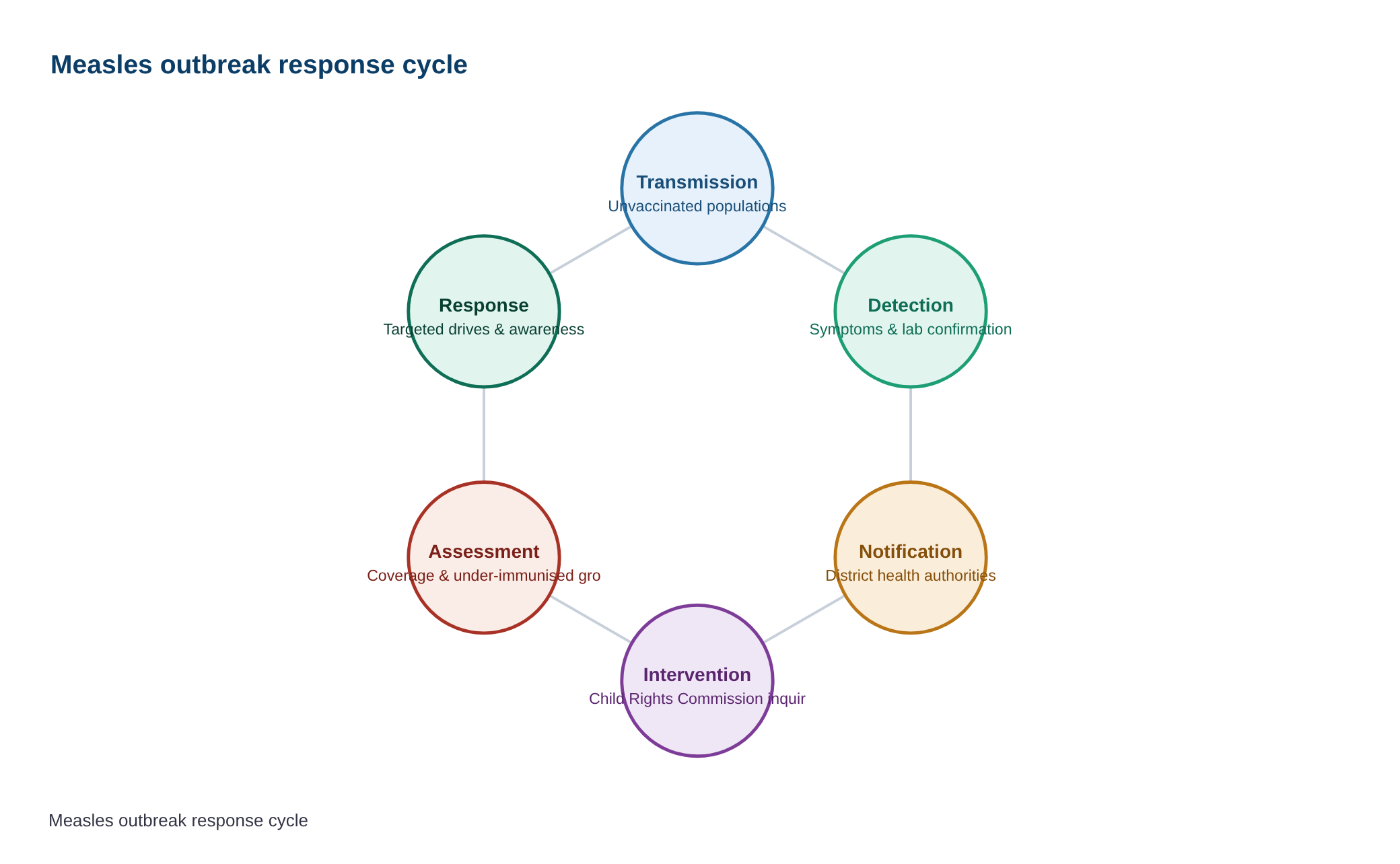
Measles transmission in unvaccinated populations → Outbreak detection through clinical symptoms and laboratory confirmation → Notification to district health authorities and activation of surveillance systems → Suo motu intervention by State Child Rights Commission to investigate lapses → Assessment of vaccination coverage and identification of under-immunised groups → Implementation of targeted vaccination drives and community awareness programmes → Monitoring of outbreak containment and evaluation of policy effectiveness
Prelims Practice Questions
Q1. Consider the following statements regarding measles immunisation in India:
1. The Measles-Rubella vaccination campaign in India is administered in two doses at 9 months and 15 months of age.
2. The National Immunisation Schedule mandates that 100% coverage of the first dose of measles vaccine is achieved before a child reaches 12 months of age.
3. The Kerala State Commission for Protection of Child Rights has suo motu powers to initiate action on child rights violations.
How many of the above statements are correct?
- Only one
- Only two
- All three
- None
Answer: All three — Statement 1 is correct: The Measles-Rubella (MR) vaccine is administered at 9–12 months and 15–18 months. Statement 2 is incorrect: While the first dose is due at 9 months, 100% coverage is not mandated by 12 months; coverage targets are set annually. Statement 3 is correct: The Kerala State Commission for Protection of Child Rights can initiate suo motu action under the Commissions for Protection of Child Rights Act, 2005.
Q2. Assertion (A): The Constitution of India does not explicitly guarantee a fundamental right to health.
Reason (R): The Directive Principles of State Policy under Part IV of the Constitution provide for the right to health as part of the welfare state obligations.
Options:
A. Both A and R are true, and R is the correct explanation of A.
B. Both A and R are true, but R is not the correct explanation of A.
C. A is true but R is false.
D. A is false but R is true.
Answer: ? — Assertion (A) is true: The Constitution does not explicitly guarantee a fundamental right to health. Reason (R) is true: Article 47 under the DPSP directs the State to raise the level of nutrition and standard of living and to improve public health. However, R is not the correct explanation of A, as the absence of a fundamental right does not stem from the DPSP but from the constitutional text itself.
Q3. Match the following pairs related to child health and immunisation in India:
Column I (Committee/Scheme) Column II (Focus Area)
A. Mission Indradhanush 1. Strengthening immunisation coverage in high-risk districts
B. National Rural Health Mission 2. Integrated child development services and nutrition
C. Integrated Child Development Services 3. Comprehensive primary healthcare in rural areas
D. Universal Immunisation Programme 4. Providing free immunisation to all children under five years
Options:
A-1, B-3, C-2, D-4
A-2, B-3, C-1, D-4
A-4, B-3, C-2, D-1
A-1, B-2, C-3, D-4
Answer: ? — A-1: Mission Indradhanush targets high-risk districts for immunisation intensification. B-3: NRHM focuses on comprehensive primary healthcare in rural areas. C-2: ICDS provides integrated child development services including nutrition. D-4: UIP provides free immunisation to all children under five years.
Mains Practice Question
✍ The recent measles-related child deaths in Malappuram district of Kerala have underscored systemic gaps in India’s immunisation governance. Critically examine the constitutional, statutory, and institutional frameworks that govern child health and immunisation in India. Also, analyse the role of state commissions for child rights in ensuring accountability in public health delivery. (15 Marks)
Approach: MODEL-ANSWER SKELETON:
1. Constitutional and Legal Framework:
– Article 21A (Right to Education) and Article 45 (DPSP) as foundational references for child welfare.
– Article 244 and Sixth Schedule provisions for tribal areas where immunisation gaps persist.
– The Commissions for Protection of Child Rights Act, 2005: Section 13 (powers of State Commissions), suo motu action, and suo motu inquiry.
– The National Commission for Protection of Child Rights (NCPCR) and State Commissions: role in monitoring child rights violations.
2. Statutory and Policy Frameworks:
– National Immunisation Schedule: Measles vaccine doses at 9–12 months and 15–18 months; Universal Immunisation Programme (UIP).
– Mission Indradhanush: Intensified immunisation drives in low-coverage districts.
– National Rural Health Mission (NRHM) and Ayushman Bharat: primary healthcare infrastructure.
– Kerala’s State Child Rights Commission: suo motu registration of cases and inquiry powers under the 2005 Act.
3. Institutional Mechanisms and Accountability:
– Role of District Medical Officers and Women and Child Development departments in Kerala.
– Inter-sectoral coordination: Health, Women and Child Development, and local governance (panchayats).
– Data systems: Health Management Information System (HMIS) and immunisation coverage tracking.
– Kerala’s Health Department alert and intensified drives in Malappuram.
4. Challenges in Implementation:
– Vaccine hesitancy: socio-cultural, religious, and misinformation factors.
– Access barriers: remote areas, tribal populations, and migrant communities.
– Monitoring and evaluation gaps: low coverage in specific blocks (Vengara, Tanur, Areekode).
– Role of State Commissions in identifying systemic lapses and recommending corrective measures.
5. Recommendations for Strengthening Governance:
– Strengthening State Commissions with greater investigative powers and resource allocation.
– Community engagement: leveraging ASHAs, Anganwadi workers, and local leaders.
– Data-driven micro-planning: targeted interventions in high-risk areas.
– Inter-state learning: Kerala’s model of health governance for replication in other states.
Source: The Hindu
Generated by AanyaAi for educational purpose.
Related guides on our sites
- Current affairs for upsc 2026
- Best PSIR optional coaching for upsc
- Best economics optional coaching for upsc
- Best PSIR optional teacher for upsc

- यूक्रेन का रोबोट सेना अभियान: युद्ध में मानव हानि कम करने की रणनीति - September 27, 2026
- Ukraine’s ‘Army of Robots’: A Game-Changer for UPSC Mains 2026 Polity & Governance - September 27, 2026
- रूस ने भारत-ब्राजील को दिया UNSC स्थायी सदस्यता का समर्थन, जर्मनी-जापान विरोध में - September 27, 2026

No Comments