


08 Aug Kerala’s FCRA Scrutiny: Manappat Foundation Under Legal Lens for Punarjani Scheme
✎ Rule 19 of the FCRA mandates strict maintenance of records of foreign contributions and their utilisation by NGOs; a violation of Rule 19 of the FCRA would constitute an offence under the Prevention of Corruption Act (PCA) if the…
Subject Relevance — Where This Topic Fits
- GS Paper II — Governance, Transparency and Accountability | GS Paper III — Issues relating to NGO Sector and Foreign Contributions
- Prelims: Foreign Contribution (Regulation) Act, 2010, Rule 19 of FCRA, Vigilance and Anti-Corruption Bureau (VACB), Central Bureau of Investigation (CBI), Prevention of Corruption Act (PCA), Prohibition of Benami Property Transactions Act, 1988, Prevention of Money Laundering Act (PMLA), Public servant under PCA
- Essay: The role of NGOs in disaster rehabilitation: Ethical imperatives and regulatory challenges, Balancing transparency and trust in civil society organisations: A case for robust legal frameworks
Quick Revision: Rule 19 of the FCRA mandates strict maintenance of records of foreign contributions and their utilisation by NGOs; a violation of Rule 19 of the FCRA would constitute an offence under the Prevention of Corruption Act (PCA) if the contravention involves persons who fall under the broad definition of a public office.
Why is this in the news?
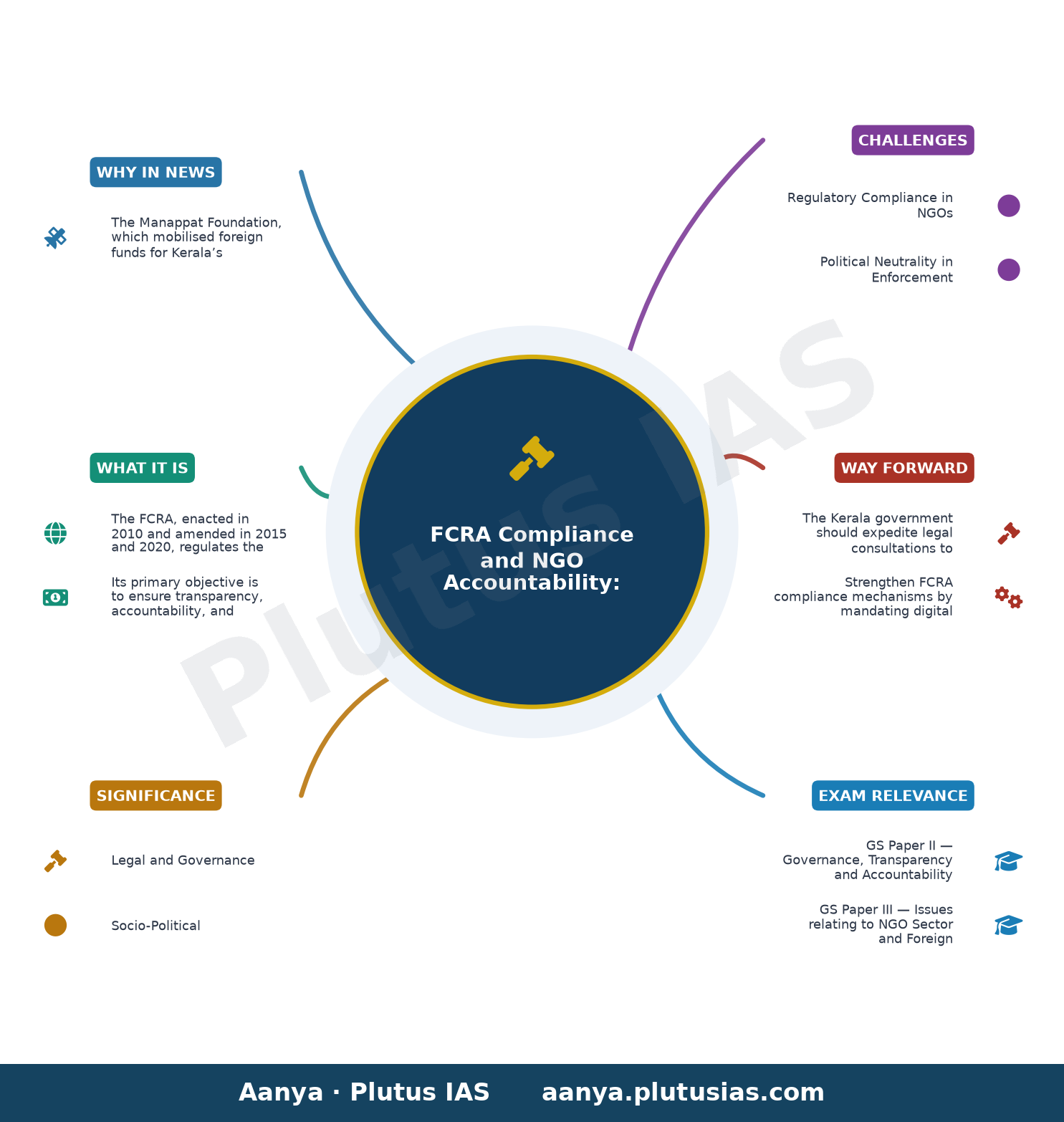
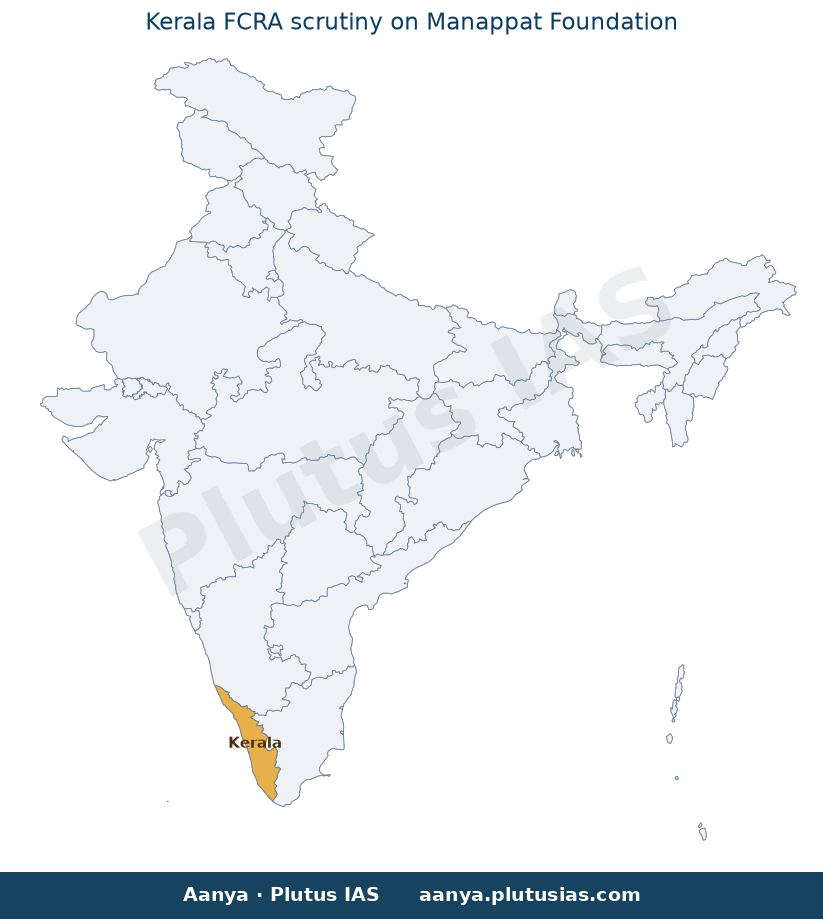
The Manappat Foundation, which mobilised foreign funds for Kerala’s Punarjani flood rehabilitation scheme led by the state’s Leader of the Opposition V.D. Satheesan, is under legal scrutiny for alleged violations of the Foreign Contribution (Regulation) Act (FCRA), 2010. The Kerala government is examining a 2025 Vigilance and Anti-Corruption Bureau (VACB) report that accuses the NGO of failing to maintain records of foreign donations and their utilisation, potentially inviting prosecution under the Prevention of Corruption Act (PCA) and other financial legislations. The case underscores critical issues of accountability, transparency, and regulatory compliance in the NGO sector, particularly in disaster relief operations.
Background
- The Foreign Contribution (Regulation) Act (FCRA), 2010, regulates the acceptance and utilisation of foreign contributions by individuals, associations, and companies in India to ensure transparency and prevent misuse.
- Rule 19 of FCRA mandates NGOs to maintain separate accounts and records of foreign contributions received and their utilisation, failing which constitutes a violation.
- The Punarjani scheme was launched by V.D. Satheesan, Leader of the Opposition in Kerala, to rehabilitate flood-affected constituents in Paravoor, Ernakulam, with support from foreign donors.
- The Vigilance and Anti-Corruption Bureau (VACB) of Kerala submitted a report in 2025 to the Home Department, highlighting alleged irregularities in the Manappat Foundation’s handling of foreign funds, including suspicious transactions amounting to ₹1.22 crore.
- The VACB recommended a Central Bureau of Investigation (CBI) probe into the NGO’s chairperson, Ameer Ahammed, and sought legal opinion on the applicability of the Prevention of Corruption Act (PCA), Prohibition of Benami Property Transactions Act, 1988, and Prevention of Money Laundering Act (PMLA).
- The case has political overtones, with the Congress alleging a ‘political witch-hunt’ against Satheesan, while the government asserts the need for legal scrutiny to uphold regulatory compliance.
What is the Foreign Contribution (Regulation) Act (FCRA), 2010?
- The FCRA, enacted in 2010 and amended in 2015 and 2020, regulates the acceptance and utilisation of foreign contributions by individuals, associations, and companies in India.
- Its primary objective is to ensure transparency, accountability, and prevention of misuse of foreign funds for activities detrimental to national interest or public order.
- The Act mandates NGOs and other entities to register with the Ministry of Home Affairs (MHA) to receive foreign contributions and prohibits acceptance of funds from certain foreign sources.
- Rule 19 of FCRA requires NGOs to maintain separate accounts and records of foreign contributions received, their sources, and utilisation, failing which constitutes a violation punishable under the Act.
- The Act empowers the Central Government to prohibit the utilisation of foreign funds if they are likely to prejudicially affect the sovereignty and integrity of India or public interest.
- The FCRA applies to all categories of foreign contributions, including donations, grants, and endowments, and covers both monetary and non-monetary contributions.
- The Act also prohibits the transfer of foreign contributions to other entities without prior approval from the MHA.
Key Features
| Feature | Significance |
|---|---|
| FCRA Rule 19 Violation | Mandates NGOs receiving foreign contributions to maintain meticulous records of receipts and utilisation; non-compliance constitutes a punishable offence under the Prevention of Corruption Act (PCA) if linked to public servants. |
| VACB Investigation | The Vigilance and Anti-Corruption Bureau’s report forms the basis for legal scrutiny, recommending a CBI probe into suspicious transactions and alleged financial impropriety by the NGO’s leadership. |
| CBI’s Jurisdiction | The Central Bureau of Investigation’s potential involvement underscores the gravity of the allegations, particularly if public servants are implicated in FCRA violations under the PCA. |
| Prohibition of Benami Property Transactions Act, 1988 & PMLA | Legal opinions sought on whether the alleged FCRA violations could trigger provisions under these Acts, indicating potential money laundering or benami transactions. |
| Speaker’s Role | The Speaker’s office seeking clarifications from the VACB highlights the institutional oversight required in cases involving elected representatives and foreign fund utilisation. |
Why it Matters
Legal and Governance
- The case exemplifies the enforcement of FCRA regulations, which are critical for maintaining transparency in foreign funding of NGOs and preventing misuse of public office.
- The involvement of the CBI and legal opinions on PMLA and benami laws signal a multi-agency approach to combating financial irregularities in charitable organisations.
- The scrutiny of a prominent Opposition leader’s NGO raises questions about the accountability of public representatives in managing foreign contributions, even for ostensibly charitable purposes.
Socio-Political
- The allegations and subsequent political responses—denials by the accused and accusations of ‘political witch-hunt’—highlight the intersection of governance, politics, and regulatory compliance.
- The Punarjani scheme’s association with flood rehabilitation underscores the ethical and legal complexities of mobilising foreign funds for disaster relief, a domain often scrutinised for transparency.
Economic
- The alleged misappropriation of ₹1.22 crore through suspicious transactions points to potential financial mismanagement, which could erode public trust in NGOs and charitable organisations.
- The case may influence future foreign funding flows to Indian NGOs, particularly those operating in disaster relief or socio-political advocacy, by increasing regulatory scrutiny.
Challenges
1. Regulatory Compliance in NGOs
- FCRA violations, particularly under Rule 19, pose a challenge due to the complexity of maintaining records for foreign contributions and their utilisation.
- The lack of uniform enforcement mechanisms across states complicates accountability, as seen in the Kerala government’s legal examination of the VACB report.
UPSC Link: GS-II: Statutory, Regulatory and various Quasi-judicial Bodies
2. Political Neutrality in Enforcement
- The case raises concerns about the impartiality of regulatory and investigative agencies, especially when allegations involve high-profile political figures.
- Political responses—such as accusations of ‘witch-hunt’—underscore the need for transparent and apolitical investigations to uphold public trust.
UPSC Link: GS-II: Role of Civil Services in a Democracy
3. Transparency in Disaster Relief Funding
- Mobilising foreign funds for disaster relief, such as the Punarjani scheme, requires stringent oversight to prevent misuse and ensure funds reach intended beneficiaries.
- The case highlights the need for clear guidelines on the utilisation of foreign contributions in humanitarian aid, balancing urgency with accountability.
UPSC Link: GS-III: Disaster Management
4. Inter-Agency Coordination
- The involvement of multiple agencies—the VACB, CBI, and legal experts—demonstrates the need for seamless coordination to address financial irregularities effectively.
- Delays in seeking legal opinions or clarifications can undermine the efficacy of investigations, as seen in the timeline of the VACB report and subsequent actions.
UPSC Link: GS-II: Government Policies and Interventions
5. Public Trust in Charitable Organisations
- Allegations of financial impropriety in NGOs can erode public confidence in charitable organisations, particularly those involved in socio-political or disaster relief work.
- The case underscores the importance of third-party audits and independent oversight to maintain transparency and credibility in the NGO sector.
UPSC Link: GS-IV: Ethics and Integrity in Governance
Challenges — UPSC Perspective
| Issue | Concern |
|---|---|
| FCRA Compliance | Failure to maintain records of foreign contributions and their utilisation, leading to legal scrutiny and potential PCA violations. |
| Political Accountability | Implications for public servants (e.g., Opposition leaders) in managing foreign funds, raising questions about misuse of office. |
| Multi-Agency Coordination | Need for seamless collaboration between VACB, CBI, and legal experts to ensure timely and effective investigations. |
| Disaster Relief Transparency | Ensuring foreign funds for humanitarian aid are utilised as intended, without diversion or misappropriation. |
| Public Perception | Risk of erosion of trust in NGOs and charitable organisations due to allegations of financial impropriety. |
| Legal Ambiguity | Uncertainty over whether FCRA violations could trigger provisions under PMLA or the Prohibition of Benami Property Transactions Act. |
Government Initiatives — Must-Memorise for Prelims
- Punarjani Scheme (Kerala Flood Rehabilitation Initiative)
- Foreign Contribution (Regulation) Act, 2010 (FCRA)
- Prevention of Corruption Act, 1988 (PCA)
- Prohibition of Benami Property Transactions Act, 1988
- Prevention of Money Laundering Act, 2002 (PMLA)
Way Forward
- The Kerala government should expedite legal consultations to determine the appropriate course of action, including whether to refer the case to the CBI or other agencies.
- Strengthen FCRA compliance mechanisms by mandating digital record-keeping and third-party audits for NGOs receiving foreign contributions.
- Clarify the role of public servants in managing foreign funds, ensuring that utilisation aligns with the intended purpose and regulatory norms.
- Enhance inter-agency coordination between the VACB, CBI, and legal experts to streamline investigations and avoid delays.
- Conduct a transparent and impartial investigation into the allegations, with findings made public to restore trust in the NGO sector.
- Review and update guidelines for disaster relief funding to ensure strict accountability and transparency in the utilisation of foreign contributions.
- Encourage NGOs to adopt self-regulatory mechanisms, such as independent audits and public disclosures, to pre-empt regulatory scrutiny.
- Explore legislative or policy reforms to address ambiguities in FCRA enforcement, particularly regarding the liability of public servants.
UPSC Value Addition
Keywords for Mains Answer-Writing
Foreign Contribution (Regulation) Act, 2010 · Rule 19 of FCRA · Vigilance and Anti-Corruption Bureau (VACB) · Central Bureau of Investigation (CBI) · Prevention of Corruption Act, 1988 · Prohibition of Benami Property Transactions Act, 1988 · Prevention of Money Laundering Act, 2002 · Public office under FCRA · NGO accountability · FCRA violations in flood relief · Political witch-hunt versus institutional scrutiny · Role of Speaker in parliamentary oversight
Constitutional & Policy Linkages
- Article 19(1)(c) – Right to form associations (with FCRA as a reasonable restriction)
- Article 26 – Freedom to manage religious and charitable institutions (subject to public order and morality)
- Article 300A – Right to property (in the context of FCRA compliance and asset tracing)
Concept Flow
NGO receives foreign contributions for Punarjani scheme → Alleged failure to maintain FCRA-mandated records under Rule 19 → VACB investigates and submits report to Home Department → Kerala government seeks legal opinion on FCRA violations → VACB recommends CBI probe into suspicious transactions (~₹1.22 crore) → Potential PCA violations if public servants implicated → Legal opinions sought on PMLA and benami laws → Political and institutional responses (e.g., Speaker’s clarifications, Congress accusations) → Allegations denied by accused; case enters judicial/executive scrutiny → Outcome may influence future FCRA enforcement and NGO accountability.
Prelims Practice Questions
Q1. Consider the following statements regarding the Foreign Contribution (Regulation) Act (FCRA), 2010:
1. Rule 19 of FCRA mandates NGOs to maintain records of foreign donations and their utilisation.
2. Violation of FCRA rules can be prosecuted under the Prevention of Corruption Act, 1988, if the offence involves a person holding a public office.
3. The Central Bureau of Investigation (CBI) is empowered to investigate FCRA violations without prior approval from the Union Home Ministry.
How many of the above statements are correct?
- Only one
- Only two
- All three
- None
Answer: Only two — Statement 1 is correct as Rule 19 of FCRA explicitly requires NGOs to maintain records of foreign contributions and their utilisation. Statement 2 is correct under Section 13 of the Prevention of Corruption Act, 1988, which covers offences by public servants. Statement 3 is incorrect as CBI requires prior approval from the Union Home Ministry for investigation under Section 6 of the Delhi Special Police Establishment Act, 1946.
Q2. Assertion (A): The Vigilance and Anti-Corruption Bureau (VACB) of Kerala recommended a CBI inquiry against the Manappat Foundation under the Foreign Contribution (Regulation) Act (FCRA), 2010.
Reason (R): The VACB found that the NGO failed to maintain records of foreign donations and their utilisation, amounting to a violation of Rule 19 of FCRA.
In the context of the above statements, which of the following is correct?
- Both A and R are true, and R is the correct explanation of A.
- Both A and R are true, but R is not the correct explanation of A.
- A is true, but R is false.
- A is false, but R is true.
Answer: Both A and R are true, and R is the correct explanation of A. — Both the Assertion (A) and Reason (R) are true. The VACB did recommend a CBI inquiry against the Manappat Foundation for alleged FCRA violations, and the reason cited was the failure to maintain records of foreign donations and their utilisation, which is a direct violation of Rule 19 of FCRA.
Q3. Which of the following Acts is NOT directly invoked in the legal scrutiny of the Manappat Foundation case in Kerala?
- Foreign Contribution (Regulation) Act, 2010
- Prevention of Corruption Act, 1988
- Prohibition of Benami Property Transactions Act, 1988
- Right to Information Act, 2005
Answer: Right to Information Act, 2005 — The Right to Information Act, 2005, is not directly invoked in the legal scrutiny of the Manappat Foundation case. The scrutiny involves the Foreign Contribution (Regulation) Act, 2010, the Prevention of Corruption Act, 1988, and the Prohibition of Benami Property Transactions Act, 1988, as per the VACB report and subsequent legal opinions sought by the Kerala government.
Mains Practice Question
✍ The Foreign Contribution (Regulation) Act (FCRA), 2010, is designed to regulate foreign contributions to NGOs and ensure transparency in their utilisation. Critically examine the efficacy of Rule 19 of FCRA in preventing financial irregularities in NGOs, with particular reference to the recent legal scrutiny faced by the Manappat Foundation in Kerala. Also, analyse the implications of such violations for democratic accountability and institutional trust. (15 Marks)
Approach: MODEL-ANSWER SKELETON:
1. **Introduction (2 marks)**: Define FCRA, 2010, and its objectives. Briefly introduce Rule 19 and its purpose in mandating record-keeping of foreign contributions and their utilisation.
2. **Efficacy of Rule 19 (5 marks)**:
– **Strengths**: Rule 19 enhances transparency by requiring NGOs to maintain detailed records of foreign funds received and utilised. It acts as a deterrent against financial irregularities and misuse of funds.
– **Limitations**: Rule 19’s effectiveness is contingent on strict enforcement and oversight. The Manappat Foundation case highlights gaps in compliance and monitoring, suggesting that Rule 19 alone may not suffice without robust institutional mechanisms.
– **Comparative Perspective**: Cite international frameworks (e.g., UN Convention Against Corruption) that emphasise transparency in NGO funding to underscore the global relevance of Rule 19.
3. **Legal and Institutional Implications (5 marks)**:
– **FCRA Violations and Legal Consequences**: Discuss the legal provisions under FCRA, 2010, and their interplay with the Prevention of Corruption Act, 1988, and the Prohibition of Benami Property Transactions Act, 1988. Highlight the role of the VACB, CBI, and judicial oversight in addressing violations.
– **Democratic Accountability**: Examine how FCRA violations erode public trust in NGOs and democratic institutions. Discuss the role of the Speaker’s office and parliamentary oversight in addressing such issues.
– **Institutional Trust**: Analyse the broader impact on institutional credibility, particularly when allegations involve political figures and flood relief efforts.
4. **Conclusion (3 marks)**: Summarise the need for strengthening Rule 19 through technological solutions (e.g., digital record-keeping), stricter penalties, and inter-agency coordination. Emphasise the balance between regulatory oversight and the autonomy of NGOs in delivering welfare services.
Source: The Hindu
Generated by AanyaAi for educational purpose.

- हिमाचल में बाल पोषण योजना: अब सप्ताह में दो बार मिलेगा अंडा या फल - September 23, 2026
- Himachal Pradesh’s Nutritious Food Scheme: Eggs/Fruits Twice Weekly for 5.5L Students - September 23, 2026
- रिफाइनरी क्षेत्र के लिए ऊर्जा सुरक्षा और नेट-ज़ीरो लक्ष्य में संतुलन जरूरी: विशेषज्ञ - September 23, 2026

No Comments