


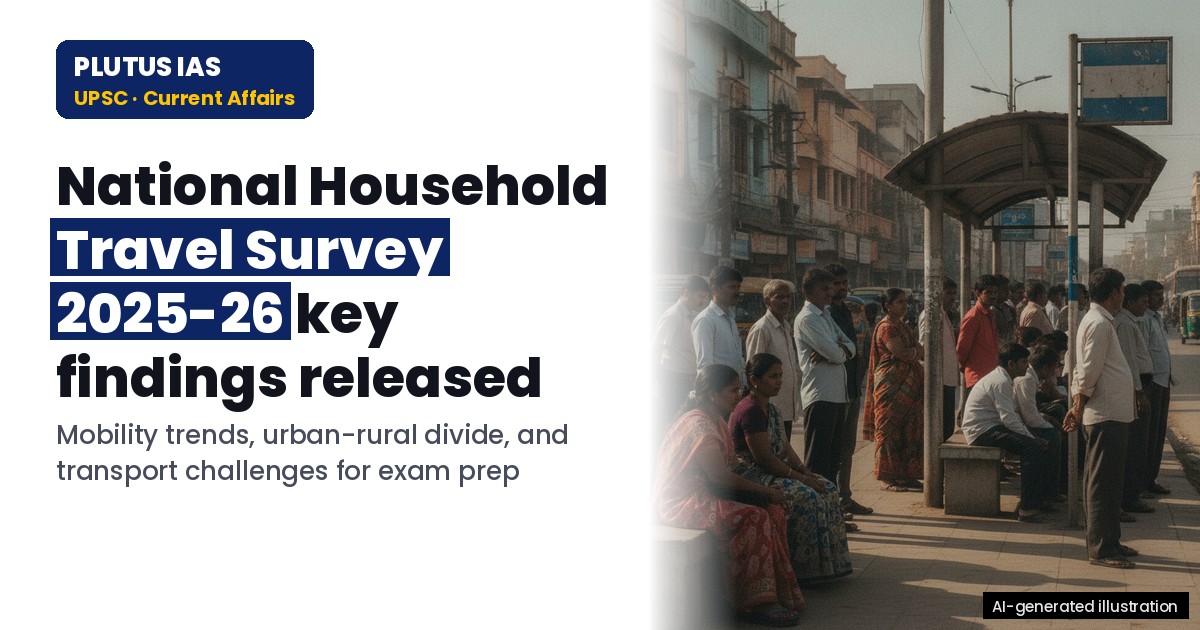
05 Oct Key Findings of National Household Travel Survey 2025-26 for UPSC
✎ The National Household Travel Survey (NHTS) 2025–26 is a critical data-gathering exercise to inform India’s urban transport policies, with findings expected to guide the revision of the National Urban Transport Policy and the…
Subject Relevance — Where This Topic Fits
- GS Paper II — Governance, Constitution, Polity, Social Justice and International Relations (Urbanisation, Transport Policy) | GS Paper III — Economy (Infrastructure, Transport Economics, Data Collection and Analysis)
- Prelims: National Sample Survey Office (NSSO), Urban Mobility Index, Decentralised Urban Governance, Sustainable Development Goals (SDG 11), Data Privacy and Security (Digital Personal Data Protection Act, 2023)
- Essay: The Role of Data in Shaping Inclusive Urban Futures, Balancing Mobility, Equity, and Environmental Sustainability in India’s Urban Transition
Quick Revision: The National Household Travel Survey (NHTS) 2025–26 is a critical data-gathering exercise to inform India’s urban transport policies, with findings expected to guide the revision of the National Urban Transport Policy and the formulation of city-level Mobility Plans under AMRUT 2.0.
Why is this in the news?
The Union Ministry of Housing and Urban Affairs (MoHUA) has announced the conduct of the National Household Travel Survey (NHTS) for the fiscal year 2025–26, marking a critical step in generating empirical data on urban and peri-urban mobility patterns. This survey will provide granular insights into travel behaviour, mode choice, and infrastructure gaps, thereby informing the formulation and revision of national urban transport policies such as the National Urban Transport Policy (NUTP) 2014 and the Atal Mission for Rejuvenation and Urban Transformation (AMRUT) 2.0. The survey’s findings are expected to support evidence-based decision-making in the context of rapid urbanisation, climate change mitigation, and the promotion of public and non-motorised transport systems.
Background
- The National Household Travel Survey (NHTS) is a periodic, nationwide exercise conducted by the Ministry of Housing and Urban Affairs (MoHUA) in collaboration with state governments and urban local bodies (ULBs).
- The survey builds on the legacy of the 2019 NHTS, which provided foundational data on travel demand, modal split, and accessibility across 42 cities, covering over 1.5 lakh households.
- Urban transport in India is characterised by high motorisation rates, congestion, air pollution, and inequitable access to mobility services, particularly affecting low-income and peri-urban populations.
- The Government of India has prioritised sustainable urban mobility through initiatives such as the Smart Cities Mission (2015), AMRUT 2.0 (2021), and the National Clean Air Programme (NCAP), all of which require robust data inputs for effective implementation.
- The survey aligns with the Sustainable Development Goals (SDG 11.2), which calls for access to safe, affordable, accessible, and sustainable transport systems for all by 2030.
- Data privacy and security are critical considerations, given the survey’s scope and the Digital Personal Data Protection Act, 2023, which mandates strict protocols for the collection, storage, and dissemination of personal data.
What is the National Household Travel Survey (NHTS)?
- The NHTS is a nationwide, sample-based survey designed to capture detailed data on household travel behaviour, including trip purposes, modes of transport, travel time, distances, and expenditure on mobility.
- The survey covers both urban and peri-urban areas across all states and Union Territories, with a stratified sampling framework to ensure representativeness across demographic and socio-economic strata.
- Key data points include: (a) modal split (public transport, private vehicles, walking, cycling, intermediate public transport), (b) trip frequency and purpose (work, education, healthcare, leisure), (c) household vehicle ownership and usage patterns, and (d) perceptions of safety, affordability, and accessibility in urban transport systems.
- Survey methodology includes household interviews, GPS-based tracking of sample trips (where feasible), and digital data collection tools to enhance accuracy and reduce reporting biases.
- The 2025–26 NHTS is expected to utilise advanced data analytics and machine learning techniques to identify mobility trends, predict future demand, and simulate policy scenarios for sustainable urban transport planning.
- Findings from the survey will be used to update the Urban Mobility Index (UMI), a composite indicator developed by MoHUA to benchmark and monitor urban transport performance across Indian cities.
- The survey also serves as an input for the formulation of city-specific Mobility Plans, which are mandatory under the AMRUT 2.0 guidelines for all mission cities.
Key Features
| Feature | Significance |
|---|---|
| Periodicity and Scope | The National Household Travel Survey (NHTS) for July 2025–June 2026 is a nationally representative, periodic survey designed to capture comprehensive data on household-level travel patterns, mobility choices, and transportation infrastructure utilisation across rural and urban India. |
| Data Granularity | The survey provides disaggregated data at district, state, and national levels, enabling evidence-based policymaking in urban planning, rural connectivity, and transport sector governance. |
| Modal Split Analysis | It systematically records the distribution of travel modes (public transport, private vehicles, non-motorised transport, and emerging modes like e-rickshaws) to assess the effectiveness of existing transport policies and infrastructure investments. |
| Socio-Economic Correlates | The survey links travel behaviour with socio-economic variables (income quintiles, occupation, gender, and age cohorts), facilitating targeted interventions for equitable mobility solutions. |
| Policy Feedback Loop | Findings from the NHTS directly inform the formulation and revision of national and state-level transport policies, including the National Urban Transport Policy (NUTP) and the National Logistics Policy. |
Why it Matters
Economic Implications
- The survey’s data on intra-city and inter-city travel demand supports infrastructure planning for roads, railways, and urban transit systems, thereby enhancing economic efficiency through reduced logistics costs and improved labour mobility.
- Insights into commuting patterns help optimise public transport investments, reducing the economic burden of private vehicle ownership and congestion on national productivity.
- The survey aids in assessing the economic viability of emerging transport modes (e.g., metro rail, electric buses, and shared mobility solutions) by quantifying their adoption and utilisation across different income groups.
Social Equity and Inclusion
- By capturing gender-disaggregated travel data, the survey highlights mobility barriers faced by women, children, the elderly, and persons with disabilities, enabling the design of inclusive transport policies.
- Analysis of travel behaviour across income quintiles informs policies aimed at reducing transport poverty and improving access to essential services (healthcare, education, and employment) for marginalised communities.
- The survey’s findings can guide the implementation of fare subsidies, last-mile connectivity solutions, and women-friendly public transport infrastructure under schemes like the ‘Sakhi Niwas’ initiative for working women.
Environmental Sustainability
- The modal split data provides a baseline for evaluating the environmental impact of transport choices, supporting policies to promote low-carbon mobility (e.g., public transport, cycling, and walking).
- Trends in electric vehicle (EV) adoption and shared mobility usage can be benchmarked against the survey’s baseline to assess progress toward India’s decarbonisation goals under the FAME-II scheme.
- The survey’s regional disaggregation allows for targeted interventions to reduce urban air pollution by identifying high-emission zones and prioritising public transport electrification.
Governance and Institutional Capacity
- The NHTS strengthens the evidence base for the Ministry of Housing and Urban Affairs (MoHUA) and the Ministry of Road Transport and Highways (MoRTH) to align transport policies with the Sustainable Development Goals (SDGs) and the 2030 Agenda.
- Data from the survey enhances the capacity of State Transport Undertakings (STUs) and Urban Local Bodies (ULBs) to plan and implement transport projects in a participatory and transparent manner.
- The survey’s findings can be integrated with the National Urban Data Exchange (NUDX) platform to create a unified data ecosystem for urban governance and smart mobility initiatives.
Challenges
1. Data Quality and Representativeness
- Ensuring accurate and representative sampling across diverse geographies (hilly regions, tribal areas, and metropolitan cities) poses logistical challenges, particularly in areas with low population density or poor accessibility.
- The survey’s reliance on self-reported travel diaries and recall-based data may introduce biases, necessitating robust validation mechanisms and triangulation with administrative records.
- Digital literacy gaps among respondents in rural areas may affect data collection efficiency, requiring innovative methods (e.g., mobile app-based surveys) to improve response rates.
UPSC Link: Statistics, Data Interpretation
2. Integration with Existing Data Systems
- The survey’s findings must be harmonised with other datasets (e.g., Census 2021, National Sample Survey Office (NSSO) data, and GST-based logistics data) to avoid duplication and ensure policy coherence.
- Lack of standardised data formats across states and union territories complicates the aggregation and comparative analysis of travel patterns at the national level.
- The survey’s outputs need to be aligned with the National Data Governance Framework Policy (NDGFP) to ensure data privacy, security, and interoperability with other government platforms.
UPSC Link: Governance, e-Governance
3. Policy Implementation Gaps
- Even with robust data, translating survey findings into actionable policies faces challenges due to limited fiscal space, bureaucratic inertia, and competing sectoral priorities (e.g., healthcare vs. transport).
- Coordination between central ministries (MoHUA, MoRTH, NITI Aayog) and state governments is critical but often hindered by administrative silos and differing political priorities.
- The survey’s recommendations may require legislative or regulatory changes (e.g., amendments to the Motor Vehicles Act, 1988), which involve lengthy parliamentary processes.
UPSC Link: Governance, Public Policy
4. Emerging Mobility Trends
- Rapid adoption of app-based mobility services (e.g., ride-hailing, bike-sharing) and micro-mobility solutions (e.g., e-scooters) complicates the survey’s traditional categorisation of transport modes, necessitating periodic updates to survey instruments.
- The proliferation of electric vehicles (EVs) and hydrogen-powered transport introduces new variables (charging infrastructure, battery range, and fuel costs) that the survey must incorporate to remain relevant.
- The rise of remote work and hybrid models post-COVID-19 pandemic has altered commuting patterns, requiring the survey to adapt its methodology to capture non-traditional travel behaviour.
UPSC Link: Science & Technology, Urbanisation
5. Climate Change and Resilience
- Extreme weather events (e.g., floods, heatwaves) disrupt transport infrastructure and travel patterns, but the survey’s static design may not fully capture the dynamic impacts of climate variability on mobility.
- The survey must incorporate climate-resilient design principles (e.g., flood-proof roads, heat-resistant pavements) into its recommendations to align with India’s climate adaptation goals.
- Data on disaster-resilient transport infrastructure (e.g., elevated corridors, underground metro systems) is essential for building climate-proof urban mobility systems.
UPSC Link: Disaster Management, Climate Change
Challenges — UPSC Perspective
| Issue | Concern |
|---|---|
| Sampling Bias in Rural Areas | Low population density and poor road connectivity may lead to underrepresentation of certain demographic groups, skewing policy recommendations. |
| Data Privacy and Consent | Collecting geospatial and personal travel data raises concerns about privacy violations and requires strict adherence to data protection norms. |
| Inter-Ministerial Coordination | Delays in integrating survey findings with other transport-related datasets (e.g., NHAI’s traffic counts, metro ridership data) hinder timely policymaking. |
| Digital Divide in Data Collection | Limited internet access in rural and tribal regions may reduce response rates, necessitating hybrid data collection methods. |
| Policy-Utility Mismatch | Even with high-quality data, translating findings into actionable policies is constrained by fiscal limitations and bureaucratic delays. |
| Climate Adaptation Blind Spots | The survey’s current design does not systematically capture the impact of climate change on transport infrastructure, limiting resilience planning. |
Way Forward
- Establish a **National Transport Data Consortium** comprising MoRTH, MoHUA, NITI Aayog, and state governments to harmonise survey data with existing transport datasets and ensure policy coherence.
- Develop a **standardised digital platform** for real-time data collection, validation, and dissemination, leveraging mobile applications and GIS mapping to improve accuracy and accessibility.
- Integrate **gender-disaggregated travel data** into the survey’s core methodology to identify and address mobility barriers faced by women, children, and persons with disabilities.
- Conduct **pilot studies** in climate-vulnerable regions (e.g., coastal areas, flood-prone zones) to assess the impact of extreme weather on transport infrastructure and inform climate-resilient design.
- Strengthen **capacity-building initiatives** for state transport departments and urban local bodies to analyse and utilise survey data for evidence-based policymaking.
- Align the survey’s findings with the **National Logistics Policy (NLP)** and **Gati Shakti National Master Plan** to prioritise multi-modal connectivity and reduce logistics costs.
- Introduce **periodic mid-term reviews** of the survey’s methodology to incorporate emerging mobility trends (e.g., EVs, shared mobility) and ensure relevance.
- Establish a **public-private partnership (PPP) framework** to crowdsource travel data from app-based mobility providers, enhancing the granularity and timeliness of insights.
UPSC Value Addition
Keywords for Mains Answer-Writing
National Household Travel Survey (NHTS) · Urban Mobility · Rural Mobility · Transport Infrastructure · Household Survey Methodology · Modal Share of Transport · Inter-State Travel · Intra-State Travel · Mobility Patterns · Sustainable Transport · Policy Implications for Urban Planning · Decentralised Data Collection · Statistical Rigour in Policy · Data-Driven Governance · Ministry of Housing and Urban Affairs (MoHUA) · Census and Survey Methodology · Household Socio-Economic Survey · Transport Policy Framework · Urban-Rural Divide in Mobility · Data Utilisation for Infrastructure Planning
Constitutional & Policy Linkages
- [‘Article 21 (Right to Life)’, ‘Implied right to safe and accessible transport’]
- [‘Article 38 (Directive Principles)’, ‘Promotion of welfare through equitable mobility’]
- [‘Article 39 (Directive Principles)’, ‘Equitable distribution of resources in transport infrastructure’]
- [‘Article 41 (Directive Principles)’, ‘Right to public assistance in case of unemployment and old age, linked to mobility’]
Concept Flow
Household-level travel behaviour → Data collection via NHTS → Aggregation and analysis → Policy formulation (NUTP, NLP) → Infrastructure investment (metros, highways) → Impact assessment → Feedback loop for iterative improvements. → Socio-economic variables (income, gender) → Travel mode choice → Public transport utilisation → Congestion and pollution → Policy interventions (fare subsidies, EV adoption) → Behavioural change in commuting patterns. → Climate variability → Disruption of transport networks → Survey data on resilience needs → Climate-proof infrastructure design → Integration with National Disaster Management Authority (NDMA) guidelines. → Emerging mobility trends (EVs, app-based services) → Survey adaptation → Data on adoption rates → Policy support (FAME-II, PLI schemes) → Market transformation towards sustainable transport. → Digital divide in data collection → Hybrid survey methods → Improved response rates → Enhanced representativeness → Inclusive policymaking for rural and tribal communities. → Inter-ministerial coordination gaps → Data harmonisation initiatives → Unified transport data ecosystem → Efficient resource allocation → Accelerated implementation of Gati Shakti Master Plan.
Prelims Practice Questions
Q1. Consider the following statements regarding the National Household Travel Survey (NHTS):
1. The NHTS is conducted annually by the Ministry of Housing and Urban Affairs (MoHUA).
2. The survey aims to capture data on both intra-state and inter-state travel patterns of households.
3. The NHTS provides disaggregated data on modal share of transport (e.g., public vs private transport).
4. The survey is designed to replace the decadal Census for mobility-related data collection.
How many of the above statements are correct?
- Only one
- Only two
- Only three
- All
Answer: Only three — Statements 2 and 3 are correct. Statement 1 is incorrect as the NHTS is not conducted annually; it is a periodic survey. Statement 4 is incorrect as the NHTS complements, rather than replaces, the decadal Census.
Q2. Assertion (A): The National Household Travel Survey (NHTS) is a critical tool for evidence-based policy formulation in urban and rural transport planning.
Reason (R): The NHTS provides granular data on household travel behaviour, which is essential for designing sustainable transport infrastructure and policies.
In the context of the above two statements, which one of the following is correct?
- Both A and R are true, and R is the correct explanation of A.
- Both A and R are true, but R is not the correct explanation of A.
- A is true, but R is false.
- A is false, but R is true.
Answer: Both A and R are true, and R is the correct explanation of A. — Both the assertion and reason are true. The NHTS indeed provides granular data on household travel behaviour, and this data is critical for evidence-based policy formulation in transport planning. Thus, R correctly explains A.
Q3. Match the following columns related to transport surveys in India:
Column I (Survey Type) | Column II (Conducting Agency)
———————|—————————
A. National Household Travel Survey (NHTS) | 1. Ministry of Road Transport and Highways
B. All India Survey on Migrant Workers | 2. Ministry of Housing and Urban Affairs
C. National Sample Survey on Employment and Unemployment | 3. Ministry of Labour and Employment
D. Road Accidents in India | 4. NITI Aayog
Select the correct match:
- A-2, B-3, C-1, D-4
- A-2, B-3, C-4, D-1
- A-1, B-3, C-2, D-4
- A-4, B-2, C-3, D-1
Answer: A-2, B-3, C-4, D-1 — A-2: NHTS is conducted by the Ministry of Housing and Urban Affairs. B-3: The All India Survey on Migrant Workers is conducted by the Ministry of Labour and Employment. C-4: The National Sample Survey on Employment and Unemployment is conducted by NITI Aayog. D-1: Road Accidents in India is published by the Ministry of Road Transport and Highways.
Mains Practice Question
✍ ‘The National Household Travel Survey (NHTS) serves as a foundational instrument for evidence-based transport policy in India.’ Critically examine this statement with reference to the objectives, methodology, and policy implications of the NHTS. Also, discuss how the NHTS can bridge the urban-rural divide in mobility planning. (15 Marks)
Approach: MODEL-ANSWER SKELETON:
1. **Introduction (2 marks)**
– Define the National Household Travel Survey (NHTS) and its purpose: to capture data on household travel behaviour, modal share, and mobility patterns.
– State that the NHTS is a critical tool for evidence-based policy formulation in transport planning.
2. **Objectives of NHTS (3 marks)**
– Primary objectives: To gather data on intra-state and inter-state travel, modal share (public vs private transport), trip purposes, and socio-economic determinants of mobility.
– Secondary objectives: To identify gaps in transport infrastructure, assess accessibility, and inform urban and rural transport planning.
– Reference: Ministry of Housing and Urban Affairs (MoHUA) guidelines or official documentation on NHTS.
3. **Methodology (3 marks)**
– Explain the survey methodology: sample size, sampling framework, data collection tools (e.g., household questionnaires, GPS tracking for validation), and statistical rigour.
– Highlight the role of decentralised data collection (e.g., state-level agencies, local bodies) in ensuring representativeness.
– Discuss the integration of NHTS with other data sources (e.g., Census, National Sample Survey) for triangulation.
4. **Policy Implications (4 marks)**
– Discuss how NHTS data informs policy decisions: e.g., prioritising public transport infrastructure, designing last-mile connectivity solutions, and promoting sustainable mobility.
– Reference: Examples of policy frameworks or schemes that utilise NHTS data (e.g., National Urban Transport Policy, Smart Cities Mission).
– Critically examine limitations: e.g., potential biases in sampling, underrepresentation of marginalised groups, or delays in data dissemination.
5. **Bridging the Urban-Rural Divide (3 marks)**
– Analyse how NHTS data can address disparities in mobility infrastructure between urban and rural areas.
– Discuss specific measures: e.g., rural connectivity schemes (PMGSY), last-mile solutions in rural areas, or targeted interventions for women and elderly populations.
– Highlight the role of NHTS in identifying mobility deserts (areas with poor access to transport) and informing decentralised planning.
6. **Conclusion (2 marks)**
– Summarise the critical role of NHTS in evidence-based transport policy.
– Emphasise the need for continuous data updates, stakeholder consultations, and integration with other socio-economic datasets for holistic planning.
Source: PIB (Press Information Bureau)
Generated by AanyaAi for educational purpose.
Related guides on our sites
- Current affairs for upsc 2026
- Best PSIR optional coaching for upsc
- Best economics optional coaching for upsc
- Best PSIR optional teacher for upsc

- Karnataka Halts Farm Land Survey Fee Hike Amid Drought Concerns - October 5, 2026
- न्यायमूर्ति पी. सैम कोशी बने तेलंगाना उच्च न्यायालय के कार्यवाहक मुख्य न्यायाधीश - October 5, 2026
- Andhra HC Rejects Relaxation in Environmental Norms for Vizag Data Centre - October 5, 2026

No Comments