


07 Aug Kisan Janata opposes Kerala’s pension disbursal shift to commercial banks
Cooperative banksCommercial bank accountsAadhaar-linked systemSocial welfare pensionsDoorstep delivery✎ Cooperative banks in India, regulated by the RBI and governed by state-specific cooperative laws, serve as critical last-mile institutions for social welfare delivery, but their role is increasingly contested amid the push for…
Subject Relevance — Where This Topic Fits
- GS Paper II — Governance, Transparency and Accountability | GS Paper III — Indian Economy and Issues Relating to Planning, Mobilization of Resources, Growth, Development and Employment
- Prelims: Cooperative Banks, Social Security Pensions, Aadhaar-enabled Payment System (AePS), Direct Benefit Transfer (DBT), Financial Inclusion, Last-mile Delivery, Rashtriya Janata Dal (RJD), Kisan Janata, Cooperative Societies Act, 1912 (amended), NITI Aayog’s Three-Year Action Agenda (2017-20), RBI Guidelines on Cooperative Banks (2020), Aadhaar Authentication, Financial Exclusion Risks, Vulnerable Groups, Elderly Citizens, Doorstep Delivery
- Essay: The Role of Cooperative Institutions in India’s Social Welfare Architecture, Balancing Efficiency and Equity in Public Service Delivery: Lessons from Pension Disbursement Reforms
Quick Revision: Cooperative banks in India, regulated by the RBI and governed by state-specific cooperative laws, serve as critical last-mile institutions for social welfare delivery, but their role is increasingly contested amid the push for digital public infrastructure and Direct Benefit Transfer reforms.
Why is this in the news?
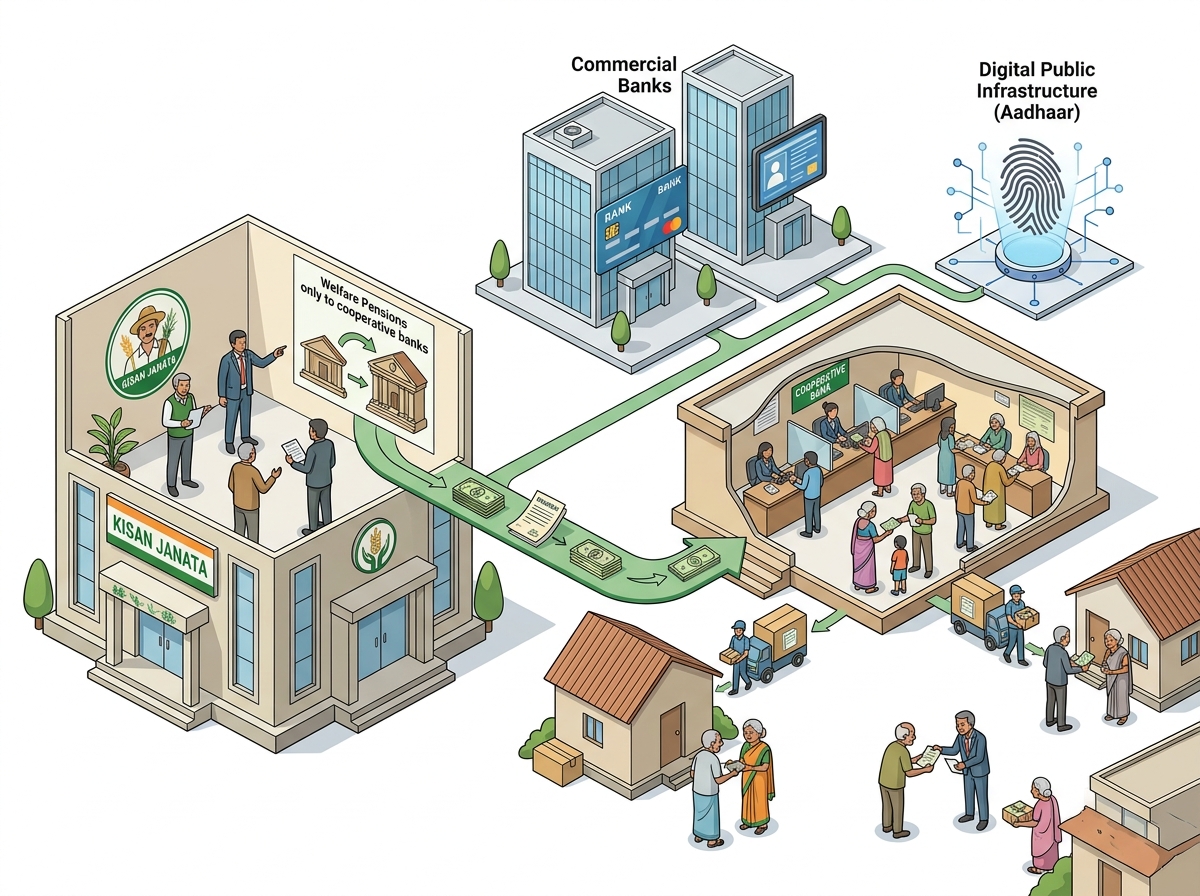
The Kisan Janata, a farmers’ organisation affiliated with the RJD, has opposed the Kerala government’s decision to shift the disbursement of social welfare pensions from cooperative banks to Aadhaar-linked commercial bank accounts. The organisation argues that this move undermines an efficient, doorstep delivery system, particularly disadvantaging elderly and economically vulnerable beneficiaries who rely on cooperative banks for seamless access to pensions. The controversy highlights the broader tension between digital public infrastructure (Aadhaar, DBT) and the institutional capacity of cooperative banks in ensuring inclusive financial access.
Background
- Kerala has historically leveraged its extensive network of primary agricultural credit societies (PACS) and cooperative banks to deliver social welfare pensions, ensuring last-mile connectivity, especially in rural and semi-urban areas.
- The State government’s decision to disengage cooperative banks from pension disbursement aligns with the national push for Direct Benefit Transfer (DBT) and Aadhaar-enabled Payment System (AePS), aimed at reducing leakages and improving transparency in welfare delivery.
- Cooperative banks in Kerala, governed by the Kerala Cooperative Societies Act, 1969 (amended), have played a pivotal role in financial inclusion, particularly for marginalised communities, by offering low-cost, accessible banking services.
- The shift to commercial bank accounts via Aadhaar linkage is part of a broader trend in India to digitise welfare delivery, as recommended by NITI Aayog’s Three-Year Action Agenda (2017-20) and the RBI’s 2020 guidelines on cooperative banks.
- Critics argue that the new system may exacerbate financial exclusion risks for elderly citizens and those unfamiliar with digital banking, despite the government’s emphasis on reducing corruption and inefficiency.
- The RBI’s regulatory framework for cooperative banks (2020) mandates stricter governance norms, which some stakeholders argue may have inadvertently reduced the operational flexibility of these institutions in welfare delivery.
What are Cooperative Banks and their Role in Social Welfare Delivery?
- Cooperative banks are financial institutions owned and operated by their members, governed by the Cooperative Societies Act, 1912 (amended by state-specific laws such as the Kerala Cooperative Societies Act, 1969), and regulated by the RBI under the Banking Regulation Act, 1949.
- They function as last-mile delivery channels for financial services, particularly in rural and semi-urban areas, where commercial banks have limited reach. Their structure—based on community ownership—ensures lower transaction costs and higher trust among beneficiaries.
- In Kerala, cooperative banks (including Primary Agricultural Credit Societies or PACS) have historically been instrumental in disbursing social welfare pensions, old-age pensions, and other entitlements, often through home-delivery mechanisms or fixed payment schedules at local branches.
- The shift toward Aadhaar-linked commercial bank accounts under DBT is intended to enhance transparency, reduce leakages, and streamline welfare delivery by leveraging India’s digital public infrastructure (Aadhaar, UPI, AePS).
- However, the transition poses challenges for vulnerable groups, including the elderly, illiterate, or those without smartphones, who may struggle with digital authentication, bank visits, or navigating commercial banking systems.
- The RBI’s 2020 guidelines for cooperative banks introduced stricter governance norms (e.g., higher capital adequacy, audit requirements), which, while improving financial stability, may have reduced their operational agility in welfare delivery.
- The debate reflects a broader policy tension between the efficiency gains of digital welfare delivery and the equity concerns of ensuring inclusive access, particularly for those outside the formal banking ecosystem.
- Kerala’s experience is instructive for other states considering similar reforms, as it underscores the need for phased implementation, grievance redressal mechanisms, and safeguards for marginalised groups.
UPSC Value Addition
Keywords for Mains Answer-Writing
Cooperative banks · Social welfare pensions · Doorstep delivery of welfare · Aadhaar-linked bank accounts · Rashtriya Janata Dal (RJD) · Kisan Janata · Financial inclusion · Elderly and vulnerable groups · Last-mile delivery of welfare · Aadhaar-enabled Payment System (AePS) · Service cooperative banks · Direct Benefit Transfer (DBT) · Rural banking infrastructure · Agrarian distress and welfare · Public policy and governance
Prelims Practice Questions
Q1. Consider the following statements regarding the distribution of social welfare pensions in India:
1. The Direct Benefit Transfer (DBT) mechanism mandates the use of Aadhaar-linked bank accounts for pension disbursement.
2. Service cooperative banks have historically played a key role in the doorstep delivery of pensions to rural and elderly beneficiaries.
3. The Aadhaar-enabled Payment System (AePS) is exclusively used for disbursing pensions through commercial banks.
How many of the above statements are correct?
- Only one
- Only two
- All three
- None
Answer: Only two — Statement 1 is correct as DBT requires Aadhaar-linked bank accounts. Statement 2 is correct as cooperative banks have been instrumental in doorstep delivery. Statement 3 is incorrect because AePS can also be used through cooperative banks and business correspondents.
Q2. Assertion (A): The Rashtriya Janata Dal (RJD) has opposed the exclusion of cooperative banks from the distribution of social welfare pensions in Kerala.
Reason (R): Cooperative banks provide an efficient, doorstep delivery system for pensions, particularly benefiting elderly and vulnerable groups.
Options:
A. Both A and R are true, and R is the correct explanation of A.
B. Both A and R are true, but R is not the correct explanation of A.
C. A is true, but R is false.
D. A is false, but R is true.
- A
- B
- C
- D
Answer: A — Both Assertion (A) and Reason (R) are true, and R correctly explains A as it highlights the efficiency and inclusivity of cooperative banks in pension delivery.
Q3. Which of the following is NOT a feature of the Direct Benefit Transfer (DBT) mechanism for welfare pensions in India?
- Mandatory linkage of Aadhaar with bank accounts
- Exclusive reliance on commercial banks for disbursement
- Use of Aadhaar-enabled Payment System (AePS) for authentication
- Provision for doorstep delivery through banking correspondents
Answer: Exclusive reliance on commercial banks for disbursement — DBT does not mandate exclusive reliance on commercial banks; cooperative banks and business correspondents are also integral to the system.
Mains Practice Question
✍ ‘The exclusion of cooperative banks from the distribution of social welfare pensions undermines the principles of financial inclusion and last-mile delivery.’ Critically examine this statement with reference to the recent developments in Kerala and the broader framework of Direct Benefit Transfer (DBT) in India. (15 Marks)
Approach: MODEL-ANSWER SKELETON:
1. **Context and Recent Developments**: Briefly outline the Kerala government’s decision to disengage cooperative banks from pension disbursement and the opposition by Kisan Janata under RJD. Highlight the claims regarding inefficiencies in the new system (e.g., long queues, lack of doorstep delivery).
2. **Role of Cooperative Banks**: Explain the historical and institutional role of cooperative banks in rural India, particularly in financial inclusion, doorstep delivery of welfare, and last-mile connectivity. Cite examples of their success in states like Kerala, Maharashtra, and Karnataka.
3. **Direct Benefit Transfer (DBT) Framework**: Describe the DBT mechanism, its objectives (transparency, leakage reduction, efficiency), and the role of Aadhaar, AePS, and banking correspondents. Contrast this with the traditional cooperative bank model.
4. **Principles of Financial Inclusion**: Discuss how cooperative banks align with financial inclusion goals by serving marginalized groups (elderly, rural poor, women). Reference the RBI’s emphasis on cooperative banks as tools for inclusive growth (e.g., NABARD reports, Priority Sector Lending).
5. **Critique of Exclusion**: Analyze the potential drawbacks of excluding cooperative banks, including:
– Disruption of established, efficient delivery systems.
– Increased burden on elderly and vulnerable groups due to lack of doorstep services.
– Risk of exclusion for those without access to commercial banks or digital infrastructure.
6. **Counterarguments and Balancing Views**: Acknowledge the rationale for DBT (e.g., reducing corruption, ensuring transparency) and the need for digital infrastructure. Discuss whether a hybrid model (cooperative banks + DBT) could address both efficiency and inclusion.
7. **Conclusion**: Take a reasoned position on whether the exclusion of cooperative banks is justified or whether a more inclusive approach is necessary. Suggest policy recommendations (e.g., integrating cooperative banks into DBT, strengthening AePS, or providing subsidies for digital infrastructure).
Source: The Hindu
Generated by AanyaAi for educational purpose.

- तमिलनाडु के लिए क्या है ‘एल नीनो’ और उत्तर-पूर्वी मानसून का खतरा? - September 23, 2026
- El Nino & Northeast Monsoon: Impact on Tamil Nadu for UPSC 2026 - September 23, 2026
- हिमाचल में डिजिटल भुगतान क्रांति: बिलासपुर अव्वल, महिलाओं की भागीदारी 93% तक पहुंची - September 23, 2026

No Comments