


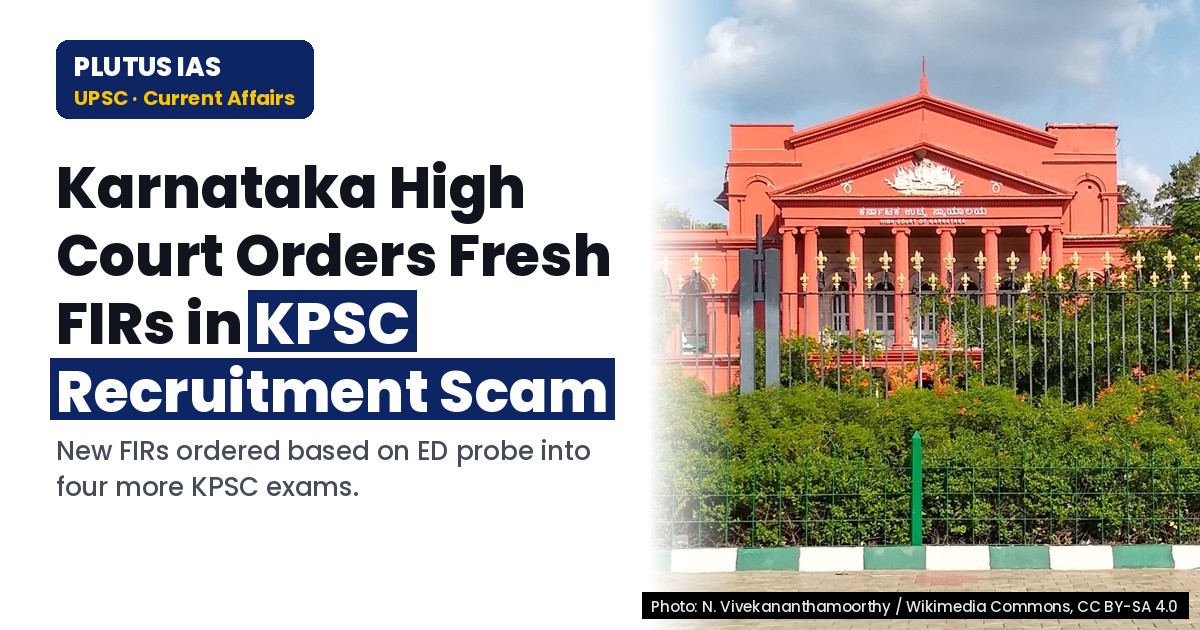
25 Nov KPSC Recruitment Scam: Karnataka HC Orders Fresh FIRs
✎ The Karnataka High Court's directive for fresh FIRs based on ED findings highlights the critical role of judicial oversight and investigative agencies in upholding the integrity of public recruitment processes and combating…
Subject Relevance — Where This Topic Fits
- GS Paper II — Governance, Constitution, Polity, Social Justice | GS Paper IV — Ethics, Integrity, and Aptitude
- Prelims: Karnataka High Court, Enforcement Directorate (ED), Prevention of Money Laundering Act (PMLA), First Information Report (FIR), Cognisable Offence, Karnataka Public Service Commission (KPSC), Special Investigation Team (SIT), Public Recruitment Examinations
- Essay: Ensuring probity and transparency in public administration, The role of independent institutions in upholding democratic values
Quick Revision: The Karnataka High Court’s directive for fresh FIRs based on ED findings highlights the critical role of judicial oversight and investigative agencies in upholding the integrity of public recruitment processes and combating corruption.
Why is this in the news?
The Karnataka High Court has directed jurisdictional police to register fresh First Information Reports (FIRs) based on information provided by the Enforcement Directorate (ED) regarding alleged irregularities in four additional recruitment examinations conducted by the Karnataka Public Service Commission (KPSC). This directive follows the ED’s status report, which revealed evidence of illegalities, prompting judicial concern over the credibility of the KPSC’s recruitment processes.
Background
- The Karnataka Public Service Commission (KPSC) is a constitutional body responsible for conducting examinations for appointments to various state civil services.
- Allegations of irregularities and malpractices in KPSC recruitment examinations have been a recurring concern, impacting public trust in the selection process.
- Previously, the High Court had constituted a Special Investigation Team (SIT) to probe two existing cases of illegalities within the KPSC, including the selection of a KPSC chairperson’s daughter and issues in veterinary officer recruitment.
- The Enforcement Directorate (ED), a multi-disciplinary organisation, is mandated to investigate economic crimes and enforce the Prevention of Money Laundering Act (PMLA), 2002.
- Section 66(2) of the PMLA allows the ED to share information with other agencies if it discloses the commission of any cognisable offence.
- The present judicial directive underscores the High Court’s role in ensuring accountability and maintaining the integrity of public institutions and recruitment processes.
The Role of Investigative Agencies and Judicial Review in Public Recruitment
- The Enforcement Directorate (ED) investigates financial crimes, including money laundering, and can uncover related offences during its probes, as demonstrated by its findings in the KPSC recruitment cases.
- The Prevention of Money Laundering Act (PMLA), 2002, provides the legal framework for the ED’s investigations into proceeds of crime and allows for information sharing with other law enforcement agencies.
- A First Information Report (FIR) is the document prepared by the police when they receive information about the commission of a cognisable offence, marking the commencement of a criminal investigation.
- Cognisable offences are those for which a police officer may arrest without a warrant, and the police can initiate an investigation without the prior permission of a court.
- The High Court, through its powers of judicial review and oversight, plays a critical role in ensuring that constitutional bodies like the KPSC operate transparently and fairly.
- Special Investigation Teams (SITs) are often constituted by courts or governments to investigate specific, complex cases, providing focused attention to serious allegations.
- The integrity of public service recruitment is paramount for good governance, ensuring that meritorious candidates are selected and public trust in institutions is maintained.
Key Features
| Feature | Significance |
|---|---|
| Karnataka High Court Directive | Mandates registration of fresh First Information Reports (FIRs) by jurisdictional police based on information provided by the Enforcement Directorate (ED) regarding alleged irregularities in recruitment examinations. |
| Enforcement Directorate’s Role | The ED’s investigation, initially focused on money laundering, uncovered evidence of cognisable offences in the recruitment processes of the Karnataka Public Service Commission (KPSC), leading to a broader probe. |
| Scope of Alleged Irregularities | Extends beyond existing cases to include four additional KPSC recruitment exams: Assistant Executive Engineer, KAS Gazetted Probationary Officers-2023, Motor Vehicle Inspector-2016, and Assistant Engineers in BBMP. |
| Credibility of Recruitment Process | The High Court expressed concern that if the allegations are proven, they would severely undermine the integrity and public trust in the KPSC’s examination system. |
| Inter-Agency Information Sharing | The ED, acting under Section 66(2) of the Prevention of Money Laundering Act (PMLA), shared crucial information with the Special Investigation Team (SIT), highlighting collaborative efforts in combating corruption. |
Why it Matters
Governance and Public Administration
- Underscores the critical importance of transparent and fair recruitment processes for maintaining public trust in governmental institutions.
- Highlights the judiciary’s role in upholding accountability and ensuring the integrity of public service selection mechanisms.
- Reveals systemic vulnerabilities within public service commissions that can compromise merit-based appointments.
Rule of Law and Justice
- Demonstrates the principle that no institution is above scrutiny, reinforcing the legal framework designed to address corruption.
- Emphasises the necessity of prompt and thorough investigation into allegations of malpractices to ensure justice for affected candidates.
- Illustrates the multi-faceted approach of law enforcement agencies (ED, Police, SIT) in tackling complex financial and criminal offences.
Social and Ethical Implications
- Raises concerns about the impact of such irregularities on the aspirations of meritorious candidates and the morale of the youth.
- Challenges the ethical standards within public administration and the potential for corruption to permeate critical selection processes.
- Stresses the societal demand for meritocracy and equal opportunity in accessing public employment.
Challenges
1. Maintaining Integrity of Recruitment
- Ensuring that public service recruitment examinations are conducted with absolute fairness, transparency, and impartiality.
- Preventing malpractices such as question paper leaks, manipulation of results, and illegal gratification in the selection process.
UPSC Link: GS-II: Governance, Transparency & Accountability
2. Inter-Agency Coordination
- Facilitating seamless and effective information sharing and operational coordination between various investigative agencies like the ED, state police, and SITs.
- Overcoming jurisdictional complexities and ensuring that shared intelligence leads to actionable legal outcomes.
UPSC Link: GS-II: Governance, Law Enforcement
3. Restoring Public Trust
- Rebuilding public confidence in the credibility and fairness of public service commissions and the overall recruitment system.
- Implementing robust reforms that address systemic weaknesses and prevent future occurrences of similar irregularities.
UPSC Link: GS-IV: Ethics, Public Service Values
4. Legal and Procedural Delays
- Expediting investigations and judicial proceedings to ensure timely justice and prevent prolonged uncertainty for candidates.
- Addressing challenges in gathering conclusive evidence and prosecuting individuals involved in complex corruption cases.
UPSC Link: GS-II: Judiciary, Justice Delivery
Challenges — UPSC Perspective
| Issue | Concern |
|---|---|
| Systemic Corruption in Recruitment | Erosion of meritocracy and fairness in public service appointments, undermining the quality of governance. |
| Impact on Aspirants | Demoralisation of genuine candidates, wastage of time and resources, and potential for social unrest due to perceived injustice. |
| Institutional Credibility | Damage to the reputation and public trust in constitutional bodies like Public Service Commissions. |
| Enforcement Effectiveness | Challenges in ensuring that investigations translate into successful prosecutions and deterrent penalties for offenders. |
| Preventive Mechanisms | Inadequacy of existing checks and balances to detect and prevent irregularities before they escalate. |
Way Forward
- Implement comprehensive reforms in the examination and recruitment processes of Public Service Commissions, focusing on enhanced transparency and technological safeguards.
- Strengthen the oversight mechanisms within recruitment bodies to detect and prevent malpractices at early stages.
- Expedite investigations and judicial proceedings related to recruitment scams to ensure timely justice and impose stringent penalties on offenders.
- Promote inter-agency cooperation and information sharing among law enforcement and investigative bodies to tackle complex corruption cases effectively.
- Establish a robust grievance redressal mechanism for candidates to report irregularities and ensure prompt action.
- Conduct regular audits of recruitment processes and introduce independent external evaluations to ensure impartiality and integrity.
- Leverage technology, such as AI and blockchain, for secure examination administration, result processing, and candidate verification to minimise human intervention and potential for manipulation.
UPSC Value Addition
Keywords for Mains Answer-Writing
Public Service Commissions · Recruitment irregularities · Enforcement Directorate · Prevention of Money Laundering Act (PMLA) · Judicial oversight · Rule of law · Good governance · Accountability in public administration · Ethical governance · Constitutional bodies · Transparency in recruitment · Corruption in public service
Constitutional & Policy Linkages
- {‘article’: ‘Article 315’, ‘note’: ‘Establishment of Public Service Commissions’}
- {‘article’: ‘Article 320’, ‘note’: ‘Functions of Public Service Commissions’}
- {‘article’: ‘Article 14’, ‘note’: ‘Right to Equality, Equal Opportunity’}
- {‘article’: ‘Article 226’, ‘note’: “High Court’s writ jurisdiction”}
Concept Flow
Allegations of irregularities in KPSC exams surface. → Enforcement Directorate (ED) probe uncovers further illegalities. → ED shares information with Special Investigation Team (SIT) under PMLA Section 66(2). → Karnataka High Court directs registration of fresh FIRs by jurisdictional police. → Investigation into alleged cognisable offences commences. → Potential for prosecution and systemic reforms in KPSC recruitment.
Prelims Practice Questions
Q1. Consider the following statements regarding the Enforcement Directorate (ED) and its functions:
1. The ED is a multi-disciplinary organisation mandated to investigate offences of money laundering and violations of foreign exchange laws.
2. It derives its powers primarily from the Prevention of Money Laundering Act (PMLA), 2002, and the Foreign Exchange Management Act (FEMA), 1999.
3. The ED can initiate investigations suo motu without a prior First Information Report (FIR) registered by another agency.
How many of the above statements are correct?
- Only one
- Only two
- All three
- None
Answer: All three — Statement 1 is correct: The ED is indeed a multi-disciplinary organisation investigating money laundering and foreign exchange violations. Statement 2 is correct: PMLA and FEMA are the primary statutes governing ED’s powers. Statement 3 is incorrect: While the ED can register an Enforcement Case Information Report (ECIR) based on a predicate offence, a prior FIR or equivalent complaint by a scheduled agency is generally required for the predicate offence that forms the basis for a PMLA investigation.
Q2. Which of the following articles of the Indian Constitution deals with the establishment and functions of State Public Service Commissions?
- Article 312
- Article 315
- Article 320
- Article 323
Answer: Article 315 — Article 315 of the Indian Constitution provides for the establishment of Public Service Commissions for the Union and for each State. Article 312 deals with All India Services, Article 320 outlines the functions of Public Service Commissions, and Article 323 pertains to reports of Public Service Commissions.
Mains Practice Question
✍ The recent revelations of irregularities in recruitment examinations conducted by State Public Service Commissions underscore systemic vulnerabilities. Critically examine the role of constitutional bodies like State Public Service Commissions in upholding meritocracy and ensuring fair recruitment processes. Also, discuss the implications of such irregularities on public trust and governance. (15 Marks)
Approach: MODEL-ANSWER SKELETON:
1. **Introduction:** Briefly contextualise the issue of recruitment irregularities in State Public Service Commissions (SPSCs) as highlighted by recent events.
2. **Role of SPSCs (Constitutional Mandate):**
* Constitutional provisions: Articles 315-323 (appointment, removal, functions).
* Functions: Conduct examinations, advise on recruitment, promotions, disciplinary matters (Article 320).
* Upholding meritocracy: Ensuring selection based on competence and fairness.
* Independence: Safeguards like security of tenure, conditions of service, removal process.
3. **Systemic Vulnerabilities and Challenges:**
* Vulnerabilities to corruption: Leakage of papers, manipulation of marks, influence peddling.
* Lack of transparency in certain processes.
* Delayed recruitment cycles.
* Overburdened infrastructure.
* External pressures.
4. **Implications on Public Trust and Governance:**
* Erosion of public trust in constitutional institutions.
* Demoralisation of genuine aspirants.
* Compromise of administrative efficiency and quality of public service.
* Perpetuation of corruption and unethical practices.
* Threat to the principle of ‘rule of law’.
* Socio-economic consequences (unemployment, social unrest).
5. **Measures for Strengthening SPSCs and Recruitment:**
* Enhanced use of technology (e.g., online examinations, digital evaluation).
* Robust vigilance and internal audit mechanisms.
* Strict enforcement of anti-corruption laws (e.g., PMLA, Prevention of Corruption Act).
* Judicial oversight and intervention (as seen in the news).
* Recommendations of administrative reforms commissions (e.g., ARC reports).
* Promoting ethical conduct and accountability among commission members and staff.
6. **Conclusion:** Reiterate the critical importance of independent and credible SPSCs for democratic governance and suggest a way forward for reinforcing their integrity and effectiveness.
Source: The Hindu
Karnataka PCS (KPSC) — State PCS Practice
Prelims: Which of the following bodies has ordered fresh FIRs following the Enforcement Directorate’s probe into illegalities in KPSC recruitment exams?
- A. Karnataka State Government
- B. Supreme Court of India
- C. Karnataka High Court
- D. Union Public Service Commission
Answer: C. Karnataka High Court — The Karnataka High Court ordered fresh FIRs after the ED probe revealed illegalities in KPSC recruitment exams.
Mains: Analyze the implications of the Karnataka High Court’s order for fresh FIRs in KPSC recruitment exams, considering its impact on public trust in state institutions and the future of administrative reforms in Karnataka.
Generated by AanyaAi for educational purpose.
Related guides on our sites
- Current affairs for upsc 2026
- Best PSIR optional coaching for upsc
- Best PSIR optional teacher for upsc
- Best teacher of PSIR optional for upsc

- KPSC Recruitment Scam: Karnataka HC Orders Fresh FIRs - November 25, 2026
- आंध्र प्रदेश: भारत का पहला राज्य जिसने चक्रीय अर्थव्यवस्था नीति अपनाई - November 25, 2026
- AI, Quantum Sensing to Boost India’s Electronic Warfare - November 25, 2026

No Comments