


08 Oct Landslides in India – A Growing Challenge in the Era of Climate Change
This article covers “Daily Current Affairs” and Landslides in India – A Growing Challenge in the Era of Climate Change
SYLLABUS MAPPING:
GS- 3-Environment- Landslides in India – A Growing Challenge in the Era of Climate Change
FOR PRELIMS
What is a landslide? What are the key features of the NDMA guidelines on landslides?
FOR MAINS
What are the main causes of landslides in India? What challenges does India face in managing landslides?
Why in the News?
In Bilaspur, Himachal Pradesh, a severe landslide struck a private bus traveling through a hilly stretch, resulting in at least 15 deaths (some reports suggest 18) and multiple injuries. The incident occurred following days of intense rainfall that destabilized the hillside. Rescue operations were launched immediately by the NDRF and local administration.
In Darjeeling, West Bengal, torrential rainfall triggered multiple landslides across hill and foothill areas, leading to at least 24 deaths, destruction of houses, and massive damage to roads, bridges, and power infrastructure. The heavy downpour (over 300 mm in less than 12 hours) overwhelmed slope stability, causing widespread displacement and disruption of essential services.
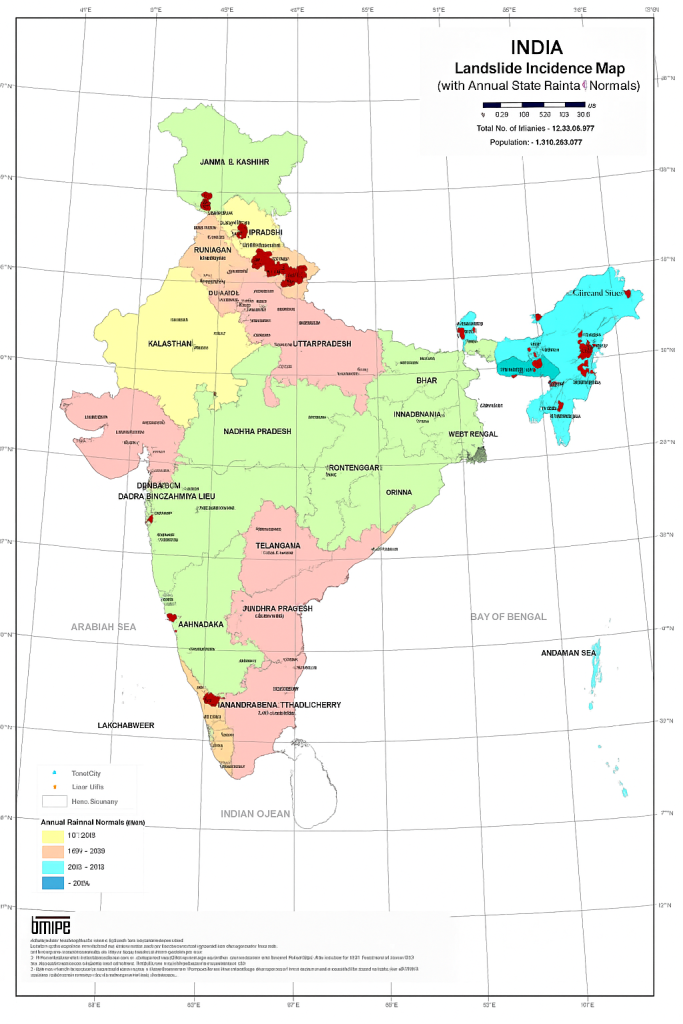
Definition (According to NDMA)
National Disaster Management Authority (NDMA) defines a landslide as: “The movement of a mass of rock, debris, or earth down a slope under the influence of gravity, often triggered by natural or human-induced factors.”
It is classified under “Hydro-Meteorological and Geological hazards.”
NDMA recognizes landslides as a recurring disaster in the Himalayan and Western Ghat regions.
India is among the most landslide-prone countries in the world, with about 12.6% of its total land area susceptible to this hazard.
Causes of Landslides in India
| Category | Cause / Activity | Description | Example / Region |
|---|---|---|---|
| (A) Natural / Geographical Factors | Heavy Rainfall | Intense monsoon rainfall increases pore pressure in soil, reducing cohesion and triggering slope failure. | Wayanad, Kerala (2024) – extreme monsoon rain caused multiple fatal landslides. |
| Earthquakes | Seismic vibrations loosen rock mass, especially in fragile mountain regions. | 2015 Nepal quake triggered massive slides in North Sikkim & Uttarakhand. | |
| Soil Erosion & Weathering | Continuous erosion by rivers and weathering weakens slope strength and stability. | Teesta Valley (Sikkim) – river undercutting led to repeated slope instability. | |
| Snowmelt & Glacier Retreat | Rapid melting causes water saturation in slope soils, reducing strength. | Kedarnath region (Uttarakhand) – 2013 disaster linked to glacial melt and slope failure. | |
| Steep Slope & Geological Structure | Faults, joints, and fractured rocks make slopes inherently weak and prone to movement. | Darjeeling Himalaya & North-Eastern hill ranges. | |
| (B) Anthropogenic (Human-Induced) Factors | Deforestation | Removal of vegetation cover destabilizes slopes and reduces root binding capacity. | Nilgiris (Tamil Nadu) – tea plantation expansion caused slope failures. |
| Unplanned Construction | Road cutting, tunnelling, and hill slope encroachments disturb slope balance. | Joshimath, Uttarakhand (2023) – land subsidence and slope destabilization. | |
| Mining & Quarrying | Blasting and excavation induce vibrations, leading to cracks and loosening of slopes. | Jharia coal fields, Jharkhand. | |
| Poor Drainage & Urbanization | Blocked natural drains cause water accumulation, triggering slope instability. | Mumbai suburban slides (Ghatkopar, 2000). | |
| Agricultural Expansion on Hills | Terracing and irrigation practices increase infiltration, reducing slope stability. | Meghalaya – shifting cultivation areas. |
Consequences of Landslides in India
| Dimension | Impact / Description | Example / Evidence |
|---|---|---|
| Environmental | Destruction of forests, biodiversity loss, and river sedimentation. | Wayanad (2024) – destroyed 200+ ha of forest and altered local hydrology. |
| Economic | Damage to infrastructure such as roads, bridges, power lines, and farmlands; increases maintenance costs. | NH-44 (J&K) and NH-10 (Sikkim) frequently blocked, costing ₹650 crore annually in maintenance. |
| Social | Displacement of populations, loss of housing, and livelihood insecurity in affected areas. | Himachal Pradesh – several villages relocated after 2023 monsoon slides. |
| Health | Deaths, injuries, and disease outbreaks due to contaminated water and blocked health access. | Over 300 deaths annually in India (NDMA). |
| Mental Health | Trauma and long-term psychological stress among survivors, especially in hill communities. | Post-2023 Raigad slide, several families required psychological counselling. |
| National Security | Disrupts border roads, army logistics, and communication lines in sensitive regions. | Arunachal Pradesh & Ladakh – frequent slides obstruct Indo-China border movement. |
Measures for Prevention and Mitigation
| Category | Measure / Strategy | Implementing Agency / Example |
|---|---|---|
| Structural Measures | Construction of retaining walls, rock bolting, gabion walls, slope drainage systems, and afforestation. | BRO (Border Roads Organisation) in Sikkim & Himachal Pradesh uses bio-engineering for slope stabilization. |
| Non-Structural Measures | Hazard zonation mapping, early warning systems, and regulation of land use. | GSI’s Landslide Susceptibility Mapping Project (2023). |
| Policy & Institutional | Implementation of the National Landslide Risk Management Strategy (2019) focusing on mapping, mitigation, and awareness. | NDMA & MoEFCC executing integrated hill area planning. |
| Technology & Forecasting | Use of LiDAR, GIS, drones, and satellite data for slope monitoring and forecasting. | ISRO’s Bhukosh platform integrates landslide inventory and vulnerability data. |
| Community-Based Preparedness | Awareness drives, mock drills, and training at panchayat levels to build resilience. | Himachal Pradesh & Sikkim – NDMA’s Landslide Ready Hill Communities program. |
| Environmental Management | Regulation of quarrying, eco-sensitive zoning, construction of check dams, and afforestation. | Kerala & Uttarakhand governments (post-2018) introduced buffer zones around high-risk slopes. |
Conclusion
Landslides represent a complex environmental disaster arising from the interaction of geological, ecological, and human factors. In India, regions like the Himalayan arc and the Western Ghats are natural hotspots due to their fragile terrain and high rainfall. However, the increasing frequency and intensity of landslides in recent years reflect deeper issues of poor slope governance, unplanned urban expansion, and unsustainable land use. Addressing this challenge requires a resilient and integrated approach that combines scientific mapping through collaborations between agencies such as ISRO and GSI, policy coordination involving the NDMA and State Disaster Management Authorities, and eco-restoration efforts supported by community awareness.
Prelims question:
Q. With reference to landslides in India, consider the following statements:
1. The Himalayas are more prone to landslides due to their young fold mountain structure and high seismic activity.
2. The Western Ghats experience landslides primarily due to excessive rainfall and deforestation.
3. The Landslide Hazard Zonation (LHZ) maps are prepared by the Indian Space Research Organisation (ISRO).
How many of the above-given statements are correct?
A. Only one
B. Only two
C. All three
D. None
Answer: B
Mains Question:
Q. Landslides are a recurrent disaster in India, especially in the Himalayan and Western Ghats regions.” Discuss the causes, consequences, and mitigation strategies for landslides in India.
(250 words)

- Before New Taxes, Make Every Rupee Count: Fiscal Discipline and Outcome-Based Governance in Tamil Nadu - August 20, 2026
- A Palestinian State as the Foundation for Regional Peace - August 20, 2026
- A Vision for an Inclusive Bangladesh: Democracy, Minority Rights and India’s Neighbourhood - August 19, 2026

No Comments