


21 Nov Launch Vehicle Mark-3: The Backbone of India’s Strategic, Commercial, and Human Space Missions
This article covers “Daily Current Affairs” and From Launch Vehicle Mark-3: The Backbone of India’s Strategic, Commercial, and Human Space Missions
SYLLABUS MAPPING
GS-3- Science & Technology-Launch Vehicle Mark-3: The Backbone of India’s Strategic, Commercial, and Human Space Missions
FOR PRELIMS
What is the role of the CE-20 cryogenic engine in LVM3?
FOR MAINS
What is the significance of the Launch Vehicle Mark-3 (LVM3) for India’s space programme?
Why in the News?
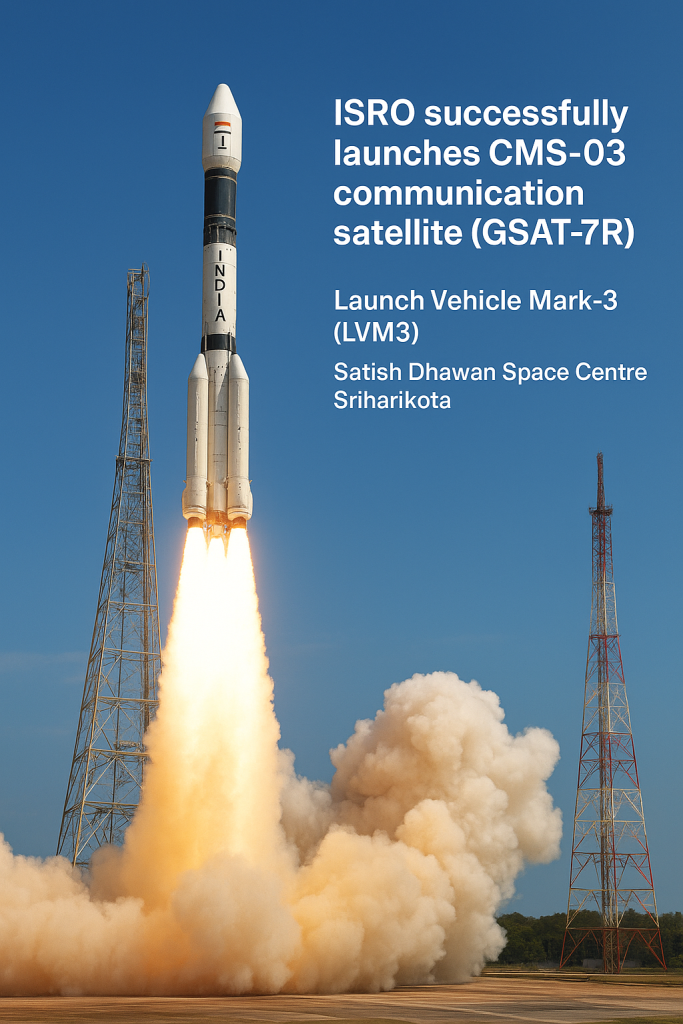
1. Evolution and Background
- The LVM3 was conceptualized to meet India’s long-term requirement of launching 4–6 tonne class communication satellites to Geostationary Orbit (GEO).
- Initial missions like GSAT satellites, and later high-profile missions like Chandrayaan-2, OneWeb launches, and future Gaganyaan human-spaceflight tests, established LVM3 as a dependable heavy-lift launcher.
- It is built with a focus on indigenous technology, reducing foreign dependency for heavy satellite launches.
| Orbit Type | Payload Capacity |
|---|---|
| Low Earth Orbit (LEO) | Up to 8,000 kg |
| Geosynchronous Transfer Orbit (GTO) | 4,000 – 4,500 kg |
| Deep-space Missions | Payloads > 3 tonnes |
Key Missions & Strengths of LVM3
| Mission | Year | Purpose / Payload | Significance |
|---|---|---|---|
| Chandrayaan-2 | 2019 | India’s 2nd lunar mission | Proved LVM3’s capability for deep-space missions |
| OneWeb Launches | 2022–23 | 72 broadband satellites | Established India as a global commercial launch provider |
| GSAT Series | Various | GSAT-19, GSAT-29, GSAT-7R, Defence Comms | Strengthened India’s strategic and communication capacities |
| Gaganyaan Programme | Ongoing | Crewed spaceflight missions | HLVM3 being developed with enhanced safety systems |
Strengths & Innovations of LVM3
| Category | Key Features |
|---|---|
| Indigenous Cryogenic Technology | CE-20 engine mastery; major milestone in space self-reliance |
| Modular & Reliable Design | Simplified structure, easy assembly, high reliability |
| Commercial Market Potential | Suitable for broadband constellations, heavy satellites, foreign payloads |
| Strategic Importance | Enables launch of military, strategic communication, navigation satellites |
| 100% Success in Operational Missions | India’s most dependable heavy-lift rocket |
Significance for India’s Space Programme
1. Boost to Communication & Defence: Supports heavy satellites like GSAT-7R, ensuring secure naval and strategic communication.
2. Enhances India’s Autonomy: Reduces dependence on foreign launchers like Arianespace.
3. Backbone of Deep-Space Missions: Future missions like Chandrayaan-3, Mars Orbiter Missions, Venus Orbiter, etc., rely on LVM3 capability.
4. Paves the Way for Human Spaceflight: LVM3 is the core of India’s Gaganyaan programme.
5. Strengthens Atmanirbhar Bharat: Demonstrates India’s capability in complex propulsion systems, especially cryogenics.
Future Developments
HLVM3 (Human-Rated LVM3)
- Designed for crew safety:
- Redundant systems
- Strengthened structures
- Advanced failure detection systems
Reusable Launch Vehicle Prospects
- Studies ongoing to integrate reusable technologies into future variants.
Potential Upgrades
- Higher thrust boosters
- Improved cryogenic engines
- Increased payload capacity
Conclusion
LVM3 stands as a symbol of India’s technological prowess and engineering excellence. With a perfect operational success record, indigenous cryogenic capabilities, advanced propulsion stages, and compatibility with defence, commercial, and human spaceflight missions, the rocket has become the backbone of India’s space ambitions. As India expands into deep-space exploration and manned missions, LVM3 will remain at the heart of the country’s strategic and scientific journey, reflecting true Atmanirbhar Bharat in the space sector.
Prelims question:
Q. Consider the following statements regarding the Launch Vehicle Mark-3 (LVM3):
1. LVM3 uses a combination of solid, liquid, and cryogenic propulsion stages.
2. The CE-20 cryogenic engine used in LVM3’s upper stage runs on Liquid Hydrogen (LH₂) and Liquid Oxygen (LOX).
3. LVM3 can place up to 8,000 kg payload into Geosynchronous Transfer Orbit (GTO).
4. LVM3 is the designated launch vehicle for India’s Gaganyaan mission.
How many of the above statements are correct?
(a) Only one
(b) Only two
(c) Only three
(d) All four
Answer: C
Mains Question:
Q. Discuss the significance of the Launch Vehicle Mark-3 (LVM3) in strengthening India’s space capabilities. How does it support India’s strategic, commercial, and human spaceflight ambitions?
(250 words)

- RBI’s Shrinking Real-Rate Cushion Amid Rising Inflation and Strong Demand - September 21, 2026
- India’s NGOs at a New Funding Crossroads - September 21, 2026
- Deep-Sea Discovery, Environmental Responsibility - September 19, 2026

No Comments