


04 Aug Lok Sabha Adjourns After Passing Appropriation Bill 2026: Key Details for UPSC
✎ The Appropriation Bill, mandated by Article 114, authorises the withdrawal of excess funds from the Consolidated Fund of India post-facto, ensuring constitutional compliance and parliamentary oversight over government expenditure.
Subject Relevance — Where This Topic Fits
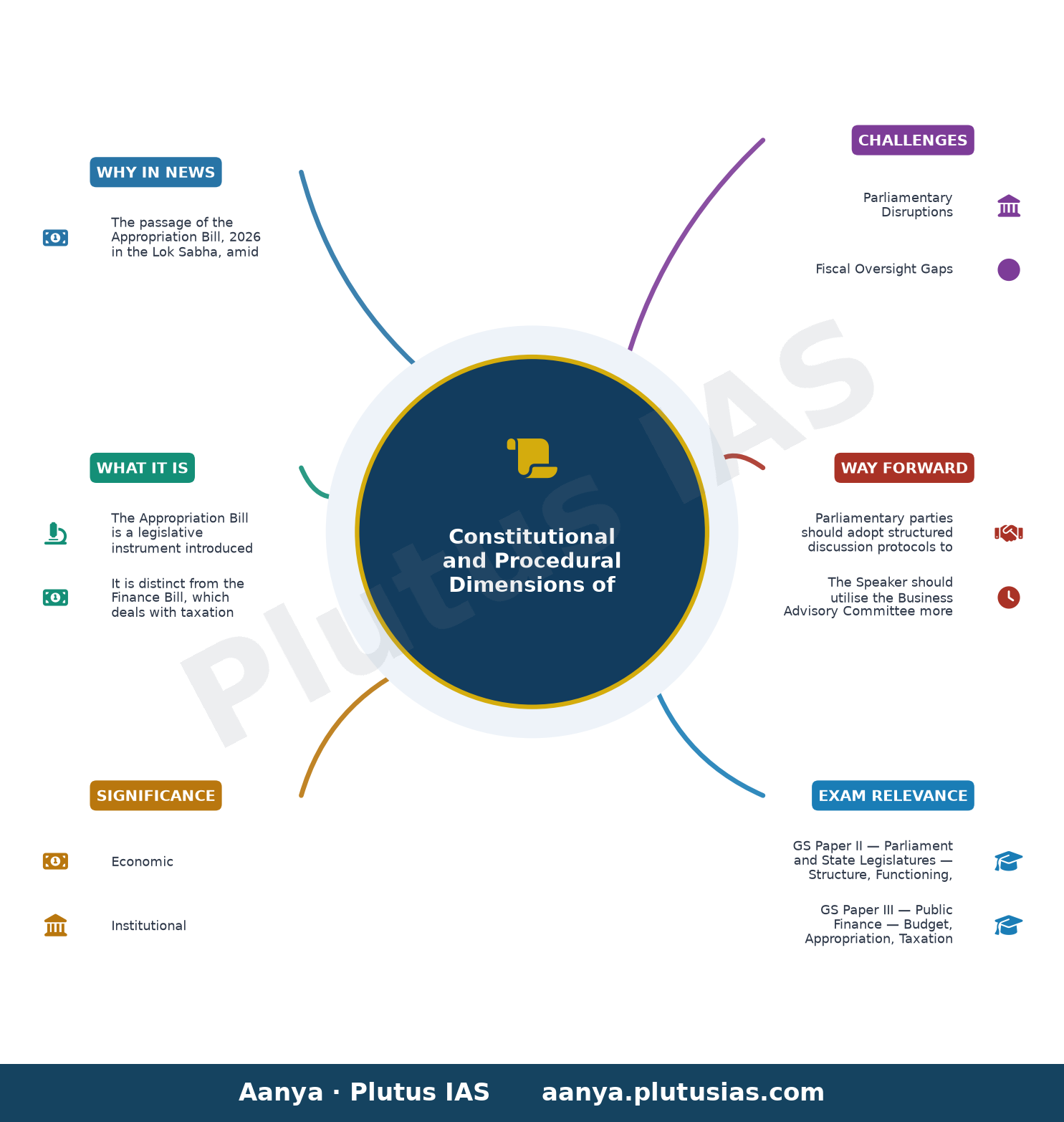
- GS Paper II — Parliament and State Legislatures — Structure, Functioning, Conduct of Business, Powers & Privileges | GS Paper III — Public Finance — Budget, Appropriation, Taxation and Fiscal Policy
- Prelims: Appropriation Bill, Consolidated Fund of India, Finance Bill, Annual Financial Statement, Article 112 of the Constitution, Article 114 of the Constitution, Lok Sabha Speaker’s role, Voice vote, Ordinance, Parliamentary adjournment
- Essay: Parliament as the supreme forum of democratic deliberation: balancing legislation and disruption, The fiscal accountability of the executive to the legislature: the constitutional mandate of appropriation
Quick Revision: The Appropriation Bill, mandated by Article 114, authorises the withdrawal of excess funds from the Consolidated Fund of India post-facto, ensuring constitutional compliance and parliamentary oversight over government expenditure.
Why is this in the news?
The passage of the Appropriation Bill, 2026 in the Lok Sabha, amid disruptions and adjournments, underscores the procedural and constitutional significance of fiscal legislation in India’s parliamentary democracy. The Bill authorises the withdrawal of funds from the Consolidated Fund of India to meet expenditure that exceeded the original grants for the financial year 2022–23. Its adoption, despite procedural disruptions, reflects the tension between legislative efficiency and democratic accountability in fiscal governance.
Background
- The Appropriation Bill is a constitutional requirement under Article 114 of the Constitution, which mandates parliamentary approval for any withdrawal from the Consolidated Fund of India beyond the amounts granted by the Appropriations Act.
- The Lok Sabha’s passage of the Bill by voice vote indicates procedural compliance with constitutional norms, despite opposition protests over unrelated issues such as police action on student protesters and alleged financial irregularities.
- The Bill forms part of the Monsoon Session’s legislative agenda, during which five Bills have been passed by the Lok Sabha, including the Public Examinations (Amendment) Bill, 2026 and the Prevention of Insults to National Honour (Amendment) Bill, 2026.
- The Speaker’s appeal for orderly conduct highlights the constitutional expectation that Parliament functions as a deliberative body rather than a platform for protest.
- The Bill awaits consideration in the Rajya Sabha, where it must be passed before receiving the President’s assent to become law.
What is the Appropriation Bill?
- The Appropriation Bill is a legislative instrument introduced under Article 114 of the Constitution to authorise the withdrawal of moneys from the Consolidated Fund of India for expenditure incurred in excess of the amounts granted by the Parliament in the previous financial year.
- It is distinct from the Finance Bill, which deals with taxation proposals and is introduced alongside the Union Budget under Article 110 of the Constitution.
- The Bill is introduced after the Union Budget is presented and the demands for grants are voted upon by the Lok Sabha, ensuring that expenditure is constitutionally sanctioned.
- The Appropriation Bill is passed by the Lok Sabha and then transmitted to the Rajya Sabha for recommendation; however, the Rajya Sabha cannot amend or reject it—only suggest changes.
- Once passed by both Houses, the Bill receives the President’s assent and becomes law, enabling the government to draw funds from the Consolidated Fund of India for the specified purposes.
- The passage of the Bill by voice vote reflects procedural compliance with constitutional norms, though it does not preclude substantive debate on fiscal accountability.
- The Bill is a critical component of India’s system of parliamentary financial control, ensuring that the executive remains accountable to the legislature for public expenditure.
Key Features
| Feature | Significance |
|---|---|
| Passage of Appropriation Bill, 2026 | Authorises expenditure from the Consolidated Fund of India for the financial year 2022-23, ensuring legal sanction for government spending beyond initial allocations. |
| Opposition protest over police action on student march | Highlights democratic concerns regarding state response to dissent, relevant to the study of fundamental rights and public order under the Constitution. |
| Introduction of Taxation and Other Laws (Amendment) Bill, 2026 | Proposes amendments to the Income-tax Act, 2025, and Payment and Settlement Systems Act, 2007, to exempt foreign investment in government securities from income tax. |
| Supreme Court Judges (Amendment) Bill, 2026 | Seeks to increase the sanctioned strength of Supreme Court judges from 34 to 38, addressing judicial pendency and workload management. |
| Disruption of Question Hour | Underscores the importance of parliamentary decorum and the role of the Speaker in maintaining legislative discipline. |
Why it Matters
Economic
- The Appropriation Bill, 2026, ensures fiscal accountability by legalising excess expenditure, a critical function of parliamentary oversight in democratic budgetary processes.
- The proposed tax exemption for foreign investment in government securities aims to attract capital inflows, potentially reducing the cost of borrowing for the government and supporting economic growth.
- Amendments to the Payment and Settlement Systems Act, 2007, may enhance the efficiency of digital financial transactions, aligning with India’s push for a cashless economy.
Institutional
- The Supreme Court Judges (Amendment) Bill, 2026, reflects the judiciary’s response to the increasing volume of litigation, ensuring timely justice delivery through expanded judicial capacity.
- The Speaker’s intervention to restore Question Hour underscores the institutional role of Parliament in deliberative democracy, despite disruptions.
Constitutional
- The passage of the Appropriation Bill exemplifies the constitutional principle of parliamentary control over public finance, as enshrined in Articles 112-117 of the Constitution.
- Opposition protests over police action on student march highlight the tension between public order (Article 19(2)) and the right to protest (Article 19(1)(a)).
Legislative
- The Monsoon Session’s productivity, with five Bills passed, demonstrates the functioning of Parliament, though disruptions may delay critical legislation awaiting Rajya Sabha clearance.
- The Taxation and Other Laws (Amendment) Bill, 2026, reflects the government’s intent to liberalise investment norms, a key aspect of economic policy.
Challenges
1. Parliamentary Disruptions
- Frequent adjournments and protests impede legislative productivity, delaying crucial Bills and undermining parliamentary efficiency.
- The Speaker’s role in maintaining order is tested, requiring balanced interventions to uphold democratic norms without stifling dissent.
UPSC Link: GS-II: Parliament and State Legislatures
2. Fiscal Oversight Gaps
- Excess expenditure authorised via the Appropriation Bill raises concerns about fiscal discipline and the efficacy of parliamentary scrutiny over government spending.
- The lack of detailed debate on the Appropriation Bill may obscure accountability for deviations from budgetary estimates.
UPSC Link: GS-III: Public Finance
3. Judicial Workload Management
- Increasing the sanctioned strength of Supreme Court judges addresses pendency but raises questions about the optimal judge-to-case ratio and resource allocation.
- Delays in judicial appointments and infrastructure constraints may offset the benefits of increased strength.
UPSC Link: GS-II: Judiciary
4. Balancing Security and Dissent
- Police action against student protesters during their march to Parliament raises ethical and legal questions about the state’s response to peaceful dissent.
- The episode tests the government’s commitment to democratic freedoms under Article 19(1)(a) and the reasonable restrictions under Article 19(2).
UPSC Link: GS-II: Fundamental Rights
Challenges — UPSC Perspective
| Issue | Concern |
|---|---|
| Disruption of Parliamentary Proceedings | Undermines legislative efficiency and delays critical Bills, affecting governance and accountability. |
| Excess Expenditure Authorisation | Raises concerns about fiscal discipline and the adequacy of parliamentary oversight over government spending. |
| Tax Exemption for Foreign Investment | Potential revenue loss for the exchequer; requires evaluation of long-term economic benefits versus short-term fiscal costs. |
| Increased Judicial Strength | May lead to resource strain in the judiciary; effectiveness depends on concurrent improvements in infrastructure and appointment processes. |
| Police Action on Protesters | Raises questions about the balance between public order and democratic freedoms, particularly the right to peaceful protest. |
| Rajya Sabha Clearance Delays | Critical Bills awaiting Rajya Sabha approval may face prolonged delays, affecting policy implementation. |
Way Forward
- Parliamentary parties should adopt structured discussion protocols to minimise disruptions and ensure productive legislative sessions.
- The Speaker should utilise the Business Advisory Committee more effectively to allocate time for debates and minimise adjournments.
- The government must provide detailed justifications for excess expenditure in the Appropriation Bill to enhance parliamentary scrutiny and fiscal accountability.
- Judicial reforms should accompany the increase in Supreme Court strength to address infrastructure gaps and appointment bottlenecks.
- Police action against protesters must adhere to constitutional principles, ensuring that restrictions on dissent are reasonable and proportionate.
- The Rajya Sabha should expedite the consideration of pending Bills to prevent legislative logjams and ensure policy continuity.
- Civil society and media should play a proactive role in monitoring parliamentary proceedings and holding institutions accountable for disruptions.
- Aspirants should analyse the economic impact of tax exemptions on foreign investment and their implications for fiscal policy and revenue generation.
UPSC Value Addition
Keywords for Mains Answer-Writing
Appropriation Bill 2026 · Parliamentary financial control · Consolidated Fund of India · Lok Sabha legislative process · Opposition protests in Parliament · Fiscal accountability · Money Bill vs Financial Bill · Parliamentary adjournment procedures · Public Examinations Amendment Bill 2026 · Supreme Court Judges Amendment Bill 2026 · Monsoon Session 2026 · Speaker’s role in parliamentary discipline
Concept Flow
Opposition protests over police action → Disruption of Question Hour → Speaker’s intervention to restore order → Passage of Appropriation Bill to authorise excess expenditure → Introduction of Taxation and Other Laws (Amendment) Bill to exempt foreign investment from income tax → Supreme Court Judges (Amendment) Bill to increase judicial strength → Awaiting Rajya Sabha clearance for pending Bills.
Prelims Practice Questions
Q1. Consider the following statements regarding the Appropriation Bill in the Indian parliamentary system:
1. It is introduced in the Lok Sabha only.
2. It authorises the withdrawal of money from the Consolidated Fund of India.
3. It requires the President’s assent before introduction in Parliament.
4. It is a Money Bill and cannot be amended by the Rajya Sabha.
How many of the above statements are correct?
- Only one
- Only two
- Only three
- All four
Answer: Only three — Statements 1, 2, and 4 are correct. The Appropriation Bill is introduced in the Lok Sabha, authorises withdrawal from the Consolidated Fund, and is a Money Bill (hence Rajya Sabha cannot amend it). Statement 3 is incorrect as the President’s assent is not required before introduction; it is required only for the Bill to become law after passage.
Q2. Assertion (A): The Speaker of the Lok Sabha has the power to adjourn the House under Rule 34 of the Rules of Procedure and Conduct of Business in Lok Sabha.
Reason (R): The Speaker’s decision to adjourn the House is subject to judicial review.
In the context of the above two statements, which one of the following is correct?
- Both A and R are true, and R is the correct explanation of A
- Both A and R are true, but R is not the correct explanation of A
- A is true, but R is false
- A is false, but R is true
Answer: A is true, but R is false — Assertion (A) is true: the Speaker has the power to adjourn the House under Rule 34. Reason (R) is also true but does not explain (A); the Speaker’s decision to adjourn is not subject to judicial review as it is a procedural matter within the domain of parliamentary sovereignty.
Q3. Match the following parliamentary Bills with their respective legislative stages as of August 2026:
Column I (Bill) Column II (Stage)
a. Appropriation Bill, 2026 1. Passed by both Houses
b. Public Examinations Amendment Bill, 2026 2. Awaiting Rajya Sabha consideration
c. Prevention of Insults to National Honour Bill, 2026 3. Passed by Lok Sabha only
d. Supreme Court Judges Amendment Bill, 2026 4. Pending in Lok Sabha
Select the correct match:
- a-2, b-1, c-3, d-4
- a-2, b-1, c-1, d-2
- a-3, b-1, c-1, d-2
- a-2, b-3, c-1, d-2
Answer: a-3, b-1, c-1, d-2 — Appropriation Bill, 2026 (a) is awaiting Rajya Sabha consideration (2). Public Examinations Amendment Bill, 2026 (b) and Prevention of Insults to National Honour Bill, 2026 (c) have been passed by both Houses (1). Supreme Court Judges Amendment Bill, 2026 (d) is awaiting Rajya Sabha consideration (2).
Mains Practice Question
✍ The Appropriation Bill, 2026, was passed by the Lok Sabha amid Opposition protests, reflecting contemporary challenges in parliamentary functioning. Critically examine the significance of the Appropriation Bill in India’s parliamentary democracy and analyse the procedural and political constraints that may impede its smooth passage. Also, assess the implications of frequent adjournments on legislative accountability. (15 Marks)
Approach: MODEL-ANSWER SKELETON:
1. **Significance of the Appropriation Bill** (4 Marks):
– Constitutional basis: Article 114(3) read with Article 112 (Annual Financial Statement) and Article 266 (Consolidated Fund of India).
– Purpose: Authorises withdrawal of moneys from the Consolidated Fund to meet excess expenditure beyond the original grant for the financial year ended March 31, 2023.
– Parliamentary control: Ensures legislative scrutiny over executive expenditure; part of the ‘Money Bill’ category under Article 109.
– Link to fiscal accountability: Demonstrates the principle of ‘no taxation without representation’ and the doctrine of legislative supremacy in financial matters.
2. **Procedural and Political Constraints** (5 Marks):
– Procedural: Money Bills require Lok Sabha’s exclusive jurisdiction (Article 109); Rajya Sabha can only recommend amendments, not reject.
– Political: Opposition protests (e.g., Ram Temple donation issue, student protests) disrupt proceedings, delaying or obstructing legislative business.
– Ordinance route vs legislative process: The Bill replaced an Ordinance, highlighting executive’s recourse to bypass parliamentary debate.
– Speaker’s role: Rule 34 of the Rules of Procedure empowers the Speaker to adjourn the House, but frequent adjournments dilute the House’s functional efficiency.
3. **Implications of Frequent Adjournments** (4 Marks):
– Erosion of legislative accountability: Reduced time for scrutiny of Bills, Questions, and debates.
– Executive dominance: Accelerated passage of Bills without adequate debate, undermining parliamentary oversight.
– Democratic deficit: Public perception of Parliament as a forum for disruption rather than deliberation, eroding trust in institutions.
– Consequences: Delayed implementation of policies, accumulation of pending legislative business, and potential constitutional crises if deadlock persists.
4. **Balanced View and Way Forward** (2 Marks):
– Need for consensus: Political parties must prioritise national interest over partisan protests.
– Institutional reforms: Strengthening the Business Advisory Committee, enforcing strict time limits for debates, and leveraging technology for virtual sittings.
– Role of the Chair: The Speaker must balance parliamentary discipline with the right to protest, ensuring decorum while facilitating legislative business.
Source: Hindustan Times
Generated by AanyaAi for educational purpose.

- Odisha Launches Shree Jagannath Darshan Yojana for Senior Citizens Pilgrimage - September 21, 2026
- ग्वालियर में एशिया के पहले दूरसंचार विनिर्माण क्षेत्र की आधारशिला: जानिए पूरा विवरण और महत्व - September 21, 2026
- Gwalior to host Asia’s 1st Telecom Manufacturing Zone: ₹5,500 Cr Investment & 18K Jobs - September 21, 2026

No Comments