


11 Aug Lok Sabha Clears Kerala Renaming to ‘Keralam’ Amid Opposition Deadlock
Kerala Name Change BillCo-operative Sector BillsLok SabhaState LegislatureConstitution of India✎ The renaming of a State under Article 3 of the Constitution requires the State Legislature’s views and subsequent parliamentary approval, while amendments to statutory bodies like the NCDC must align with legislative procedures…
Subject Relevance — Where This Topic Fits
- GS Paper II — Polity and Governance (Constitutional Provisions, Federalism, Parliamentary Procedures) | GS Paper III — Economy (Co-operative Sector Reforms, Amendments to Statutory Bodies)
- Prelims: Article 3 of the Constitution, State Reorganisation Act, 1956, National Co-operative Development Corporation (NCDC), Parliamentary procedures under Rules of Procedure and Conduct of Business in Lok Sabha, Federalism and State identity, Co-operative societies and their regulatory framework
- Essay: The Role of Constitutional Amendments in Federal Governance, Institutional Integrity and Parliamentary Functioning in a Democratic Framework
Quick Revision: The renaming of a State under Article 3 of the Constitution requires the State Legislature’s views and subsequent parliamentary approval, while amendments to statutory bodies like the NCDC must align with legislative procedures and federal principles to ensure institutional integrity.
Why is this in the news?
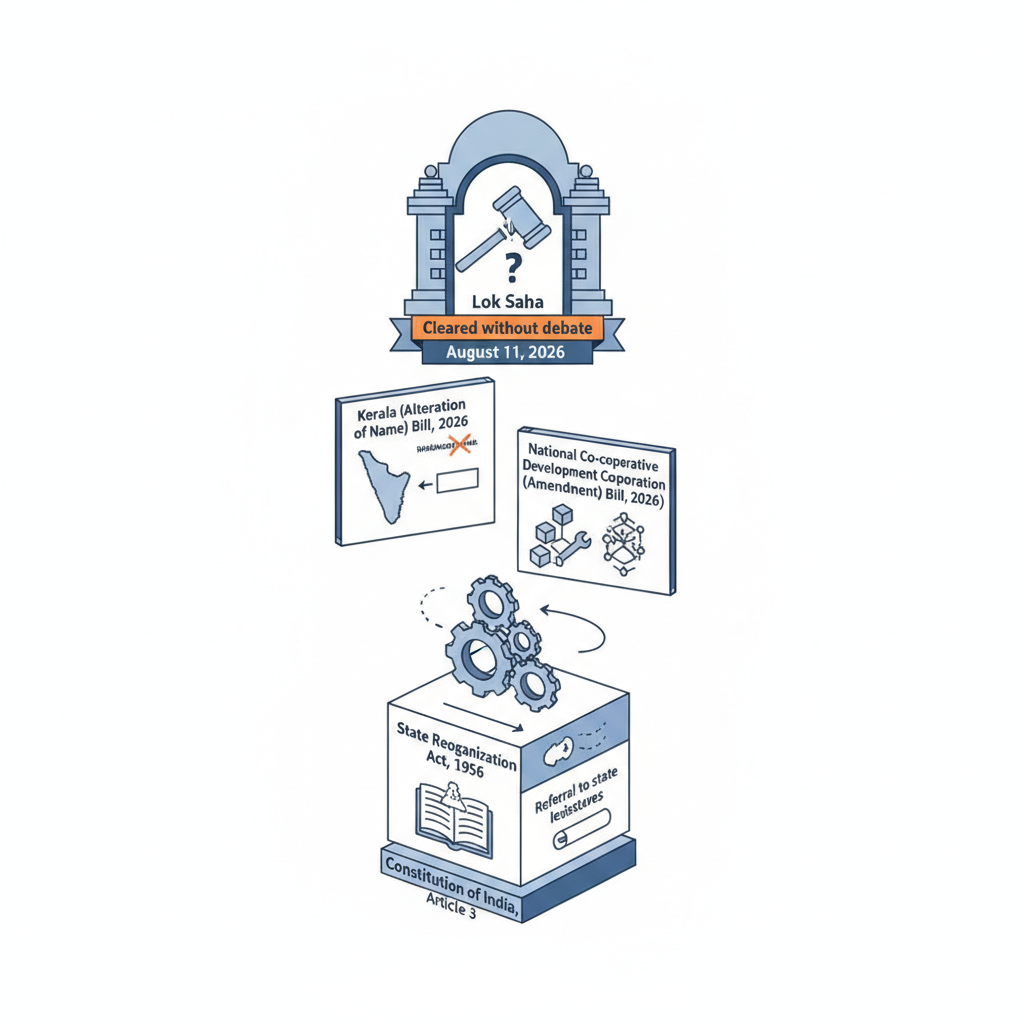
The Lok Sabha, on August 11, 2026, passed two Bills without debate—namely, the Kerala (Alteration of Name) Bill, 2026, and the National Co-operative Development Corporation (Amendment) Bill, 2026—amidst sustained legislative deadlock over unrelated procedural disputes. The passage of these Bills, despite the absence of discussion, underscores critical questions regarding parliamentary norms, federal governance, and the procedural integrity of legislative amendments to constitutional and statutory frameworks.
Background
- The Constitution of India, under Article 3, empowers Parliament to alter the name of any State by law, provided the Bill is referred to the State Legislature for its views within a specified period.
- The State Reorganisation Act, 1956, and subsequent amendments have historically governed the process of renaming States, reflecting linguistic, cultural, and administrative considerations.
- The National Co-operative Development Corporation (NCDC), established under the National Co-operative Development Corporation Act, 1962, is the apex statutory body for promoting and developing co-operative societies in India.
- The NCDC Act has been amended periodically to align with evolving policy priorities, including financial autonomy, governance reforms, and expansion of its mandate.
- Parliamentary procedures, as outlined in the Rules of Procedure and Conduct of Business in Lok Sabha, mandate that Bills be debated unless waived under specific circumstances, such as urgency or procedural consensus.
- The Monsoon Session of Parliament in 2026 has been marked by disruptions, highlighting tensions between legislative efficiency and the principle of informed debate in a bicameral system.
Constitutional and Procedural Framework for State Renaming and Statutory Amendments
- The Kerala (Alteration of Name) Bill, 2026 seeks to rename the State of Kerala to ‘Keralam,’ reflecting its Malayalam linguistic identity. This aligns with the provisions of Article 3 of the Constitution, which requires the Bill to be referred to the Kerala Legislative Assembly for its views before introduction in Parliament.
- The National Co-operative Development Corporation (Amendment) Bill, 2026 proposes amendments to the NCDC Act, 1962, to enhance its functional autonomy, streamline governance, and expand its role in the co-operative sector. Key amendments may include provisions for increased financial powers, digital governance integration, and alignment with the Multi-State Co-operative Societies Act, 2002.
- The NCDC operates under the administrative control of the Ministry of Cooperation, Government of India, and functions as a nodal agency for the development of co-operative societies across sectors such as agriculture, housing, and credit.
- The passage of these Bills without debate raises questions about the balance between legislative efficiency and the principle of informed deliberation, especially in the context of federal governance and statutory amendments.
- The co-operative sector in India, governed by the Constitution’s Directive Principles (Article 43B) and the 97th Constitutional Amendment Act, 2011, plays a pivotal role in socio-economic development, particularly in rural and marginalised communities.
- Amendments to the NCDC Act must ensure compliance with the principles of cooperative federalism, transparency, and accountability, while also addressing the evolving needs of the co-operative movement in India.
Key Features
| Feature | Significance |
|---|---|
| Kerala (Alteration of Name) Bill, 2026 | Initiates the constitutional process for renaming a State under Article 3 of the Constitution, which empowers Parliament to alter the name of any State on the recommendation of the President. |
| National Co-operative Development Corporation (Amendment) Bill, 2026 | Proposes amendments to the NCDC Act, 1962, aimed at enhancing the regulatory and developmental framework for the co-operative sector in India. |
| Voice vote passage without debate | Demonstrates the procedural flexibility of Parliament to pass non-controversial Bills even amid disruptions, while highlighting the erosion of deliberative democracy in the absence of structured debate. |
| Lok Sabha deadlock due to Opposition protests | Illustrates the constitutional tension between parliamentary sovereignty and the Opposition’s right to demand discussions on governance failures, as enshrined in Article 75(3) and Rules of Procedure. |
| Speaker’s adjournment powers under Rule 375 | Highlights the Speaker’s discretionary authority to adjourn the House in cases of unruly conduct, balancing the need for legislative continuity with the right to protest. |
Why it Matters
Constitutional and Procedural Significance
- The Kerala (Alteration of Name) Bill, 2026, underscores the constitutional mechanism for State name changes, which requires Parliamentary approval under Article 3, followed by Presidential assent and the State Legislature’s recommendation.
- The passage of the Bill without debate, despite procedural norms, reflects the procedural flexibility of Parliament but raises questions about the erosion of deliberative democracy in the legislative process.
- The National Co-operative Development Corporation (Amendment) Bill, 2026, aligns with the constitutional directive under Article 43 to promote co-operative societies as instruments of economic democracy and social welfare.
- The deadlock in the Lok Sabha highlights the constitutional tension between the government’s accountability obligations under Article 75(3) and the Opposition’s right to demand discussions on governance issues.
Economic and Sectoral Significance
- The co-operative sector in India, governed by the National Co-operative Development Corporation (NCDC) Act, 1962, plays a critical role in agricultural credit, rural development, and poverty alleviation, particularly in States like Kerala with a strong co-operative movement.
- Amendments to the NCDC Act could enhance the Corporation’s financial autonomy, governance, and capacity to fund co-operative enterprises, thereby strengthening the sector’s contribution to the formal economy.
- The renaming of Kerala to ‘Keralam’ holds symbolic and cultural significance, reflecting the State’s linguistic identity and potentially enhancing its administrative and tourism branding.
Parliamentary and Democratic Significance
- The passage of Bills without debate amid disruptions underscores the procedural challenges in Parliament, where legislative efficiency must be balanced against the right to dissent and demand accountability.
- The Opposition’s demand for a discussion on alleged governance failures (e.g., student protests, donation theft) aligns with the constitutional principle of parliamentary oversight and the right of elected representatives to seek explanations from the executive.
- The Speaker’s adjournment powers, exercised under Rule 375, serve as a mechanism to restore order but also raise concerns about the suppression of legitimate dissent in the legislative process.
Challenges
1. Erosion of Deliberative Democracy
- The passage of Bills without debate undermines the principle of informed legislative scrutiny, which is fundamental to parliamentary democracy.
- Disruptions in Parliament, while a legitimate form of protest, risk normalising legislative bypass, thereby eroding public trust in democratic institutions.
- The lack of structured debate on Bills like the NCDC Amendment Bill limits the scope for expert inputs, stakeholder consultations, and public accountability.
UPSC Link: GS-II: Parliament and State Legislatures—Structure, Functioning, Conduct of Business, Powers & Privileges
2. Constitutional Tensions in Parliamentary Proceedings
- The deadlock highlights the conflict between the government’s obligation to maintain legislative productivity and the Opposition’s right to demand discussions on governance failures.
- The Speaker’s exercise of adjournment powers under Rule 375 may be perceived as partisan, raising questions about the neutrality of the Chair in managing legislative disruptions.
- The absence of a formal mechanism to resolve deadlocks without compromising legislative integrity poses a challenge to the smooth functioning of Parliament.
UPSC Link: GS-II: Parliament and State Legislatures—Role of the Speaker, Parliamentary Committees
3. Governance Accountability and Public Trust
- The Opposition’s demand for discussions on alleged governance failures (e.g., student protests, donation theft) reflects public concerns about transparency and accountability in governance.
- The inability to address these concerns in Parliament risks exacerbating public disillusionment with democratic institutions and processes.
- The lack of structured debate on governance issues limits the scope for corrective action and policy reforms based on parliamentary scrutiny.
UPSC Link: GS-IV: Ethics, Integrity and Aptitude—Accountability and Ethical Governance
4. Sectoral Challenges in the Co-operative Movement
- The co-operative sector faces structural challenges, including limited financial autonomy, governance inefficiencies, and regulatory gaps, which the NCDC Amendment Bill seeks to address.
- The sector’s contribution to rural development and poverty alleviation is constrained by inadequate funding, capacity-building, and technological integration.
- The lack of structured debate on the NCDC Amendment Bill limits the scope for addressing these challenges through informed legislative scrutiny.
UPSC Link: GS-III: Agriculture—Co-operative Societies and Rural Development
Challenges — UPSC Perspective
| Issue | Concern |
|---|---|
| Procedural bypass in legislative scrutiny | Risk of normalising legislative bypass without debate, undermining parliamentary democracy and public accountability. |
| Constitutional tensions in parliamentary proceedings | Conflict between legislative productivity and Opposition’s right to demand discussions, raising questions about the neutrality of the Speaker. |
| Governance accountability deficits | Inability to address public concerns about transparency and accountability due to lack of structured debate in Parliament. |
| Structural challenges in the co-operative sector | Limited financial autonomy, governance inefficiencies, and regulatory gaps constrain the sector’s contribution to rural development. |
| Public trust in democratic institutions | Disruptions and lack of debate risk exacerbating public disillusionment with Parliament and governance processes. |
| Regulatory and administrative bottlenecks | Lack of structured debate on sectoral Bills limits the scope for informed policy reforms and corrective actions. |
Way Forward
- Constitute a Parliamentary Committee on Legislative Scrutiny to review Bills passed without debate and recommend reforms to enhance deliberative democracy.
- Strengthen the role of Department-Related Standing Committees in pre-legislative scrutiny to ensure Bills are debated before passage, aligning with the 2019 recommendation of the National Commission to Review the Working of the Constitution.
- Introduce a formal mechanism for resolving deadlocks in Parliament, such as a bipartisan consensus-building committee, to balance legislative productivity with Opposition demands for discussions.
- Enhance the NCDC’s financial autonomy and governance framework through the Amendment Bill, ensuring greater transparency and stakeholder consultations in its operations.
- Promote co-operative sector reforms at the State level, particularly in Kerala, to align with the NCDC’s enhanced regulatory framework and improve sectoral efficiency.
- Establish a dedicated Parliamentary Ombudsman to address public grievances related to governance failures, thereby reducing reliance on disruptions as a form of protest.
- Conduct a comprehensive review of the Speaker’s adjournment powers under Rule 375 to ensure their exercise is neutral, transparent, and aligned with democratic principles.
- Encourage structured media briefings by the government on governance issues to address public concerns and reduce the need for disruptive parliamentary protests.
UPSC Value Addition
Keywords for Mains Answer-Writing
State name change procedure · Article 3 of the Constitution · Parliamentary legislative process · Lok Sabha legislative procedure · Unanimous consent in Parliament · Co-operative sector governance · National Co-operative Development Corporation (NCDC) · Parliamentary deadlock and legislative efficiency · Constitutional amendment process · Legislative oversight and debate · Federalism and State identity · Parliamentary procedures under Rule 193 · Role of Speaker in legislative business · Federal-State relations in legislative matters
Constitutional & Policy Linkages
- Article 3: Alteration of the name of a State by Parliament on the recommendation of the President and the State Legislature.
- Article 75(3): Collective responsibility of the Council of Ministers to the Lok Sabha, underpinning the Opposition’s right to demand discussions on governance issues.
Concept Flow
State Legislature of Kerala recommends name change to ‘Keralam’ → Union Cabinet approves the proposal → President refers the Bill to the State Legislature for recommendation → Parliament introduces the Kerala (Alteration of Name) Bill, 2026 under Article 3 → Lok Sabha passes the Bill without debate due to Opposition disruptions → Bill awaits Rajya Sabha passage and Presidential assent → Name change takes effect upon notification in the Gazette of India. → Co-operative sector faces structural challenges (e.g., financial autonomy, governance inefficiencies) → NCDC Act, 1962, amended to enhance regulatory and developmental framework → National Co-operative Development Corporation (Amendment) Bill, 2026 introduced in Parliament → Bill passed without debate amid Opposition disruptions → Amendments await Rajya Sabha passage and Presidential assent → Enhanced NCDC framework implemented to strengthen the co-operative sector. → Opposition demands discussion on governance failures (e.g., student protests, donation theft) → Government offers to discuss but Opposition resorts to disruptions → Lok Sabha deadlock ensues, disrupting legislative proceedings → Speaker adjourns House under Rule 375 to restore order → Deadlock highlights constitutional tension between legislative productivity and Opposition’s right to demand accountability → Need for reforms in parliamentary procedures to balance efficiency and dissent. → Public disillusionment with governance failures (e.g., student protests, alleged donation theft) → Opposition protests in Parliament to demand discussions → Lack of structured debate exacerbates public concerns about transparency and accountability → Risk of erosion of public trust in democratic institutions → Need for mechanisms to address governance failures and restore public confidence in Parliament.
Prelims Practice Questions
Q1. Consider the following statements regarding the procedure for altering the name of a State in India:
1. The Bill for altering the name of a State can be introduced in either House of Parliament.
2. The Bill requires the prior consent of the State Legislature before introduction in Parliament.
3. The Bill must be passed by a special majority in Parliament as per Article 3 of the Constitution.
4. The President’s assent is mandatory for the Bill to become law.
How many of the above statements are correct?
- Only one
- Only two
- Only three
- All four
Answer: All four — Statements 1, 2, and 4 are correct. Statement 3 is incorrect: the Bill does not require a special majority; it is passed by a simple majority in Parliament. Prior consent of the State Legislature is required only if the Bill seeks to affect the area, boundaries, or name of the State (Article 3).
Q2. Assertion (A): The National Co-operative Development Corporation (Amendment) Bill, 2026, was passed without debate in the Lok Sabha.
Reason (R): The Bill was moved under Rule 193 of the Rules of Procedure and Conduct of Business in Lok Sabha, which allows for consideration and passing of a Bill without debate if there is no formal opposition.
Options:
A. Both A and R are true, and R is the correct explanation of A.
B. Both A and R are true, but R is not the correct explanation of A.
C. A is true, but R is false.
D. A is false, but R is true.
- A
- B
- C
- D
Answer: A — Both the Assertion (A) and Reason (R) are true. The Bill was indeed passed without debate, and Rule 193 permits such a procedure when there is no formal opposition or when the Speaker deems it fit. Rule 193 allows for the consideration and passing of a Bill without debate if the Speaker permits.
Q3. Match the following legislative procedures with their respective constitutional or procedural provisions:
Column I (Procedure) | Column II (Provision)
1. Alteration of the name of a State | A. Article 3 of the Constitution
2. Passing of a Money Bill | B. Article 109 of the Constitution
3. Consideration of a Bill without debate | C. Rule 193 of the Rules of Procedure and Conduct of Business in Lok Sabha
4. Special majority for constitutional amendment | D. Article 368 of the Constitution
Options:
A. 1-A, 2-B, 3-C, 4-D
B. 1-B, 2-A, 3-D, 4-C
C. 1-D, 2-C, 3-B, 4-A
D. 1-C, 2-D, 3-A, 4-B
- A
- B
- C
- D
Answer: A — The correct matches are: 1-A (Article 3 governs the alteration of the name of a State), 2-B (Article 109 specifies the procedure for Money Bills), 3-C (Rule 193 allows consideration of a Bill without debate), and 4-D (Article 368 governs constitutional amendments requiring a special majority).
Mains Practice Question
✍ The Parliament recently passed the Kerala (Alteration of Name) Bill, 2026, renaming the State to ‘Keralam’ without debate. In this context, critically examine the constitutional and procedural framework governing the alteration of the name of a State in India. Also, analyse the implications of such legislative actions being undertaken without debate in the context of parliamentary democracy. (15 Marks)
Approach: MODEL-ANSWER SKELETON:
1. **Constitutional Framework (6 points)**
– Article 3 of the Constitution: Power of Parliament to form new States and alter areas, boundaries, or names of existing States.
– Prior consent of the State Legislature is required only if the Bill affects the area, boundaries, or name of the State (Article 3(2)(a)).
– Introduction of the Bill: Can be introduced in either House of Parliament (Lok Sabha or Rajya Sabha).
– Passage of the Bill: Requires a simple majority in Parliament (Article 3(2)).
– President’s assent: Mandatory for the Bill to become law (Article 3(2)).
– No requirement for a special majority or a constitutional amendment.
2. **Procedural Aspects (4 points)**
– Rule 193 of the Rules of Procedure and Conduct of Business in Lok Sabha: Allows for the consideration and passing of a Bill without debate if the Speaker permits.
– Role of the Speaker: Discretionary power to adjourn or suspend proceedings and to allow or disallow legislative business in the absence of formal opposition.
– Parliamentary deadlock: Impact on legislative efficiency and the functioning of Parliament.
– Unanimous consent: The Kerala (Alteration of Name) Bill, 2026, was passed without debate due to the Opposition’s protests, highlighting the procedural flexibility under Rule 193.
3. **Implications of Legislative Actions Without Debate (5 points)**
– Democratic accountability: Lack of debate may undermine the principle of deliberative democracy and public scrutiny.
– Transparency: Absence of debate may reduce transparency in legislative processes.
– Federalism: Potential erosion of State autonomy if legislative actions bypass State Legislatures or public discourse.
– Precedent: May set a precedent for future legislative actions to be undertaken without adequate debate, raising concerns about parliamentary norms.
– Public trust: Erosion of public trust in Parliament if legislative actions are perceived as being undertaken without due process or public consultation.
Source: The Hindu
Generated by AanyaAi for educational purpose.

- Gurugram’s groundwater extraction exceeds limit by 212%; HC seeks ban - October 4, 2026
- स्वतंत्रता सेनानी श्यामजी कृष्ण वर्मा की जन्म जयंती पर पीएम का श्रद्धांजलि - October 4, 2026
- KWML’s Feasibility Reports for Water Metro in 18 Cities: UPSC & PCS Insights - October 3, 2026

No Comments