


12 Aug Lok Sabha Passes 2 Bills Without Debate Amid Opposition Disruptions
Lok SabhaMonsoon SessionBills passed✎ The Constitution mandates that Parliament conduct its business through structured procedures, including debates and discussions, to ensure legislative scrutiny and accountability; persistent disruptions erode this foundational…
Subject Relevance — Where This Topic Fits
- GS Paper II — Polity and Governance — Parliament and State Legislatures — Structure, Functioning, Conduct of Business, Powers & Privileges and Issues Arising out of these
- Prelims: Parliamentary procedures, Zero Hour, Question Hour, Money Bill, Joint Sitting, Parliamentary Committees, Speaker of Lok Sabha, Rajya Sabha, Monsoon Session
- Essay: Parliamentary democracy: The role of debate and deliberation in lawmaking
Quick Revision: The Constitution mandates that Parliament conduct its business through structured procedures, including debates and discussions, to ensure legislative scrutiny and accountability; persistent disruptions erode this foundational principle.
Why is this in the news?
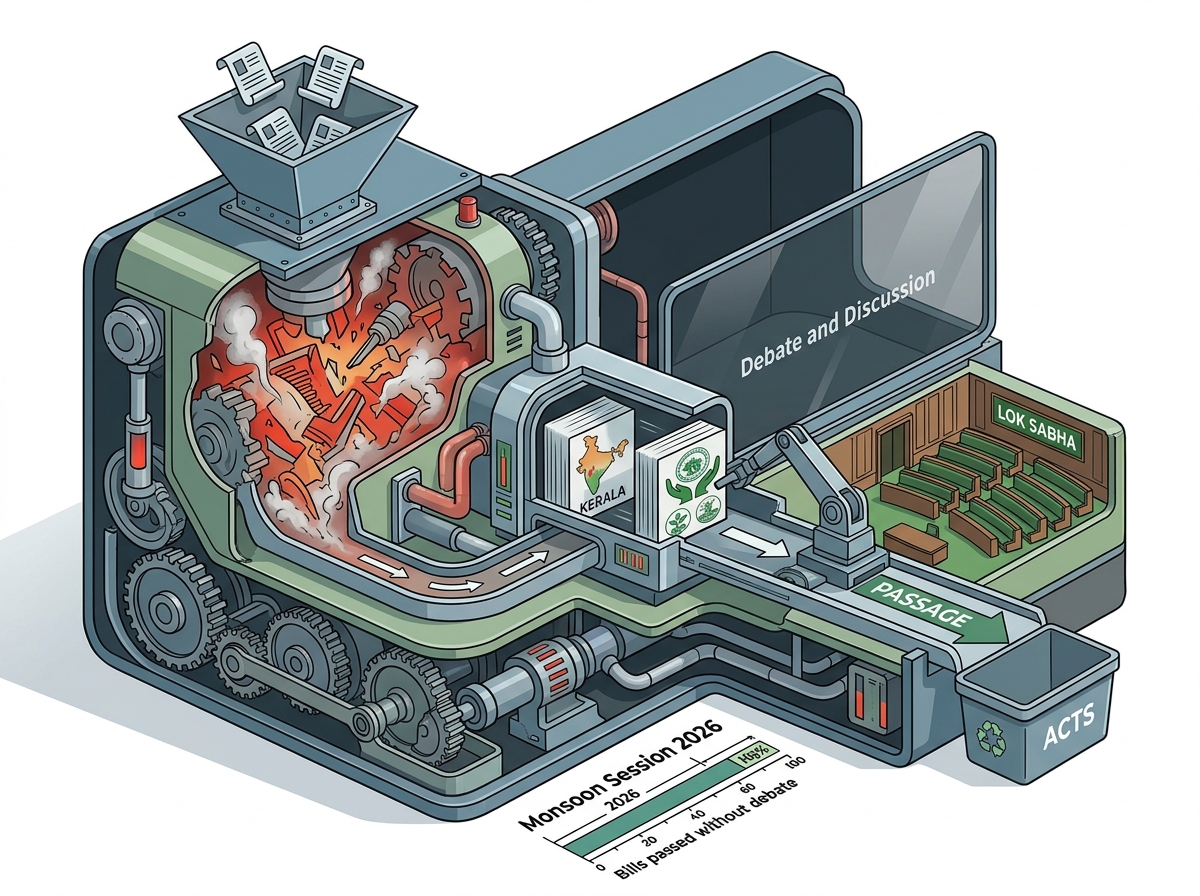
The Lok Sabha, during the Monsoon Session 2026, passed two bills—the Kerala (Alteration of Name) Bill, 2026, and the National Cooperative Development Corporation (Amendment) Bill, 2026—without any debate due to persistent disruptions by opposition members. This episode underscores systemic challenges in parliamentary functioning, particularly the erosion of deliberative processes and the procedural implications of legislative passage in the absence of discussion.
Background
- The Monsoon Session of Parliament, 2026, commenced with disruptions from the Opposition, primarily centred on demands for the presence of the Union Home Minister in the House.
- Since the beginning of the session, nine of eleven bills have been passed without any substantive discussion in the Lok Sabha.
- The Kerala (Alteration of Name) Bill, 2026, seeks to rename the state of Kerala as ‘Keralam’, aligning with the state government’s linguistic preference.
- The Speaker of the Lok Sabha, Om Birla, expressed concern over repeated disruptions and adjourned proceedings multiple times, highlighting the breakdown in parliamentary decorum.
- The Constitution of India, under Articles 79 to 122, delineates the structure, powers, and procedures of Parliament, including the conduct of legislative business.
Parliamentary Procedures and the Conduct of Legislative Business
- The Parliament of India, as the supreme legislative body, functions through structured procedures outlined in the Constitution and the Rules of Procedure and Conduct of Business in Lok Sabha.
- The Lok Sabha, as the directly elected House, is the primary forum for debate and deliberation on legislative proposals, financial matters, and governance issues.
- Key parliamentary tools for scrutiny include Question Hour, Zero Hour, Calling Attention Notices, and Motions, all designed to facilitate accountability and informed debate.
- The passage of a bill typically involves multiple stages: introduction, consideration, discussion, amendments, and voting, followed by transmission to the Rajya Sabha for its concurrence.
- A bill may be passed as a Money Bill under Article 109, which restricts the Rajya Sabha to recommending amendments but not withholding assent, thereby expediting financial legislation.
- The Speaker of the Lok Sabha plays a pivotal role in maintaining order, interpreting rules, and ensuring adherence to parliamentary procedures, including the power to adjourn or suspend sittings.
- Disruptions in Parliament, while sometimes a reflection of political tensions, undermine the core democratic function of informed deliberation and scrutiny of legislation.
- The Constitution empowers Parliament to make laws on subjects enumerated in the Union List, Concurrent List, and residuary powers, subject to constitutional limitations.
Key Features
| Feature | Significance |
|---|---|
| Lok Sabha proceedings amid disruptions | Demonstrates the operational challenges in legislative functioning during parliamentary sessions, affecting the passage of bills and question hour. |
| Passage of Kerala (Alteration of Name) Bill, 2026 | Highlights the procedural aspects of renaming a state, including the role of the Union Government and parliamentary norms. |
| National Cooperative Development Corporation (Amendment) Bill, 2026 | Expands the mandate of NCDC to include direct financial support to cooperative societies, reflecting the government’s focus on cooperative sector development. |
| Absence of debate on bills | Underscores the erosion of deliberative democracy in Parliament, where substantive discussion on legislative proposals is bypassed. |
| Adjournment of proceedings due to disruptions | Illustrates the procedural disruptions in the lower house, leading to loss of productive time and delayed legislative processes. |
Why it Matters
Legislative Process
- The passage of bills without debate raises concerns about the quality of legislative scrutiny and the robustness of parliamentary democracy.
- The procedural bypass of debate undermines the principle of informed decision-making in Parliament.
- The role of the Speaker in managing disruptions is critical to maintaining the decorum and functionality of the House.
- The absence of key ministers during proceedings highlights the challenges in ensuring ministerial accountability in the legislative process.
Cooperative Sector Governance
- The NCDC Amendment Bill expands the financial autonomy of cooperative societies, aligning with the government’s push for cooperative sector growth.
- Direct loans and grants to cooperatives may enhance financial inclusion and grassroots economic development.
- The amendment reflects a shift towards decentralized financial support mechanisms for cooperatives, reducing reliance on intermediaries.
Federalism and State Identity
- The Kerala (Alteration of Name) Bill underscores the Union Government’s role in approving state name changes, a matter of federal cooperation.
- The passage of the bill without debate raises questions about the level of consultation with the state government and local stakeholders.
- State name changes, while symbolic, reflect cultural and linguistic identity, requiring careful consideration of public sentiment.
Challenges
1. Erosion of Parliamentary Deliberation
- Frequent disruptions and lack of debate lead to poor legislative scrutiny, compromising the quality of laws.
- The bypassing of debate undermines the role of Parliament as a forum for discussion and consensus-building.
- Loss of productive time in Parliament affects the legislative agenda and delays critical reforms.
UPSC Link: Parliamentary functioning and legislative scrutiny
2. Operational Disruptions in Parliament
- Repeated adjournments due to protests disrupt the legislative schedule and question hour.
- Absence of key ministers during proceedings hampers accountability and informed debate.
- Disruptions reflect underlying political tensions, affecting the smooth functioning of democratic institutions.
UPSC Link: Parliamentary procedures and decorum
3. Federalism and State-Centre Coordination
- State name changes require careful consultation with state governments to ensure consensus.
- Lack of debate on such matters may lead to perceptions of unilateral decision-making by the Union Government.
- Federal principles demand robust coordination between the Centre and states on matters affecting state identity.
UPSC Link: Federalism and Centre-State relations
4. Accountability in Legislative Processes
- The absence of ministers during bill discussions raises questions about ministerial responsibility and oversight.
- Procedural bypasses in Parliament may erode public trust in democratic institutions.
- Ensuring the presence of key officials during legislative proceedings is essential for transparency and accountability.
UPSC Link: Parliamentary accountability and transparency
5. Grassroots Economic Development
- Expanding NCDC’s mandate to include direct financial support may enhance the financial viability of cooperatives.
- However, the lack of debate on the amendment raises concerns about the adequacy of stakeholder consultation.
- Effective implementation of such financial support requires robust monitoring and evaluation mechanisms.
UPSC Link: Cooperative sector governance and financial inclusion
Challenges — UPSC Perspective
| Issue | Concern |
|---|---|
| Lack of debate on bills | Compromises legislative scrutiny and informed decision-making. |
| Frequent disruptions in Parliament | Leads to loss of productive time and delays in legislative agenda. |
| Absence of key ministers during proceedings | Undermines ministerial accountability and informed debate. |
| Unilateral decision-making on state name changes | May erode federal principles and state autonomy. |
| Expansion of NCDC’s mandate without debate | Raises concerns about stakeholder consultation and implementation challenges. |
Way Forward
- Strengthen parliamentary norms to ensure mandatory debates on significant bills before passage.
- Enhance the role of the Speaker in maintaining decorum and ensuring productive proceedings.
- Mandate ministerial presence during critical legislative discussions to ensure accountability.
- Establish a structured consultation mechanism between the Centre and states on matters affecting state identity.
- Introduce time-bound legislative agendas to minimize disruptions and delays in Parliament.
- Promote inter-party dialogue to address underlying political tensions and reduce disruptions.
- Enhance transparency in the legislative process by publishing detailed minutes of debates and discussions.
- Strengthen the capacity of cooperative societies to effectively utilise expanded financial support under NCDC.
UPSC Value Addition
Keywords for Mains Answer-Writing
Parliamentary procedures · legislative process · bills without debate · Parliamentary disruption · legislative accountability · Parliamentary sovereignty · cooperative federalism · Parliamentary time management · legislative scrutiny · Parliamentary ethics · bill passage in absence of debate · Parliamentary reforms · legislative transparency · Parliamentary disruption and governance · legislative efficiency vs deliberation
Concept Flow
Disruptions in Lok Sabha → Adjournment of proceedings → Passage of bills sans debate → Erosion of parliamentary deliberation → Compromised legislative scrutiny → State name change proposal → Introduction of Kerala (Alteration of Name) Bill, 2026 → Passage without debate → Questions on federalism and state autonomy → Need for structured consultation → NCDC’s existing mandate → Introduction of NCDC (Amendment) Bill, 2026 → Expansion to include direct financial support → Concerns over stakeholder consultation → Implementation challenges → Absence of key ministers during proceedings → Lack of ministerial accountability → Questions on transparency and oversight → Need for procedural reforms → Frequent disruptions → Loss of productive time in Parliament → Delayed legislative agenda → Impact on governance and reform processes
Prelims Practice Questions
Q1. Consider the following statements regarding the passage of bills in the Indian Parliament:
1. A bill can be passed by the Lok Sabha even without discussion if the Speaker adjourns the House due to disruptions.
2. The National Cooperative Development Corporation (Amendment) Bill, 2026 seeks to broaden the mandate of NCDC to provide loans directly to cooperative societies.
3. The Kerala (Alteration of Name) Bill, 2026 requires a constitutional amendment to change the state’s name from Kerala to Keralam.
How many of the above statements are correct?
- Only one
- Only two
- All three
- None
Answer: Only two — Statement 1 is correct as the Speaker may adjourn the House due to disruptions, leading to bills being passed without discussion. Statement 2 is correct as the NCDC Amendment Bill aims to provide loans directly to cooperative societies. Statement 3 is incorrect as changing a state’s name does not require a constitutional amendment; it is done through a simple parliamentary bill.
Q2. Assertion (A): The Speaker of the Lok Sabha has the power to adjourn the House in case of persistent disruptions.
Reason (R): The Constitution of India explicitly empowers the Speaker to adjourn the House without the consent of the members.
Options:
A. Both A and R are true, and R is the correct explanation of A.
B. Both A and R are true, but R is not the correct explanation of A.
C. A is true, but R is false.
D. A is false, but R is true.
Answer: ? — Assertion (A) is true as the Speaker has the constitutional authority to adjourn the House in case of disruptions. However, Reason (R) is false because the Constitution does not explicitly empower the Speaker to adjourn the House; this power is derived from the Rules of Procedure and Conduct of Business in Lok Sabha.
Q3. Match the following bills with their respective objectives:
Column I (Bill) | Column II (Objective)
———————————————|———————————————
A. Kerala (Alteration of Name) Bill, 2026 | 1. Broadens the mandate of NCDC to provide loans directly to cooperative societies
B. National Cooperative Development Corporation | 2. Renames the state from Kerala to Keralam
(Amendment) Bill, 2026
C. Right to Information (Amendment) Bill, 2023 | 3. Amends the RTI Act to change the tenure and salaries of Information Commissioners
D. Citizenship (Amendment) Act, 2019 | 4. Grants citizenship to non-Muslim migrants from Pakistan, Bangladesh, and Afghanistan
- A-2, B-1, C-3, D-4; A-1, B-2, C-3, D-4; A-2, B-1, C-4, D-3; A-1, B-2, C-4, D-3
- answer_letter_indexing_scheme_used_here_to_match_pairs_in_explain_field_only_for_internal_checking_but_output_must_be_in_JSON_as_per_instructions
- answer_letter_indexing_scheme_used_here_to_match_pairs_in_explain_field_only_for_internal_checking_but_output_must_be_in_JSON_as_per_instructions
Answer: A-2, B-1, C-3, D-4; A-1, B-2, C-3, D-4; A-2, B-1, C-4, D-3; A-1, B-2, C-4, D-3 — A-2: The Kerala (Alteration of Name) Bill, 2026 seeks to rename the state from Kerala to Keralam. B-1: The NCDC Amendment Bill broadens the mandate of NCDC to provide loans directly to cooperative societies. C-3: The RTI Amendment Bill amends the RTI Act to change the tenure and salaries of Information Commissioners. D-4: The Citizenship (Amendment) Act, 2019 grants citizenship to non-Muslim migrants from Pakistan, Bangladesh, and Afghanistan.
Mains Practice Question
✍ The passage of bills in the Indian Parliament without discussion, as observed in the Monsoon Session 2026, raises critical questions about the balance between legislative efficiency and the principles of deliberation and accountability. Critically examine the implications of such procedural practices on the functioning of parliamentary democracy in India. (15 Marks)
Approach: MODEL-ANSWER SKELETON:
1. **Introduction (2 marks)**: Define the legislative process in Parliament and the constitutional mandate for deliberation (Articles 75, 85, 100, 107-111). Highlight the significance of debate and discussion in ensuring accountability and transparency.
2. **Procedural Context (3 marks)**: Explain the Rules of Procedure and Conduct of Business in Lok Sabha (Rule 333) and the Speaker’s powers to adjourn or suspend proceedings (Speaker’s Ruling in 1998 on disruptions). Discuss the role of Question Hour and Zero Hour in parliamentary scrutiny.
3. **Implications of Bypassing Debate (5 marks)**:
– **Erosion of Deliberative Democracy**: Link to the concept of deliberative democracy (Habermas) and the importance of reasoned debate in legitimising legislation.
– **Accountability Deficit**: Discuss how the absence of debate undermines parliamentary oversight and public scrutiny (e.g., lack of scrutiny of amendments, financial implications, or federal concerns).
– **Federalism and Cooperative Federalism**: Examine the Kerala (Alteration of Name) Bill in the context of Article 3 of the Constitution and the need for state consultation.
– **NCDC Amendment Bill**: Analyse the implications of broadening NCDC’s mandate without debate, including potential fiscal federalism concerns and cooperative governance.
4. **Counterarguments and Safeguards (3 marks)**:
– **Legislative Efficiency**: Argue that procedural disruptions necessitate alternative mechanisms (e.g., select committees, joint sittings) to ensure timely legislation.
– **Constitutional Safeguards**: Discuss the role of the Rajya Sabha in providing a revising chamber (Article 249, 252) and judicial review (Kesavananda Bharati case).
– **Parliamentary Reforms**: Mention the need for reforms such as the National Commission to Review the Working of the Constitution (NCRWC) recommendations on parliamentary time management.
5. **Conclusion (2 marks)**: Summarise the need for a balanced approach that respects both efficiency and deliberation. Suggest measures like mandatory committee scrutiny for all bills, time-bound debates, and strengthening of parliamentary committees (e.g., Standing Committees on Home Affairs, Agriculture).
Source: Times of India
Generated by AanyaAi for educational purpose.

- Gurugram’s groundwater extraction exceeds limit by 212%; HC seeks ban - October 4, 2026
- स्वतंत्रता सेनानी श्यामजी कृष्ण वर्मा की जन्म जयंती पर पीएम का श्रद्धांजलि - October 4, 2026
- KWML’s Feasibility Reports for Water Metro in 18 Cities: UPSC & PCS Insights - October 3, 2026

No Comments