


07 Aug Lok Sabha Passes Bill to Allow UPI Charges: Key Implications for UPSC
✎ The Taxation and Other Laws (Amendment) Bill, 2026, seeks to reintroduce Merchant Discount Rate (MDR) on UPI and RuPay transactions to fund digital payment infrastructure, with the levy capped at 0.25%–0.4% for transactions…
Subject Relevance — Where This Topic Fits
- GS Paper III — Indian Economy: Issues relating to Planning, Mobilisation of Resources, Growth, Development and Employment | GS Paper III — Money and Banking | GS Paper III — Government Budgeting and Fiscal Policy
- Prelims: Merchant Discount Rate (MDR), Payment and Settlement Systems Act, 2007, Unified Payments Interface (UPI), RuPay, Digital Payment Infrastructure, Fiscal Responsibility and Budget Management (FRBM) Act
- Essay: The evolution of digital payment systems in India: From zero-MDR to sustainable models, Balancing innovation and inclusivity in financial technology: The case of UPI
Quick Revision: The Taxation and Other Laws (Amendment) Bill, 2026, seeks to reintroduce Merchant Discount Rate (MDR) on UPI and RuPay transactions to fund digital payment infrastructure, with the levy capped at 0.25%–0.4% for transactions exceeding ₹2,000, subject to an overall ceiling.
Why is this in the news?
The Lok Sabha passed the Taxation and Other Laws (Amendment) Bill, 2026. This legislative move, aimed at fostering investment in digital payment infrastructure, has sparked debate regarding its potential impact on merchants, consumers, and the broader fintech ecosystem.
Background
- The zero-MDR policy was introduced to encourage the adoption of digital payments, particularly in a post-demonetisation landscape, and to align with the government’s vision of a less-cash economy.
- The Reserve Bank of India (RBI) and the National Payments Corporation of India (NPCI) have historically subsidised transaction costs to sustain the zero-MDR regime, but concerns have emerged regarding the sustainability of such subsidies in the long term.
- The Finance Minister, in her response to parliamentary queries, clarified that the proposed MDR would apply only to merchants and not to end-users, with a proposed cap of 0.25% to 0.4% for transactions exceeding ₹2,000, subject to an overall ceiling.
- The debate in Parliament highlighted contrasting views on the necessity of reintroducing MDR, with the opposition questioning its potential to increase costs for small merchants, while the government emphasised its role in incentivising investment in payment infrastructure.
What is the Payment and Settlement Systems (Amendment) Bill, 2026?
- The proposed MDR is intended to be levied on merchants rather than end-users, with a suggested cap of 0.25% to 0.4% for transactions exceeding ₹2,000, subject to an overall ceiling to prevent excessive burden.
- The amendment aims to create a sustainable revenue model for banks and fintech companies, enabling them to invest in digital payment infrastructure, innovation, and security enhancements.
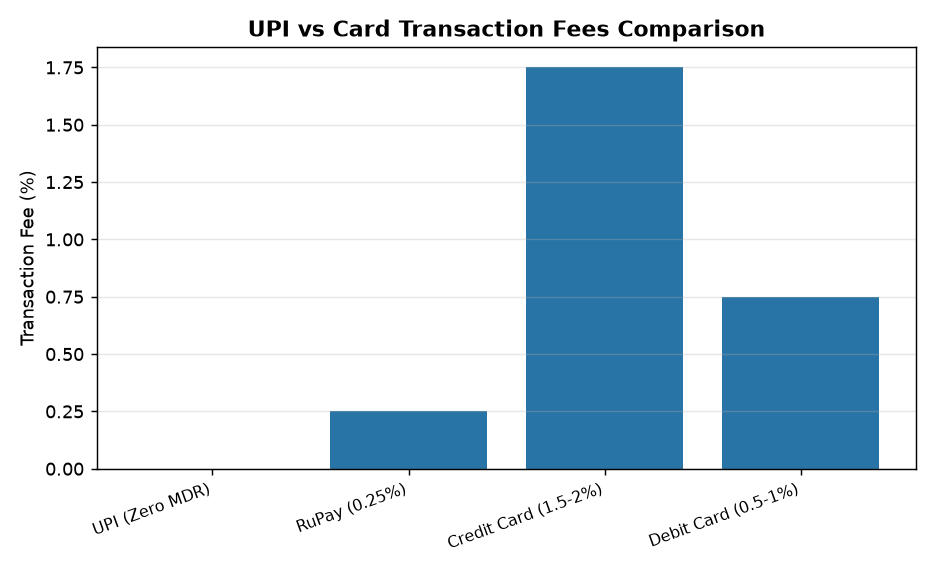
- The government has clarified that the MDR will be lower than charges levied on credit and debit cards, and most merchants are expected not to pass on the cost to consumers, thereby minimising the impact on end-users.
- The National Payments Corporation of India (NPCI), through the UPI and Services Steering Committee, will determine the final structure and rates of MDR post-enactment of the Bill.
- The amendment reflects a shift from the zero-MDR policy, which was introduced to promote digital payments but has faced sustainability challenges due to the absence of a revenue model for payment service providers.
- The Bill is part of a broader effort to balance the objectives of financial inclusion, innovation, and fiscal sustainability in the digital payments ecosystem.
Key Features
| Feature | Significance |
|---|---|
| Removal of zero-MDR provision | Enables banks and fintech firms to levy charges on UPI and RuPay transactions, facilitating revenue generation for infrastructure investment and innovation. |
| Merchant Discount Rate (MDR) applicability | Charges will be borne by merchants, not end-users, ensuring consumer protection while allowing revenue flows to payment service providers. |
| Legal backing for UPI/RuPay modifications | Provides statutory authority to the government to alter the zero-MDR framework, ensuring policy flexibility and regulatory oversight. |
| Decoupling Payment and Settlement Systems Act from Income Tax Act | Simplifies regulatory compliance and removes redundant linkages, enhancing administrative efficiency. |
| Cap on MDR rates (0.25%–0.4%) | Ensures charges remain competitive compared to credit/debit card transactions, preventing excessive burden on merchants. |
Why it Matters
Economic Implications
- Enhances revenue streams for banks and fintech firms, incentivizing investment in digital payment infrastructure and technological advancements.
- Potential reduction in government subsidies for digital payments, shifting the cost burden to merchants and indirectly to consumers.
- May accelerate financial inclusion by improving the sustainability of digital payment ecosystems, particularly in rural and semi-urban areas.
- Could lead to price distortions if merchants pass on MDR to consumers, undermining the affordability of UPI transactions.
- Raises concerns about the monopolistic dominance of NPCI in UPI, as MDR adjustments may disproportionately benefit large players.
Regulatory and Policy Dimensions
- Strengthens the government’s ability to regulate digital payment systems through statutory provisions, ensuring alignment with broader economic policies.
- Introduces flexibility in fiscal policy, allowing adjustments to MDR based on market conditions and technological evolution.
- May necessitate amendments to the Payment and Settlement Systems Act to reflect the decoupling from the Income Tax Act.
- Raises questions about the role of the UPI Steering Committee (NPCI-led) in determining MDR, potentially centralizing decision-making.
Consumer and Merchant Impact
- Shifts the cost burden from consumers to merchants, which may lead to higher operational costs for small businesses.
- Potential for increased adoption of UPI among merchants if MDR is perceived as lower than credit/debit card charges.
- Risk of price inflation if merchants pass on MDR to consumers, particularly in sectors with thin profit margins.
- May disproportionately affect micro, small, and medium enterprises (MSMEs) due to higher relative cost burdens.
Technological and Innovation Aspects
- Encourages investment in payment infrastructure and innovation by providing a sustainable revenue model for fintech firms.
- Could accelerate the development of alternative payment solutions if UPI charges become prohibitive for certain use cases.
- May foster competition among payment service providers, leading to improved user experience and lower transaction costs over time.
Challenges
1. Regulatory Arbitrage and Market Distortions
- Risk of MDR being used as a tool for anti-competitive practices by dominant players in the digital payments ecosystem.
- Potential for regulatory arbitrage if MDR rates are not uniformly applied across all payment modes, leading to market fragmentation.
- Lack of clarity on how MDR will be determined by the NPCI-led steering committee, raising concerns about transparency.
UPSC Link: GS3: Regulatory bodies in digital payments
2. Impact on Financial Inclusion
- Higher MDR may deter small merchants from adopting digital payments, reversing gains in financial inclusion.
- Risk of exclusion of low-income segments if merchants pass on costs, reducing the affordability of digital transactions.
- May disproportionately affect rural and semi-urban areas where digital payment adoption is still nascent.
UPSC Link: GS3: Financial inclusion and digital payments
3. Consumer Protection and Transparency
- Lack of transparency in how MDR is calculated and applied may lead to consumer distrust in digital payment systems.
- Risk of hidden charges if merchants impose additional fees to offset MDR, undermining the simplicity of UPI transactions.
- Need for robust grievance redressal mechanisms to address disputes arising from MDR imposition.
UPSC Link: GS3: Consumer protection in digital economy
4. Fiscal Policy and Revenue Neutrality
- Shifting the cost burden from the exchequer to merchants may lead to unintended fiscal consequences, including reduced tax compliance.
- Potential for revenue leakage if MDR is not effectively monitored and enforced, leading to underreporting of transactions.
- May require adjustments in indirect tax policies to account for the new cost structure in the digital payments ecosystem.
UPSC Link: GS3: Fiscal policy and digital economy
5. Competition and Innovation Stifling
- Risk of stifling innovation if MDR is set too high, discouraging fintech startups from entering the market.
- Potential for cartelization among payment service providers if MDR rates are collectively determined without competition oversight.
- May lead to a concentration of market power among a few dominant players, reducing consumer choice.
UPSC Link: GS3: Competition policy in digital markets
Challenges — UPSC Perspective
| Issue | Concern |
|---|---|
| Regulatory arbitrage | Risk of uneven MDR application leading to market distortions and anti-competitive practices. |
| Financial inclusion reversal | Higher MDR may deter small merchants from adopting digital payments, particularly in rural areas. |
| Consumer trust erosion | Lack of transparency in MDR calculation and potential hidden charges may reduce consumer confidence. |
| Fiscal neutrality | Shifting cost burden from exchequer to merchants may lead to unintended fiscal consequences. |
| Innovation stifling | High MDR may discourage fintech startups and reduce competition in the digital payments ecosystem. |
| Merchant burden | Small businesses may face higher operational costs, leading to price inflation or reduced profitability. |
Way Forward
- Constitute a multi-stakeholder committee under the Department of Financial Services to determine MDR rates with transparent methodologies and periodic reviews.
- Mandate NPCI to publish detailed MDR calculation frameworks and rationale for adjustments to ensure accountability.
- Introduce a cap on MDR rates for specific merchant categories (e.g., MSMEs) to mitigate disproportionate impact on small businesses.
- Strengthen consumer protection mechanisms by requiring clear disclosure of MDR and prohibiting hidden charges by merchants.
- Enhance grievance redressal infrastructure under the RBI’s Integrated Ombudsman Scheme to address disputes arising from MDR imposition.
- Conduct an impact assessment study on financial inclusion metrics post-MDR implementation to identify and address unintended consequences.
- Explore the integration of MDR revenue into a dedicated fund for digital payment infrastructure development in rural and semi-urban areas.
- Ensure periodic parliamentary debates and consultations with stakeholders to review the policy’s efficacy and address emerging concerns.
UPSC Value Addition
Keywords for Mains Answer-Writing
Unified Payments Interface (UPI) · Merchant Discount Rate (MDR) · Payment and Settlement Systems Act, 2007 · zero-MDR framework · Taxation and Other Laws (Amendment) Bill, 2026 · digital payment ecosystem · financial inclusion · fintech innovation · banking infrastructure · electronic payment modes · NPCI and UPI steering committee · fiscal federalism in digital taxation · consumer protection in digital payments
Concept Flow
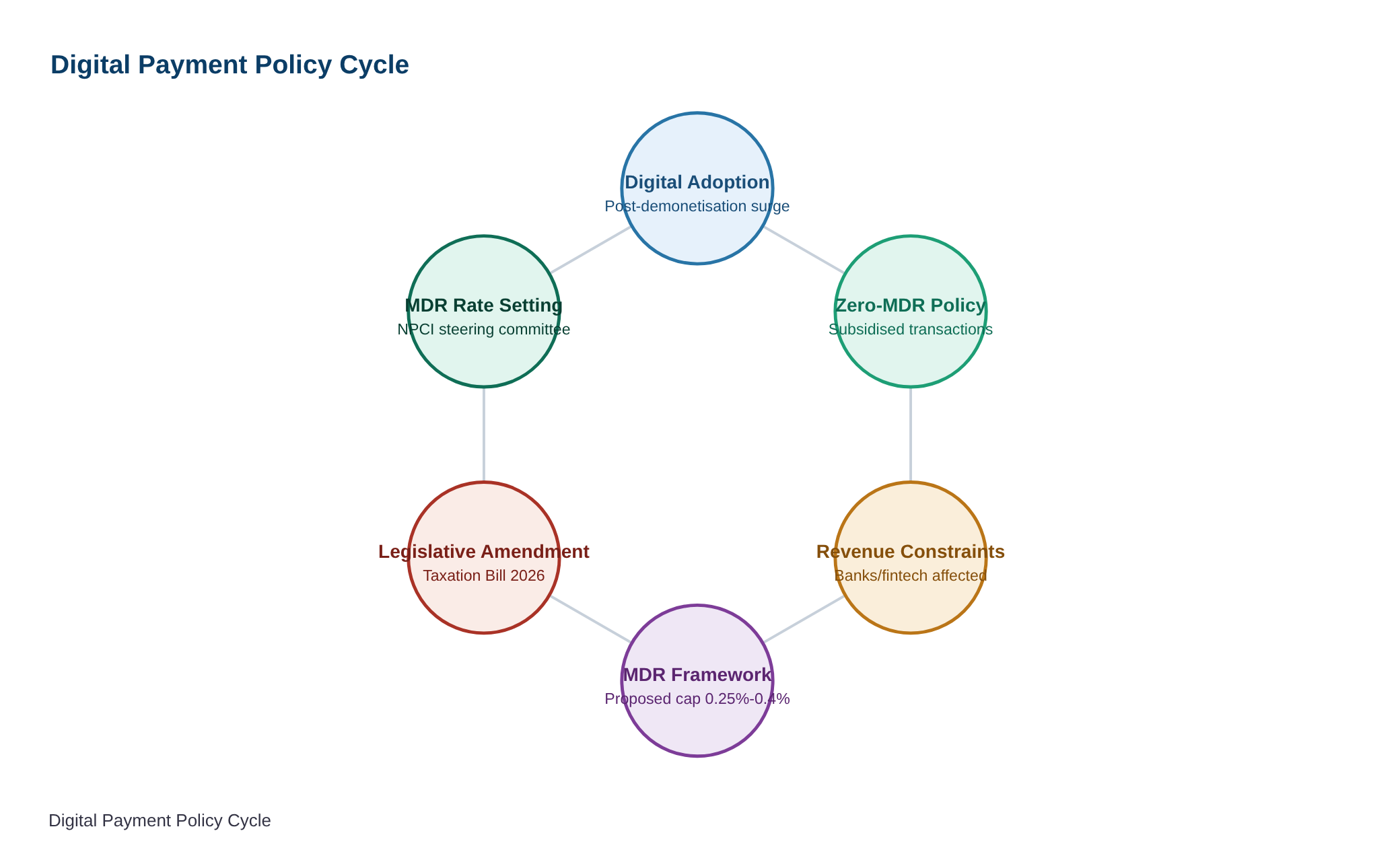
Digital payment adoption → Zero-MDR policy → Revenue constraints for banks/fintech → Government introduces MDR framework → Legislative amendment (Taxation and Other Laws Amendment Bill, 2026) → NPCI-led steering committee determines MDR rates → Merchant cost burden → Potential impact on financial inclusion and consumer affordability → Need for regulatory oversight and consumer protection measures
Prelims Practice Questions
Q1. Consider the following statements regarding the Merchant Discount Rate (MDR) in digital payments:
1. MDR is a fee charged to merchants for accepting digital payments.
2. The zero-MDR framework was mandated by the Reserve Bank of India (RBI) for all digital payment modes.
3. The Taxation and Other Laws (Amendment) Bill, 2026 seeks to remove the linkage between the Payment and Settlement Systems Act and the Income-Tax Act.
4. The Bill proposes to allow MDR on UPI transactions up to a maximum of 2% of the transaction value.
How many of the above statements are correct?
- Only one
- Only two
- Only three
- All four
Answer: Only three — Statements 1, 2, and 3 are correct. Statement 4 is incorrect as the Bill does not specify a maximum MDR of 2%; it only proposes a range of 0.25% to 0.4% for transactions exceeding ₹2,000.
Q2. Assertion (A): The Payment and Settlement Systems Act, 2007, currently prohibits banks and payment service providers from charging MDR on notified electronic payment modes.
Reason (R): The zero-MDR framework was introduced to promote digital financial inclusion and reduce the cost burden on merchants.
In the context of the above two statements, which one of the following is correct?
- Both A and R are true, and R is the correct explanation of A.
- Both A and R are true, but R is not the correct explanation of A.
- A is true, but R is false.
- A is false, but R is true.
Answer: Both A and R are true, but R is not the correct explanation of A. — Both the assertion and reason are true. The Payment and Settlement Systems Act, 2007, currently restricts MDR on notified electronic payment modes to promote digital inclusion. The zero-MDR framework was indeed introduced to reduce costs for merchants and encourage digital payments.
Q3. Match the following pairs related to digital payment systems in India:
Column I
A. Unified Payments Interface (UPI)
B. RuPay card
C. Merchant Discount Rate (MDR)
D. Payment and Settlement Systems Act, 2007
Column II
1. Operated by the National Payments Corporation of India (NPCI)
2. A fee charged to merchants for accepting digital payments
3. A statutory framework governing payment systems in India
4. A domestic card payment network
Select the correct match:
- A-1, B-4, C-2, D-3
- A-2, B-3, C-1, D-4
- A-3, B-1, C-4, D-2
- A-4, B-2, C-3, D-1
Answer: A-1, B-4, C-2, D-3 — A-1: UPI is operated by NPCI. B-4: RuPay is a domestic card payment network. C-2: MDR is a fee charged to merchants. D-3: The Payment and Settlement Systems Act, 2007, governs payment systems in India.
Mains Practice Question
✍ The Taxation and Other Laws (Amendment) Bill, 2026, seeks to remove the linkage between the Payment and Settlement Systems Act, 2007, and the Income-Tax Act, thereby enabling the levying of Merchant Discount Rate (MDR) on Unified Payments Interface (UPI) transactions. Critically examine the implications of this amendment for the digital payment ecosystem, financial inclusion, and consumer protection in India. (15 Marks)
Approach: MODEL-ANSWER SKELETON:
1. **Context and Background**: Define UPI, MDR, and the zero-MDR framework. Explain the current legal prohibition under the Payment and Settlement Systems Act, 2007. Mention the role of NPCI and the UPI steering committee in regulating MDR.
2. **Proposed Amendment**: Outline the key provisions of the Taxation and Other Laws (Amendment) Bill, 2026, including the removal of the linkage between the Payment and Settlement Systems Act and the Income-Tax Act. Explain the proposed MDR structure (0.25% to 0.4% for transactions > ₹2,000) and its rationale.
3. **Implications for Digital Payment Ecosystem**:
– **Infrastructure and Innovation**: Discuss how MDR can incentivize banks and fintech firms to invest in digital payment infrastructure and innovation (e.g., QR code adoption, contactless payments).
– **Merchant Adoption**: Analyze whether MDR will encourage or discourage small merchants from adopting digital payments, considering the cost burden.
– **Competition and Market Dynamics**: Examine the impact on UPI’s dominance versus other payment modes (e.g., RuPay, credit/debit cards) and the potential for a tiered pricing model.
4. **Financial Inclusion**:
– **Cost Implications**: Assess whether MDR will disproportionately affect small merchants and low-income consumers, potentially reversing gains in financial inclusion.
– **Rural-Urban Divide**: Discuss how MDR might exacerbate or mitigate the digital divide in rural and semi-urban areas.
5. **Consumer Protection**:
– **Transparency**: Evaluate whether MDR will be passed on to consumers or remain a merchant-side cost, and the need for regulatory safeguards.
– **Grievance Redressal**: Highlight the role of the RBI and NPCI in ensuring fair pricing and protecting consumers from hidden charges.
6. **Balancing Views**:
– **Proponents’ Argument**: MDR will reduce the subsidy burden on the exchequer and promote sustainable growth in the digital payment sector.
– **Critics’ Argument**: MDR may lead to exclusion of small merchants and reverse the gains of the zero-MDR framework in promoting digital payments.
7. **Conclusion**: Provide a reasoned stance on whether the amendment strikes a balance between fostering innovation and protecting consumers, and suggest safeguards (e.g., capping MDR, exemptions for small merchants).
Source: Times of India
Generated by AanyaAi for educational purpose.

- मुख्यमंत्री माझी बोले, शिक्षकों की समस्याओं पर त्रिपाठी पैनल की रिपोर्ट के बाद होगी निर्णय - September 21, 2026
- Odisha CM Majhi to Decide on Teachers’ Issues via Tripathy Panel Report - September 21, 2026
- एनएससी ने हरियाणा में कुरुक्षेत्र आईटीआई क्लस्टर के लिए ₹320 करोड़ मंजूर किए, जिंदल नवीन साझेदार - September 21, 2026

No Comments