


07 Aug Lok Sabha Passes Bill to Allow UPI Charges: Key Implications for UPSC
✎ The Payment and Settlement Systems (Amendment) Bill, 2026, seeks to introduce a capped Merchant Discount Rate (MDR) on UPI and RuPay transactions, levied on merchants (not users), to fund digital payment infrastructure while…
Subject Relevance — Where This Topic Fits
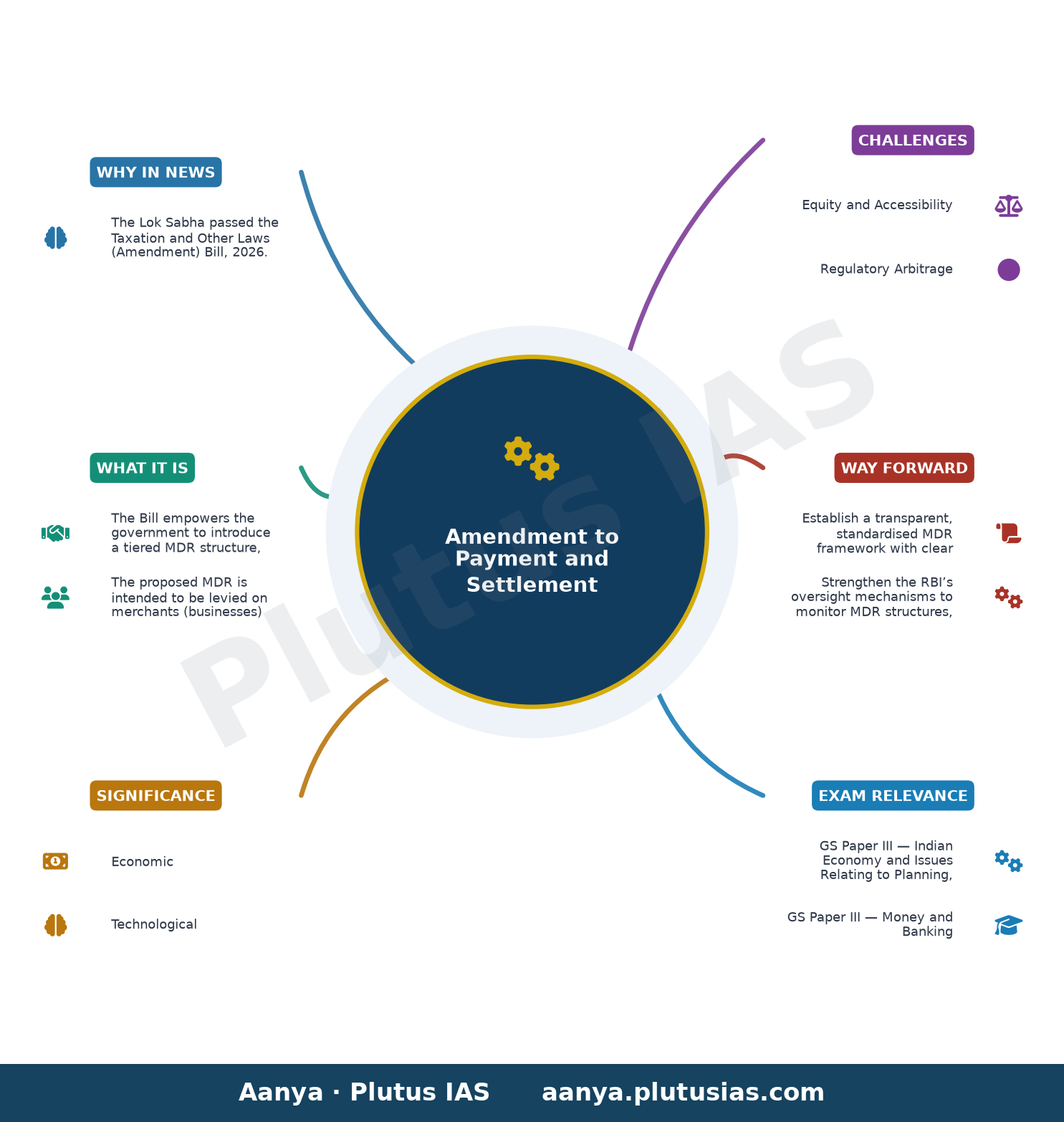
- GS Paper III — Indian Economy and Issues Relating to Planning, Mobilisation of Resources, Growth, Development and Employment | GS Paper III — Money and Banking
- Prelims: UPI, Merchant Discount Rate (MDR), Payment and Settlement Systems Act, 2007, NPCI, RuPay, Digital Payment Infrastructure, Zero-MDR framework, Taxation and Other Laws (Amendment) Bill, 2026, Fintech sector, digital public infrastructure
- Essay: The Role of Digital Public Infrastructure in India’s Economic Transformation, Balancing Innovation and Regulation in Financial Technologies: A Case Study of UPI
Quick Revision: The Payment and Settlement Systems (Amendment) Bill, 2026, seeks to introduce a capped Merchant Discount Rate (MDR) on UPI and RuPay transactions, levied on merchants (not users), to fund digital payment infrastructure while maintaining the zero-MDR framework’s consumer-centric approach.
Why is this in the news?
The Lok Sabha passed the Taxation and Other Laws (Amendment) Bill, 2026. This legislative move has sparked debate on its potential impact on digital payment adoption, consumer welfare, and the sustainability of the fintech ecosystem. The Bill’s passage amid procedural disruptions underscores its significance in shaping India’s digital payment landscape.
Background
- The zero-MDR framework was introduced to incentivise digital transactions, particularly for small merchants, and align with the government’s vision of a cashless economy under initiatives like Digital India and Jan Dhan Yojana.
- The Reserve Bank of India (RBI) and the National Payments Corporation of India (NPCI) have historically subsidised MDR costs to sustain the UPI ecosystem, but concerns over fiscal sustainability and the need for investment in infrastructure have prompted reconsideration.
- The Union Budget 2023-24 had proposed a phased introduction of MDR for UPI transactions, but the proposal was deferred due to opposition and lack of consensus on its implementation.
- The debate reflects broader tensions between fostering innovation in fintech and ensuring equitable access to digital payment systems, particularly for small merchants and low-income users.
What is the Payment and Settlement Systems (Amendment) Bill, 2026?
- The Bill empowers the government to introduce a tiered MDR structure, where charges may apply to merchant transactions exceeding ₹2,000, with an overall cap to prevent excessive levies.
- The proposed MDR is intended to be levied on merchants (businesses) rather than end-users (consumers), ensuring that the financial burden does not directly impact the public.
- The Finance Minister clarified that the MDR will be significantly lower than charges on credit or debit cards, with estimates suggesting a range of 0.25% to 0.4% for eligible transactions.
- The Bill includes provisions for the UPI and Services Steering Committee, led by the NPCI, to determine the final structure of MDR after parliamentary approval, ensuring stakeholder consultation.
- The amendment aims to generate revenue for banks and fintech companies to reinvest in digital payment infrastructure, innovation, and cybersecurity, thereby enhancing the robustness of the ecosystem.
- The Bill is part of a broader effort to balance fiscal sustainability with the promotion of digital payments, addressing concerns over the long-term viability of the zero-MDR regime.
Key Features
| Feature | Significance |
|---|---|
| Removal of zero-MDR linkage for UPI/RuPay | Enables banks and fintech firms to levy Merchant Discount Rate (MDR) on notified electronic payment modes, facilitating revenue generation for infrastructure investment. |
| Legal backing for government to modify UPI/RuPay frameworks | Provides statutory authority to the executive to adjust transaction charges, ensuring policy flexibility without legislative intervention for each change. |
| Merchant-focused levy (not on users) | Ensures consumer protection by preventing direct cost imposition on end-users, while allowing businesses to bear the transaction cost. |
| Cap on MDR (0.25%–0.4% for payments >₹2,000) | Balances revenue generation with affordability, preventing excessive charges while ensuring sustainability for payment service providers. |
| Decoupling of Payment and Settlement Systems Act from I-T Act | Eliminates procedural redundancies, streamlining regulatory oversight and reducing compliance burdens for payment system operators. |
Why it Matters
Economic
- Enhances revenue streams for banks and fintech firms, enabling reinvestment in digital payment infrastructure, innovation, and cybersecurity.
- Promotes competition among payment service providers by allowing differentiated pricing models, potentially improving service quality.
- Supports the government’s vision of a cashless economy by ensuring the sustainability of digital payment ecosystems without over-reliance on subsidies.
- Potential to reduce the fiscal burden on the exchequer by shifting the cost of digital payment infrastructure from taxpayer-funded subsidies to market-driven models.
Technological
- Encourages investment in next-generation payment technologies (e.g., real-time payments, AI-driven fraud detection) by providing a viable revenue model.
- Facilitates the integration of UPI with global payment systems, enhancing India’s position in cross-border digital transactions.
- May accelerate the adoption of RuPay cards in international markets, reducing dependence on foreign payment networks like Visa or Mastercard.
Regulatory
- Clarifies the legal framework governing digital payments, reducing ambiguity in the application of tax and regulatory provisions.
- Strengthens the Reserve Bank of India’s (RBI) role in regulating MDR structures, ensuring alignment with monetary policy objectives.
- Establishes a precedent for dynamic policy adjustments in response to technological and market evolution.
Social
- Maintains affordability for small merchants and consumers by capping MDR and preventing direct user charges, ensuring inclusive digital adoption.
- Supports the formalisation of the economy by incentivising digital transactions, thereby reducing tax evasion and enhancing transparency.
Challenges
1. Equity and Accessibility
- Risk of MDR being passed on to small merchants, particularly in rural or low-income areas, undermining the goal of financial inclusion.
- Potential for differential pricing to disadvantage micro, small, and medium enterprises (MSMEs) compared to larger businesses.
- Ensuring equitable access to digital payment infrastructure across geographies and socio-economic strata remains a persistent challenge.
UPSC Link: GS-III: Financial Inclusion
2. Regulatory Arbitrage
- Lack of a clear cap on MDR for all transaction sizes may lead to exploitative pricing by dominant payment service providers.
- Risk of regulatory capture, where a few large fintech firms or banks influence MDR structures to their advantage.
- Need for robust oversight by the RBI to prevent cartelisation and ensure fair competition.
UPSC Link: GS-III: Regulatory Frameworks
3. Consumer Protection
- Ensuring transparency in MDR structures to prevent hidden charges or deceptive practices by payment aggregators.
- Addressing grievances related to disputed transactions or incorrect MDR deductions requires a strong consumer redressal mechanism.
- Balancing innovation with consumer rights, particularly for vulnerable groups such as the elderly or digitally illiterate.
UPSC Link: GS-II: Consumer Rights
4. Fiscal Impact
- Long-term fiscal implications of reduced subsidies for digital payments, particularly for low-income users, remain uncertain.
- Potential for MDR revenue to be misallocated or underutilised if not ring-fenced for infrastructure development.
- Impact on government revenues from GST on digital transactions, which may fluctuate with changes in MDR structures.
UPSC Link: GS-III: Fiscal Policy
5. Technological Fragmentation
- Risk of fragmentation in the digital payment ecosystem if MDR structures vary significantly across banks and fintech firms.
- Potential delays in the adoption of emerging technologies (e.g., blockchain, CBDCs) due to regulatory uncertainty around pricing models.
- Need for interoperability standards to ensure seamless integration across payment platforms.
UPSC Link: GS-III: Digital Infrastructure
Challenges — UPSC Perspective
| Issue | Concern |
|---|---|
| Small merchant exclusion | MSMEs may face higher relative costs, reducing their competitiveness against larger businesses. |
| Regional disparities | Rural and semi-urban areas may lack access to affordable digital payment infrastructure, exacerbating digital divide. |
| Price opacity | Lack of standardised MDR disclosure may lead to consumer exploitation or distrust in digital payments. |
| Regulatory capture | Dominant players may influence MDR structures to create entry barriers for smaller fintech firms. |
| Cybersecurity risks | Increased transaction volumes may attract higher cyber threats, necessitating robust safeguards. |
| Fiscal sustainability | Over-reliance on MDR may reduce the government’s ability to subsidise digital payments for low-income users. |
Way Forward
- Establish a transparent, standardised MDR framework with clear caps and disclosure norms to prevent exploitation and ensure fairness.
- Strengthen the RBI’s oversight mechanisms to monitor MDR structures, prevent cartelisation, and promote competition.
- Invest in digital literacy programmes to ensure equitable access and adoption of digital payment systems across all socio-economic groups.
- Develop a robust grievance redressal system for consumers and merchants to address disputes related to MDR and transaction errors.
- Encourage public-private partnerships to expand digital payment infrastructure in underserved regions, particularly rural and tribal areas.
- Integrate MDR revenue into a dedicated fund for digital payment infrastructure development, ensuring accountability and targeted utilisation.
- Conduct periodic reviews of the MDR framework to assess its impact on financial inclusion, competition, and innovation.
- Promote interoperability among payment systems to reduce fragmentation and enhance user convenience.
UPSC Value Addition
Keywords for Mains Answer-Writing
Unified Payments Interface (UPI) · Merchant Discount Rate (MDR) · Payment and Settlement Systems Act, 2007 · Taxation and Other Laws (Amendment) Bill, 2026 · digital payments ecosystem · financial inclusion · reserve pricing mechanism · NPCI and UPI steering committee · fintech innovation · regulatory arbitrage in digital payments
Concept Flow
Digital Payment Ecosystem Growth → Zero-MDR Policy → Revenue Constraints for Banks/Fintech → Bill to Enable MDR → Legislative Approval → Regulatory Framework Adjustment → Merchant-Focused Levies → Infrastructure Investment → Enhanced Digital Adoption
Prelims Practice Questions
Q1. Consider the following statements regarding the Payment and Settlement Systems Act, 2007:
1. It regulates all payment systems in India, including UPI and RuPay.
2. The Act currently mandates a zero-MDR framework for UPI transactions.
3. The Act is linked to the Income-Tax Act, 1961, for tax-related provisions.
4. The Act empowers the Reserve Bank of India to levy charges on digital payment transactions.
How many of the above statements are correct?
- Only one
- Only two
- Only three
- All four
Answer: Only three — Statements 1, 2, and 3 are correct. Statement 4 is incorrect as the Act does not empower RBI to levy charges; it regulates payment systems and settlement mechanisms.
Q2. Assertion (A): The proposed amendment to the Payment and Settlement Systems Act, 2007 seeks to decouple it from the Income-Tax Act, 1961.
Reason (R): This decoupling is intended to provide the government with the flexibility to introduce a Merchant Discount Rate (MDR) on UPI transactions.
In the context of the above two statements, which one of the following is correct?
- Both A and R are true, and R is the correct explanation of A
- Both A and R are true, but R is not the correct explanation of A
- A is true, but R is false
- A is false, but R is true
Answer: Both A and R are true, but R is not the correct explanation of A — Both the Assertion and Reason are true. The decoupling (A) is indeed intended to enable the government to introduce MDR (R), making R the correct explanation of A.
Q3. Which of the following committees is responsible for steering the UPI ecosystem and determining the Merchant Discount Rate (MDR) framework?
- A. Reserve Bank of India (RBI) Monetary Policy Committee
- B. NPCI UPI and Services Steering Committee
- C. Ministry of Electronics and Information Technology (MeitY) Digital Payments Task Force
- D. NITI Aayog’s Digital Payments Advisory Group
Answer: B. NPCI UPI and Services Steering Committee — The NPCI UPI and Services Steering Committee, headed by the National Payments Corporation of India (NPCI), is responsible for steering the UPI ecosystem and determining the MDR framework.
Mains Practice Question
✍ The proposed amendments to the Payment and Settlement Systems Act, 2007, envisage the introduction of a Merchant Discount Rate (MDR) on UPI transactions. Critically examine the implications of this shift for India’s digital payments ecosystem, financial inclusion, and the balance between innovation and consumer protection. (15 Marks)
Approach: MODEL-ANSWER SKELETON:
1. **Introduction**: Define UPI, MDR, and the zero-MDR framework. Contextualise the amendment within India’s digital payments revolution (e.g., Jan Dhan Yojana, Aadhaar, UPI adoption metrics).
2. **Arguments in Favour**:
– **Revenue Model for Banks/Fintechs**: MDR can provide a sustainable revenue stream to invest in infrastructure and innovation (e.g., NPCI’s role in UPI).
– **Cost Recovery**: Merchants benefit from digital payments; MDR can offset the cost of payment acceptance infrastructure.
– **Global Precedents**: Countries like Singapore and Brazil levy MDR on digital payments to fund ecosystem growth.
– **Flexibility for Government**: Decoupling from the Income-Tax Act allows dynamic policy adjustments without tax-related constraints.
3. **Arguments Against**:
– **Impact on Small Merchants/Informal Sector**: Risk of MDR being passed on to consumers, particularly in the informal sector, undermining financial inclusion.
– **Regulatory Arbitrage**: Potential for fintechs to bypass MDR by promoting alternative payment modes (e.g., wallets, cards).
– **Consumer Burden**: Even if MDR is capped (e.g., 0.25–0.4%), it may deter small transactions, reversing the gains of low-cost digital payments.
– **Policy Inconsistency**: The zero-MDR policy was a cornerstone of India’s digital public infrastructure (DPI) strategy; reversal may erode trust.
4. **Balancing Innovation and Protection**:
– **NPCI’s Role**: The UPI steering committee must ensure MDR is equitable and does not stifle innovation (e.g., UPI Lite, UPI 123PAY).
– **Consumer Protection**: RBI’s guidelines on MDR must cap charges and prohibit merchant pass-through to users.
– **Data Localisation and Security**: MDR revenue could fund cybersecurity and fraud prevention measures in the digital payments ecosystem.
5. **Conclusion**: Weigh the trade-offs—whether MDR is a necessary step for ecosystem maturity or a regressive measure that risks excluding marginalised users. Advocate for a phased, consultative approach with safeguards.
Source: Times of India
Generated by AanyaAi for educational purpose.

- मुख्यमंत्री माझी बोले, शिक्षकों की समस्याओं पर त्रिपाठी पैनल की रिपोर्ट के बाद होगी निर्णय - September 21, 2026
- Odisha CM Majhi to Decide on Teachers’ Issues via Tripathy Panel Report - September 21, 2026
- एनएससी ने हरियाणा में कुरुक्षेत्र आईटीआई क्लस्टर के लिए ₹320 करोड़ मंजूर किए, जिंदल नवीन साझेदार - September 21, 2026

No Comments