


06 Aug Lok Sabha Passes Bill to Allow UPI Transaction Charges: Key Implications for UPSC Aspirants
✎ The amendment to the Payment and Settlement Systems Act, 2007, removes the blanket prohibition on charges for UPI transactions, enabling the government to permit minimal levies to sustain the digital payments ecosystem.
Subject Relevance — Where This Topic Fits
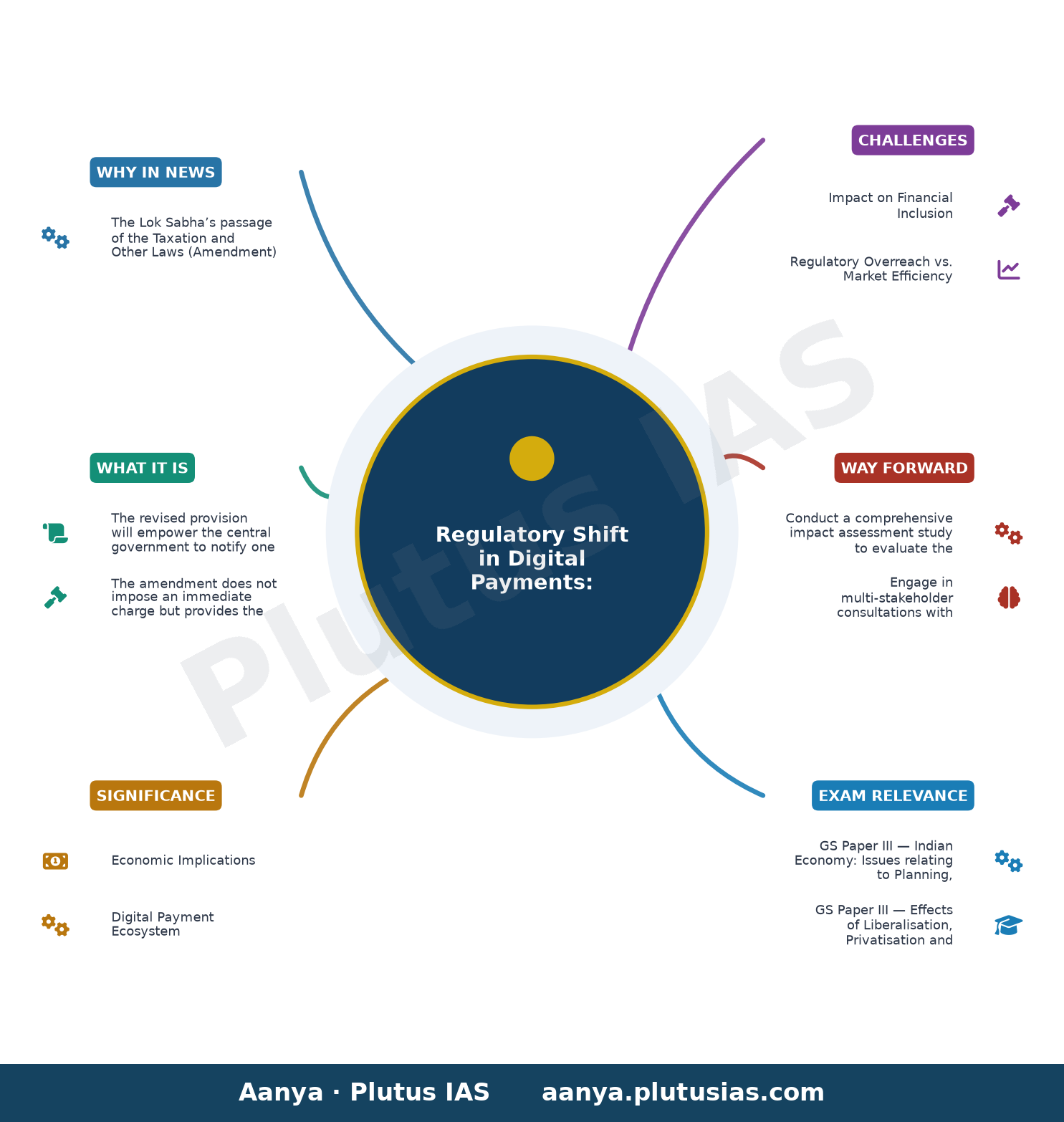
- GS Paper III — Indian Economy: Issues relating to Planning, Mobilisation of Resources, Growth, Development and Employment | GS Paper III — Effects of Liberalisation, Privatisation and Globalisation on the Economy, Changes in Industrial Policy and their Effects on Industrial Growth
- Prelims: Unified Payments Interface (UPI), Merchant Discount Rate (MDR), Payment and Settlement Systems Act 2007, Section 10A, Section 269SU of Income Tax Act 1961, Digital Payment Ecosystem, Real-Time Gross Settlement (RTGS), National Electronic Funds Transfer (NEFT)
- Essay: The future of digital public infrastructure in India: Balancing innovation with equitable access, Sustainable financing models for public goods: Lessons from digital payment systems
Quick Revision: The amendment to the Payment and Settlement Systems Act, 2007, removes the blanket prohibition on charges for UPI transactions, enabling the government to permit minimal levies to sustain the digital payments ecosystem.
Why is this in the news?
The Lok Sabha’s passage of the Taxation and Other Laws (Amendment) Bill, 2026, on August 6, 2026, marks a significant regulatory shift by amending the Payment and Settlement Systems Act, 2007 to permit banks and payment service providers to levy charges on UPI transactions. This development, driven by the need to sustain the digital payments ecosystem, raises critical questions about affordability, financial inclusion, and the trajectory of India’s digital public infrastructure.
Background
- The Payment and Settlement Systems Act, 2007, was enacted to regulate and supervise payment systems in India, ensuring stability and consumer protection in electronic fund transfers.
- Section 269SU of the Income Tax Act, 1961, mandates large businesses (turnover > ₹50 crore) to accept payments through specified electronic modes, including UPI and RuPay QR codes, to promote digitalisation.
- UPI, launched in 2016 by the National Payments Corporation of India (NPCI), has revolutionised retail payments in India, processing over 14 billion transactions monthly as of 2026, with near-zero transaction costs for users.
- The exemption of UPI from charges has been a cornerstone of its rapid adoption, particularly among small businesses and low-income users, aligning with the government’s push for a cashless economy.
- The amendment aligns with global practices where digital payment systems often incorporate cost-sharing mechanisms to ensure sustainability of payment infrastructure providers.
What is the proposed amendment to the Payment and Settlement Systems Act, 2007?
- The revised provision will empower the central government to notify one or more electronic modes of payment (including UPI) on which charges may be levied, thereby introducing flexibility in the regulatory framework.
- The amendment does not impose an immediate charge but provides the legal framework for the government to permit such levies in the future, subject to notification.
- The move is justified by the government as a means to ensure the financial sustainability of banks, payment service providers (PSPs), and infrastructure firms that underpin the digital payments ecosystem.
- The proposed charges are expected to be minimal and targeted, potentially affecting only specific transaction types or user segments to avoid burdening low-income users.
- The amendment is part of a broader legislative package, the Taxation and Other Laws (Amendment) Bill, 2026, which also includes changes to the Income Tax Act and the Finance Act.
- The government has emphasised that the objective is to balance affordability with the need to sustain innovation and investment in digital payment infrastructure.
- The amendment does not alter the existing mandate under Section 269SU, which continues to require large businesses to accept digital payments, including UPI.
Key Features
| Feature | Significance |
|---|---|
| Amendment to Payment and Settlement Systems Act, 2007 | Removes the prohibition on banks and payment service providers (PSPs) from levying charges on UPI and other notified electronic payment modes, enabling revenue generation for ecosystem stakeholders. |
| Substitution of Section 10A | Replaces the reference to Section 269SU of the Income Tax Act, 1961 with a broader provision empowering the government to specify electronic modes subject to charges, enhancing regulatory flexibility. |
| Merchant Discount Rate (MDR) implications | Reintroduces the concept of MDR, a fee charged to merchants for accepting digital payments, which may now be applied to UPI transactions, potentially increasing costs for businesses. |
| Exemption for RTGS/NEFT | RTGS and NEFT transactions already attract service charges, while UPI has been exempt; the amendment removes this exemption, aligning UPI with other payment systems. |
| Revenue model sustainability | Aims to create a sustainable revenue model for banks, PSPs, and infrastructure firms by allowing small charges on digital payments, supporting digital payment ecosystem growth. |
Why it Matters
Economic Implications
- Enhances revenue streams for banks and PSPs, addressing the cost burden of maintaining digital payment infrastructure while ensuring affordability for consumers and small businesses.
- May incentivize banks to invest further in digital payment technologies, including UPI, by providing a monetization avenue for their services.
- Potential to reduce the burden on the exchequer by shifting the cost of digital payment infrastructure maintenance from taxpayers to end-users, aligning with market-driven economic principles.
- Could lead to a tiered pricing model where premium services (e.g., instant settlements) attract higher charges, fostering innovation in payment solutions.
- Raises concerns about regressive impact on small merchants and low-income consumers, who may face higher transaction costs, exacerbating digital divide concerns.
Digital Payment Ecosystem
- UPI, a flagship initiative under Digital India, has been a global model for low-cost, interoperable digital payments; introducing charges may dilute its competitive advantage.
- May prompt users to revert to cash transactions, undermining the government’s push for a less-cash economy and financial inclusion goals.
- Encourages PSPs to innovate in cost-reduction strategies, such as offering bundled services or cross-subsidization, to maintain UPI’s popularity.
- Could lead to fragmentation in digital payment preferences, with users migrating to alternative platforms that offer lower or no charges.
Regulatory and Policy Framework
- Demonstrates the government’s intent to regulate digital payment ecosystems more dynamically, allowing for periodic adjustments based on market conditions.
- Highlights the need for a balanced regulatory approach to ensure that charges do not stifle innovation or disproportionately burden vulnerable sections of society.
- Raises questions about the consistency of the government’s stance on digital payments, given UPI’s historical emphasis on zero-cost transactions.
Financial Inclusion
- Introducing charges on UPI transactions may deter first-time digital payment users, particularly in rural and semi-urban areas, where financial literacy and access to alternatives are limited.
- Could widen the digital divide by making digital payments less accessible to low-income groups, contradicting the objectives of schemes like PMJDY and Stand-Up India.
- May necessitate targeted subsidies or waivers for small merchants and low-income users to mitigate adverse impacts on inclusion.
Challenges
1. Impact on Financial Inclusion
- Risk of excluding low-income and rural populations from the digital economy due to higher transaction costs.
- Potential increase in cash usage, undermining the government’s push for a cashless economy and financial inclusion goals.
- May disproportionately affect small merchants and street vendors who rely on UPI for daily transactions.
UPSC Link: GS III: Indian Economy – Issues relating to development and management of Social Sector/Services relating to Health, Education, Human Resources
2. Regulatory Overreach vs. Market Efficiency
- Challenge of determining an optimal charge structure that balances revenue generation for banks with affordability for users.
- Risk of regulatory arbitrage, where users and merchants migrate to unregulated or alternative payment platforms to avoid charges.
- Need for transparent and participatory consultation with stakeholders (banks, PSPs, merchants, consumers) before implementing charges.
UPSC Link: GS II: Government Policies and Interventions for development in various sectors and issues arising out thereof
3. Economic Burden on Small Businesses
- Small merchants may face higher operational costs due to MDR, reducing their profit margins and competitiveness.
- Could lead to increased prices of goods and services, indirectly affecting consumers, particularly in essential sectors like food and healthcare.
- May discourage small businesses from adopting digital payment systems, reverting to cash-based transactions.
UPSC Link: GS III: Indian Economy – Effects of Liberalization on the Economy, Changes in Industrial policy and their effects on industrial growth
4. Technological and Operational Challenges
- Implementation of a tiered charge structure may require significant upgrades in payment infrastructure and billing systems for banks and PSPs.
- Risk of user confusion and dissatisfaction due to lack of clarity on when and how charges will be applied.
- Potential for disputes between merchants, banks, and users over the application and amount of charges.
UPSC Link: GS III: Science and Technology – Developments and their Applications and Effects in Everyday Life
5. Global Competitiveness of UPI
- UPI’s global reputation as a low-cost, efficient payment system may suffer, affecting India’s position as a leader in digital payments innovation.
- Could lead to reduced foreign investment in India’s fintech sector, given concerns over regulatory unpredictability.
- May prompt global users and businesses to prefer alternative payment systems, reducing UPI’s adoption abroad.
UPSC Link: GS III: Indian Economy – Mobilization of Resources, Growth, Development and Employment
Challenges — UPSC Perspective
| Issue | Concern |
|---|---|
| Financial Inclusion | Higher transaction costs may exclude low-income and rural populations from the digital economy. |
| Regulatory Arbitrage | Users and merchants may migrate to unregulated or alternative platforms to avoid charges. |
| Small Business Burden | Increased operational costs for small merchants may reduce competitiveness and adoption of digital payments. |
| Infrastructure Upgrades | Banks and PSPs may face significant costs to implement tiered charge structures and billing systems. |
| User Confusion | Lack of clarity on charge application may lead to dissatisfaction and disputes. |
| Global Competitiveness | UPI’s reputation as a low-cost system may suffer, affecting India’s fintech leadership. |
Way Forward
- Conduct a comprehensive impact assessment study to evaluate the potential effects of UPI charges on financial inclusion, small businesses, and the broader digital payment ecosystem.
- Engage in multi-stakeholder consultations with banks, PSPs, merchant associations, consumer groups, and fintech startups to design a fair and transparent charge structure.
- Implement a phased rollout of charges, starting with pilot programs in selected sectors or regions, to assess real-world impacts before full-scale adoption.
- Introduce tiered pricing models where charges are proportional to transaction value or frequency, ensuring affordability for low-income users and small merchants.
- Develop targeted subsidies or waivers for small merchants and low-income consumers to mitigate adverse impacts on financial inclusion.
- Enhance digital literacy programs to educate users on the benefits of digital payments and the rationale behind charges, reducing resistance to adoption.
- Strengthen grievance redressal mechanisms to address disputes between users, merchants, and banks regarding charge application and amounts.
- Monitor global trends in digital payment regulations and ensure that India’s policies remain competitive and aligned with international best practices.
UPSC Value Addition
Keywords for Mains Answer-Writing
Unified Payments Interface (UPI) · Payment and Settlement Systems Act, 2007 · Merchant Discount Rate (MDR) · Digital Payment Ecosystem · Taxation and Other Laws (Amendment) Bill, 2026 · Section 10A of Payment and Settlement Systems Act · Section 269SU of Income Tax Act, 1961 · Banks and Payment Service Providers · Sustainable Revenue Model for Digital Payments · Electronic Modes of Payment · Digital Public Infrastructure (DPI) · Financial Inclusion
Concept Flow
Government introduces amendment to Payment and Settlement Systems Act, 2007 to permit charges on UPI transactions → Removal of Section 10A prohibition on MDR for electronic payments → Potential introduction of tiered charges based on transaction value/frequency → Impact on financial inclusion and small business adoption of digital payments → Possible migration to cash transactions or alternative payment platforms → Re-evaluation of policy by government based on feedback and impact assessments
Prelims Practice Questions
Q1. Consider the following statements regarding the Payment and Settlement Systems Act, 2007:
1. Section 10A of the Act prohibits banks and system providers from imposing any charges on electronic payments.
2. The Act mandates large businesses with a turnover exceeding Rs 50 crore to accept payments through specific electronic modes, including RuPay debit cards and BHIM-UPI QR codes under Section 269SU of the Income Tax Act, 1961.
3. The recent amendment to the Act seeks to remove the existing legal provision that prevents banks from charging Merchant Discount Rate (MDR) on notified electronic payment modes.
How many of the above statements are correct?
- Only one
- Only two
- All three
- None
Answer: All three — Statements 1 and 3 are correct. Statement 2 is incorrect as Section 269SU mandates acceptance of payments through specified electronic modes but does not impose a turnover threshold of Rs 50 crore; the threshold is Rs 500 crore as per the Income Tax Act.
Q2. Assertion (A): The Taxation and Other Laws (Amendment) Bill, 2026 seeks to amend the Payment and Settlement Systems Act, 2007 to permit banks to levy charges on UPI transactions.
Reason (R): The amendment aims to create a sustainable revenue model for banks and payment service providers while ensuring digital payment services remain accessible to consumers and small businesses.
Options:
A. Both A and R are true, and R is the correct explanation of A.
B. Both A and R are true, but R is not the correct explanation of A.
C. A is true, but R is false.
D. A is false, but R is true.
- A
- B
- C
- D
Answer: B — Both the assertion and reason are true, and the reason correctly explains the assertion. The Bill amends the Act to permit charges on UPI transactions to sustain the digital payment ecosystem, aligning with the stated objective in the reason.
Q3. Match the following electronic payment modes with their respective regulatory or statutory provisions:
Column I | Column II
— | —
A. UPI | 1. Section 10A of Payment and Settlement Systems Act, 2007
B. NEFT | 2. No specific statutory provision for charges
C. RTGS | 3. Service charges applicable as per RBI guidelines
D. BHIM-UPI QR codes | 4. Section 269SU of Income Tax Act, 1961
Options:
A. A-1, B-3, C-3, D-4
B. A-2, B-3, C-3, D-4
C. A-4, B-2, C-3, D-1
D. A-1, B-2, C-3, D-4
- A
- B
- C
- D
Answer: B — A-1: UPI transactions were exempt from charges under Section 10A of the Payment and Settlement Systems Act, 2007 (now amended). B-3: NEFT transactions attract service charges as per RBI guidelines. C-3: RTGS transactions also attract service charges as per RBI guidelines. D-4: BHIM-UPI QR codes are mandated under Section 269SU of the Income Tax Act, 1961.
Mains Practice Question
✍ Critically examine the implications of the recent amendment to the Payment and Settlement Systems Act, 2007, which authorises the government to permit banks to levy charges on UPI transactions. How far does this amendment align with the objectives of financial inclusion and digital public infrastructure in India? (15 Marks)
Approach: MODEL-ANSWER SKELETON:
1. **Context and Objective of the Amendment**:
– Brief explanation of the Payment and Settlement Systems Act, 2007 and Section 10A.
– Rationale behind the amendment: sustainability of digital payment ecosystem, revenue model for banks and PSPs.
– Government’s stated objective: balancing accessibility and viability.
2. **Financial Inclusion and Digital Public Infrastructure (DPI)**:
– UPI as a flagship DPI underpinning India’s digital transformation (JAM trinity, Jan Dhan Yojana).
– Role of UPI in promoting financial inclusion, reducing cash dependency, and empowering small businesses.
– Statutory and policy frameworks supporting DPI (e.g., National Payments Corporation of India, RBI guidelines).
3. **Potential Implications of Levying Charges**:
– **Positive**: Sustainable revenue model for banks and PSPs, incentivizing innovation and infrastructure development.
– **Negative**: Risk of reduced adoption of digital payments among low-income and small business users, potential reversal of financial inclusion gains.
– **Empirical Evidence**: Lessons from countries where MDR was introduced (e.g., Singapore, Australia) and their impact on digital payment adoption.
4. **Balancing Act**:
– Need for a tiered or progressive charging mechanism (e.g., exemptions for small transactions, caps on MDR).
– Role of RBI in regulating charges to prevent exploitation and ensure affordability.
– Comparison with existing models (e.g., NEFT/RTGS charges, interchange fees in card payments).
5. **Constitutional and Legal Dimensions**:
– Compliance with Directive Principles of State Policy (Article 38, 39) and Fundamental Rights (Article 19(1)(g)).
– Judicial scrutiny: precedent on digital rights and affordability (e.g., Right to Access Digital Services).
6. **Conclusion**:
– Synthesis of arguments: necessity of revenue sustainability vs. risk to inclusion.
– Policy recommendations: phased introduction, safeguards for vulnerable users, and continuous monitoring of impact on digital payment adoption.
Source: The Hindu
Generated by AanyaAi for educational purpose.

- यूपी नीट यूजी काउंसलिंग राउंड-2: मेरिट लिस्ट हुई जारी, 22 सितंबर से रिपोर्टिंग शुरू - September 21, 2026
- UP NEET UG Counselling 2026 Round 2: Merit List Out, Key Dates & Reporting Process - September 21, 2026
- UPSC Civil Services (Main) Examination 2026 — Geology Optional Paper I: Question Paper | Plutus IAS - September 21, 2026

No Comments