


29 Jul Lok Sabha Passes Bill to Auction 204 De-allocated Coal Blocks
Subject Relevance — Where This Topic Fits
- GS Paper II — Government Policies and Interventions for Development in various sectors | GS Paper III — Infrastructure: Energy, Ports, Roads, Airports, Railways; Investment Models
- Prelims: Coal Mines (Special Provisions) Act, 2015, Supreme Court’s 2014 coal block allocation cancellation order, Coal India Limited (CIL), Singareni Collieries Company Limited (SCCL), Commercial Mining of Coal, End-use restrictions in coal block allocation, Revenue Sharing Model, Parliamentary Standing Committee on Coal and Steel, Departmental Standing Committee, Ordinance Route in legislative process
- Essay: Energy Security and Sustainable Development: Balancing Economic Growth with Environmental Concerns, Role of Parliamentary Debates in Shaping Public Policy: A Case Study of the Coal Mines (Special Provisions) Bill, 2014
Quick Revision: The Coal Mines (Special Provisions) Bill, 2014, essentially replaces the Ordinance route to provide a permanent legislative framework for the auction of 204 de-allocated coal blocks, ensuring continuity in coal supply, energy security, and transparent revenue sharing between the Centre and States.
Why is this in the news?
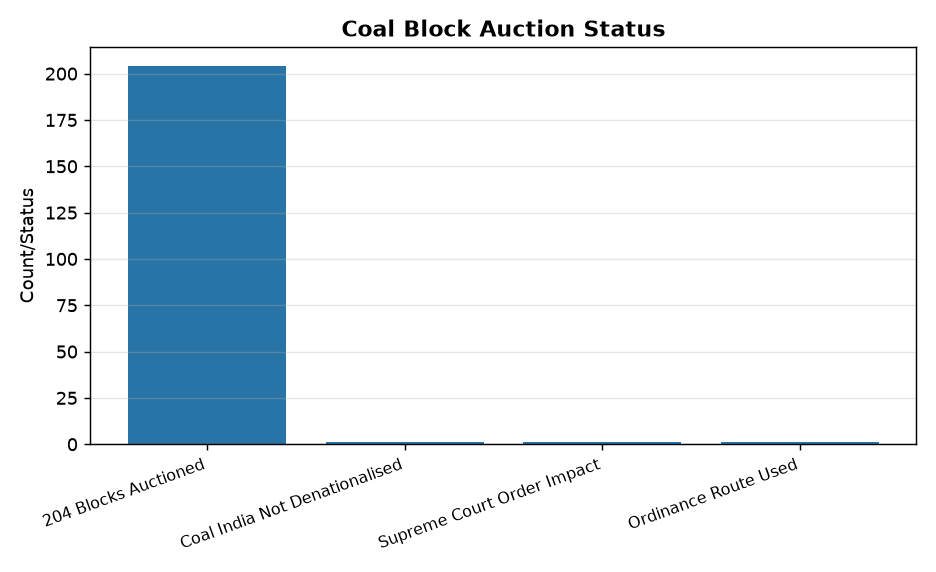
The Lok Sabha’s passage of the Coal Mines (Special Provisions) Bill, 2014, marks a critical legislative intervention to address the Supreme Court’s 2014 order cancelling the allocation of 204 coal blocks. The Bill seeks to facilitate the auction of these de-allocated blocks, ensuring continuity in coal supply, preventing job losses, and maintaining energy security, while also addressing concerns regarding transparency, revenue sharing, and the role of public sector undertakings like Coal India Limited (CIL) in the coal sector.
Background
- The Supreme Court, in its landmark judgment dated September 24, 2014, cancelled the allocation of 204 coal blocks allocated between 1993 and 2010, citing procedural lapses and arbitrariness in the allocation process, which violated the principles of transparency and fairness enshrined in Articles 14 and 19(1)(g) of the Constitution.
- The cancellation of coal block allocations led to significant disruptions in coal supply, particularly for power and steel sectors, which rely heavily on domestic coal for their operations, thereby threatening energy security and economic stability.
- To mitigate the adverse impacts of the Supreme Court’s order, the Union Government promulgated the Coal Mines (Special Provisions) Ordinance, 2014, on October 21, 2014, to provide a legal framework for the auction of de-allocated coal blocks and ensure continuity in coal production.
- The passage of the Bill assumes significance in the context of India’s commitment to reducing coal imports, enhancing domestic coal production, and transitioning towards a more transparent and competitive coal allocation regime.
What is the Coal Mines (Special Provisions) Bill, 2014?
- The Coal Mines (Special Provisions) Bill, 2014, is a legislative measure introduced to address the Supreme Court’s order cancelling the allocation of 204 coal blocks, which were allocated between 1993 and 2010 but were not operational or were allocated arbitrarily.
- The primary objective of the Bill is to facilitate the auction of de-allocated coal blocks to ensure continuity in coal supply, prevent job losses, and maintain energy security, particularly for the power and steel sectors, which are heavily dependent on domestic coal.
- The Bill seeks to replace the Coal Mines (Special Provisions) Ordinance, 2014, which was promulgated to provide an interim legal framework for the auction of de-allocated coal blocks while the Parliament deliberated on the issue.
- The Bill introduces provisions for the auction of coal blocks through a transparent and competitive bidding process, with a focus on revenue maximisation for the exchequer and ensuring that the allocated blocks are utilised for specified end-use purposes, such as power generation, steel production, and other industrial uses.
- The Bill addresses concerns regarding the end-use of coal blocks by specifying that the allocated blocks must be used for the purpose for which they were auctioned, with provisions for monitoring and enforcement to prevent diversion or misuse of coal resources.
- The Bill also includes provisions for the sharing of revenue generated from the auction of coal blocks between the Central Government and the State Governments, with a significant portion of the revenue accruing to the State Governments where the coal blocks are located, thereby addressing concerns regarding the equitable distribution of benefits.
- The Bill reflects the government’s commitment to enhancing the efficiency and transparency of the coal sector, while also addressing the need for sustainable mining practices and the protection of the environment and local communities.
UPSC Value Addition
Keywords for Mains Answer-Writing
Coal Mines (Special Provisions) Bill, 2014 · coal block allocation · Supreme Court verdict on coal blocks · Commercial coal mining · Coal India Limited · end-use clause in mining · reverse auction mechanism · energy security in India · mineral sector reforms · federalism and resource ownership · Parliamentary Standing Committee · public sector undertakings in coal · auction of de-allocated coal blocks · discretionary practices in resource allocation · coal deficit and power sector · mining sector regulation
Prelims Practice Questions
Q1. Consider the following statements regarding the Coal Mines (Special Provisions) Bill, 2014:
1. The Bill seeks to auction 204 coal blocks de-allocated by the Supreme Court.
2. The Bill mandates that all coal blocks must be allocated through reverse auction only.
3. The Bill explicitly prohibits the denationalisation of Coal India Limited.
4. The Bill includes provisions for the improvement of work conditions of coal miners.
How many of the above statements are correct?
- Only one
- Only two
- Only three
- All four
Answer: Only three — Statements 1 and 3 are correct. Statement 2 is incorrect as the Bill allows for different allocation mechanisms for regulated and unregulated entities. Statement 4 is incorrect as the Bill does not include provisions for improving work conditions of coal miners.
Q2. Assertion (A): The Coal Mines (Special Provisions) Bill, 2014, was introduced to comply with the Supreme Court’s order cancelling the allocation of 204 coal blocks.
Reason (R): The Bill aims to address apprehensions of job losses and ensure uninterrupted power supply by facilitating fresh auctions of de-allocated coal blocks.
Options:
A. Both A and R are true, and R is the correct explanation of A.
B. Both A and R are true, but R is not the correct explanation of A.
C. A is true, but R is false.
D. A is false, but R is true.
Answer: ? — Both the Assertion (A) and Reason (R) are true, and R correctly explains A as the Bill was introduced to comply with the Supreme Court order and address job losses and power supply concerns.
Mains Practice Question
✍ The Coal Mines (Special Provisions) Bill, 2014, represents a legislative attempt to reform India’s coal sector by auctioning de-allocated coal blocks. Critically examine the provisions of the Bill, its objectives, and the concerns raised by the Opposition regarding discretionary practices and federalism. Also, analyse the implications of the Bill for energy security and the role of Coal India Limited. (15 Marks)
Approach: MODEL-ANSWER SKELETON:
1. **Introduction (2 marks)**: Briefly state the context—Supreme Court’s 2014 order cancelling 204 coal block allocations, leading to the Coal Mines (Special Provisions) Bill, 2014. Mention the Bill’s primary objective: auctioning de-allocated coal blocks to ensure coal supply for power generation and address job losses.
2. **Key Provisions of the Bill (4 marks)**:
– Auction of 204 de-allocated coal blocks (as per Supreme Court order).
– Introduction of commercial coal mining to attract private investment.
– Provision for allocation through reverse auction for regulated entities and revenue maximisation for unregulated entities.
– Assurance against denationalisation of Coal India Limited (CIL) and its subsidiaries.
– Definition of ‘end use’ clause as ‘any other use as specified by the Central government,’ raising concerns about discretion.
3. **Opposition Concerns and Criticisms (4 marks)**:
– **Discretionary Practices**: Opposition argues the ‘end use’ clause leaves scope for discretionary allocation (e.g., Tatagatha Satpathy, BJD).
– **Federalism**: States argue coal blocks are their property, and proceeds should not be framed as ‘charity’ (e.g., Kalyan Banerjee, Trinamool).
– **Work Conditions**: Lack of provisions for improving work conditions of coal miners (e.g., Jyotiraditya Scindia, Congress).
– **Lack of Scrutiny**: Demand for referral to Standing Committee citing haste in passing the Bill.
4. **Implications for Energy Security and CIL (3 marks)**:
– **Energy Security**: Auctioning coal blocks aims to bridge coal deficit and ensure uninterrupted power supply.
– **Role of CIL**: Strengthening CIL as a public sector entity while allowing private participation in commercial mining.
– **Balancing Act**: Need to balance revenue maximisation, job security, and scientific mining practices.
5. **Conclusion (2 marks)**: The Bill is a pragmatic response to the Supreme Court order but raises valid concerns about federalism, discretion, and worker welfare. Its success hinges on transparent implementation, addressing Opposition concerns, and ensuring that energy security does not come at the cost of equitable resource distribution.
Source: The Hindu
Generated by AanyaAi for educational purpose.

- एल नीनो: दुनिया के सामने जलवायु अनुकूलन की चुनौती - September 23, 2026
- El Niño 2026: A Critical Test for Climate Adaptation in UPSC Mains - September 23, 2026
- हिमाचल में आयुष चिकित्सा का बढ़ता प्रचलन: 57.2% लोगों ने अपनाई आयुष पद्धतियाँ, जानें कारण - September 23, 2026

No Comments