


11 Aug Lok Sabha Passes Kerala Renaming Bill Without Debate Amid Deadlock
✎ The alteration of a State’s name in India requires a constitutional amendment under Article 3, introduced in Parliament after Presidential recommendation and State Legislature consultation, and does not affect the State’s…
Subject Relevance — Where This Topic Fits
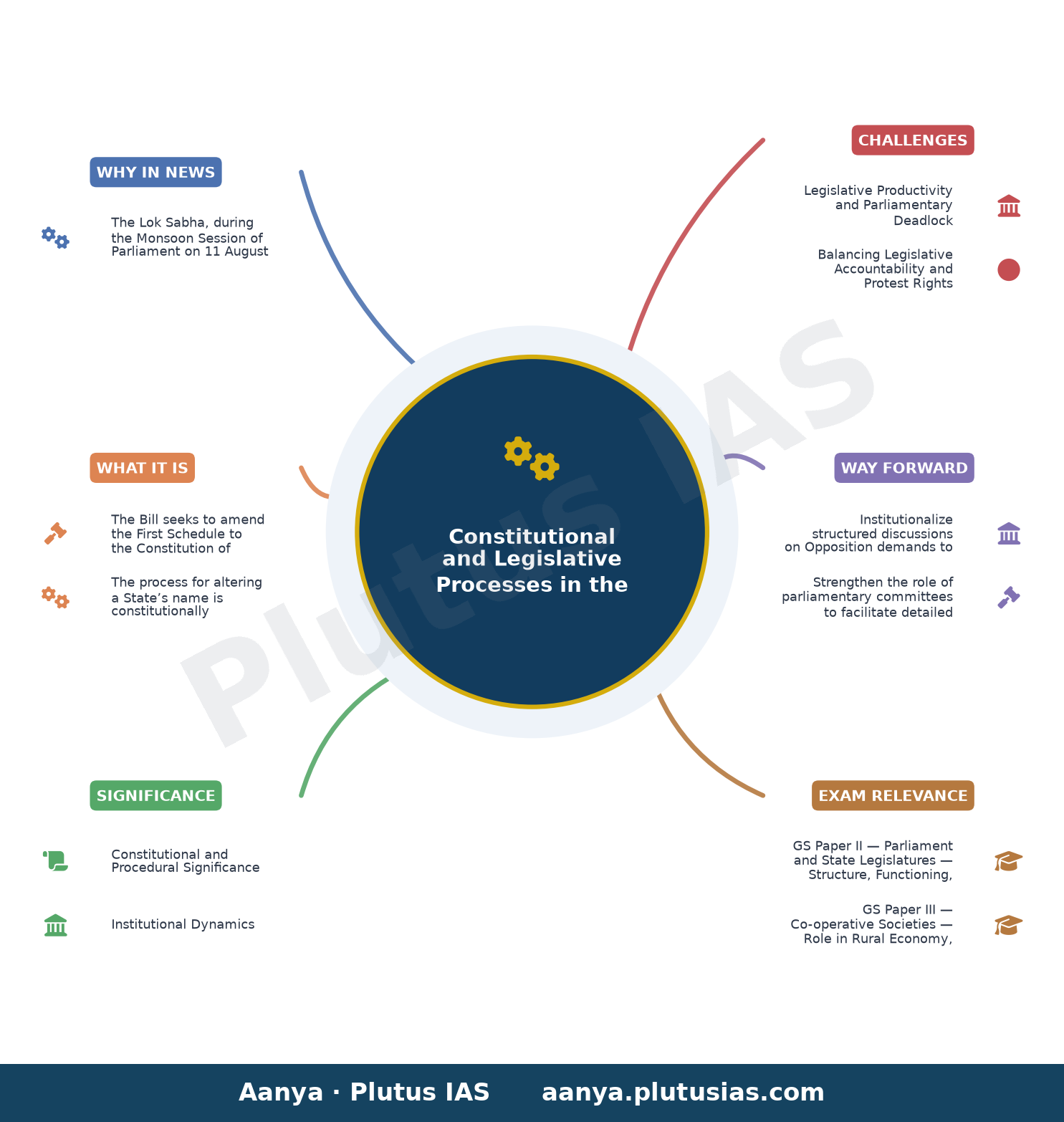
- GS Paper II — Parliament and State Legislatures — Structure, Functioning, Conduct of Business, Powers & Privileges and Issues Arising out of these | GS Paper III — Co-operative Societies — Role in Rural Economy, Legal Framework, and Government Policies
- Prelims: Article 3 of the Constitution, State Reorganisation Act 1956, NCDC, Co-operative Societies Act 1912, Parliamentary Proceedings, Voice Vote, Adjournment Motion
- Essay: The Role of Parliament in Democratic Governance: Functioning Amidst Disruptions, Co-operatives as Instruments of Inclusive Development: Policy and Legal Frameworks
Quick Revision: The alteration of a State’s name in India requires a constitutional amendment under Article 3, introduced in Parliament after Presidential recommendation and State Legislature consultation, and does not affect the State’s administrative or territorial status.
Why is this in the news?
The Lok Sabha, during the Monsoon Session of Parliament on 11 August 2026, passed two Bills—the Kerala (Alteration of Name) Bill, 2026, and the National Co-operative Development Corporation (Amendment) Bill, 2026—without discussion amid continued legislative deadlock over procedural and substantive demands raised by the Opposition. This development underscores the procedural flexibility of Parliament in passing non-contentious legislation even during periods of procedural impasse, while also highlighting the constitutional and administrative frameworks governing state renaming and co-operative sector reforms.
Background
- The Constitution of India, under Article 3, empowers Parliament to alter the name of any State by law, provided the concerned State Legislature is consulted and the Bill is introduced in Parliament with prior recommendation of the President.
- The State of Kerala, established in 1956 under the States Reorganisation Act, 1956, has historically been referred to in its Malayalam form as ‘Keralam’ in official and literary contexts.
- The National Co-operative Development Corporation (NCDC), established in 1963 under the National Co-operative Development Corporation Act, 1962, functions as the apex developmental institution for the co-operative sector in India, promoting and financing programmes for the promotion and development of co-operatives.
- Parliamentary proceedings are governed by the Rules of Procedure and Conduct of Business in Lok Sabha, which permit the passage of Bills through voice vote in the absence of formal debate, particularly for non-controversial or procedural amendments.
- The Monsoon Session of Parliament in 2026 has been marked by repeated disruptions, with Opposition members demanding statements on specific incidents involving law enforcement and alleged financial irregularities, leading to adjournments and procedural delays.
What is the Kerala (Alteration of Name) Bill, 2026?
- The Bill seeks to amend the First Schedule to the Constitution of India by substituting the name ‘Kerala’ with ‘Keralam’ in the English language, while retaining the Malayalam script ‘കേരളം’ in official usage.
- The process for altering a State’s name is constitutionally mandated under Article 3, which requires the Bill to be introduced in Parliament only after the President’s recommendation and consultation with the concerned State Legislature.
- The Bill, once passed by Parliament and assented to by the President, becomes a constitutional amendment and is published in the Official Gazette, thereby altering the official nomenclature of the State in all constitutional and legal contexts.
- The renaming of a State does not alter its geographical boundaries, administrative structure, or legal identity; it is purely a matter of nomenclature and linguistic representation.
- The Bill reflects the State’s long-standing cultural and linguistic preference for the Malayalam form of its name, aligning official usage with the predominant language of the region.
- The passage of the Bill without debate underlines the procedural consensus on non-contentious constitutional amendments, even amid broader legislative disruptions.
Key Features
| Feature | Significance |
|---|---|
| Passage of Bills without discussion | Demonstrates the procedural flexibility of the Lok Sabha under Article 107(1) of the Constitution, which permits the passage of Bills without debate if agreed to by voice vote, especially in cases of procedural consensus. |
| State name alteration process | Highlights the constitutional mechanism under Article 3 of the Constitution for the alteration of a State’s name, requiring parliamentary approval via a simple majority in both Houses. |
| Co-operative sector reform | Illustrates the legislative process for amending laws governing co-operative societies, specifically the National Co-operative Development Corporation (Amendment) Bill, 2026, aimed at enhancing the regulatory and developmental framework for co-operatives. |
| Role of the Speaker | Emphasises the constitutional authority of the Speaker of the Lok Sabha under Article 93 to maintain order and ensure the orderly conduct of legislative business, including adjournments and resumptions of proceedings. |
| Opposition’s procedural tactics | Showcases the use of legislative tactics such as adjournments, protests, and slogans by the Opposition to stall proceedings, reflecting the dynamics of parliamentary democracy and the balance of power between the government and Opposition. |
Why it Matters
Constitutional and Procedural Significance
- The passage of the Kerala (Alteration of Name) Bill, 2026, underscores the constitutional process for altering a State’s name, which is initiated by a Bill introduced in Parliament and requires a simple majority for passage.
- The National Co-operative Development Corporation (Amendment) Bill, 2026, signifies the legislative intent to reform the co-operative sector, aligning with the constitutional directive under Article 43 to promote co-operative societies as a means of securing economic justice.
- The procedural flexibility demonstrated in passing Bills without debate highlights the importance of consensus in legislative processes, even in the absence of detailed discussion.
Institutional Dynamics
- The stalemate in the Lok Sabha reflects the institutional challenges in maintaining legislative productivity, particularly when opposition demands for discussions on sensitive issues are not met.
- The role of the Speaker in managing disruptions and ensuring the continuity of legislative business is critical, as seen in the adjournment and resumption of proceedings.
- The Opposition’s use of procedural tactics to stall proceedings raises questions about the balance between legislative accountability and the right to protest within parliamentary democracy.
Governance and Policy Implications
- The co-operative sector reform, as envisaged in the National Co-operative Development Corporation (Amendment) Bill, 2026, aims to strengthen the regulatory and developmental framework for co-operatives, which play a vital role in rural and agricultural economies.
- The renaming of Kerala to ‘Keralam’ is a symbolic yet procedurally significant act, reflecting the cultural and linguistic identity of the State within the federal framework of India.
Challenges
1. Legislative Productivity and Parliamentary Deadlock
- The continued stalemate in the Lok Sabha due to Opposition protests highlights the challenge of maintaining legislative productivity in a polarized political environment.
- The inability to conduct discussions on critical issues, such as the use of force against protesters and alleged financial irregularities, underscores the need for mechanisms to address Opposition concerns without disrupting legislative business.
- The procedural flexibility in passing Bills without debate, while constitutionally valid, risks undermining the principle of informed debate and scrutiny in Parliament.
UPSC Link: Parliamentary procedures and legislative scrutiny
2. Balancing Legislative Accountability and Protest Rights
- The Opposition’s use of protests and slogans to stall proceedings raises questions about the boundaries of legitimate protest within parliamentary democracy.
- The challenge lies in ensuring that legislative accountability is maintained without stifling the right to dissent, which is a cornerstone of democratic governance.
- The role of the Speaker in managing disruptions while upholding the dignity of the House is a critical institutional challenge.
UPSC Link: Parliamentary democracy and dissent
3. Constitutional Process for State Name Alteration
- The alteration of a State’s name requires parliamentary approval, which must be obtained through a Bill introduced in Parliament and passed by a simple majority.
- The process must ensure that the proposal is not merely symbolic but also reflects the aspirations and identity of the State’s people.
- The passage of the Kerala (Alteration of Name) Bill, 2026, without discussion raises questions about the adequacy of debate and scrutiny in such cases.
UPSC Link: Article 3 of the Constitution
4. Co-operative Sector Reforms and Legislative Scrutiny
- The National Co-operative Development Corporation (Amendment) Bill, 2026, aims to reform the co-operative sector, which is a key component of India’s rural and agricultural economy.
- The lack of debate on the Bill raises concerns about the depth of scrutiny and the potential impact of the amendments on co-operative societies and their stakeholders.
- The challenge lies in ensuring that legislative reforms in the co-operative sector are accompanied by adequate discussion and stakeholder consultation.
UPSC Link: Co-operative societies and economic justice
Challenges — UPSC Perspective
| Issue | Concern |
|---|---|
| Legislative productivity | Risk of prolonged deadlocks undermining the legislative agenda and delaying critical reforms. |
| Procedural flexibility vs. scrutiny | Passage of Bills without debate may compromise the principle of informed legislative scrutiny. |
| Opposition’s protest tactics | Stalling of proceedings through protests and slogans may disrupt the orderly conduct of business. |
| State name alteration process | Symbolic changes may lack adequate debate, raising questions about the depth of scrutiny. |
| Co-operative sector reforms | Lack of discussion on amendments may impact the effectiveness and inclusivity of reforms. |
| Role of the Speaker | Balancing order and dissent while upholding the dignity of the House remains a persistent challenge. |
Way Forward
- Institutionalize structured discussions on Opposition demands to prevent disruptions while ensuring legislative productivity.
- Strengthen the role of parliamentary committees to facilitate detailed scrutiny of Bills, even in the absence of floor debates.
- Encourage the use of the ‘Zero Hour’ and ‘Special Mentions’ to address Opposition concerns without stalling proceedings.
- Promote consensus-building mechanisms, such as all-party meetings, to address contentious issues before they escalate into deadlocks.
- Enhance the transparency and accessibility of legislative processes to foster public trust and accountability.
- Develop guidelines for the Speaker to balance the right to protest with the need for orderly conduct in the House.
- Encourage pre-legislative consultations with stakeholders to ensure that Bills are well-informed and inclusive.
UPSC Value Addition
Keywords for Mains Answer-Writing
Parliamentary procedures · Legislative deadlock · State name alteration · Constitutional amendment · Co-operative sector reforms · Voice vote · Lok Sabha proceedings · Parliamentary sovereignty · Legislative accountability · Constitutional provisions for state name change · National Co-operative Development Corporation · Parliamentary deadlock and legislative productivity
Concept Flow
Opposition protests and demands for discussions → Stalemate in Lok Sabha proceedings → Speaker adjourns and resumes House → Bills moved and passed without debate → Procedural flexibility under Article 107(1) invoked → State name alteration process initiated → Kerala (Alteration of Name) Bill, 2026 introduced → Passed by voice vote without debate → Constitutional requirement under Article 3 fulfilled → Co-operative sector reform proposed → National Co-operative Development Corporation (Amendment) Bill, 2026 introduced → Passed without debate → Legislative intent to strengthen co-operative societies → Parliamentary stalemate continues → Legislative productivity compromised → Institutional challenges in balancing dissent and order → Role of Speaker in managing disruptions highlighted
Prelims Practice Questions
Q1. Consider the following statements regarding the procedure for altering the name of a State in India:
1. The Bill for altering the name of a State must be introduced in the Parliament only with the prior consent of the concerned State Legislature.
2. The Constitution of India does not specify any mandatory consultation with the State Legislature for such Bills.
3. The Bill for altering the name of a State is required to be referred to a Parliamentary Committee for detailed examination.
4. The President of India must give his/her assent to the Bill before it can become law.
How many of the above statements are correct?
- Only one
- Only two
- Only three
- All
Answer: Only three — Statements 1 and 4 are correct. The consent of the State Legislature is mandatory under Article 3 of the Constitution for altering the name of a State. The President’s assent is also required for such Bills to become law. Statements 2 and 3 are incorrect as the Constitution mandates prior consent of the State Legislature, and there is no mandatory reference to a Parliamentary Committee.
Q2. Assertion (A): The National Co-operative Development Corporation (NCDC) is a statutory body established under an Act of Parliament.
Reason (R): The NCDC was established to promote and develop co-operative societies in India and operates under the administrative control of the Ministry of Cooperation.
In the context of the above two statements, which one of the following is correct?
- Both A and R are true, and R is the correct explanation of A.
- Both A and R are true, but R is NOT the correct explanation of A.
- A is true, but R is false.
- A is false, but R is true.
Answer: A is true, but R is false. — The National Co-operative Development Corporation (NCDC) is indeed a statutory body established under the National Co-operative Development Corporation Act, 1962. However, the reason (R) does not explain the assertion (A) because the administrative control of the NCDC is not explicitly stated as being under the Ministry of Cooperation in the Act itself; it is a statutory body created for a specific purpose.
Q3. Which of the following is NOT a correct statement about the legislative procedure in the Lok Sabha?
- A Bill may be passed by a voice vote if there is no formal division demanded by members.
- The Speaker of the Lok Sabha has the power to adjourn the House in case of persistent disorder.
- A Bill passed by the Lok Sabha must be sent to the Rajya Sabha for consideration before it can become law.
- The President of India can withhold assent to a Bill passed by the Parliament indefinitely.
Answer: The President of India can withhold assent to a Bill passed by the Parliament indefinitely. — While a Bill passed by the Lok Sabha must be sent to the Rajya Sabha for consideration, it is not mandatory for the Rajya Sabha to pass the Bill. The Rajya Sabha can suggest amendments or reject the Bill, but the Lok Sabha retains the power to override the Rajya Sabha’s rejection under certain conditions (e.g., Money Bills). The other statements are correct.
Mains Practice Question
✍ The passage of legislative business in the Lok Sabha without discussion, as witnessed in the passage of the Kerala (Alteration of Name) Bill, 2026 and the National Co-operative Development Corporation (Amendment) Bill, 2026, raises critical questions about the efficacy of parliamentary democracy in India. Critically examine the procedural and constitutional implications of such legislative practices. Also, analyse the consequences for legislative accountability and public trust in Parliament. (15 Marks)
Approach: MODEL-ANSWER SKELETON:
1. **Procedural Implications**:
– Article 107 of the Constitution outlines the legislative procedure, including the requirement for discussion unless a formal division is demanded.
– Rule 266 of the Rules of Procedure and Conduct of Business in Lok Sabha provides for passing Bills by voice vote in the absence of a formal division.
– The Speaker’s discretion under Rule 374 to adjourn the House in case of disorder.
– The role of parliamentary conventions and the principle of ‘no taxation without representation’ in ensuring deliberative democracy.
2. **Constitutional Safeguards and Limitations**:
– Article 3 of the Constitution mandates prior consent of the State Legislature for altering the name of a State, which was complied with in the Kerala (Alteration of Name) Bill.
– The National Co-operative Development Corporation (Amendment) Bill, 2026, falls under the Union List (Entry 43), requiring no State consent but must adhere to parliamentary procedures.
– The doctrine of ‘legislative sovereignty’ and the principle that Parliament is the supreme law-making body, subject to constitutional limits.
3. **Legislative Accountability**:
– The lack of debate undermines the principle of accountability, as members are unable to scrutinise the Bill’s provisions or seek clarifications.
– The role of the Opposition in ensuring legislative scrutiny and the importance of debate in a parliamentary democracy.
– The potential for misuse of procedural rules to bypass scrutiny, as seen in the use of voice votes without discussion.
4. **Public Trust and Democratic Norms**:
– The erosion of public trust in Parliament due to perceived procedural shortcuts, particularly when Bills are passed without debate.
– The importance of transparency and public participation in the legislative process.
– The need for institutional reforms to balance efficiency with deliberative democracy, such as the establishment of specialized committees for pre-legislative scrutiny.
5. **Comparative Perspective**:
– Reference to other parliamentary democracies where similar practices exist and their impact on democratic norms.
– The role of the judiciary in ensuring that legislative procedures are not arbitrarily bypassed (e.g., in cases involving constitutional amendments).
6. **Conclusion**:
– While procedural efficiency is necessary, it must not come at the cost of democratic principles.
– Recommendations for strengthening parliamentary debates, such as mandatory committee references for significant Bills or time-bound discussions.
Source: The Hindu
Generated by AanyaAi for educational purpose.

- Gurugram’s groundwater extraction exceeds limit by 212%; HC seeks ban - October 4, 2026
- स्वतंत्रता सेनानी श्यामजी कृष्ण वर्मा की जन्म जयंती पर पीएम का श्रद्धांजलि - October 4, 2026
- KWML’s Feasibility Reports for Water Metro in 18 Cities: UPSC & PCS Insights - October 3, 2026

No Comments