


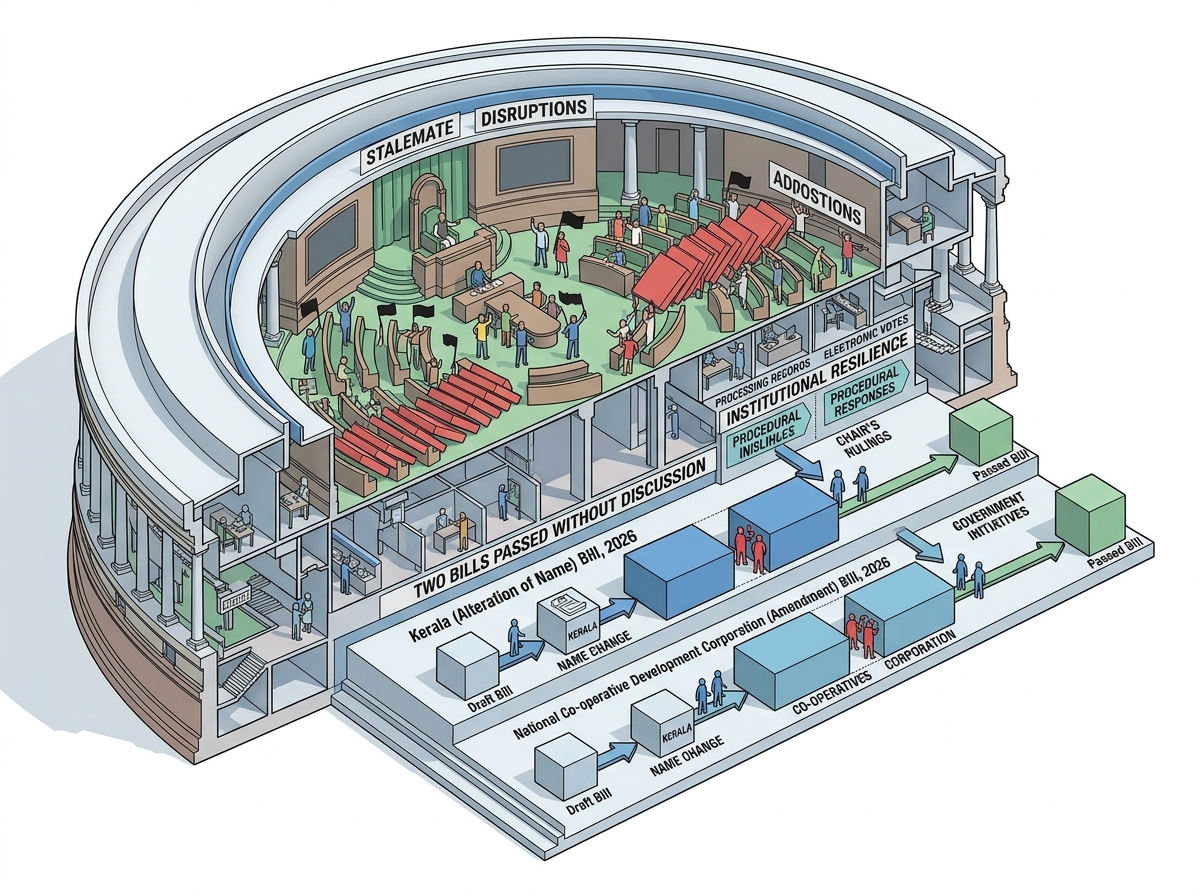
11 Aug Lok Sabha Passes Kerala Renaming & Co-operative Bills Without Debate
Lok SabhaOpposition protestsSpeaker ChairGovernment responseLegislative BillsParliamentary disruption✎ The passage of the Kerala (Alteration of Name) Bill and the National Co-operative Development Corporation (Amendment) Bill without debate in the Lok Sabha underscores the procedural dynamics of Parliament, where disruptions can…
Subject Relevance — Where This Topic Fits
- GS Paper II — Parliament and State Legislatures — Structure, Functioning, Conduct of Business, Powers & Privileges and Issues Arising Out of these | GS Paper III — Co-operative Societies: Role in Economic Development
- Prelims: Lok Sabha, List of Business, voice vote, adjournment sine die, National Co-operative Development Corporation (NCDC), co-operative sector reforms, Article 3 of the Constitution, Kerala (Alteration of Name) Bill, parliamentary procedure, Monsoon Session 2026
- Essay: Parliamentary democracy: The balance between legislative efficiency and deliberative democracy, Institutional resilience in governance: Navigating procedural disruptions while upholding constitutional mandates
Quick Revision: The passage of the Kerala (Alteration of Name) Bill and the National Co-operative Development Corporation (Amendment) Bill without debate in the Lok Sabha underscores the procedural dynamics of Parliament, where disruptions can override deliberative processes despite constitutional and statutory compliance.
Why is this in the news?
The Lok Sabha, during the Monsoon Session of 2026, passed two Bills—the Kerala (Alteration of Name) Bill, 2026, and the National Co-operative Development Corporation (Amendment) Bill, 2026—without debate amid ongoing disruptions in proceedings. The passage occurred despite persistent Opposition protests, highlighting procedural responses by the Chair and the government, as well as the broader implications for legislative functioning and institutional resilience in Parliament.
Background
- The Lok Sabha has been experiencing prolonged disruptions, with Opposition members demanding statements on specific incidents, including alleged use of force against student protesters and alleged financial irregularities related to the Ram Temple. These demands have led to repeated adjournments and stalled legislative business.
- Speaker Om Birla adjourned the House twice on August 11, 2026, first in the morning due to protests and later after resumption, reflecting the procedural challenges in maintaining order during sessions marked by high political tension.
- The Kerala (Alteration of Name) Bill, 2026, seeks to rename the state from ‘Kerala’ to ‘Keralam’, invoking constitutional provisions under Article 3 for alteration of a state’s name.
- The National Co-operative Development Corporation (Amendment) Bill, 2026, aims to amend the National Co-operative Development Corporation Act, 1962, to enhance the operational and financial autonomy of the NCDC, a statutory body under the Ministry of Cooperation.
- Parliamentary Affairs Minister Kiren Rijiju stated that the government was prepared for discussions on the Opposition’s demands but accused the Opposition of walking out and disrupting proceedings, thereby preventing substantive debate.
Key Aspects of the Bills and Parliamentary Procedures Involved
- **Kerala (Alteration of Name) Bill, 2026**: This Bill proposes to rename the State of Kerala as ‘Keralam’. The procedure for altering a state’s name involves: (a) introduction of a Bill in Parliament, (b) reference to the concerned state legislature for its views, (c) consideration and passage by both Houses of Parliament, and (d) Presidential assent. The Bill was passed without debate, indicating procedural compliance but raising questions about the lack of deliberation on socio-cultural and linguistic implications.
- The term ‘Keralam’ is the Malayalam name for the state, and the Bill reflects the linguistic and cultural identity of the region. However, the absence of debate in Parliament underscores the procedural constraints imposed by disruptions rather than the merits of the proposal.
- The Bill was moved by the Minister of State for Home, Nityanand Rai, and passed by a voice vote, a procedural mechanism used when the Chair determines that the matter is non-contentious or when the House is unable to deliberate due to disruptions.
- **National Co-operative Development Corporation (Amendment) Bill, 2026**: This Bill seeks to amend the National Co-operative Development Corporation Act, 1962, to modernize the governance and operational framework of the NCDC. Key amendments may include: enhancing the Board’s composition to include more stakeholders, expanding the scope of activities to align with contemporary co-operative principles, and strengthening financial oversight mechanisms.
- The NCDC, established in 1962, is a statutory body under the Ministry of Cooperation, tasked with promoting and developing co-operative societies in India. Its role is critical in the co-operative sector, which contributes significantly to rural and agricultural development.
- The Bill was moved by the Minister of State for Cooperation, Murlidhar Mohol, and passed without debate, reflecting the procedural challenges in ensuring substantive discussion on sectoral reforms amid legislative disruptions.
- The passage of Bills without debate, while procedurally valid, raises concerns about the quality of legislative scrutiny and the ability of Parliament to fulfill its deliberative function, particularly in sectors requiring expert input and stakeholder consultation.
- The procedural response by the Chair, including adjournments and the use of voice votes, highlights the institutional mechanisms available to maintain order in the House, but also underscores the limitations imposed by persistent disruptions.
Key Features
| Feature | Significance |
|---|---|
| Voice vote passage of Bills | Demonstrates the procedural mechanism for legislation during disruptions, highlighting the role of parliamentary rules in ensuring continuity of governance despite procedural deadlocks. |
| State name alteration procedure | Illustrates the constitutional process for renaming a state under Article 3 of the Constitution, which requires parliamentary approval via a simple majority. |
| Amendment to co-operative sector legislation | Showcases the legislative process for amending central laws governing co-operative societies, particularly the National Co-operative Development Corporation (NCDC) Act. |
| Speaker’s adjournment power | Highlights the constitutional authority of the Speaker under Article 118 to adjourn or suspend proceedings in case of disorder, ensuring the House’s functioning amidst disruptions. |
| Ministerial responsibility in absence of debate | Demonstrates the executive’s ability to move and pass Bills without debate during disruptions, underscoring the separation of legislative and executive functions in parliamentary democracy. |
Why it Matters
Constitutional and Procedural
- The passage of the Kerala (Alteration of Name) Bill, 2026, without debate, underscores the procedural flexibility within parliamentary democracy to enact state-specific amendments, provided they comply with constitutional requirements under Article 3.
- The National Co-operative Development Corporation (Amendment) Bill, 2026, reflects the central government’s role in regulating co-operative societies, a subject listed in the Union List (List I, Seventh Schedule), ensuring uniformity in policy across states.
- The Speaker’s adjournment power, exercised under Article 118, serves as a critical tool to maintain order and prevent procedural stagnation, ensuring the continuity of legislative business even amid disruptions.
Governance and Institutional
- The incident highlights the institutional challenge of maintaining legislative productivity during periods of political deadlock, necessitating procedural adaptations to uphold governance.
- The passage of Bills without discussion raises questions about the quality of legislative scrutiny, particularly for amendments affecting co-operative sectors, which are vital for rural and agricultural development.
- The role of the National Co-operative Development Corporation (NCDC) in fostering co-operative enterprises aligns with the constitutional directive under Article 43 to promote cottage and village industries, ensuring equitable economic growth.
Federalism and State Autonomy
- The Kerala name change process exemplifies the federal structure, where state identity is subject to parliamentary approval, balancing state autonomy with national unity.
- The co-operative sector amendments reflect the central government’s role in harmonising policies across states, ensuring coherence in economic governance while respecting state-specific variations.
Challenges
1. Legislative Productivity vs. Procedural Disruptions
- Sustained disruptions in Parliament impede thorough debate and scrutiny of Bills, potentially compromising the quality of legislation.
- The absence of discussion on critical amendments, such as those affecting the co-operative sector, may lead to inadequate stakeholder consultation and policy gaps.
- Procedural deadlocks risk eroding public trust in legislative institutions, as perceived inefficiency may undermine democratic accountability.
UPSC Link: Parliamentary procedures and legislative scrutiny
2. Balancing State Autonomy and National Unity
- The process of renaming a state, while procedurally straightforward, must balance local aspirations with national cohesion, particularly in linguistically and culturally distinct regions.
- Centralised amendments to state-specific co-operative policies may inadvertently dilute regional economic priorities, necessitating careful federal consultation.
UPSC Link: Federalism and co-operative federalism
3. Ensuring Quality of Legislative Scrutiny
- Passage of Bills without debate risks overlooking critical amendments, particularly in sectors like co-operatives, which directly impact rural and agricultural economies.
- The lack of structured discussion may lead to ambiguities in implementation, requiring subsequent executive clarifications or judicial interpretations.
UPSC Link: Role of Parliamentary Committees
4. Maintaining Institutional Credibility
- Frequent disruptions and procedural shortcuts may undermine the perceived legitimacy of legislative processes, affecting public confidence in democratic institutions.
- The executive’s ability to bypass debate during disruptions could be misconstrued as undermining parliamentary sovereignty, necessitating transparent procedural norms.
UPSC Link: Parliamentary sovereignty and executive-legislature relations
5. Stakeholder Engagement in Policy Formulation
- Amendments to co-operative sector laws require extensive consultation with stakeholders, including co-operative societies, farmers, and state governments, to ensure policy relevance and effectiveness.
- The absence of debate may limit opportunities for expert inputs, potentially leading to suboptimal policy outcomes.
UPSC Link: Multi-stakeholder governance models
Challenges — UPSC Perspective
| Issue | Concern |
|---|---|
| Procedural deadlocks in Parliament | Impedes legislative scrutiny and delays critical policy decisions, affecting governance efficiency. |
| Passage of Bills without debate | Raises concerns about the quality of legislation and adequacy of stakeholder consultation. |
| State name alteration process | Must balance local identity aspirations with national unity and constitutional provisions. |
| Centralised co-operative sector amendments | Risk diluting state-specific economic priorities and reducing regional autonomy. |
| Perceived erosion of parliamentary sovereignty | Undermines public trust in legislative institutions and democratic accountability. |
| Inadequate stakeholder engagement | May lead to policy gaps and implementation challenges, particularly in sectors like co-operatives. |
Way Forward
- Strengthen parliamentary norms to ensure structured debates and consultations, even during disruptions, to uphold legislative quality.
- Encourage the use of parliamentary committees for detailed scrutiny of Bills, particularly those affecting federal structures or sectoral policies.
- Promote multi-stakeholder consultations for amendments to co-operative sector laws, involving state governments, co-operative societies, and experts.
- Enhance transparency in procedural adaptations, such as voice votes during disruptions, to maintain public trust in legislative processes.
- Reinforce the role of the Speaker in maintaining order while ensuring that procedural adaptations do not undermine democratic principles.
- Develop mechanisms for post-legislative scrutiny to address ambiguities arising from Bills passed without debate.
- Foster inter-state and inter-ministerial coordination to harmonise co-operative sector policies while respecting regional priorities.
- Invest in capacity-building for parliamentary staff and committees to handle complex legislative processes efficiently.
UPSC Value Addition
Keywords for Mains Answer-Writing
Lok Sabha legislative process · Parliamentary deadlock · State name alteration · Constitutional provisions for state name change · Co-operative sector reforms · National Co-operative Development Corporation (NCDC) · Parliamentary procedures under Article 107 · Role of Speaker in legislative business · Legislative accountability and debate · Federalism and state identity
Constitutional & Policy Linkages
- Article 3: Alteration of name of a State.
- Article 118: Rules of procedure and conduct of business in Parliament.
- Seventh Schedule: Distribution of legislative powers between Union and States (Union List, Item 44: Co-operative Societies).
Concept Flow
Political disruptions in Lok Sabha → Speaker adjourns proceedings under Article 118 → Ministers move Bills without debate → Bills passed via voice vote → Procedural continuity maintained but scrutiny compromised → Questions arise over legislative quality and stakeholder engagement → Need for reforms in parliamentary norms and multi-stakeholder consultations.
Prelims Practice Questions
Q1. Consider the following statements regarding the procedure for altering the name of a State in India:
1. The Bill for altering the name of a State can be introduced in either House of Parliament.
2. The Bill requires the prior recommendation of the President of India before its introduction.
3. The Bill must be referred to the concerned State Legislature for its views before being taken up for consideration in Parliament.
How many of the above statements are correct?
- Only one
- Only two
- All three
- None
Answer: All three — Statement 1 is correct: A Bill for altering the name of a State can be introduced in either House of Parliament (Article 3 of the Constitution). Statement 2 is incorrect: The Bill does not require the prior recommendation of the President before introduction, though the President’s assent is required for the Bill to become law. Statement 3 is correct: The Bill must be referred to the State Legislature concerned for its views (Article 3(2)).
Q2. Assertion (A): The National Co-operative Development Corporation (Amendment) Bill, 2026 seeks to amend the National Co-operative Development Corporation Act, 1962.
Reason (R): The National Co-operative Development Corporation is a statutory body established under the said Act to promote and develop co-operative societies in India.
In the context of the above two statements, which one of the following is correct?
- Both A and R are true, and R is the correct explanation of A
- Both A and R are true, but R is not the correct explanation of A
- A is true, but R is false
- A is false, but R is true
Answer: Both A and R are true, but R is not the correct explanation of A — The Assertion (A) is true: The Bill seeks to amend the National Co-operative Development Corporation Act, 1962. The Reason (R) is also true and correctly explains the Assertion, as the NCDC is indeed a statutory body established under the 1962 Act to promote and develop co-operative societies in India.
Q3. Which of the following is NOT a power of the Speaker of the Lok Sabha under the Constitution of India?
- To adjourn the House or suspend the sitting in case of grave disorder
- To certify a Money Bill
- To decide on the disqualification of a member under the Tenth Schedule
- To pass a Bill without discussion in case of a deadlock
Answer: To pass a Bill without discussion in case of a deadlock — The Speaker of the Lok Sabha does not have the power to decide on the disqualification of a member under the Tenth Schedule; this power lies with the Chairman or Speaker of the respective House under the supervision of the President (Article 102 read with the Tenth Schedule). The other options are correct powers of the Speaker.
Mains Practice Question
✍ The passage of Bills in the Lok Sabha without discussion, amidst a legislative deadlock, raises questions about the efficacy of parliamentary procedures in ensuring legislative accountability. Critically examine the constitutional and procedural dimensions of this issue, with reference to the role of the Speaker and the principles of parliamentary democracy. (15 Marks)
Approach: MODEL-ANSWER SKELETON:
1. Introduction (2 marks):
– Briefly define the constitutional framework governing the passage of Bills in Parliament (Article 107-109).
– Highlight the significance of legislative debate in a parliamentary democracy.
2. Constitutional and Procedural Dimensions (5 marks):
– Article 107: Modes of passing Bills (ordinary, money, financial, constitutional amendment).
– Article 118: Rules of procedure in Parliament; the Speaker’s role in regulating legislative business.
– Article 108: Joint sitting provisions (though not directly relevant here, mention as a safeguard).
– Rule 279 of the Rules of Procedure and Conduct of Business in Lok Sabha: Adjournment of the House and resumption of business.
3. Role of the Speaker (4 marks):
– Constitutional provisions governing the Speaker’s authority (Article 93, Tenth Schedule).
– Speaker’s discretion in allowing Bills to be moved or passed without discussion (Rule 279, 280).
– Balancing act: Maintaining decorum vs. ensuring legislative accountability.
– Recent precedents where Bills were passed without discussion (cite examples if possible).
4. Principles of Parliamentary Democracy (3 marks):
– Importance of legislative debate for transparency, accountability, and public scrutiny.
– Risks of bypassing debate: Erosion of public trust, potential for misuse of legislative power.
– Comparative perspective: How other parliamentary democracies handle legislative deadlocks.
5. Conclusion (1 mark):
– Summarise the need for a balanced approach that upholds both legislative efficiency and democratic accountability.
Source: The Hindu
Generated by AanyaAi for educational purpose.

- Gurugram’s groundwater extraction exceeds limit by 212%; HC seeks ban - October 4, 2026
- स्वतंत्रता सेनानी श्यामजी कृष्ण वर्मा की जन्म जयंती पर पीएम का श्रद्धांजलि - October 4, 2026
- KWML’s Feasibility Reports for Water Metro in 18 Cities: UPSC & PCS Insights - October 3, 2026

No Comments