


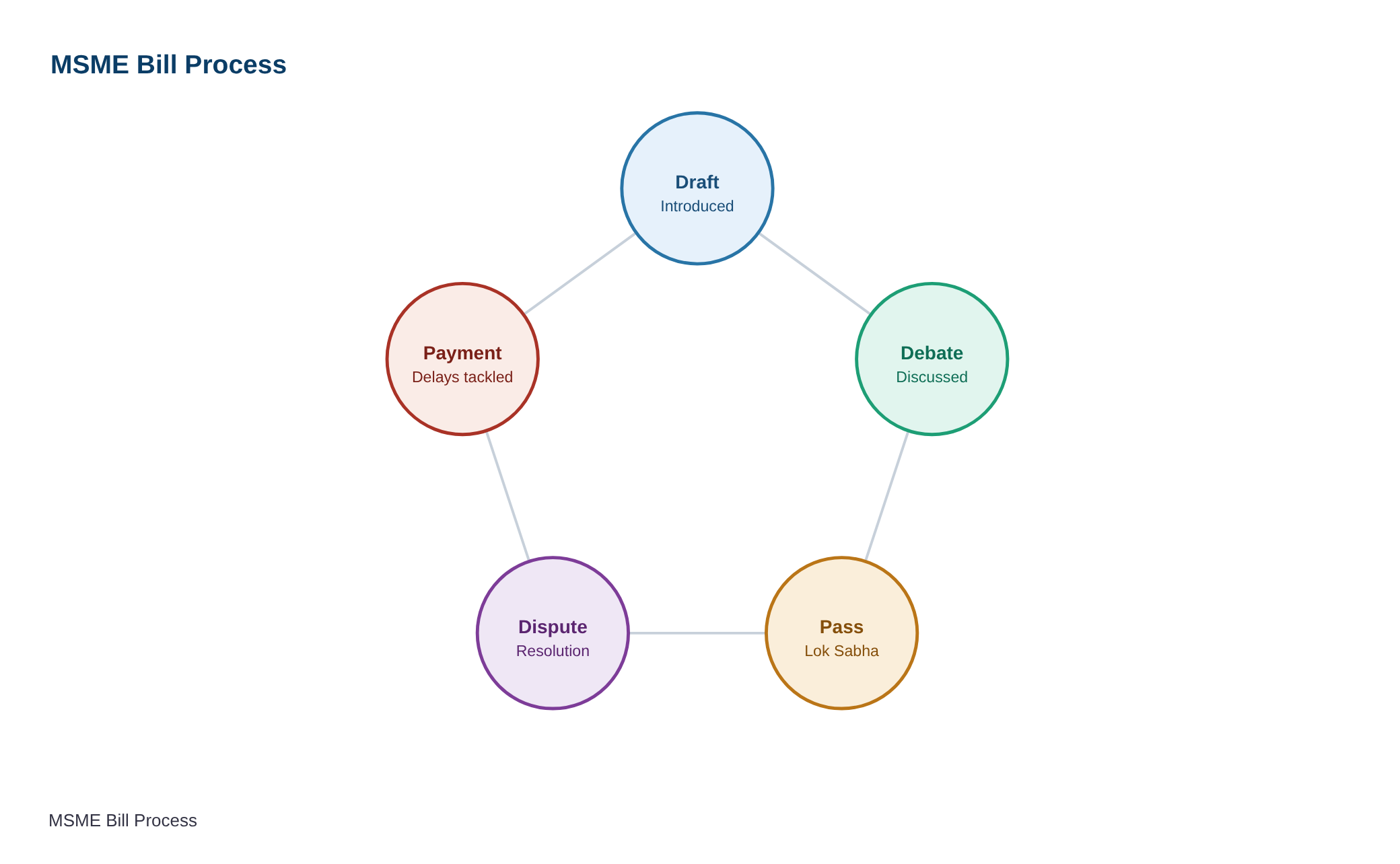
07 Aug Lok Sabha Passes MSME Bill 2024: Key Provisions for UPSC Exam
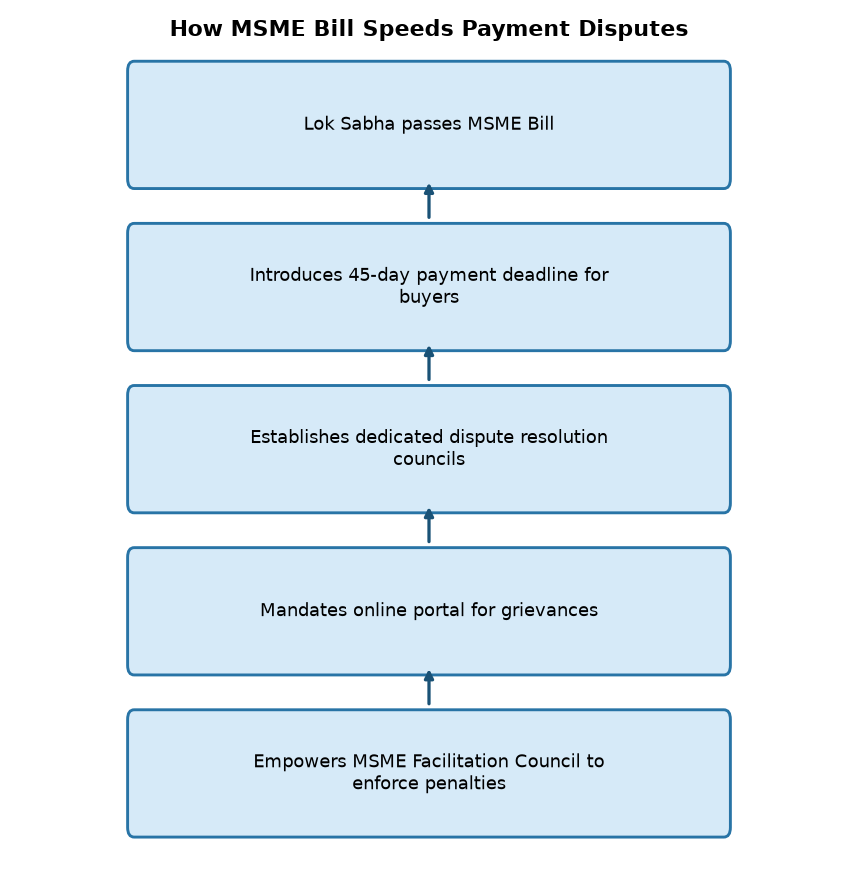
✎ MSME Bill 2024 aims to curb payment delays and speed up dispute resolution for MSMEs by enforcing strict timelines and penal interest.
Relevance for UPSC & State PCS: Polity
The Lok Sabha recently passed the Micro, Small and Medium Enterprises (MSME) Development (Amendment) Bill, 2024, aimed at addressing chronic payment delays and expediting dispute resolution for small businesses. The bill introduces stricter timelines for settling dues from buyers to MSMEs, mandating payments within 45 days of acceptance or deemed acceptance of goods or services, failing which interest at three times the RBI’s benchmark rate will be levied. It also empowers the MSME Facilitation Council to act as an arbitral tribunal for disputes, reducing judicial delays and ensuring faster redressal. These provisions seek to alleviate the financial strain on MSMEs, which often face liquidity crises due to protracted payment cycles.
For UPSC and State PCS aspirants, this bill is significant as it intersects with India’s broader economic policies, particularly the ‘Make in India’ initiative and the push for self-reliance. The amendments reflect the government’s commitment to fostering a conducive environment for MSMEs, which contribute nearly 30% to India’s GDP and employ over 110 million people. Understanding the bill’s provisions helps aspirants grasp the interplay between legislative reforms and economic growth, a recurring theme in both prelims and mains examinations. Additionally, the focus on dispute resolution mechanisms aligns with judicial reforms, a key topic in polity and governance studies.
The bill’s emphasis on reducing payment delays also ties into India’s broader financial inclusion and ease-of-doing-business agendas. Aspirants should note how such legislative measures complement initiatives like the Udyam Registration Portal and the TReDS (Trade Receivables Discounting System) platform, which aim to streamline MSME operations. For State PCS exams, where local economic policies and their implementation are often tested, this bill serves as a case study in how central legislation can empower state-level institutions like MSME Facilitation Councils to resolve disputes efficiently.
From a polity perspective, the bill underscores the role of Parliament in economic governance and the need for responsive legislation to address sector-specific challenges. Aspirants should analyze how the bill balances the interests of MSMEs with those of larger buyers, ensuring fairness without stifling business operations. This nuanced understanding is crucial for answering questions on policy-making, federalism, and the judiciary’s role in economic disputes, making the bill a relevant topic for both UPSC and State PCS preparations.
Source: ndtv.com
Practice Questions
Q1. What is the primary objective of the MSME Bill recently passed by the Lok Sabha?
- To provide financial subsidies to MSMEs for technological upgrades
- To tackle payment delays and speed up dispute resolution for MSMEs
- To exempt MSMEs from all tax liabilities for five years
- To mandate a 25% quota for MSMEs in government procurement
Answer
To tackle payment delays and speed up dispute resolution for MSMEs — The MSME Bill passed by the Lok Sabha primarily aims to address payment delays faced by Micro, Small, and Medium Enterprises (MSMEs) and expedite the resolution of disputes related to payments, ensuring better cash flow and operational stability for these businesses.
Q2. Which of the following issues is specifically addressed by the recently passed MSME Bill?
- Export promotion for MSMEs
- Payment delays and dispute resolution
- Direct credit guarantees from banks
- Mandatory skill development programs
Answer
Payment delays and dispute resolution — The MSME Bill focuses on resolving payment delays and streamlining dispute resolution mechanisms, which are critical challenges for MSMEs in India.
Generated by AanyaAi for educational purpose.

- जल जीवन मिशन 2.0: कुशल कार्यबल निर्माण के लिए पहली वर्चुअल सम्मेलन आयोजित - September 22, 2026
- DDWS Hosts Virtual Meet to Strengthen Rural Water Workforce Under JJM 2.0 - September 22, 2026
- किशाऊ परियोजना विवाद: पंजाब सुप्रीम कोर्ट पहुंचेगा, जानें पूरा मामला - September 22, 2026

No Comments