


07 Aug Lok Sabha Passes MSME Bill 2024: Key Provisions for UPSC Exam
✎ MSME Bill 2024 aims to curb payment delays and streamline dispute resolution to strengthen India’s MSME sector.
Relevance for UPSC & State PCS: Polity
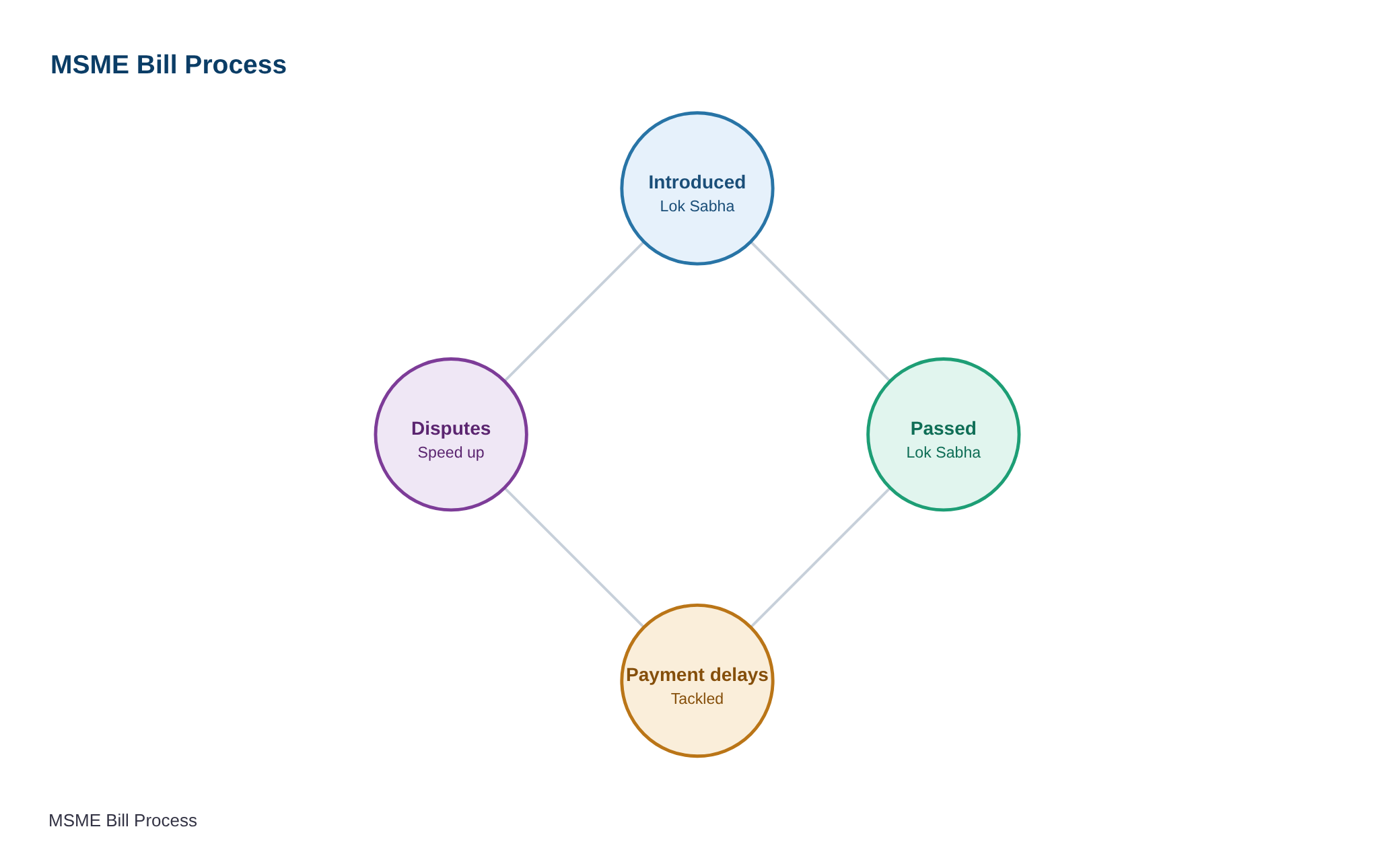
The Lok Sabha recently passed the Micro, Small and Medium Enterprises (MSME) Development (Amendment) Bill, 2024, aimed at addressing persistent challenges in the MSME sector, particularly payment delays and dispute resolution. The bill introduces amendments to the existing MSME Development Act, 2006, with a focus on strengthening the legal framework to ensure timely payments to MSMEs by larger buyers. This legislative move is significant as it seeks to mitigate the financial strain on small enterprises, which often face cash flow disruptions due to delayed payments from corporates and government agencies. The bill also proposes mechanisms to expedite the resolution of disputes arising from delayed payments, thereby fostering a more conducive business environment for MSMEs.
For UPSC and State PCS aspirants, this development holds relevance in the context of India’s economic policies and governance, particularly under the broader framework of the *Make in India* initiative and the *Atmanirbhar Bharat* campaign. The bill aligns with the government’s efforts to promote self-reliance by supporting small businesses, which contribute nearly 30% to India’s GDP and employ over 110 million people. Understanding the nuances of such legislative amendments is crucial for aspirants, as it reflects the government’s approach to balancing industrial growth with the protection of vulnerable sectors. The bill also touches upon the role of regulatory bodies like the MSME Facilitation Council, which plays a pivotal role in dispute resolution, making it a pertinent topic for discussions on governance and policy implementation.
From a constitutional perspective, the bill underscores the importance of cooperative federalism, as MSMEs are a state subject under the Seventh Schedule of the Constitution. However, the central government’s intervention through legislative amendments highlights the need for a unified approach to address sectoral challenges. For State PCS aspirants, this raises questions about the coordination between central and state authorities in implementing such policies. Additionally, the bill’s provisions on dispute resolution could be linked to the judiciary’s role in ensuring timely justice, a topic often examined in the UPSC Mains General Studies Paper-II, which covers governance, constitution, and judiciary.
The passage of the MSME bill also reflects broader trends in India’s economic governance, such as the push for digitalization and ease of doing business. The proposed amendments could pave the way for the integration of technology in dispute resolution mechanisms, such as online portals for grievance redressal, which is a key focus area in contemporary policy discussions. For aspirants preparing for the UPSC Prelims or Mains, this bill serves as a case study in how legislative changes can address real-world economic challenges. It also provides an opportunity to analyze the interplay between economic policies, legal frameworks, and administrative efficiency—a recurring theme in the UPSC syllabus.
Source: ndtv.com
Practice Questions
Q1. What is the primary objective of the MSME Bill recently passed by the Lok Sabha?
- To provide tax exemptions to MSMEs for the next five years
- To tackle payment delays and speed up dispute resolution for MSMEs
- To merge all MSMEs into larger corporations for better efficiency
- To increase the export quotas for MSME products
Answer
To tackle payment delays and speed up dispute resolution for MSMEs — The MSME Bill passed by the Lok Sabha aims to address payment delays faced by Micro, Small, and Medium Enterprises (MSMEs) and expedite the resolution of disputes related to payments, thereby improving their financial stability and operational efficiency.
Q2. Which of the following issues is the MSME Bill primarily designed to address?
- High interest rates on loans for MSMEs
- Payment delays and slow dispute resolution mechanisms
- Lack of skilled manpower in MSMEs
- Inadequate infrastructure for MSMEs
Answer
Payment delays and slow dispute resolution mechanisms — The MSME Bill focuses on resolving payment delays and accelerating dispute resolution processes, which are critical challenges for MSMEs in maintaining cash flow and business continuity.
Generated by AanyaAi for educational purpose.

- Tamil Nadu Expands Breakfast Scheme to Classes 6-8: 15.30 Lakh Students Benefit - September 22, 2026
- राज्यसभा उपचुनाव उत्तराखंड: 16 अक्तूबर को मतदान, जानें पूरा कार्यक्रम और महत्व - September 22, 2026
- राज्यसभा उपचुनाव उत्तराखंड: 16 अक्टूबर को मतदान, जानें प्रक्रिया और महत्व - September 22, 2026

No Comments