


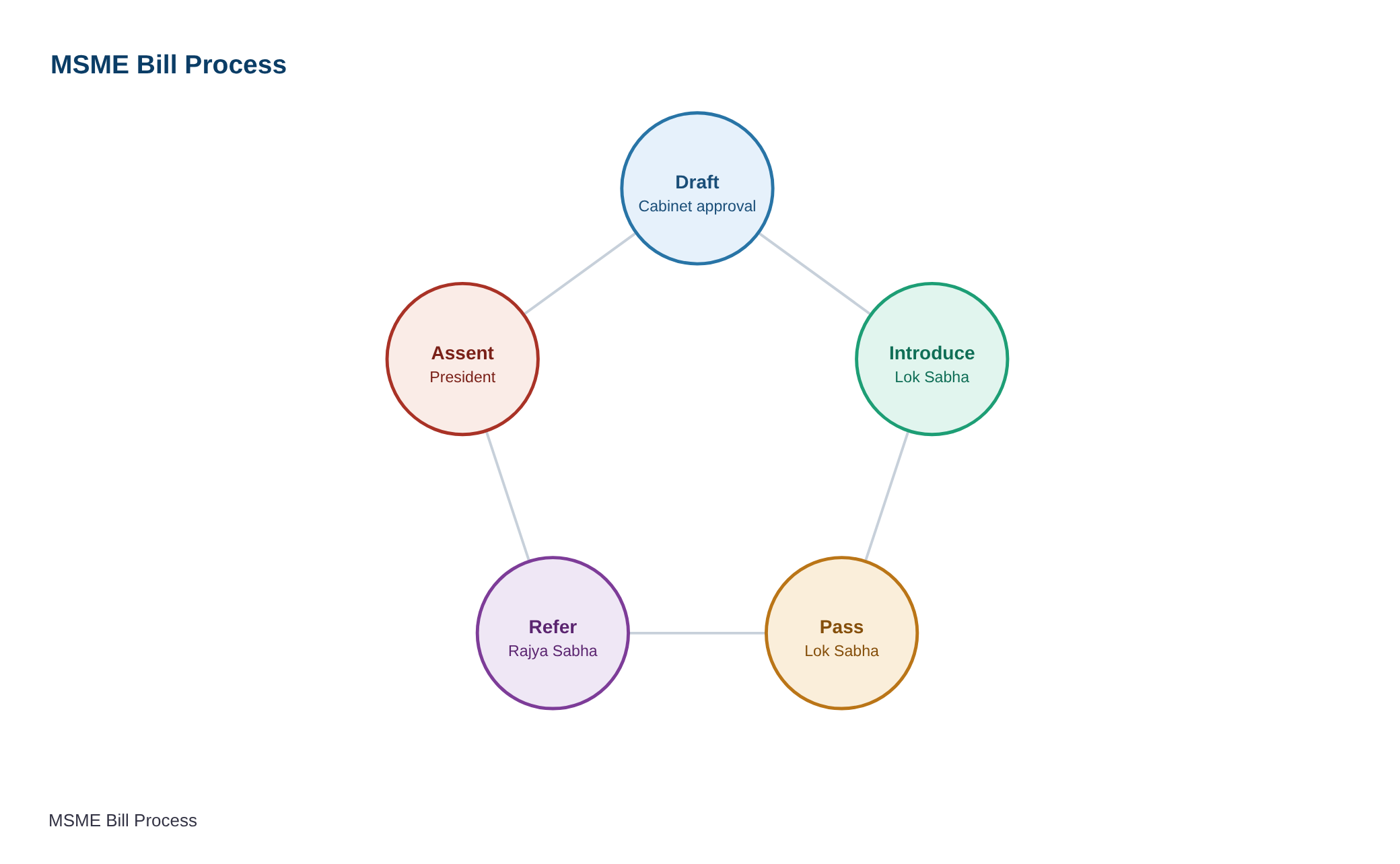
07 Aug Lok Sabha Passes MSME Bill: Key Features & UPSC Implications Explained
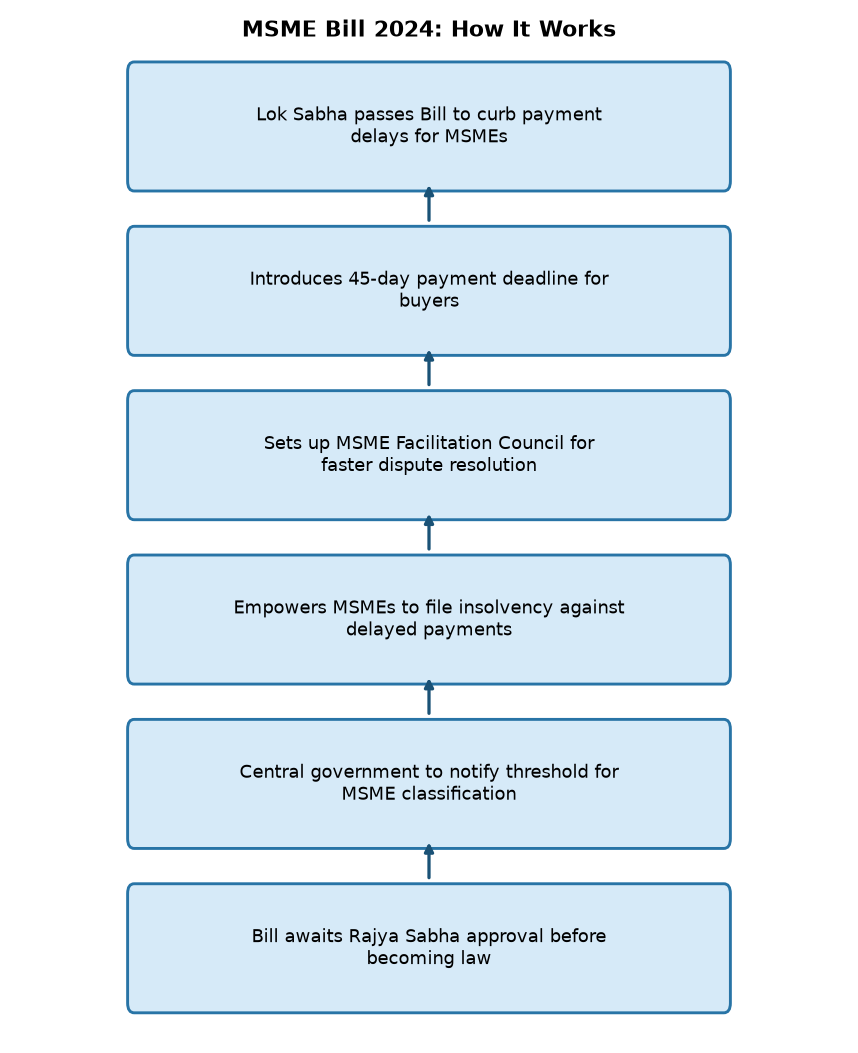
✎ MSME Bill 2024 aims to curb payment delays and expedite dispute resolution for small businesses.
Relevance for UPSC & State PCS: Polity
The Lok Sabha’s passage of the Micro, Small and Medium Enterprises (MSME) Development (Amendment) Bill, 2024 marks a decisive step toward addressing systemic payment delays and expediting dispute resolution for India’s MSME sector. The bill introduces critical amendments to the MSME Development Act, 2006, aimed at enforcing stricter timelines for payments to MSMEs by buyers, including government agencies, and streamlining the adjudication process for delayed payments. By mandating that payments be settled within 45 days—extendable to 100 days under exceptional circumstances—the legislation seeks to alleviate the financial strain on small businesses that often face prolonged delays, sometimes extending beyond a year. This move aligns with the broader policy push to formalize and strengthen the MSME ecosystem, which contributes nearly 30% to India’s GDP and employs over 110 million people, making it a linchpin of the country’s economic resilience.
For UPSC and State PCS aspirants, the bill’s provisions offer a lens to examine the intersection of economic governance, constitutional directives, and administrative reforms. The amendment’s emphasis on reducing payment delays resonates with the constitutional mandate under Article 43, which directs the State to secure a living wage and decent conditions of work for workers, including those in the informal sector. Additionally, the bill’s focus on dispute resolution through dedicated mechanisms—such as the facilitation of conciliation and the establishment of dedicated tribunals—highlights the government’s evolving approach to grievance redressal, a topic often probed in the mains examination under governance and public policy segments. The legislative intent also underscores the role of Parliament in amending sector-specific laws to adapt to contemporary challenges, a recurring theme in UPSC’s polity syllabus.
The bill’s relevance extends to the State PCS domain, particularly in understanding how sub-national governments implement central schemes and address local economic bottlenecks. States like Maharashtra, Tamil Nadu, and Gujarat, which host a significant concentration of MSMEs, will need to align their procurement policies with the new timelines, offering aspirants a case study in inter-governmental coordination. Furthermore, the amendment’s provisions on penalties for non-compliance—including compounding of offenses and interest payments—raise questions about the balance between regulatory enforcement and ease of doing business, a debate that frequently features in State PCS interviews and mains papers. The bill also serves as a practical example of how legislative reforms can translate into tangible economic benefits, a perspective valuable for aspirants tackling questions on inclusive growth and industrial policy.
From a broader UPSC perspective, the MSME bill reflects the government’s commitment to formalizing the economy and reducing the vulnerabilities of the informal sector, a priority echoed in initiatives like the Udyam Registration portal and the Emergency Credit Line Guarantee Scheme (ECLGS). For mains answer writing, aspirants can draw parallels between this amendment and
Source: ndtv.com
Practice Questions
Q1. What is the primary objective of the MSME Bill recently passed by the Lok Sabha?
- To provide financial subsidies directly to MSMEs for expansion
- To tackle payment delays and speed up dispute resolution for MSMEs
- To mandate a minimum turnover for MSMEs to qualify for government tenders
- To establish a new regulatory body for MSMEs in India
Answer
To tackle payment delays and speed up dispute resolution for MSMEs — The MSME Bill passed by the Lok Sabha primarily aims to address payment delays faced by Micro, Small, and Medium Enterprises (MSMEs) and expedite the resolution of disputes related to delayed payments.
Q2. Which legislative body passed the MSME Bill mentioned in the news?
- Rajya Sabha
- Lok Sabha
- President of India
- Supreme Court
Answer
Lok Sabha — The MSME Bill was passed by the Lok Sabha, as explicitly stated in the provided news headline.
Generated by AanyaAi for educational purpose.

- Tamil Nadu Expands Breakfast Scheme to Classes 6-8: 15.30 Lakh Students Benefit - September 22, 2026
- राज्यसभा उपचुनाव उत्तराखंड: 16 अक्तूबर को मतदान, जानें पूरा कार्यक्रम और महत्व - September 22, 2026
- राज्यसभा उपचुनाव उत्तराखंड: 16 अक्टूबर को मतदान, जानें प्रक्रिया और महत्व - September 22, 2026

No Comments