


06 Aug Lok Sabha Passes Taxation Bill Allowing MDR on UPI Transactions: Key Provisions Explained
✎ The Taxation and Other Laws (Amendment) Bill, 2026, introduces a legal framework for levying MDR on UPI transactions above a specified threshold while extending income-tax exemptions for foreign investors in India’s electronics…
Subject Relevance — Where This Topic Fits
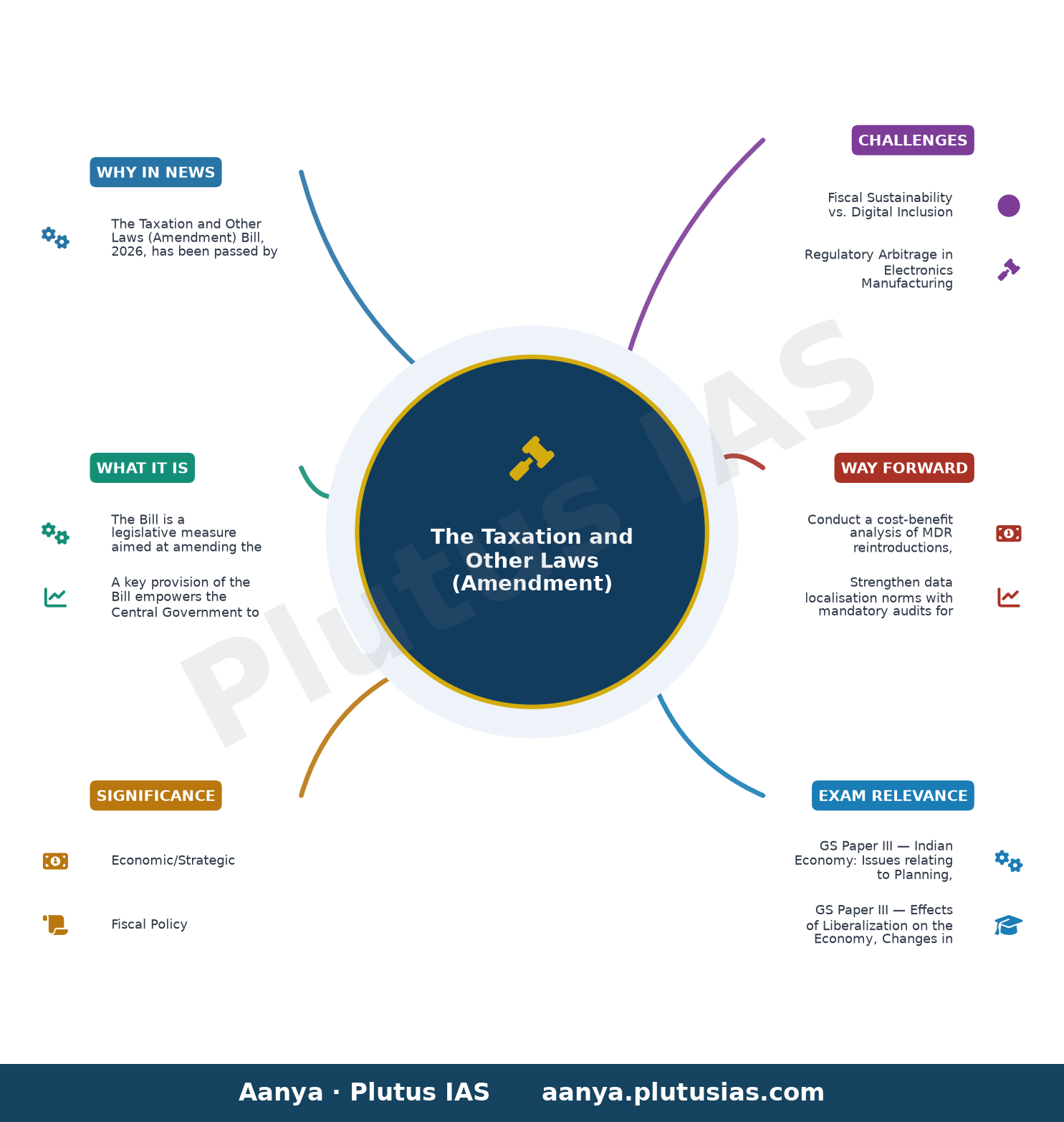
- GS Paper III — Indian Economy: Issues relating to Planning, Mobilization of Resources, Growth, Development and Employment | GS Paper III — Effects of Liberalization on the Economy, Changes in Industrial Policy and their Effects on Industrial Growth | GS Paper III — Science and Technology — Developments and their Applications and Effects in Everyday Life | GS Paper II — Government Policies and Interventions for Development in various sectors and Issues arising out of their Design and Implementation
- Prelims: Payment and Settlement Systems Act, 2007, Merchant Discount Rate (MDR), Zero-MDR regime, Foreign Portfolio Investors (FPIs), Customs-bonded warehouses, Income-tax exemption for contract manufacturing, Data localisation, Rupee-denominated bonds
- Essay: The role of fiscal policy in catalysing domestic manufacturing: A case study of India’s electronics sector, Balancing innovation and regulation: The future of digital payments in India
Quick Revision: The Taxation and Other Laws (Amendment) Bill, 2026, introduces a legal framework for levying MDR on UPI transactions above a specified threshold while extending income-tax exemptions for foreign investors in India’s electronics manufacturing and digital infrastructure sectors.
Why is this in the news?
The Taxation and Other Laws (Amendment) Bill, 2026, has been passed by the Lok Sabha to promote domestic electronics manufacturing and provide a legal framework for levying Merchant Discount Rate (MDR) on UPI transactions above a specified threshold. The Bill also seeks to enhance policy certainty for foreign investors, including foreign portfolio investors and cloud service providers, by amending the Payment and Settlement Systems Act, 2007, and the Income Tax Act, 1961. The legislative intervention assumes significance in the context of India’s push for self-reliance in electronics manufacturing and the growing digital payments ecosystem.
Background
- The Government of India has consistently prioritised the electronics manufacturing sector under initiatives such as the ‘Make in India’ programme and the Production-Linked Incentive (PLI) schemes to reduce import dependence and boost domestic value addition.
- The Payment and Settlement Systems Act, 2007, currently mandates a zero-MDR regime for UPI and RuPay debit card transactions, which has been a key enabler of digital financial inclusion but has also imposed a cost burden on payment system providers.
- The Reserve Bank of India (RBI) has, on multiple occasions, highlighted the need for a calibrated approach to MDR to ensure the sustainability of the digital payments ecosystem while balancing the interests of all stakeholders.
- Foreign Portfolio Investors (FPIs) have historically faced tax uncertainties in India, particularly concerning investments in government securities, which the proposed amendments aim to address through income-tax exemptions.
- The global shift towards data localisation and the use of domestic data centres by foreign cloud service providers has necessitated regulatory clarity to attract investment in India’s digital infrastructure.
- The Bill replaces an ordinance issued on 5 June 2026, which provided income-tax exemptions for FPIs on interest income and capital gains from government securities, signalling a commitment to policy continuity.
What is the Taxation and Other Laws (Amendment) Bill, 2026?
- The Bill is a legislative measure aimed at amending the Income Tax Act, 1961, and the Payment and Settlement Systems Act, 2007, to facilitate foreign investment, promote domestic electronics manufacturing, and introduce flexibility in the digital payments ecosystem.
- A key provision of the Bill empowers the Central Government to specify, through notification, the electronic payment modes or transactions that must remain free of charges, thereby allowing for the levying of Merchant Discount Rate (MDR) on UPI transactions above a specified threshold.
- The Bill extends the income-tax exemption for foreign companies engaged in contract manufacturing of specified electronic goods in India until FY 2040-41, with a 15-year income tax exemption for strengthening the electronics manufacturing supply chain.
- The legislation delinks the Payment and Settlement Systems Act, 2007, from the Income Tax Act, 1961, to provide legal clarity and operational flexibility for payment system providers and regulators.
- To attract foreign cloud service providers, the Bill provides ‘process certainty’ to make it easier for overseas cloud companies to use data centres located in the country, thereby facilitating data localisation and reducing compliance burdens.
- The Bill also addresses tax uncertainties faced by foreign portfolio investors by providing income-tax exemptions on interest income and capital gains from investments in government securities, thereby enhancing India’s appeal as an investment destination.
- The proposed amendments are part of a broader strategy to align India’s fiscal and regulatory frameworks with global best practices while ensuring policy certainty for investors in critical sectors such as electronics manufacturing and digital payments.
Key Features
| Feature | Significance |
|---|---|
| Delinking Payment and Settlement Systems Act from Income Tax Act | Reduces regulatory overlap and streamlines compliance for digital payment systems. |
| Empowerment to reintroduce MDR on UPI transactions | Provides fiscal flexibility for incentivising digital payment infrastructure while maintaining zero MDR for specified transactions. |
| Extension of income-tax exemption for foreign companies in electronics manufacturing | Encourages investment in domestic electronics production, aligning with ‘Make in India’ objectives. |
| 15-year tax exemption for foreign firms storing components in customs-bonded warehouses | Strengthens supply-chain resilience and reduces costs for contract manufacturers. |
| Simplification of regulatory framework for foreign cloud service providers | Facilitates data localisation while reducing compliance burdens for global tech firms. |
Why it Matters
Economic/Strategic
- Enhances India’s attractiveness as an investment destination by offering fiscal stability and regulatory clarity for foreign capital.
- Supports the electronics manufacturing ecosystem, critical for reducing import dependence and boosting ‘Atmanirbhar Bharat’.
- Balances digital public infrastructure (UPI) with fiscal sustainability by allowing selective MDR on high-value transactions.
Fiscal Policy
- Replaces the June 2026 ordinance on tax exemptions for foreign portfolio investors, ensuring continuity in capital inflows.
- Introduces conditionalities for MDR reintroductions, ensuring revenue neutrality while supporting digital payment growth.
Digital Economy
- Preserves the zero-MDR regime for low-value UPI transactions while enabling cost-sharing for high-value transactions to sustain infrastructure.
- Reduces compliance barriers for cloud service providers, accelerating data centre localisation and reducing latency for digital services.
Challenges
1. Fiscal Sustainability vs. Digital Inclusion
- Reintroducing MDR risks disproportionately affecting small merchants and low-income users, potentially slowing UPI adoption.
- The conditional nature of MDR exemptions may create ambiguity, leading to litigation and compliance challenges.
UPSC Link: GS3: Digital Economy
2. Regulatory Arbitrage in Electronics Manufacturing
- Extending tax exemptions beyond 2040-41 may strain fiscal resources without commensurate gains in domestic value addition.
- Over-reliance on customs-bonded warehouses could incentivise import substitution over genuine manufacturing innovation.
UPSC Link: GS3: Industrial Policy
3. Data Localisation and Cloud Provider Compliance
- Simplifying approvals may reduce oversight on data security and privacy, risking breaches of sensitive information.
- Foreign cloud providers may relocate data centres to India but retain control over infrastructure, defeating localisation goals.
UPSC Link: GS3: Cyber Security
Challenges — UPSC Perspective
| Issue | Concern |
|---|---|
| Reintroduction of MDR on UPI | Potential erosion of digital inclusion for low-income users. |
| Extension of tax exemptions for electronics manufacturing | Fiscal burden without guaranteed employment or technology transfer. |
| Simplified approvals for cloud providers | Risk of inadequate data protection and privacy safeguards. |
| Ambiguity in conditional MDR exemptions | Litigation and regulatory uncertainty for payment aggregators. |
Way Forward
- Conduct a cost-benefit analysis of MDR reintroductions, prioritising low-value transaction exemptions.
- Strengthen data localisation norms with mandatory audits for foreign cloud providers operating in India.
- Enhance skilling programmes in electronics manufacturing to ensure tax exemptions translate into employment.
- Establish a grievance redressal mechanism for merchants impacted by potential MDR reintroductions.
- Monitor the fiscal impact of extended tax exemptions to prevent revenue leakage without proportional economic gains.
- Collaborate with RBI to define thresholds for high-value UPI transactions to balance revenue and inclusion.
- Promote R&D in domestic electronics components to reduce reliance on customs-bonded warehouses.
UPSC Value Addition
Keywords for Mains Answer-Writing
Taxation and Other Laws (Amendment) Bill 2026 · MDR on UPI transactions · Payment and Settlement Systems Act 2007 · electronic manufacturing in India · foreign portfolio investors (FPIs) · income-tax exemption for contract manufacturing · customs-bonded warehouses for electronics · data localisation for cloud services · RuPay card payments · foreign cloud service providers · process certainty in taxation · domestic value addition in electronics manufacturing
Concept Flow
Lok Sabha passes Taxation and Other Laws (Amendment) Bill, 2026 → Bill amends Payment and Settlement Systems Act, 2007 to reintroduce MDR provisions → Zero-MDR regime retained for low-value UPI transactions; high-value transactions subject to MDR → Fiscal incentives extended to foreign electronics manufacturers and cloud providers → Potential impact: Digital inclusion vs. infrastructure funding, data localisation vs. compliance burdens → Policy outcome: Balancing economic growth, fiscal prudence, and digital public good
Prelims Practice Questions
Q1. Consider the following statements regarding the Taxation and Other Laws (Amendment) Bill, 2026:
1. The Bill seeks to delink the Payment and Settlement Systems Act, 2007 from the Income Tax Act.
2. It proposes to extend the income-tax exemption for foreign companies engaged in contract manufacturing of electronic goods until 2040-41.
3. The Bill introduces a provision to levy Merchant Discount Rate (MDR) on all UPI transactions uniformly.
4. It provides for a 15-year income-tax exemption for foreign companies storing electronic components in customs-bonded warehouses.
How many of the above statements are correct?
- Only one
- Only two
- Only three
- All
Answer: Only three — Statements 1, 2, and 4 are correct. Statement 3 is incorrect as the Bill empowers the government to specify transactions exempt from MDR rather than imposing it uniformly on all UPI transactions.
Q2. Assertion (A): The Taxation and Other Laws (Amendment) Bill, 2026, aims to provide process certainty to foreign cloud service providers by removing approval requirements for using Indian data centres.
Reason (R): The Bill seeks to facilitate the relocation of fund managers to India by reducing compliance conditions for global income taxation.
Options:
A. Both A and R are true, and R is the correct explanation of A.
B. Both A and R are true, but R is not the correct explanation of A.
C. A is true, but R is false.
D. A is false, but R is true.
Answer: ? — Both Assertion (A) and Reason (R) are true, but Reason (R) is not the correct explanation of Assertion (A). The Bill addresses both data centre operations and fund manager relocation, but these are separate provisions.
Q3. Match the following provisions of the Taxation and Other Laws (Amendment) Bill, 2026 with their respective objectives:
Column I (Provision)
1. Extension of income-tax exemption for contract manufacturing of electronic goods
2. 15-year income-tax exemption for foreign companies in customs-bonded warehouses
3. Removal of approval requirements for foreign cloud service providers using Indian data centres
4. Empowerment to specify MDR-exempt transactions
Column II (Objective)
A. Promote domestic electronics manufacturing
B. Provide process certainty for overseas cloud companies
C. Facilitate relocation of fund managers to India
D. Ensure zero-MDR regime for specific UPI transactions
Options:
1-A, 2-B, 3-C, 4-D
1-A, 2-D, 3-B, 4-C
1-C, 2-A, 3-B, 4-D
1-A, 2-B, 3-D, 4-C
Answer: ? — The correct match is: 1-A (extension of exemption for contract manufacturing promotes domestic electronics manufacturing), 2-B (15-year exemption for customs-bonded warehouses supports process certainty for overseas cloud companies), 3-C (removal of approvals facilitates fund manager relocation), and 4-D (empowerment to specify MDR-exempt transactions ensures zero-MDR for specific UPI transactions).
Mains Practice Question
✍ The Taxation and Other Laws (Amendment) Bill, 2026, seeks to balance fiscal incentives with regulatory flexibility to attract foreign capital and promote domestic manufacturing. Critically examine the key provisions of the Bill in this context. Also, analyse the potential implications of introducing Merchant Discount Rate (MDR) on UPI transactions for digital payment ecosystems in India. (15 Marks)
Approach: MODEL-ANSWER SKELETON:
1. **Introduction** (1 mark): Briefly state the objective of the Bill—attracting foreign capital, promoting electronics manufacturing, and providing process certainty for overseas cloud companies.
2. **Key Provisions and Their Rationale** (6 marks):
– **Delinking Payment and Settlement Systems Act from Income Tax Act** (1 mark): Explain the legal separation and its purpose in providing clarity and avoiding conflicts.
– **Extension of income-tax exemption for contract manufacturing** (1 mark): Cite the specified electronic products (mobile phones, laptops, servers, etc.) and the rationale for extending the exemption until 2040-41 to boost domestic value addition.
– **15-year income-tax exemption for customs-bonded warehouses** (1 mark): Link this to strengthening the electronics manufacturing supply chain and reducing costs for foreign companies.
– **Removal of approval requirements for foreign cloud service providers** (1 mark): Discuss how this aligns with data localisation policies and the Digital Personal Data Protection Act, 2023.
– **Empowerment to specify MDR-exempt transactions** (2 marks): Explain the current zero-MDR regime, the proposed flexibility, and the rationale behind allowing MDR on transactions above ₹2,000 (as per RBI Governor’s statement).
3. **Critical Analysis of MDR Provisions** (5 marks):
– **Digital Payment Ecosystem** (2 marks): Discuss the role of UPI and RuPay in India’s digital economy, their adoption rates, and the potential impact of MDR on user adoption, merchant acceptance, and financial inclusion.
– **Stakeholder Perspectives** (2 marks): Weigh the arguments of banks/payment providers (who bear the cost of zero-MDR) versus the government’s objective of fiscal sustainability and the need to subsidise digital payments.
– **Global Comparisons** (1 mark): Briefly compare India’s approach with global practices (e.g., EU’s PSD2 regulations or Singapore’s tiered MDR structure) to highlight India’s unique position.
4. **Potential Challenges and Way Forward** (3 marks):
– **Fiscal Impact**: Discuss the revenue implications of extending tax exemptions and the need for alternative revenue sources.
– **Regulatory Arbitrage**: Analyse risks of regulatory arbitrage if MDR is selectively applied.
– **Policy Coherence**: Highlight the need for coherence between the Bill, the Digital India mission, and the RBI’s guidelines on digital payments.
5. **Conclusion** (1 mark): Summarise the Bill’s role in balancing fiscal incentives with regulatory flexibility and the importance of calibrating MDR policies to sustain digital payment growth.
Source: Times of India
Generated by AanyaAi for educational purpose.

- मध्य प्रदेश: हाईकोर्ट ने बलात्कार मामले में आरोपी को डीएनए सबूत के आधार पर किया दोषमुक्त - September 21, 2026
- MP High Court Acquits Rape Convict Due to Negative DNA Evidence - September 21, 2026
- Odisha Launches Shree Jagannath Darshan Yojana for Senior Citizens Pilgrimage - September 21, 2026

No Comments