


06 Aug Lok Sabha passes Taxation Bill: MDR on UPI transactions above ₹2,000 introduced
✎ The Taxation and Other Laws (Amendment) Bill, 2026, introduces a legal framework for levying MDR on UPI transactions above a threshold, while extending fiscal incentives for electronic manufacturing and streamlining compliance…
Subject Relevance — Where This Topic Fits
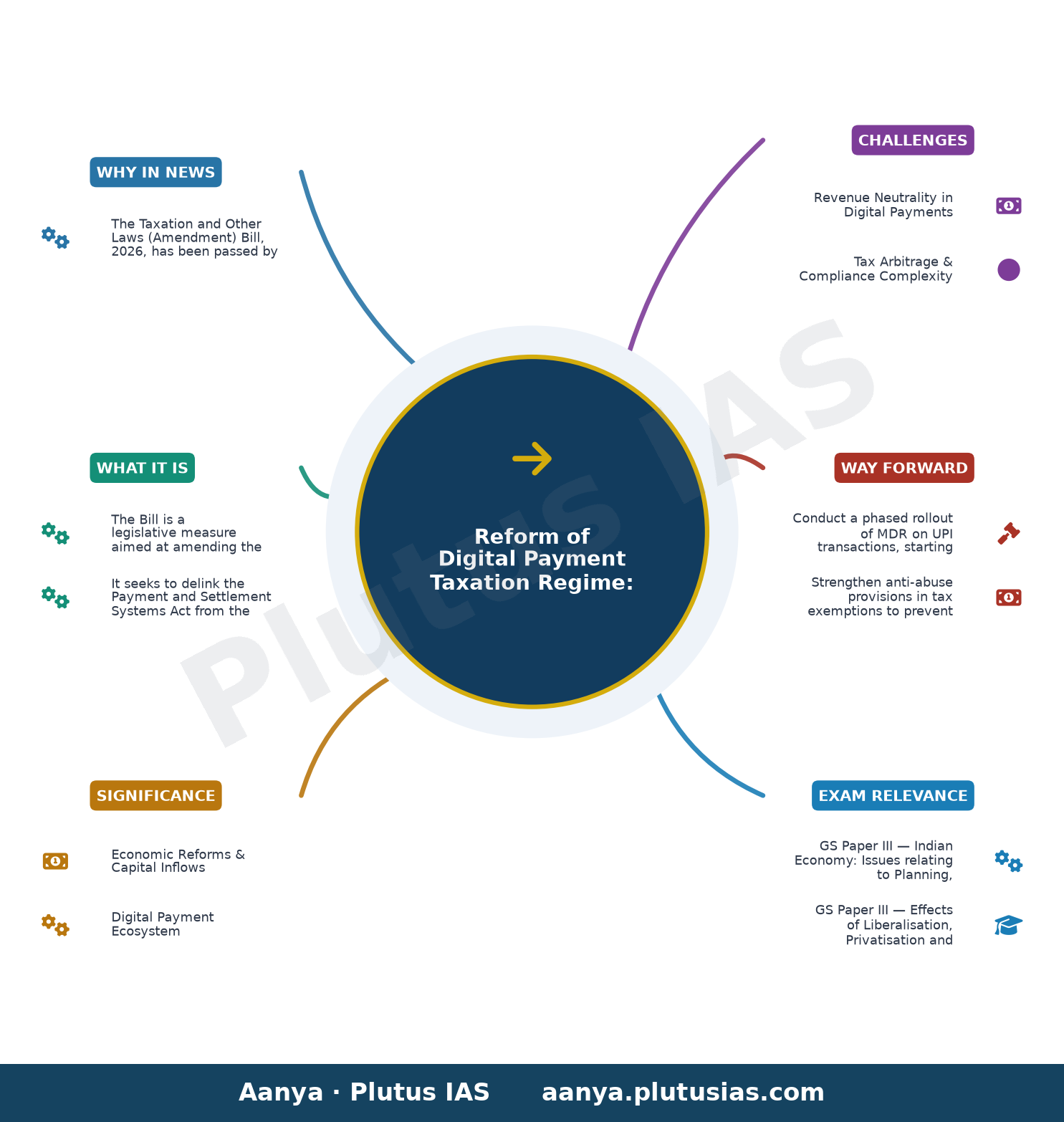
- GS Paper III — Indian Economy: Issues relating to Planning, Mobilization of Resources, Growth, Development and Employment | GS Paper III — Effects of Liberalisation, Privatisation and Globalisation on the Economy, Changes in Industrial Policy and their Effects on Industrial Growth
- Prelims: Merchant Discount Rate (MDR), Payment and Settlement Systems Act, 2007, UPI, RuPay, digital payments ecosystem, Foreign Portfolio Investors (FPIs), Contract Manufacturing under Income Tax Act, Customs-bonded warehouses, Data localisation norms for cloud service providers
- Essay: The role of digital public infrastructure in India’s economic transformation, Balancing innovation and regulation in the digital economy
Quick Revision: The Taxation and Other Laws (Amendment) Bill, 2026, introduces a legal framework for levying MDR on UPI transactions above a threshold, while extending fiscal incentives for electronic manufacturing and streamlining compliance for foreign cloud service providers.
Why is this in the news?
The Taxation and Other Laws (Amendment) Bill, 2026, has been passed by the Lok Sabha, introducing significant amendments to the Payment and Settlement Systems Act, 2007, and the Income Tax Act, 1961. The Bill introduces a legal framework for levying Merchant Discount Rate (MDR) on UPI transactions above a specified threshold, thereby potentially altering the zero-MDR regime that has hitherto incentivised digital payments. Additionally, the Bill extends fiscal incentives for electronic manufacturing and streamlines regulatory compliance for foreign cloud service providers, reflecting the government’s dual focus on promoting domestic industry and integrating global digital services.
Background
- The zero-MDR regime for UPI and RuPay transactions was introduced to promote digital payments and reduce the cost burden on consumers, aligning with the government’s vision of a cashless economy under initiatives such as Digital India and the Unified Payments Interface (UPI).
- India’s electronic manufacturing sector has been a key focus of the Production-Linked Incentive (PLI) schemes, particularly for mobile phones and components, to reduce import dependence and enhance self-reliance under the Atmanirbhar Bharat initiative.
- Foreign Portfolio Investors (FPIs) have historically benefited from tax exemptions on income from government securities, a provision extended by the Finance Act, 2020, to attract global capital into Indian debt markets.
- The global shift towards cloud computing and data localisation has necessitated regulatory reforms to ensure compliance with domestic data sovereignty requirements while facilitating ease of doing business for foreign cloud service providers.
What is the Taxation and Other Laws (Amendment) Bill, 2026?
- The Bill is a legislative measure aimed at amending the Income Tax Act, 1961, and the Payment and Settlement Systems Act, 2007, to introduce fiscal and regulatory reforms in digital payments and electronic manufacturing.
- It seeks to delink the Payment and Settlement Systems Act from the Income Tax Act, thereby enabling independent regulatory oversight of digital payment systems and their associated costs.
- The Bill introduces a legal framework for the levy of Merchant Discount Rate (MDR) on UPI transactions above a specified threshold, replacing the existing zero-MDR regime for certain transactions.
- It extends income-tax exemptions for foreign companies engaged in contract manufacturing of specified electronic goods in India until FY 2040-41, aligning with the PLI scheme’s long-term objectives.
- The legislation replaces an earlier ordinance (June 5, 2026) that granted the aforementioned tax exemptions, ensuring legislative continuity and compliance with parliamentary procedures.
Key Features
| Feature | Significance |
|---|---|
| Delinking Payment and Settlement Systems Act from Income Tax Act | Removes legal redundancy and enables independent regulatory oversight of digital payment systems. |
| Provision for MDR on UPI transactions | Introduces a mechanism to levy merchant discount rates on UPI payments exceeding ₹2,000, potentially shifting the cost burden from banks to merchants or consumers. |
| Extension of income-tax exemption for foreign companies in electronics manufacturing | Extends tax benefits until FY 2040-41 to incentivize long-term investment in domestic electronics production. |
| 15-year tax exemption for foreign firms storing components in bonded warehouses | Encourages establishment of supply-chain hubs within India, reducing import dependency for critical electronics components. |
| Simplification of regulatory framework for foreign cloud service providers | Removes approval requirements for data centre operations, fostering growth in India’s cloud infrastructure sector. |
Why it Matters
Economic Reforms & Capital Inflows
- Enhances policy predictability for foreign investors by extending tax exemptions and clarifying regulatory frameworks, aligning with the ‘Make in India’ and ‘Digital India’ objectives.
- Facilitates relocation of fund managers to India by relaxing tax residency conditions, potentially boosting the financial services sector.
- Supports the electronics manufacturing ecosystem by incentivizing contract manufacturing and supply-chain localization, reducing import reliance for high-tech goods.
Digital Payment Ecosystem
- Introduces MDR on UPI transactions for amounts above ₹2,000, addressing the revenue gap for payment system providers and banks while maintaining UPI’s accessibility for small transactions.
- Balances consumer convenience with fiscal sustainability by allowing selective charges, ensuring the digital payment infrastructure remains viable.
- Aligns with global practices where MDR is a standard revenue model for digital payment platforms.
Data Localization & Cloud Infrastructure
- Streamlines compliance for foreign cloud service providers by removing approval requirements, accelerating the development of India’s data centre infrastructure.
- Supports the ‘Data Localization’ policy by encouraging the use of Indian data centres, enhancing data sovereignty and cybersecurity resilience.
- Reduces operational bottlenecks for global tech firms, positioning India as a competitive hub for cloud services.
Fiscal Policy & Tax Rationalization
- Provides tax certainty for foreign portfolio investors (FPIs) by exempting interest income and capital gains from government securities, attracting portfolio capital inflows.
- Extends tax exemptions for electronics manufacturing until 2040-41, ensuring long-term policy stability for investors in this sector.
Challenges
1. Revenue Neutrality in Digital Payments
- The introduction of MDR on UPI transactions risks increasing costs for merchants and consumers, potentially dampening the adoption of digital payments for small transactions.
- The government must calibrate the MDR threshold and rates to avoid disproportionately burdening small businesses and low-value transactions.
UPSC Link: GS3: Digital Economy
2. Tax Arbitrage & Compliance Complexity
- Extending tax exemptions for foreign companies may lead to tax arbitrage, where firms structure operations to exploit loopholes rather than engaging in genuine economic activity.
- The simplification of tax residency rules for fund managers could inadvertently encourage tax avoidance if not accompanied by robust anti-abuse measures.
UPSC Link: GS3: Taxation
3. Data Localization vs. Global Competitiveness
- While removing approval requirements for cloud providers may accelerate infrastructure growth, it risks diluting data localization norms if not complemented by strong data protection laws.
- Over-reliance on foreign cloud providers without adequate domestic capacity could pose risks to data sovereignty and cybersecurity.
UPSC Link: GS3: Cyber Security
4. Supply Chain Vulnerabilities in Electronics Manufacturing
- The 15-year tax exemption for bonded warehouses incentivizes storage but does not address critical gaps in India’s electronics supply chain, such as semiconductor fabrication and rare earth material sourcing.
- Dependence on contract manufacturing leaves India vulnerable to global supply chain disruptions, as seen during the COVID-19 pandemic.
UPSC Link: GS3: Industrial Policy
5. Political Economy of Tax Reforms
- The passage of the bill without discussion highlights legislative challenges in a polarized parliament, raising concerns about the quality of democratic deliberation on economic reforms.
- Opposition sloganeering and adjournments may delay critical reforms, undermining investor confidence in policy stability.
UPSC Link: GS2: Parliament & State Legislatures
Challenges — UPSC Perspective
| Issue | Concern |
|---|---|
| Impact on UPI’s affordability | Risk of reduced adoption of digital payments for small transactions due to MDR imposition. |
| Tax arbitrage in electronics manufacturing | Potential misuse of tax exemptions without genuine value addition in India. |
| Data sovereignty vs. cloud infrastructure growth | Balancing rapid cloud adoption with stringent data localization requirements. |
| Supply chain over-reliance on contract manufacturing | Vulnerability to global disruptions in critical electronics components. |
| Legislative gridlock on economic reforms | Delays in passing reforms due to political polarization, eroding investor trust. |
Way Forward
- Conduct a phased rollout of MDR on UPI transactions, starting with high-value transactions to minimize disruption to small businesses.
- Strengthen anti-abuse provisions in tax exemptions to prevent profit-shifting and ensure genuine economic activity in India.
- Accelerate the development of domestic semiconductor fabrication and rare earth material processing to reduce import dependency.
- Enact a comprehensive Data Protection Law to complement the removal of approval requirements for cloud providers, ensuring data sovereignty.
- Establish a dedicated task force to monitor the impact of tax exemptions on electronics manufacturing and adjust policies as needed.
- Enhance parliamentary deliberation mechanisms to ensure economic reforms are debated thoroughly without procedural disruptions.
- Promote public-private partnerships to develop India’s data centre infrastructure, ensuring redundancy and resilience.
- Align the MDR framework with global best practices to maintain India’s competitiveness in digital payments.
UPSC Value Addition
Keywords for Mains Answer-Writing
Taxation and Other Laws (Amendment) Bill, 2026 · Merchant Discount Rate (MDR) on UPI transactions · Payment and Settlement Systems Act, 2007 · Zero-MDR regime for UPI and RuPay · Foreign Portfolio Investors (FPIs) tax exemption · Electronic manufacturing in India · Customs-bonded warehouses for electronic components · Data localisation for foreign cloud service providers · Income Tax Act amendments · Policy certainty for foreign investors
Constitutional & Policy Linkages
- [‘Article 265: Taxation must be by authority of law’, ‘Ensures MDR imposition is constitutionally valid.’]
- [‘Article 301: Freedom of trade and commerce’, ‘Balances digital payment regulations with economic freedom.’]
- [‘Article 304: Non-discriminatory taxation’, ‘Mandates fair treatment of domestic and foreign firms in tax policies.’]
Concept Flow
Lok Sabha passes Taxation and Other Laws (Amendment) Bill, 2026 → Delinks Payment and Settlement Systems Act from Income Tax Act → Enables MDR on UPI transactions above ₹2,000 → Introduces selective charges to sustain digital payment ecosystem. → Extension of tax exemptions for electronics manufacturing → Encourages foreign investment in contract manufacturing and bonded warehouses → Strengthens domestic supply chain for high-tech goods. → Simplification of regulatory framework for cloud providers → Removes approval requirements → Accelerates data centre growth in India → Supports data localization and cybersecurity resilience. → Policy certainty for foreign portfolio investors → Exempts interest income and capital gains on government securities → Attracts portfolio capital inflows → Boosts financial sector growth. → Relaxation of tax residency rules for fund managers → Facilitates relocation of financial services to India → Enhances India’s role in global fund management.
Prelims Practice Questions
Q1. Consider the following statements regarding the Taxation and Other Laws (Amendment) Bill, 2026:
1. The Bill seeks to delink the Payment and Settlement Systems Act, 2007 from the Income Tax Act.
2. It proposes to introduce Merchant Discount Rate (MDR) on all UPI transactions uniformly.
3. The Bill extends income-tax exemption for foreign companies engaged in electronic manufacturing in India until 2040-41.
4. It removes the requirement for approval for foreign cloud service providers to use Indian data centres.
How many of the above statements are correct?
- Only one
- Only two
- Only three
- All four
Answer: Only three — Statements 1, 3, and 4 are correct. Statement 2 is incorrect as the Bill empowers the government to specify transactions that must remain free of charges, not all UPI transactions uniformly.
Q2. Assertion (A): The Taxation and Other Laws (Amendment) Bill, 2026, aims to promote electronic manufacturing in India by providing tax incentives.
Reason (R): The Bill extends income-tax exemption for foreign companies engaged in producing specified electronic goods in India until 2040-41.
In the context of the above two statements, which one of the following is correct?
- Both A and R are true, and R is the correct explanation of A.
- Both A and R are true, but R is not the correct explanation of A.
- A is true, but R is false.
- A is false, but R is true.
Answer: Both A and R are true, and R is the correct explanation of A. — Both the assertion and reason are true, and the reason correctly explains the assertion as the tax incentives are a key measure to promote electronic manufacturing.
Q3. Match the following provisions of the Taxation and Other Laws (Amendment) Bill, 2026, with their respective objectives:
Column I (Provision) | Column II (Objective)
1. Delinking Payment and Settlement Systems Act from Income Tax Act | A. To provide policy certainty for foreign investors
2. Extension of income-tax exemption for electronic manufacturing | B. To simplify regulatory framework for foreign cloud providers
3. Removal of approval requirements for foreign cloud providers | C. To delink regulatory frameworks
4. Granting income-tax exemption to FPIs on government securities | D. To support domestic electronics manufacturing
Select the correct match:
- 1-C, 2-D, 3-B, 4-A
- 1-A, 2-B, 3-C, 4-D
- 1-D, 2-A, 3-B, 3-C
- 1-B, 2-D, 3-A, 4-C
Answer: 1-C, 2-D, 3-B, 4-A — The correct matches are: 1-C (delinking frameworks), 2-D (supporting manufacturing), 3-B (simplifying cloud provider regulations), 4-A (policy certainty for FPIs).
Mains Practice Question
✍ The Taxation and Other Laws (Amendment) Bill, 2026, seeks to introduce Merchant Discount Rate (MDR) on UPI transactions while simultaneously extending tax incentives for electronic manufacturing in India. Critically examine the implications of these provisions on digital payment ecosystems, foreign investment, and domestic manufacturing. Also, analyse the constitutional validity of empowering the Central Government to specify free-of-charge transactions under the Bill. (15 Marks)
Approach: MODEL-ANSWER SKELETON:
1. **Introduction (2 marks)**: Briefly outline the key provisions of the Bill—MDR on UPI transactions (above ₹2,000), tax exemptions for electronic manufacturing, and delinking of Payment and Settlement Systems Act from Income Tax Act.
2. **Implications on Digital Payment Ecosystem (4 marks)**:
– Discuss the potential impact of MDR on UPI adoption, financial inclusion, and cost burden on merchants.
– Analyse the RBI Governor’s stance on ‘someone has to pay the cost’ and the balance between sustainability and accessibility.
– Reference the zero-MDR regime and its role in India’s digital payment revolution (e.g., UPI’s global leadership).
3. **Foreign Investment and Policy Certainty (4 marks)**:
– Examine how tax exemptions for FPIs and electronic manufacturing incentives align with the ‘Make in India’ and ‘Digital India’ initiatives.
– Discuss the Bill’s role in providing ‘process certainty’ for foreign cloud providers and fund managers relocating to India.
– Cite the extension of tax exemptions until 2040-41 and its significance for long-term investment planning.
4. **Constitutional Validity of Government’s Empowerment (3 marks)**:
– Analyse the constitutional framework under Article 265 (taxation must be by authority of law) and Article 14 (reasonable classification).
– Discuss the doctrine of ‘legitimate expectation’ and whether the Bill violates it by altering the zero-MDR regime retroactively.
– Reference judicial precedents (e.g., *Union of India v. Azadi Bachao Andolan*) on tax exemptions and parliamentary supremacy.
5. **Conclusion (2 marks)**: Weigh the trade-offs between revenue generation (MDR) and digital inclusion, and the need for a balanced approach to sustain India’s digital economy while attracting investment.
Source: Times of India
Generated by AanyaAi for educational purpose.

- यूपीएससी के लिए सीएसआईआर साइक्विज: जानिए कैसे करें भागीदारी और लाभ उठाएं - September 21, 2026
- UPSC Alert: CSIR Science Quiz on My Bharat Portal for UPSC & State PCS 2026 - September 21, 2026
- एमएसएमई मंत्रालय ने शुरू किया विशेष अभियान 6.0: स्वच्छता और शिकायत निपटान पर जोर - September 21, 2026

No Comments