


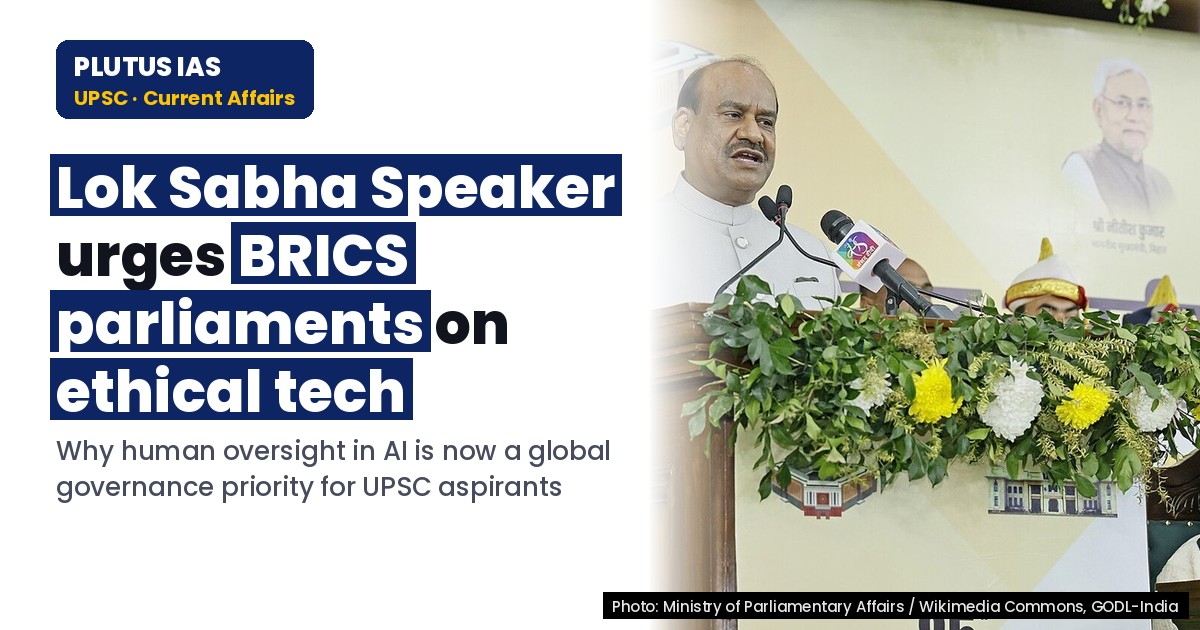
26 Oct Lok Sabha Speaker’s Call for Ethical Tech in BRICS Parliaments
✎ Ethical technology governance requires parliaments to legislate frameworks ensuring transparency, accountability, and human oversight in emerging technologies, aligning with global norms while addressing domestic priorities.
Subject Relevance — Where This Topic Fits
- GS Paper II — International Relations | GS Paper III — Science and Technology, Governance
- Prelims: BRICS Parliamentary Forum, Lok Sabha Speaker, Ethical AI, Human Oversight, Digital Governance, Parliamentary Diplomacy
- Essay: Ethical governance in the age of technological disruption, Balancing innovation with human-centric policy frameworks
Quick Revision: Ethical technology governance requires parliaments to legislate frameworks ensuring transparency, accountability, and human oversight in emerging technologies, aligning with global norms while addressing domestic priorities.
Why is this in the news?
The Lok Sabha Speaker, in his inaugural address at the 12th BRICS Parliamentary Forum (2026), underscored the imperative for BRICS parliaments to advocate for ethical, responsible, and transparent technology governance, with human oversight as the cornerstone. This directive aligns with global discourse on regulating emerging technologies while ensuring democratic accountability and public welfare.
Background
- The 12th BRICS Parliamentary Forum, held in 2026, is a platform for parliamentarians from BRICS nations (Brazil, Russia, India, China, and South Africa) to deliberate on shared governance challenges, including technological advancements and their societal implications.
- India, as the host of the 12th BRICS Parliamentary Forum, has positioned itself as a proponent of inclusive and ethical technological progress, reflecting its broader digital governance priorities.
- The call for ethical technology governance emerges amid rapid advancements in artificial intelligence (AI), biotechnology, and digital infrastructure, which pose complex regulatory and ethical dilemmas for policymakers.
- Parliamentary forums like BRICS serve as critical arenas for shaping international norms and frameworks on technology governance, given their legislative and oversight roles.
- The emphasis on human oversight aligns with constitutional principles of democratic accountability, where elected representatives must ensure that technological systems serve public interest without compromising rights or autonomy.
- The forum’s focus on ‘human-centric development’ echoes global initiatives such as the UNESCO Recommendation on the Ethics of AI and the EU’s AI Act, which prioritise ethical safeguards in technology deployment.
What is Ethical, Responsible, and Transparent Technology Governance?
- Ethical Technology Governance refers to the establishment of regulatory and institutional frameworks that ensure technology is developed and deployed in alignment with moral principles, human rights, and societal values.
- Responsible Technology Governance involves proactive measures by governments and institutions to anticipate, mitigate, and address potential harms arising from technological advancements, such as algorithmic bias, data privacy violations, or job displacement.
- Transparent Technology Governance mandates openness in the design, deployment, and regulation of technologies, enabling public scrutiny, accountability, and informed participation in decision-making processes.
- Human Oversight is a foundational principle ensuring that critical decisions in technology-driven systems remain subject to human judgment, thereby preventing the erosion of democratic accountability and individual autonomy.
- The Role of Parliamentarians includes legislative oversight, policy formulation, and international cooperation to create robust governance mechanisms for emerging technologies like AI, quantum computing, and biotechnology.
- Global Norms and Frameworks such as the UNESCO Recommendation on the Ethics of AI (2021), the OECD AI Principles, and the EU AI Act (2024) provide guiding frameworks for ethical technology governance.
- Challenges in Governance include balancing innovation with regulation, addressing cross-border data flows, ensuring equitable access to technology, and preventing misuse in areas like surveillance or deepfake proliferation.
- India’s Approach to Digital Governance, as articulated in policies like the Digital Personal Data Protection Act (2023) and the National Strategy for Artificial Intelligence, reflects a commitment to ethical, inclusive, and human-centric technological progress.
Key Features
| Feature | Significance |
|---|---|
| Ethical Technology | Ensures alignment of technological advancements with societal values, preventing misuse and safeguarding human rights. |
| Responsible Innovation | Promotes frameworks that prioritise societal well-being over unchecked technological proliferation, fostering inclusive growth. |
| Human Oversight | Mandates that human judgment remains central in decision-making processes involving technology, mitigating risks of automation bias. |
| Transparency in Governance | Advocates for clear, accountable processes in technology deployment, enhancing public trust and institutional credibility. |
| Multilateral Cooperation | Strengthens collaborative frameworks among BRICS nations to address global technological challenges through shared governance models. |
Why it Matters
Global Governance
- Establishes a normative framework for responsible technology adoption, addressing the vacuum in international regulatory standards.
- Encourages BRICS nations to adopt unified principles, reducing fragmentation in global digital governance.
- Positions India as a proactive leader in shaping ethical technology discourse within multilateral forums.
Technological Sovereignty
- Supports domestic innovation while ensuring adherence to ethical and legal safeguards, balancing autonomy with global best practices.
- Facilitates the development of indigenous technologies that align with societal needs and constitutional values.
- Enhances India’s capacity to regulate emerging technologies without compromising on democratic principles.
Public Trust and Accountability
- Reinforces the role of parliamentary institutions in overseeing technological advancements, ensuring democratic control.
- Promotes transparency in technology deployment, reducing risks of surveillance capitalism and algorithmic discrimination.
- Aligns with constitutional principles of justice, liberty, and equality by safeguarding citizen rights in the digital domain.
Strategic Diplomacy
- Strengthens BRICS as a platform for collaborative governance, distinct from Western-centric technological standards.
- Enables India to leverage its parliamentary diplomacy to influence global technology policy frameworks.
- Fosters South-South cooperation in addressing challenges like AI governance, data sovereignty, and digital public infrastructure.
Challenges
1. Regulatory Fragmentation
- Divergent national laws on technology governance create inconsistencies, complicating cross-border cooperation.
- Lack of harmonised standards may lead to regulatory arbitrage, where entities exploit weaker jurisdictions.
UPSC Link: GS II: Governance
2. Ethical Dilemmas in AI
- Ambiguity in defining ‘ethical’ AI raises questions about whose values should guide technological development.
- Risk of embedding biases in AI systems, leading to discriminatory outcomes in critical sectors like healthcare and justice.
UPSC Link: GS III: Science & Tech
3. Human Oversight vs. Efficiency
- Balancing the need for human oversight with the efficiency gains of automation remains a persistent challenge.
- Over-reliance on automation may erode institutional accountability and public trust in governance systems.
UPSC Link: GS II: Governance
4. Digital Divide and Inclusion
- Unequal access to technology exacerbates socio-economic disparities, undermining the goal of inclusive development.
- Ensuring equitable participation in technological advancements requires targeted policy interventions.
UPSC Link: GS I: Social Justice
5. Data Sovereignty and Privacy
- Cross-border data flows pose challenges to national security and individual privacy, necessitating robust legal frameworks.
- Lack of consensus on data governance complicates multilateral cooperation on ethical technology.
UPSC Link: GS II: Governance
6. Institutional Capacity Building
- Parliamentary institutions may lack the technical expertise to effectively oversee complex technological systems.
- Need for capacity-building programmes to equip legislators with the skills to engage with emerging technologies.
UPSC Link: GS II: Governance
Challenges — UPSC Perspective
| Issue | Concern |
|---|---|
| Regulatory Fragmentation | Inconsistencies in national laws may hinder cross-border technological cooperation. |
| Ethical Dilemmas in AI | Risk of biased or discriminatory outcomes in automated decision-making systems. |
| Human Oversight vs. Efficiency | Potential erosion of accountability due to over-reliance on automation. |
| Digital Divide and Inclusion | Unequal access to technology may widen socio-economic disparities. |
| Data Sovereignty and Privacy | Cross-border data flows threaten national security and individual privacy. |
| Institutional Capacity Building | Parliamentary institutions may lack expertise to oversee complex technologies. |
Way Forward
- Establish a BRICS-level working group to develop harmonised ethical guidelines for technology deployment, ensuring alignment with global best practices.
- Strengthen parliamentary oversight mechanisms through capacity-building programmes focused on emerging technologies like AI, blockchain, and quantum computing.
- Promote public-private partnerships to develop indigenous technologies that adhere to ethical and constitutional principles.
- Enhance transparency in technology governance by mandating open data policies and algorithmic accountability frameworks.
- Foster South-South cooperation through knowledge-sharing platforms to address challenges like data sovereignty and digital inclusion.
- Integrate ethical technology principles into national legislation, ensuring alignment with constitutional values and fundamental rights.
- Encourage BRICS nations to adopt multilateral agreements on data governance, balancing innovation with privacy and security concerns.
- Develop a BRICS parliamentary caucus for technology governance to facilitate regular dialogue and policy coordination among member states.
UPSC Value Addition
Keywords for Mains Answer-Writing
BRICS Parliamentary Forum · Lok Sabha Speaker · Ethical Technology · Human Oversight in AI · Responsible Innovation · BRICS 2026 · Parliamentary Diplomacy · Technology Governance · Global South Institutions · Digital Ethics · AI Regulation · BRICS Parliamentary Principles
Constitutional & Policy Linkages
- Article 21: Right to Life and Personal Liberty (protection against arbitrary technological surveillance)
- Article 14: Equality before Law (preventing algorithmic discrimination)
- Article 19(1)(a): Freedom of Speech and Expression (safeguarding against digital censorship)
- Article 51A(h): Fundamental Duties (promoting scientific temper and human-centric innovation)
Concept Flow
BRICS Parliamentary Forum identifies gaps in global technology governance → Lok Sabha Speaker proposes ethical, responsible, and transparent technology framework → Emphasis on human oversight to prevent automation bias → Call for multilateral cooperation to harmonise standards → Integration of constitutional principles into technological frameworks → Strengthening parliamentary oversight and institutional capacity → Implementation of ethical guidelines in national and international policy → Enhanced public trust and inclusive technological development
Prelims Practice Questions
Q1. Consider the following statements regarding the BRICS Parliamentary Forum:
1. It is an annual event where parliamentarians from BRICS nations deliberate on global governance issues.
2. The 12th BRICS Parliamentary Forum, 2026, was inaugurated by the Lok Sabha Speaker in New Delhi.
3. The forum exclusively focuses on economic cooperation and excludes discussions on technology governance.
How many of the above statements are correct?
- Only one
- Only two
- All three
- None
Answer: Only two — Statement 1 is correct as the BRICS Parliamentary Forum is indeed an annual event for parliamentarians. Statement 2 is correct as the 12th BRICS Parliamentary Forum, 2026, was inaugurated by the Lok Sabha Speaker in New Delhi. Statement 3 is incorrect as the forum includes discussions on technology governance, including ethical and responsible innovation.
Q2. Assertion (A): The Lok Sabha Speaker’s call for ethical, responsible, and transparent technology with human oversight aligns with the principles of the BRICS Parliamentary Forum.
Reason (R): The BRICS Parliamentary Forum prioritises parliamentary diplomacy over technological governance in its annual deliberations.
In the context of the above two statements, which one of the following is correct?
- Both A and R are true, and R is the correct explanation of A.
- Both A and R are true, but R is not the correct explanation of A.
- A is true, but R is false.
- A is false, but R is true.
Answer: A is true, but R is false. — Assertion (A) is true as the Lok Sabha Speaker’s call for ethical technology aligns with the BRICS Parliamentary Forum’s focus on parliamentary diplomacy and governance. Reason (R) is false because the forum does not prioritise parliamentary diplomacy over technological governance; rather, it includes both dimensions.
Q3. Match the following BRICS member countries with their respective parliamentary systems:
Column I (Country) | Column II (Parliamentary System Type)
——————-|——————————-
A. Brazil | 1. Bicameral Federal System
B. Russia | 2. Unicameral System
C. India | 3. Bicameral Federal System
D. China | 4. Unicameral System
Select the correct match:
- A-1, B-3, C-1, D-4
- A-1, B-4, C-3, D-2
- A-3, B-1, C-2, D-4
- A-2, B-3, C-1, D-4
Answer: A-1, B-4, C-3, D-2 — Brazil and India have bicameral federal parliamentary systems (A-1, C-3). Russia has a bicameral federal system (B-3). China has a unicameral system (D-4).
Mains Practice Question
✍ The Lok Sabha Speaker, in his address to the 12th BRICS Parliamentary Forum (2026), emphasised the need for ethical, responsible, and transparent technology with paramount human oversight. Discuss the significance of this stance in the context of global technology governance and parliamentary diplomacy. (15 Marks)
Approach: MODEL-ANSWER SKELETON:
1. **Contextualisation**: Define the BRICS Parliamentary Forum and its role in global governance, highlighting its focus on parliamentary diplomacy and cooperation among emerging economies.
2. **Technology Governance**: Explain the dimensions of ethical, responsible, and transparent technology, linking it to principles of accountability, inclusivity, and human-centric design. Cite relevant frameworks such as the UNESCO Recommendation on the Ethics of Artificial Intelligence (2021) or the EU AI Act (2024) as global benchmarks.
3. **Human Oversight**: Discuss the importance of human oversight in technology governance, particularly in AI and automated decision-making systems. Reference the principle of ‘human-in-the-loop’ and its role in mitigating risks of algorithmic bias, opacity, and unintended consequences.
4. **Parliamentary Role**: Analyse the role of parliaments in shaping technology governance through legislative oversight, ethical guidelines, and public accountability mechanisms. Highlight India’s initiatives such as the Digital Personal Data Protection Act (2023) and the establishment of the Global Partnership on Artificial Intelligence (GPAI).
5. **BRICS Perspective**: Examine how BRICS nations, as representatives of the Global South, can collectively advocate for equitable technology governance that balances innovation with ethical safeguards. Discuss the potential for BRICS to develop shared principles or frameworks for responsible innovation.
6. **Challenges and Critiques**: Acknowledge the challenges in achieving consensus among diverse nations with varying technological capacities and regulatory approaches. Critically assess the feasibility of harmonising ethical standards across BRICS member states.
7. **Conclusion**: Summarise the significance of the Lok Sabha Speaker’s call as a step towards fostering global cooperation in technology governance, while underscoring the need for sustained parliamentary engagement and institutional mechanisms to ensure ethical oversight.
Source: PIB (Press Information Bureau)
Generated by AanyaAi for educational purpose.
Related guides on our sites
- Current affairs for upsc 2026
- Best PSIR optional coaching for upsc
- Best PSIR optional teacher for upsc
- Best teacher of PSIR optional for upsc

- ESIC Karnataka dispute resolved: 37 contract workers reinstated with ₹7.4L dues paid - October 27, 2026
- तेलंगाना राज्यपाल ने प्रधानमंत्री से की बैठक: जानिए प्रमुख मुद्दे - October 27, 2026
- AI in Cybersecurity: How Black October Reshaped Digital Safety for UPSC - October 27, 2026

No Comments