


11 Aug Lok Sabha to Table Justice Varma Inquiry Report on August 12
✎ The removal of a judge under Article 124(4) requires a special majority in Parliament, with charges investigated by a committee, as per the Judges (Inquiry) Act, 1968.
Subject Relevance — Where This Topic Fits
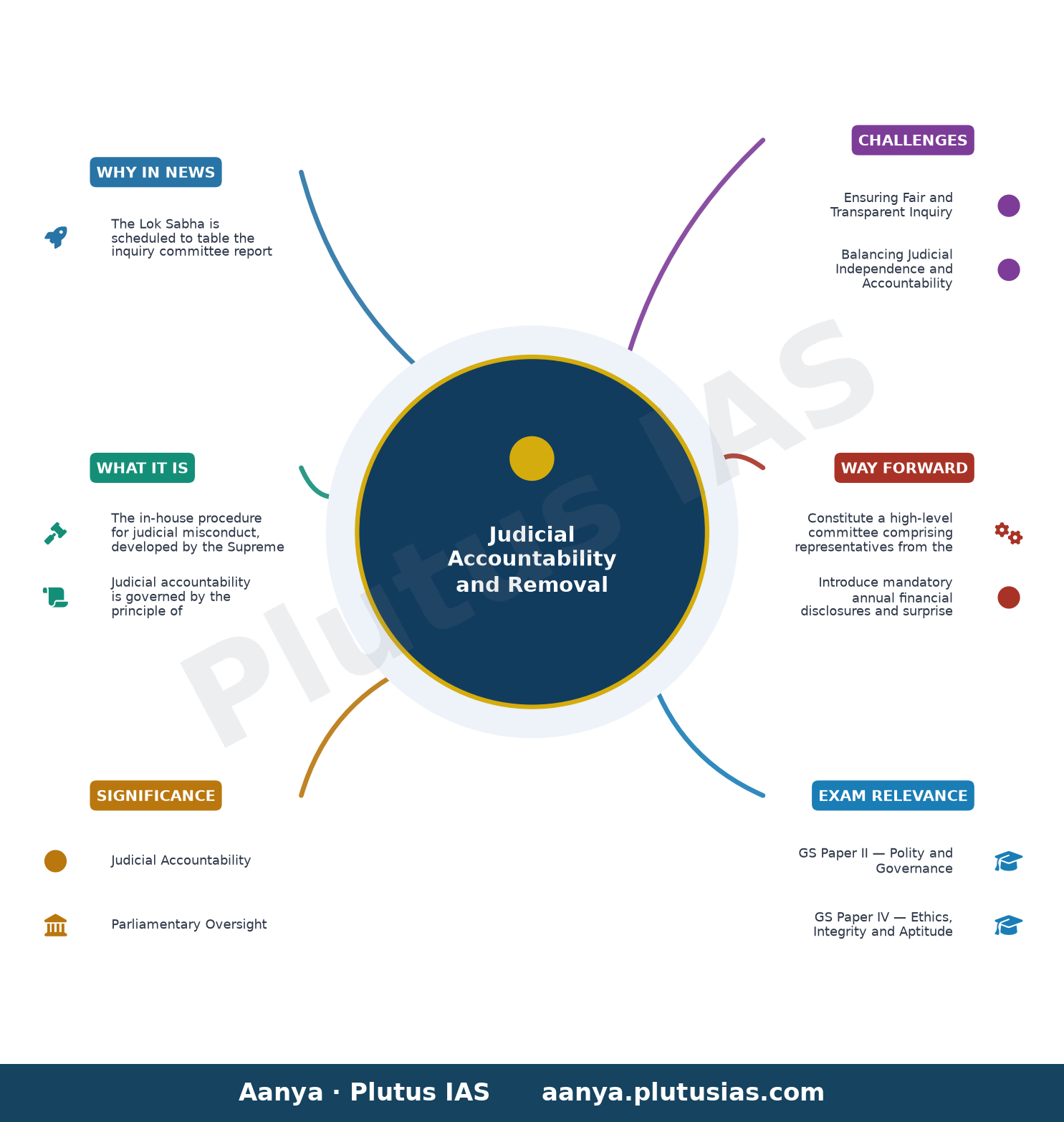
- GS Paper II — Polity and Governance | GS Paper IV — Ethics, Integrity and Aptitude
- Prelims: Judicial accountability, removal of judges, constitutional provisions under Article 124(4), impeachment process, collegium system, Supreme Court Rules 1950, in-house procedure for judicial misconduct
- Essay: Judicial independence versus judicial accountability: Balancing constitutional safeguards and public trust, Ethics in public life: The role of transparency and institutional probity in governance
Quick Revision: The removal of a judge under Article 124(4) requires a special majority in Parliament, with charges investigated by a committee, as per the Judges (Inquiry) Act, 1968.
Why is this in the news?
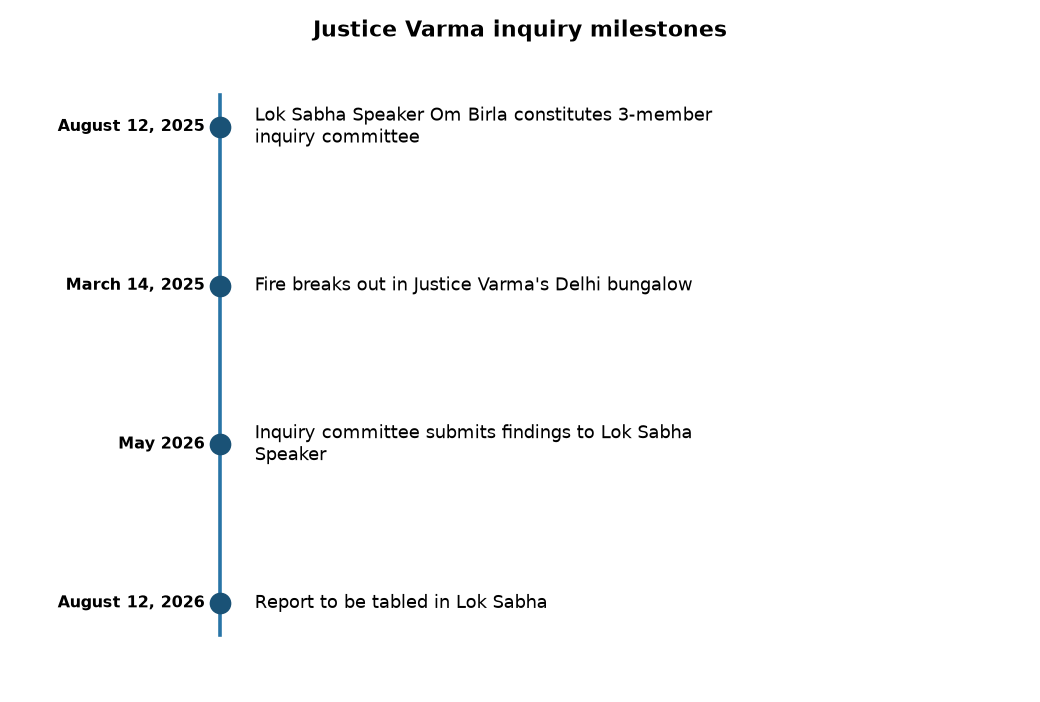
The Lok Sabha is scheduled to table the inquiry committee report on Justice Yashwant Varma on August 12, 2026, concerning allegations of unaccounted cash discovered at his official residence. This development underscores the constitutional mechanisms for judicial accountability, the procedural safeguards for judges, and the ethical imperatives governing judicial conduct. The report’s submission marks a critical juncture in assessing the efficacy of existing institutional frameworks in addressing allegations of misconduct against judicial officers.
Background
- The controversy arose following a fire incident at Justice Varma’s official residence in March 2025, during which firefighters allegedly discovered partially burnt currency notes in a storeroom, prompting allegations of unaccounted cash.
- Justice Varma, a former judge of the Delhi High Court, was repatriated to his parent court, the Allahabad High Court, following the controversy, highlighting the procedural aspects of judicial transfers and disciplinary actions.
- The inquiry committee submitted its findings to the Lok Sabha Speaker in May 2026, and the report is now set to be laid before the House, marking a procedural milestone in the accountability process.
- Justice Varma’s resignation prior to the completion of the inquiry process raises questions about the interplay between judicial accountability mechanisms and the ethical obligations of judges.
- The Law Ministry’s pending notification of the resignation underscores the administrative and procedural steps required in the aftermath of judicial misconduct allegations.
Judicial Accountability and Removal Proceedings: Constitutional and Institutional Framework
- The in-house procedure for judicial misconduct, developed by the Supreme Court in 1999, allows for the investigation of allegations against judges without recourse to impeachment, ensuring a balance between judicial independence and accountability.
- Judicial accountability is governed by the principle of ‘independence of the judiciary,’ which is enshrined in the Constitution and reinforced by judicial conventions, ensuring that judges are insulated from external pressures.
- The discovery of unaccounted cash or other financial irregularities at a judge’s residence may constitute grounds for removal under the broader rubric of ‘misbehaviour’ or ‘incapacity,’ as envisaged in the constitutional provisions.
- The role of the collegium system in judicial appointments and transfers is pivotal, as it ensures that only judges of the highest integrity are elevated to higher courts, thereby mitigating risks of misconduct.
- The inquiry committee’s report, once tabled in Parliament, will undergo scrutiny, with the possibility of further action, including impeachment, if the allegations are substantiated.
- The case highlights the ethical obligations of judges, including the duty to maintain financial probity and transparency, as enshrined in the ‘Restatement of Values of Judicial Life’ adopted by the Supreme Court.
Key Features
| Feature | Significance |
|---|---|
| Inquiry Committee Composition | A three-member committee was constituted by the Lok Sabha Speaker under the constitutional authority vested in the Speaker for maintaining parliamentary standards, ensuring due process in judicial conduct inquiries. |
| Allegation of Unaccounted Cash | The discovery of partially burnt currency notes in an official residence raises questions about financial propriety, transparency, and adherence to norms governing public officials, including judges. |
| Fire Incident and Evidence | The fire at the residence led to the recovery of burnt currency, necessitating a forensic investigation to determine the origin, value, and legitimacy of the cash, which is critical for establishing facts. |
| Resignation of Justice Varma | The resignation of a sitting judge, while removal proceedings are pending, highlights the procedural and ethical dimensions of judicial accountability and the consequences of allegations against office-holders. |
| Parliamentary Procedure for Tabling Report | The tabling of the inquiry report in the Lok Sabha follows established parliamentary practice, ensuring transparency and allowing the legislature to scrutinise the findings and recommendations of the committee. |
Why it Matters
Judicial Accountability
- The incident underscores the importance of judicial accountability mechanisms, including the role of the legislature in scrutinising allegations against judges, as outlined in the Constitution and judicial conduct rules.
- It highlights the need for robust internal mechanisms within the judiciary to prevent and address misconduct, ensuring public trust in the institution.
- The resignation of a judge prior to the completion of removal proceedings raises questions about the effectiveness of existing disciplinary frameworks and the balance between due process and expeditious resolution.
- The case exemplifies the intersection of judicial independence and accountability, a core principle in democratic governance.
Parliamentary Oversight
- The tabling of the inquiry report in Parliament demonstrates the legislature’s oversight role in matters concerning judicial conduct, reinforcing the separation of powers and checks and balances.
- It provides an opportunity for Parliament to debate the findings and recommend systemic reforms to prevent similar incidents in the future.
- The process also serves as a deterrent against financial impropriety among public officials, including judges, by setting a precedent for transparency and accountability.
- Parliamentary scrutiny of such reports enhances public confidence in the integrity of institutions.
Institutional Integrity
- The incident challenges the perception of institutional integrity, particularly in the judiciary, where public trust is paramount for the effective functioning of the rule of law.
- It necessitates a review of existing protocols for the handling of cash and valuables in official residences of judges, including storage, accounting, and audit mechanisms.
- The case may prompt the judiciary to adopt stricter guidelines for financial disclosures and asset management by its members.
- Institutional reforms must balance the need for accountability with the protection of judicial independence.
Rule of Law and Due Process
- The incident reinforces the principle that no individual, including a judge, is above the law, and that allegations of misconduct must be investigated through due process.
- The resignation of Justice Varma, while removal proceedings were pending, highlights the complexities of balancing justice with procedural fairness and the potential for unintended consequences in disciplinary actions.
- The case underscores the importance of a fair and transparent inquiry process, ensuring that findings are based on evidence and not influenced by extraneous factors.
- The tabling of the report in Parliament allows for a democratic review of the inquiry’s conclusions, ensuring that justice is seen to be done.
Challenges
1. Ensuring Fair and Transparent Inquiry
- The inquiry must adhere to principles of natural justice, ensuring that Justice Varma is given a fair opportunity to respond to the allegations and present evidence in his defence.
- The committee must avoid any bias or pre-judgment, maintaining impartiality throughout the investigation to uphold the integrity of the process.
- The forensic analysis of the burnt currency must be conducted by independent experts to ensure the accuracy and reliability of the findings.
- The committee must document all evidence and testimonies meticulously to prevent any challenges to the credibility of the inquiry.
UPSC Link: Constitutional provisions on natural justice
2. Balancing Judicial Independence and Accountability
- Judicial independence is a cornerstone of the rule of law, and any inquiry into a judge’s conduct must not undermine this principle by subjecting judges to politically motivated or frivolous allegations.
- The process must ensure that the inquiry does not become a tool for harassment or intimidation of judges, which could deter qualified individuals from joining the judiciary.
- The judiciary must retain the primary responsibility for disciplining its members, with parliamentary oversight serving as a secondary check rather than a primary mechanism.
- The case highlights the need for clear guidelines on the separation of powers between the judiciary and the legislature in matters of judicial conduct.
UPSC Link: Judicial independence and accountability
3. Addressing Financial Transparency in Public Offices
- The discovery of unaccounted cash raises questions about the financial management practices in official residences, including storage, accounting, and audit mechanisms.
- There is a need for stricter protocols governing the handling of cash and valuables by public officials, including judges, to prevent financial impropriety.
- The incident underscores the importance of regular audits and surprise inspections of official residences to ensure compliance with financial norms.
- The case may prompt the introduction of digital record-keeping systems for financial transactions in official residences to enhance transparency.
UPSC Link: Financial accountability in governance
4. Managing Public Perception and Institutional Trust
- The incident has the potential to erode public trust in the judiciary, particularly if the inquiry process is perceived as opaque or politically influenced.
- The judiciary must proactively communicate the findings and conclusions of the inquiry to the public to maintain transparency and credibility.
- The case highlights the need for the judiciary to adopt a more proactive approach to addressing public concerns about judicial conduct and integrity.
- The tabling of the report in Parliament provides an opportunity for the legislature to reassure the public about the robustness of the inquiry and the commitment to accountability.
UPSC Link: Public trust in institutions
Challenges — UPSC Perspective
| Issue | Concern |
|---|---|
| Financial Management in Official Residences | Lack of robust protocols for the storage, accounting, and audit of cash and valuables in official residences of judges. |
| Due Process in Judicial Inquiries | Risk of procedural lapses or bias in the inquiry committee, which could undermine the fairness and credibility of the process. |
| Balancing Independence and Accountability | Potential for overreach by the legislature in matters of judicial conduct, which could compromise judicial independence. |
| Public Trust and Institutional Credibility | Erosion of public confidence in the judiciary due to perceived opacity or political interference in the inquiry process. |
| Forensic Integrity of Evidence | Challenges in accurately determining the origin, value, and legitimacy of burnt currency notes recovered from the residence. |
| Resignation and Removal Proceedings | Complexities arising from the resignation of a judge during ongoing removal proceedings, including legal and procedural ambiguities. |
Way Forward
- Constitute a high-level committee comprising representatives from the judiciary, legislature, and independent experts to review and strengthen protocols for the financial management of official residences of judges, including storage, accounting, and audit mechanisms.
- Introduce mandatory annual financial disclosures and surprise inspections of official residences of judges to ensure compliance with transparency norms and prevent financial impropriety.
- Establish a dedicated grievance redressal mechanism within the judiciary to address allegations of misconduct promptly and transparently, ensuring due process and natural justice.
- Enhance public communication strategies by the judiciary to proactively share findings and conclusions of inquiries, thereby maintaining transparency and public trust.
- Review and codify the guidelines for the resignation of judges under investigation, ensuring clarity on the legal and procedural implications of such resignations.
- Strengthen forensic capabilities within the judiciary to ensure the accurate and reliable analysis of evidence, including burnt currency notes, in cases involving financial impropriety.
- Promote inter-institutional dialogue between the judiciary and the legislature to clarify the roles and responsibilities in matters of judicial accountability, ensuring a balanced approach to oversight and independence.
- Develop a national framework for the management of cash and valuables in official residences of public officials, including judges, to standardise practices and enhance accountability across all branches of government.
UPSC Value Addition
Keywords for Mains Answer-Writing
Judicial accountability · Constitutional provisions for removal of judges · Inquiry Committee under Article 217 · Independence of Judiciary · Article 124(4) of the Constitution · Provisions of the Judges (Inquiry) Act, 1968 · Procedure for removal of judges · Judicial ethics and conduct · Constitutional morality · Separation of powers
Constitutional & Policy Linkages
- Article 124(4) – Procedure for removal of a judge of the Supreme Court or High Court
- Article 217 – Appointment and conditions of office of a High Court judge
- Article 14 – Right to equality before law
- Article 19(1)(a) – Freedom of speech and expression (in the context of public scrutiny of judicial conduct)
- Article 323B – Tribunals for administrative matters (potential relevance to institutional inquiries)
Concept Flow
Allegation of unaccounted cash in official residence → Fire incident at residence → Discovery of partially burnt currency → Constitution of inquiry committee by Lok Sabha Speaker → Investigation and submission of report → Resignation of Justice Varma → Tabling of report in Lok Sabha → Parliamentary scrutiny of findings → Debate on systemic reforms → Implementation of reforms to enhance transparency and accountability
Prelims Practice Questions
Q1. Consider the following statements regarding the removal of judges in India:
1. The removal of a judge can be initiated by either House of Parliament.
2. The Judges (Inquiry) Act, 1968, provides the procedure for the investigation of misbehaviour or incapacity of a judge.
3. A motion for removal of a judge must be signed by at least 50 members of the House in which it is introduced.
4. The final decision on the removal of a judge is taken by the Supreme Court.
How many of the above statements are correct?
- Only one
- Only two
- Only three
- All
Answer: Only three — Statements 1 and 2 are correct. Statement 3 is incorrect as the motion must be signed by at least 100 members in Lok Sabha or 50 in Rajya Sabha. Statement 4 is incorrect as the final decision is taken by Parliament, not the Supreme Court.
Q2. Assertion (A): The Constitution of India provides for the removal of judges through a process that involves both Houses of Parliament and the President.
Reason (R): The process is designed to ensure judicial accountability while safeguarding the independence of the judiciary.
Options:
A. Both A and R are true, and R is the correct explanation of A.
B. Both A and R are true, but R is not the correct explanation of A.
C. A is true, but R is false.
D. A is false, but R is true.
- A
- B
- C
- D
Answer: B — Both the assertion and reason are true. The removal process under Article 124(4) involves Parliament and the President, and the design of the process balances judicial accountability with independence.
Q3. Match the following provisions with their respective constitutional articles:
Column I
1. Procedure for removal of judges
2. Appointment of judges
3. Salaries and allowances of judges
4. Oath or affirmation of judges
Column II
A. Article 124(2)
B. Article 124(4)
C. Article 125
D. Article 129
Options:
A. 1-D, 2-A, 3-C, 4-B
B. 1-B, 2-A, 3-C, 4-D
C. 1-C, 2-B, 3-A, 4-D
D. 1-A, 2-D, 3-B, 4-C
- A
- B
- C
- D
Answer: B — 1-B (Article 124(4) details removal), 2-A (Article 124(2) deals with appointment), 3-C (Article 125 covers salaries), 4-D (Article 129 confers power to punish for contempt).
Mains Practice Question
✍ The constitutional framework governing the removal of judges in India is designed to balance judicial accountability with the independence of the judiciary. Critically examine this proposition with reference to the recent inquiry into allegations against Justice Yashwant Varma. Also, outline the procedure for the removal of a judge under the Constitution of India. (15 Marks)
Approach: MODEL-ANSWER SKELETON:
1. **Constitutional Provisions**:
– Article 124(4) of the Constitution: Grounds for removal (proved misbehaviour or incapacity).
– Article 217: Jurisdiction of the High Court, including removal.
– Judges (Inquiry) Act, 1968: Procedure for investigation.
2. **Judicial Accountability vs. Independence**:
– **Accountability**: Need for transparency and public trust; examples of past removal motions (e.g., Justice V. Ramaswami).
– **Independence**: Doctrine of separation of powers; fears of executive overreach; judicial self-governance.
– **Balancing Mechanism**: Role of the inquiry committee under the Judges (Inquiry) Act; requirement of a special majority in Parliament.
3. **Recent Context (Justice Varma Case)**:
– Allegations of unaccounted cash and partial burning of currency notes.
– Resignation of Justice Varma and its implications for the removal process.
– Role of the inquiry committee report to be tabled in Lok Sabha.
4. **Procedure for Removal**:
– **Initiation**: Motion signed by at least 100 members (Lok Sabha) or 50 members (Rajya Sabha).
– **Investigation**: Inquiry committee appointed by the Speaker/Chairman; evidence collected and reported.
– **Parliamentary Proceedings**: Both Houses debate the report; special majority (two-thirds present and voting) required.
– **Presidential Role**: Final assent of the President for removal.
5. **Critical Analysis**:
– **Strengths**: Ensures checks and balances; prevents arbitrary removals.
– **Weaknesses**: Lengthy process; potential for politicisation; low success rate of removal motions.
– **Suggestions for Reform**: Streamlining the process; enhancing transparency in inquiry proceedings; clarifying grounds for removal.
6. **Conclusion**:
– The constitutional framework, while robust, requires periodic review to adapt to contemporary challenges while preserving judicial independence.
Source: The Hindu
Generated by AanyaAi for educational purpose.

- यूएस-चीन एआई हॉटलाइन: क्यों शी जिनपिंग-ट्रम्प शिखर वार्ता में टैरिफ से आगे बढ़ा ‘सुपर इंटेलिजेंस’ का मुद्दा - September 26, 2026
- US-China AI Hotline: Xi-Trump Summit’s Game-Changing AI Dialogue Explained - September 26, 2026
- आईसीएआर द्वारा स्वच्छता अभियान: गणेश विसर्जन से पर्यावरण संरक्षण तक - September 26, 2026

No Comments