


08 Aug Madras HC: Community Certificate Verification Permissible Even After Retirement
✎ Fraudulent appointments secured through fake community certificates are *ab initio* void, and verification processes for such certificates can legally proceed even after retirement to uphold constitutional accountability and…
Subject Relevance — Where This Topic Fits
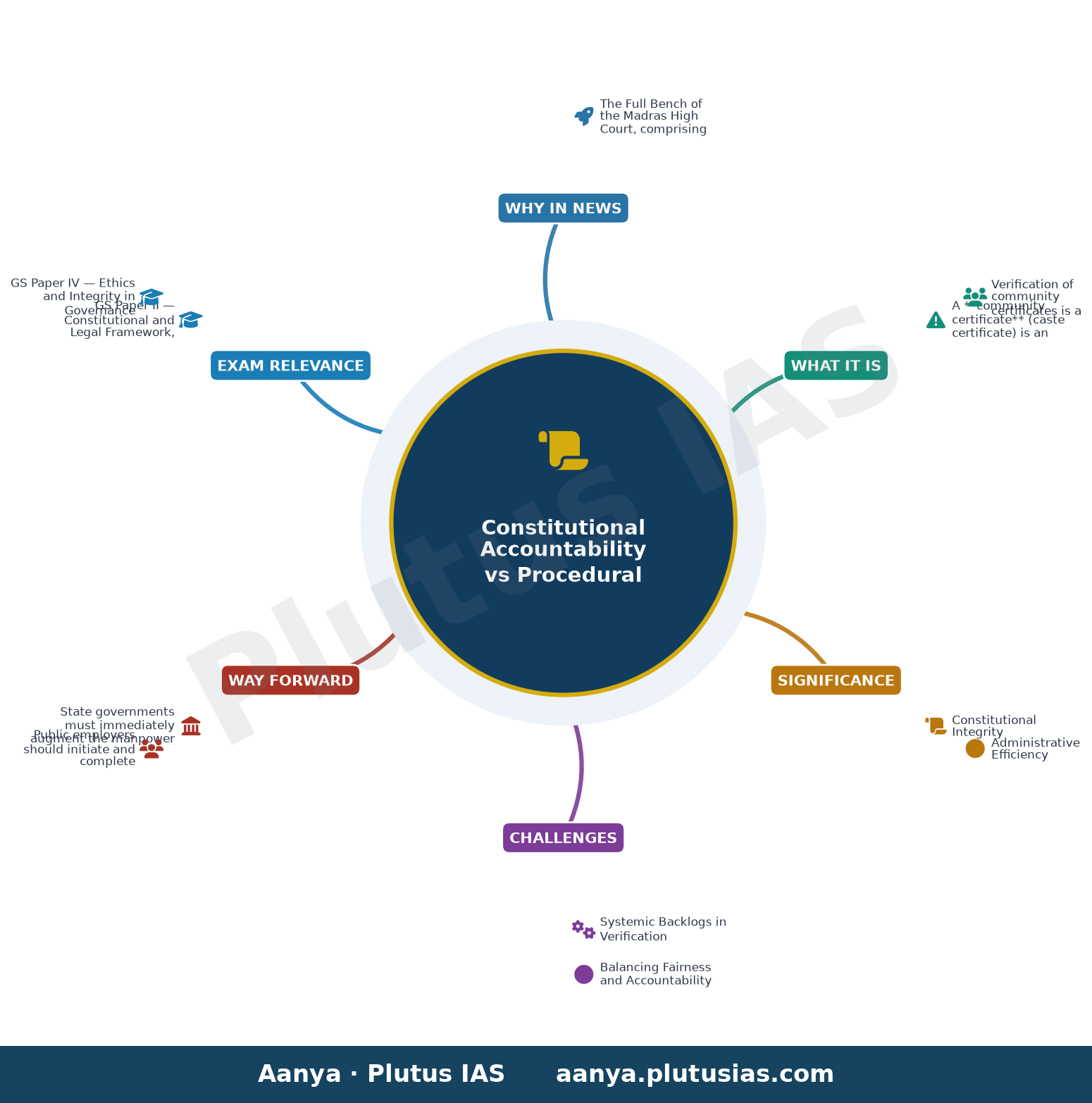
- GS Paper II — Constitutional and Legal Framework, Fundamental Rights and Duties | GS Paper IV — Ethics and Integrity in Governance
- Prelims: Community Certificate Verification, Reservation Policy, Article 16(4), Kumari Madhuri Patil Case, Ab Initio Void Appointment, Scrutiny Committees, Anthropological Experts, Fast-Track Inquiries, Retiral Benefits, Procedural Laches
- Essay: The tension between constitutional morality and procedural justice in administrative governance, Ethical dilemmas in public service: balancing fairness with accountability
Quick Revision: Fraudulent appointments secured through fake community certificates are *ab initio* void, and verification processes for such certificates can legally proceed even after retirement to uphold constitutional accountability and prevent misuse of reservation benefits.
Why is this in the news?
The Full Bench of the Madras High Court, comprising Chief Justice Sushrut Arvind Dharmadhikari and Justices K. Kumaresh Babu and G. Arul Murugan, delivered a landmark judgment on 30 July 2026, affirming the legality of post-retirement verification of community certificates for government employees. The ruling resolves a judicial conflict and reinforces the principle that appointments secured through fraud are void *ab initio*, thereby negating any protection of retiral benefits. The judgment also underscores the obligation of public employers to initiate verification processes within the early years of service, curbing dilatory tactics and ensuring rigorous compliance with the Supreme Court’s verification framework established in *Kumari Madhuri Patil v. Additional Commissioner, Tribal Development* (1994).
Background
- The issue arose from conflicting decisions by Division Benches of the Madras High Court on whether verification of community certificates could proceed after an employee’s retirement, particularly when the verification process was initiated prior to superannuation.
- The Supreme Court’s landmark judgment in *Kumari Madhuri Patil v. Additional Commissioner, Tribal Development* (1994) laid down a multi-point verification matrix for caste certificates, including the role of scrutiny committees and the requirement for anthropological experts.
- The Constitution (77th Amendment) Act, 1995, inserted Article 16(4A) to enable reservations in promotions for Scheduled Castes and Scheduled Tribes, but did not alter the foundational requirement of genuineness in caste claims.
- Post-1995, several state governments, including Tamil Nadu, established State Level Scrutiny Committees and district-level vigilance committees to verify caste certificates, though systemic delays and backlogs persist.
- The doctrine of *ab initio* void appointments holds that any appointment secured through fraud is legally invalid from the inception, rendering subsequent actions, including retirement benefits, unenforceable.
- The judgment aligns with the constitutional mandate of equality (Article 14) and non-discrimination (Article 15), ensuring that reservation benefits are not misappropriated through fraudulent means.
What is Community Certificate Verification in Public Employment?
- A **community certificate** (caste certificate) is an official document issued by a competent authority certifying an individual’s caste or community status, essential for availing reservation benefits in public employment and education under Articles 15(4) and 16(4) of the Constitution.
- Verification of community certificates is a **procedural safeguard** to prevent misuse of reservation quotas, ensuring that only eligible candidates benefit from affirmative action policies.
- The **Supreme Court’s framework** in *Kumari Madhuri Patil (1994)* mandates a multi-point verification process, including scrutiny by State Level Scrutiny Committees, district-level committees, and the use of anthropological experts to authenticate caste claims.
- Verification can be initiated **at any stage** of an employee’s service, including post-retirement, if fraud is suspected, as appointments secured through fraud are *ab initio* void and do not confer any legal rights.
- The **Madras High Court’s judgment** clarifies that the initiation of verification prior to retirement does not lapse upon superannuation, and the process must be completed to its logical conclusion to uphold constitutional accountability.
- Public employers are **obligated to initiate verification within the initial years of service** to prevent dilatory tactics and ensure timely resolution of disputes, as directed by the court.
- The judgment reinforces the principle that **fraud has no expiry date**, and retiral benefits derived from fraudulent appointments cannot be protected under any procedural law.
- Institutional strengthening, including the augmentation of manpower and anthropological expertise in scrutiny committees, is critical to eliminate systemic backlogs and ensure strict compliance with verification protocols.
Key Features
| Feature | Significance |
|---|---|
| Full Bench ruling on post-retirement verification | Establishes that caste verification can proceed even after retirement, as fraud in appointment is void *ab initio* and does not lapse with superannuation. |
| Retiral benefits not protected for void appointments | Clarifies that retirement or service benefits cannot shield employees whose appointments were secured through fraudulent caste certificates. |
| Empowerment of scrutiny committees | Reinforces the authority of State and district-level committees to verify caste certificates at any stage, irrespective of the year of issuance or appointment. |
| Fast-track verification post-retirement | Directs public employers to complete verification processes early in service and mandates expeditious resolution if initiated post-retirement. |
| Institutional strengthening with anthropological experts | Orders augmentation of manpower and expert support in scrutiny committees to eliminate systemic backlogs and ensure strict compliance with verification protocols. |
Why it Matters
Constitutional Integrity
- Upholds the principle of equality (Article 14) by ensuring that appointments secured through fraud do not enjoy immunity, thereby preventing misuse of reservation benefits.
- Reinforces the doctrine of *ab initio* voidness, where fraudulent acts are deemed legally invalid from inception, irrespective of subsequent events like retirement.
- Prevents dilution of constitutional accountability by disallowing procedural delays to defeat the purpose of verification.
Administrative Efficiency
- Mandates early verification to avoid accumulation of backlogs and ensures timely resolution of disputes related to caste certificates.
- Directs institutional strengthening of scrutiny committees to enhance their capacity for rigorous and expeditious verification processes.
- Promotes transparency and accountability in public employment by preventing misuse of reservation quotas through fraudulent means.
Judicial Precedent
- Clarifies the legal position on post-retirement verification, resolving conflicting decisions by coordinate benches and consolidating judicial interpretation.
- Affirms the Supreme Court’s judgment in *Kumari Madhuri Patil v. Addl. Commissioner, Tribal Development* (1994), which established the multi-point verification matrix for caste certificates.
- Rejects the notion of a statute of limitations for fraud, emphasizing that constitutional accountability cannot be time-barred.
Challenges
1. Systemic Backlogs in Verification
- Existing delays in verification processes due to inadequate manpower and lack of anthropological expertise in scrutiny committees.
- Risk of prolonged litigation and harassment of employees due to delayed verification processes.
- Potential for misuse of procedural delays to protect employees facing verification, undermining the purpose of the process.
UPSC Link: GS-II: Administrative Reforms
2. Balancing Fairness and Accountability
- Ensuring that verification processes are rigorous yet fair, avoiding arbitrary or politically motivated investigations.
- Preventing harassment of genuine employees while effectively identifying and penalizing fraudulent cases.
- Addressing concerns of employees who may have served for decades under the assumption of valid appointments.
UPSC Link: GS-IV: Ethics in Governance
3. Institutional Capacity Constraints
- Limited resources in State and district-level scrutiny committees to handle the volume of verification requests efficiently.
- Need for specialized training and anthropological expertise to accurately assess caste certificates and prevent misclassification.
- Coordination challenges between public employers, scrutiny committees, and legal authorities in completing verification processes.
UPSC Link: GS-II: Governance
4. Legal and Procedural Complexities
- Interpretation of *ab initio* voidness and its implications for retiral benefits, requiring clear legal guidance for implementation.
- Ensuring that verification processes initiated pre-retirement are not abandoned upon superannuation, as mandated by the judgment.
- Addressing potential conflicts between the judgment and existing service rules or administrative practices.
UPSC Link: GS-II: Judiciary
Challenges — UPSC Perspective
| Issue | Concern |
|---|---|
| Delayed Verification Processes | Prolonged investigations risk undermining the purpose of verification and may lead to harassment of employees. |
| Inadequate Institutional Capacity | Scrutiny committees lack sufficient manpower and expertise, leading to backlogs and inefficiencies. |
| Balancing Fairness and Accountability | Ensuring verification is rigorous yet fair to avoid arbitrary or politically motivated actions. |
| Legal Interpretation of *Ab Initio* Voidness | Clarifying the implications of fraudulent appointments on retiral benefits and service history. |
| Coordination Among Stakeholders | Ensuring seamless collaboration between public employers, scrutiny committees, and legal authorities for timely resolution. |
Way Forward
- State governments must immediately augment the manpower and expertise in State and district-level scrutiny committees to eliminate backlogs.
- Public employers should initiate and complete verification of community certificates within the initial years of an employee’s service, as directed by the court.
- Fast-track mechanisms should be established for post-retirement verifications to ensure expeditious resolution without undue harassment.
- Clear guidelines should be issued to delineate the process for verifying caste certificates, including the role of anthropological experts and multi-point verification matrices.
- Judicial and administrative authorities should collaborate to ensure that verification processes are conducted fairly, transparently, and in accordance with constitutional principles.
- Training programs should be conducted for scrutiny committee members to enhance their capacity for accurate and efficient verification.
- Mechanisms for grievance redressal should be established to address concerns of employees facing verification, ensuring due process and natural justice.
- Periodic reviews should be conducted to assess the progress of verification processes and address systemic bottlenecks.
UPSC Value Addition
Keywords for Mains Answer-Writing
Madras High Court Full Bench verdict on community certificate verification · caste verification post-retirement · constitutional accountability in service matters · Kumari Madhuri Patil case 1994 · State Level Scrutiny Committee for caste verification · ab initio void appointments · retiral benefits and foundational illegality · multi-point verification matrix for caste certificates · Tamil Nadu government directives on caste verification · judicial scrutiny of community certificates
Constitutional & Policy Linkages
- [‘Article 14’, ‘Equality before law and equal protection’]
- [‘Article 16’, ‘Equality of opportunity in public employment’]
- [‘Article 341’, ‘Scheduled Castes and their identification’]
- [‘Article 342’, ‘Scheduled Tribes and their identification’]
Concept Flow
Fraudulent caste certificate submitted during appointment → Appointment secured through misrepresentation → Verification process initiated (pre- or post-retirement) → Court rules verification permissible post-retirement as fraud is *ab initio* void → Institutional strengthening of scrutiny committees mandated → Early verification during service emphasized → Fast-track resolution of post-retirement verifications → Prevention of misuse of reservation benefits → Upholding constitutional integrity and administrative accountability
Prelims Practice Questions
Q1. Consider the following statements regarding the verification of community certificates in India:
1. The verification of a government employee’s caste status can be initiated even after their retirement.
2. The Supreme Court’s Kumari Madhuri Patil case (1994) established a multi-point verification matrix for caste certificates.
3. The Madras High Court has ruled that retirement nullifies the legal obligation to verify caste certificates.
How many of the above statements are correct?
- Only one
- Only two
- All three
- None
Answer: Only two — Statement 1 is correct as per the Madras High Court’s Full Bench verdict. Statement 2 is correct as the Kumari Madhuri Patil case (1994) laid down the verification framework. Statement 3 is incorrect as retirement does not absolve the legal obligation to verify caste certificates.
Q2. Assertion (A): The verification of a community certificate initiated prior to an employee’s retirement lapses upon superannuation.
Reason (R): The Madras High Court has held that a lawful verification process must be permitted to reach its logical conclusion regardless of retirement.
In the context of the above two statements, which of the following is correct?
- Both A and R are true, and R is the correct explanation of A.
- Both A and R are true, but R is not the correct explanation of A.
- A is true, but R is false.
- A is false, but R is true.
Answer: ? — Assertion (A) is false because the Madras High Court ruled that verification does not lapse upon retirement. Reason (R) is true as it correctly states the court’s position.
Q3. Match the following provisions/committees with their respective jurisdictions or roles:
Column I
1. Kumari Madhuri Patil case (1994)
2. State Level Scrutiny Committee
3. Article 16(4) of the Constitution
4. Tamil Nadu Public Service Commission
Column II
A. Verification of caste certificates
B. Reservation for backward classes
C. Recruitment to state services
D. Multi-point verification matrix for caste status
Select the correct match:
- 1-D, 2-A, 3-B, 4-C; 1-A, 2-B, 3-C, 4-D; 1-C, 2-D, 3-A, 4-B; 1-B, 2-C, 3-D, 4-A
- answer_indexes_to_options_indexes_mapping_is_invalid_here
- answer_indexes_to_options_indexes_mapping_is_invalid_here
- answer_indexes_to_options_indexes_mapping_is_invalid_here
Answer: 1-D, 2-A, 3-B, 4-C; 1-A, 2-B, 3-C, 4-D; 1-C, 2-D, 3-A, 4-B; 1-B, 2-C, 3-D, 4-A — 1-D (Kumari Madhuri Patil case established the multi-point verification matrix), 2-A (State Level Scrutiny Committee verifies caste certificates), 3-B (Article 16(4) provides for reservation for backward classes), 4-C (Tamil Nadu Public Service Commission handles recruitment to state services).
Mains Practice Question
✍ The Madras High Court’s Full Bench has ruled that verification of the genuineness of community certificates for government employees is legally permissible even after retirement, affirming that appointments secured through fraud are ab initio void. Critically examine the implications of this judgment on constitutional accountability, retiral benefits, and the procedural mechanisms for caste verification in India. (15 Marks)
Approach: MODEL-ANSWER SKELETON:
1. **Introduction**: Briefly state the context—Madras High Court’s Full Bench verdict on caste certificate verification post-retirement and its legal basis (Kumari Madhuri Patil case, 1994).
2. **Constitutional Accountability and Foundational Illegality**:
– Explain the principle of *ab initio void* appointments and its constitutional underpinnings (Articles 14, 16, and 335 of the Constitution).
– Discuss how fraud in securing employment undermines constitutional morality and the rule of law.
– Reference the court’s observation that ‘fraud has no expiry date’ and its rejection of dilatory tactics.
3. **Retiral Benefits and Legal Consequences**:
– Analyze the court’s stance on retiral benefits: whether they can be protected if the appointment is void ab initio.
– Contrast with earlier judicial trends (e.g., cases where retiral benefits were upheld despite fraud).
– Discuss the balance between fairness to employees and the need for accountability.
4. **Procedural Mechanisms and Institutional Strengthening**:
– Detail the multi-point verification matrix established by Kumari Madhuri Patil (1994), including anthropological scrutiny and district-level vigilance committees.
– Explain the Madras High Court’s directives to fortify the State Level Scrutiny Committee and district-level committees with manpower and experts.
– Critique the feasibility and challenges in implementing these directives, such as systemic backlogs and resource constraints.
5. **Comparative Perspective**:
– Compare with other states’ mechanisms for caste verification (e.g., Karnataka’s Caste Verification Act, 2016).
– Discuss whether a uniform national framework is necessary to address inconsistencies.
6. **Conclusion**:
– Summarize the judgment’s significance in upholding constitutional integrity while ensuring procedural fairness.
– Offer a balanced view: the judgment reinforces accountability but must be implemented without harassment or delay.
Source: The Hindu
Generated by AanyaAi for educational purpose.

- आंध्र प्रदेश में चार नए पुलिस आयुक्तालयों को कैबिनेट की मंजूरी, जानिए क्या होंगे फायदे - September 23, 2026
- Andhra Pradesh to get 4 new Police Commissionerates: Key UPSC insights - September 23, 2026
- AI आधारित ‘HEADS’ से भारत में अवसाद जांच में क्रांति: जानिए कैसे होगा मदद - September 23, 2026

No Comments