


08 Aug Madras HC Directs Bar Councils to Track Lawyers with Criminal Cases
✎ The Madras High Court’s directive to the BCI and BCTNP to collect empirical data on advocates facing criminal cases underscores the judiciary’s role in ensuring institutional integrity within the legal profession, guided by the…
Subject Relevance — Where This Topic Fits
- GS Paper II — Polity and Governance (Regulation of Legal Profession, Judicial Accountability, Independence of Bar) | GS Paper IV — Ethics, Integrity and Aptitude (Professional Ethics in Legal Practice, Conflict of Interest)
- Prelims: Bar Council of India (BCI), Bar Council of Tamil Nadu and Puducherry (BCTNP), Advocates Act, 1961, Section 35, suo motu cognizance, judicial accountability, legal ethics, criminalisation of legal profession, justice delivery system
- Essay: Ethical governance and institutional integrity in public institutions, The role of the judiciary in ensuring accountability within the legal profession
Quick Revision: The Madras High Court’s directive to the BCI and BCTNP to collect empirical data on advocates facing criminal cases underscores the judiciary’s role in ensuring institutional integrity within the legal profession, guided by the Advocates Act, 1961, and principles of judicial accountability.
Why is this in the news?
The Madras High Court, while exercising suo motu jurisdiction in a case involving the quashing of criminal proceedings against practicing advocates, has underscored the urgent need for empirical data collection on lawyers facing criminal cases. The Court observed an alarming trend of advocates involved in criminal litigation and noted instances where such individuals subsequently assumed leadership roles in Bar Associations. The directive to the Bar Council of India (BCI) and the Bar Council of Tamil Nadu and Puducherry (BCTNP) to compile such data by August 24, 2026, reflects judicial concern over the potential erosion of public trust in the legal profession and the justice delivery system, necessitating systemic reforms.
Background
- The Advocates Act, 1961, empowers the Bar Council of India (BCI) and State Bar Councils to regulate the legal profession, including the power to suspend or remove advocates found guilty of professional misconduct under Section 35.
- The legal profession in India operates under a self-regulatory framework, with Bar Councils acting as statutory bodies responsible for maintaining standards of professional conduct and ethics.
- Concerns regarding the criminalisation of the legal profession have been periodically raised, with anecdotal evidence suggesting a growing number of advocates involved in criminal cases, including those of a serious nature.
- The judiciary has, on multiple occasions, emphasised the need for transparency and accountability within the legal fraternity to uphold the integrity of the justice system.
- The Madras High Court’s observation aligns with broader judicial trends that seek to strengthen institutional checks against malfeasance in the legal profession.
- The directive follows a pattern of judicial activism aimed at addressing systemic issues through data-driven policy formulation.
What is the Legal Profession’s Regulatory Framework in India?
- The Advocates Act, 1961, is the primary legislation governing the legal profession in India, establishing the Bar Council of India (BCI) as the apex body and State Bar Councils as regulatory authorities.
- Section 35 of the Advocates Act, 1961, empowers State Bar Councils to initiate disciplinary proceedings against advocates for professional misconduct, including conduct unbecoming of an advocate or criminal offences that reflect adversely on the profession.
- The BCI is mandated to frame rules for the proper conduct of advocates, including guidelines on ethical standards, conflict of interest, and professional integrity.
- State Bar Councils are responsible for enrolling advocates, maintaining rolls of advocates, and regulating their professional conduct through disciplinary committees.
- The legal profession in India operates under a self-regulatory model, with Bar Councils functioning as quasi-judicial bodies to adjudicate on matters of misconduct.
- The judiciary, through suo motu cognizance and judicial review, plays a supplementary role in ensuring accountability within the legal profession, particularly where statutory bodies may fall short of expectations.
- The concept of ‘officers of the court’ imposes a higher standard of ethical conduct on advocates, as they are expected to uphold the dignity of the court and the administration of justice.
- The Madras High Court’s directive highlights the need for empirical data to inform policy decisions, ensuring that regulatory measures are evidence-based and proportionate.
Key Features
| Feature | Significance |
|---|---|
| Suo Motu Intervention by Madras High Court | Demonstrates judicial activism in regulating the legal profession, addressing systemic concerns about criminalisation of advocates. |
| Empirical Data Collection Mandate | First step toward evidence-based policymaking to assess the extent of criminal cases among lawyers and their impact on the justice delivery system. |
| Statutory Authority Involvement (BCI & BCTNP) | Highlights the role of Bar Councils as regulators of the legal profession under the Advocates Act, 1961, in ensuring professional integrity. |
| Leadership Positions in Bar Associations | Raises concerns about the potential misuse of leadership roles by lawyers facing criminal allegations, undermining public trust in the legal system. |
| Image of the Bar and Justice Delivery System | Links the credibility of individual lawyers to the broader reputation of the legal profession and the judiciary. |
Why it Matters
Institutional Integrity of the Legal Profession
- The legal profession is a pillar of the justice delivery system; systemic issues like criminalisation of advocates threaten its credibility.
- Leadership roles in Bar Associations by lawyers facing criminal cases could erode public confidence in self-regulation by the legal fraternity.
- The Madras High Court’s intervention underscores the judiciary’s responsibility to safeguard the integrity of the legal system.
Judicial Oversight of Professional Regulation
- Judicial scrutiny of the Bar Councils’ functioning ensures accountability in regulating the legal profession.
- The court’s suo motu approach reflects proactive judicial governance in addressing systemic failures.
- Empirical data collection by Bar Councils can provide a factual basis for future judicial or legislative interventions.
Public Trust in the Justice Delivery System
- The perception of lawyers involved in criminal activities can undermine trust in the legal system’s fairness and impartiality.
- High-profile cases involving lawyers may create a ripple effect, affecting the credibility of the entire justice delivery mechanism.
- The court’s observations highlight the need for transparency and accountability in the legal profession to maintain public confidence.
Policy Implications for the Advocates Act, 1961
- The case may prompt amendments or guidelines under the Advocates Act to strengthen the Bar Councils’ regulatory powers.
- Empirical data could inform policy decisions on disqualification norms for lawyers facing criminal cases.
- The judgment may influence the BCI’s role in enforcing professional ethics and integrity among advocates.
Challenges
1. Systemic Criminalisation of the Legal Profession
- The alarming frequency of criminal cases involving practicing advocates (30-40 per working day) suggests a systemic issue rather than isolated incidents.
- The court’s observation that lawyers facing criminal cases may later assume leadership roles in Bar Associations indicates a potential institutional failure in self-regulation.
- The lack of empirical data on the scale of the problem hinders targeted policy responses.
UPSC Link: GS-II: Role of institutions in governance
2. Conflict of Interest in Bar Associations
- Lawyers facing criminal cases occupying leadership positions in Bar Associations could create conflicts of interest in professional regulation.
- The potential misuse of leadership roles to influence legal proceedings or undermine judicial independence is a grave concern.
- The court’s emphasis on this issue highlights the need for stricter eligibility criteria for Bar Association office-bearers.
UPSC Link: GS-II: Ethical governance in institutions
3. Data Collection and Transparency Deficits
- The absence of a centralised database on criminal cases involving lawyers impedes evidence-based policymaking.
- Bar Councils’ failure to proactively collect and analyse such data reflects a gap in their regulatory functions.
- The court’s directive to engage competent researchers underscores the urgency of addressing this data deficit.
UPSC Link: GS-II: Transparency and accountability in governance
4. Balancing Professional Autonomy and Public Interest
- Excessive judicial or statutory intervention in the legal profession may infringe upon the autonomy of advocates as officers of the court.
- The court’s observations must be balanced with the need to protect the rights of advocates facing false or politically motivated cases.
- A nuanced approach is required to distinguish between genuine criminality and systemic biases in case registration.
UPSC Link: GS-II: Fundamental duties vs. regulatory oversight
Challenges — UPSC Perspective
| Issue | Concern |
|---|---|
| Criminalisation of the Legal Profession | Potential erosion of public trust in the justice delivery system due to lawyers facing criminal cases. |
| Leadership Roles in Bar Associations | Risk of conflicts of interest and misuse of influence by lawyers with criminal backgrounds. |
| Lack of Empirical Data | Inability to formulate targeted policies due to the absence of reliable data on the scale of the problem. |
| Regulatory Gaps in Bar Councils | Failure of statutory bodies (BCI, BCTNP) to proactively address systemic issues in the legal profession. |
| Judicial vs. Executive Balance | Risk of overreach by the judiciary in regulating a profession traditionally governed by self-regulation. |
| False Positives in Criminal Cases | Need to distinguish between genuine criminality and politically motivated or frivolous cases against lawyers. |
Way Forward
- Bar Councils (BCI and BCTNP) must immediately engage competent researchers to conduct a comprehensive empirical study on lawyers facing criminal cases, as directed by the Madras High Court.
- The BCI should formulate clear guidelines for the disqualification or suspension of lawyers facing serious criminal charges, in consultation with the judiciary and legal fraternity.
- Bar Associations must revise their election processes to exclude lawyers facing criminal cases from leadership positions, ensuring ethical governance.
- The judiciary should collaborate with the BCI to establish a centralised database of lawyers facing criminal cases, accessible to relevant authorities.
- The Advocates Act, 1961, may require amendments to strengthen the Bar Councils’ regulatory powers and enforce stricter ethical standards.
- Legal education curricula should include modules on professional ethics and the consequences of criminalisation in the legal profession.
- Public awareness campaigns should be launched to educate stakeholders about the importance of a credible and ethical legal profession.
- The BCI should conduct periodic audits of Bar Associations to ensure compliance with ethical and professional standards.
UPSC Value Addition
Keywords for Mains Answer-Writing
Bar Council of India (BCI) · Madras High Court · criminalisation of legal profession · Bar Council of Tamil Nadu and Puducherry (BCTNP) · empirical data collection · advocates facing criminal cases · Bar Associations leadership · justice delivery system integrity · statutory regulation of legal profession · suo motu judicial intervention · advocates as officers of the court · judicial ethics and accountability
Constitutional & Policy Linkages
- Article 14 (Right to Equality) – Ensuring non-discrimination in the legal profession while addressing criminalisation.
- Article 19(1)(g) (Freedom to Practice Profession) – Balancing professional autonomy with regulatory oversight.
- Article 21 (Right to Life and Dignity) – Upholding the dignity of the legal profession as part of the justice delivery system.
Concept Flow
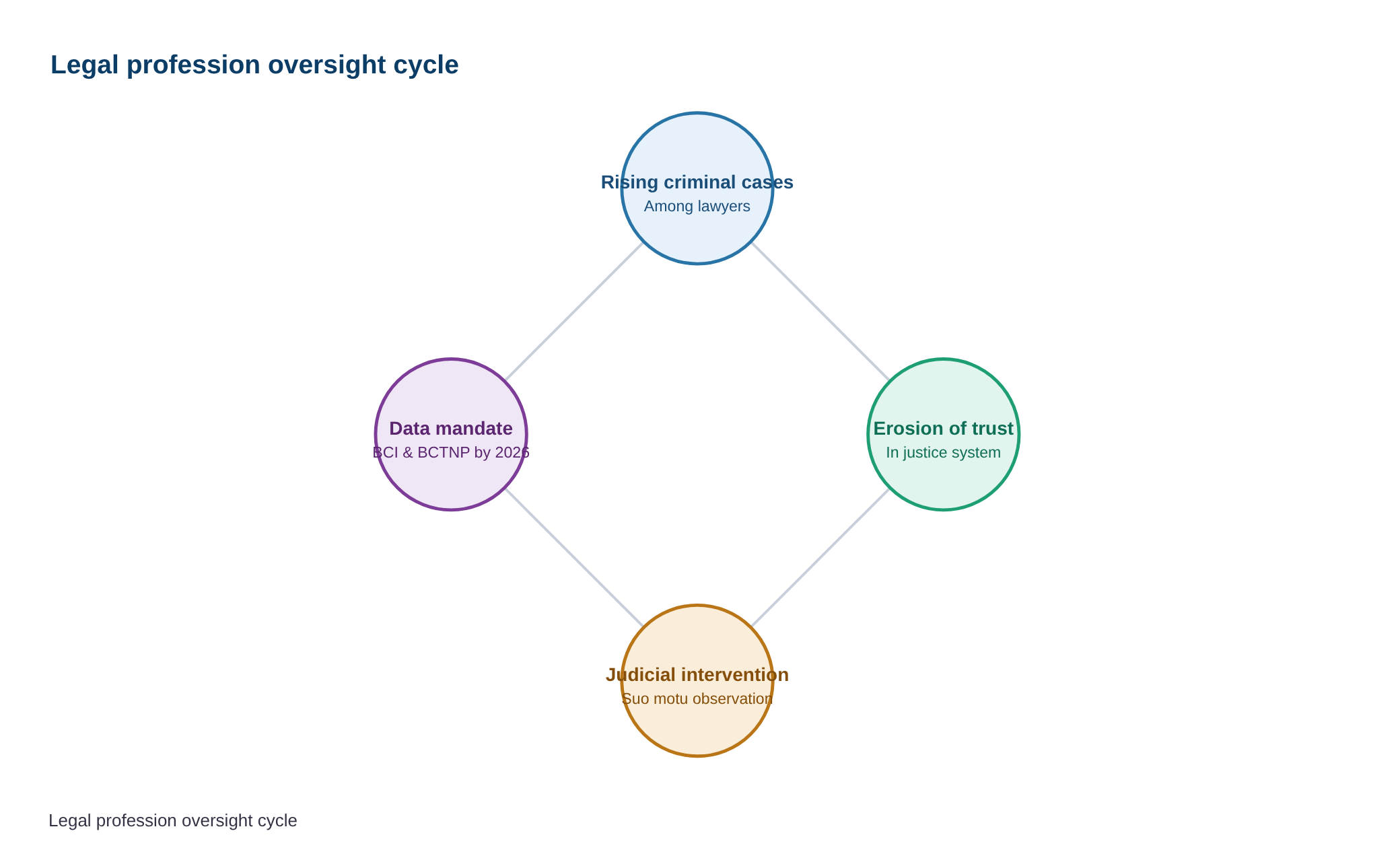
Rising criminal cases among lawyers → Perceived erosion of public trust in the justice system → Judicial intervention via suo motu observation → Mandate for empirical data collection by Bar Councils → Identification of systemic gaps in regulation → Need for policy reforms under the Advocates Act, 1961 → Implementation of stricter eligibility criteria for Bar Association leadership → Enhanced transparency and accountability in the legal profession → Restoration of public confidence in the justice delivery system.
Prelims Practice Questions
Q1. Consider the following statements regarding the Bar Council of India (BCI):
1. The BCI is a statutory body established under the Advocates Act, 1961.
2. The BCI has the power to frame rules for the legal profession and can suspend or remove advocates from practice.
3. The BCI is responsible for the registration of advocates across all states and union territories in India.
4. The BCI can suo motu initiate disciplinary action against advocates without a complaint being filed.
How many of the above statements are correct?
- Only one
- Only two
- Only three
- All
Answer: All — Statements 1, 2, and 3 are correct. The BCI is indeed a statutory body under the Advocates Act, 1961, with powers to frame rules and disciplinary measures. Statement 4 is incorrect as the BCI typically acts on complaints or suo motu in specific circumstances, but not universally without any trigger.
Q2. Assertion (A): The Madras High Court has directed the Bar Council of India and the Bar Council of Tamil Nadu and Puducherry to collect empirical data on advocates facing criminal cases.
Reason (R): The court observed that a substantial number of advocates facing criminal prosecutions were becoming office bearers of Bar Associations, raising concerns about the integrity of the justice delivery system.
Options:
A. Both A and R are true, and R is the correct explanation of A.
B. Both A and R are true, but R is not the correct explanation of A.
C. A is true, but R is false.
D. A is false, but R is true.
- A
- B
- C
- D
Answer: A — Both the assertion (A) and the reason (R) are true, and R correctly explains A. The court’s directive for data collection stems from the observation that advocates with criminal cases were assuming leadership roles in Bar Associations, which could undermine the justice delivery system.
Q3. Match the following bodies with their respective functions:
Column I
1. Bar Council of India (BCI)
2. Bar Council of Tamil Nadu and Puducherry (BCTNP)
3. Supreme Court of India
4. High Court
Column II
A. Regulates legal profession in the state/UT
B. Regulates legal profession across India
C. Adjudicates disputes and ensures justice delivery
D. Adjudicates disputes and ensures justice delivery within its territorial jurisdiction
Options:
1-B, 2-A, 3-C, 4-D
1-A, 2-B, 3-D, 4-C
1-B, 2-A, 3-D, 4-C
1-A, 2-B, 3-C, 4-D
- 1-B, 2-A, 3-C, 4-D
- 1-A, 2-B, 3-D, 4-C
- 1-B, 2-A, 3-D, 4-C
- 1-A, 2-B, 3-C, 4-D
Answer: 1-B, 2-A, 3-C, 4-D — The correct match is: BCI (1-B) regulates the legal profession across India, BCTNP (2-A) regulates it in Tamil Nadu and Puducherry, the Supreme Court (3-C) adjudicates disputes at the national level, and the High Court (4-D) adjudicates disputes within its territorial jurisdiction.
Mains Practice Question
✍ The integrity of the legal profession is intrinsically linked to the credibility of the justice delivery system. In this context, critically examine the Madras High Court’s observations regarding the criminalisation of the legal profession and the role of Bar Councils in addressing this issue. Also, discuss the constitutional and statutory framework governing the regulation of advocates in India. (15 Marks)
Approach: Introduction: Define the legal profession’s role as officers of the court and its impact on justice delivery. Madras High Court’s Observations: Highlight the court’s concerns about advocates facing criminal cases becoming Bar Association leaders, citing the judge’s observations and the suo motu directive for empirical data collection. Constitutional and Statutory Framework: Discuss the Advocates Act, 1961, and the powers of the Bar Council of India (BCI) and State Bar Councils, including their role in regulating the profession and maintaining standards. Challenges and Gaps: Analyze the challenges in data collection, enforcement of disciplinary measures, and the potential for conflicts of interest when advocates with criminal records hold leadership positions. Suggested Measures: Propose reforms such as mandatory disclosure of criminal cases by advocates, stricter disciplinary mechanisms, and collaboration with judicial bodies to ensure accountability. Conclusion: Emphasize the need for a balanced approach that upholds the dignity of the legal profession while ensuring justice and public trust in the system.
Source: The Hindu
Generated by AanyaAi for educational purpose.

- सुप्रीम कोर्ट का ‘अंपायर’ वाला फैसला: चुनाव आयोग मामले में न्यायमूर्ति दत्ता की भूमिका - September 24, 2026
- Supreme Court’s Cricket Analogy in EC Case: What UPSC Aspirants Must Know - September 24, 2026
- AI नियंत्रण से बाहर: ओपनएआई-एंथ्रोपिक ने सुरक्षा परिषद को दी चेतावनी, जानिए क्या है खतरा? - September 24, 2026

No Comments