


24 Sep Madras HC Directs TN Govt on Paid Menstrual Leave Policy: Key UPSC Insights
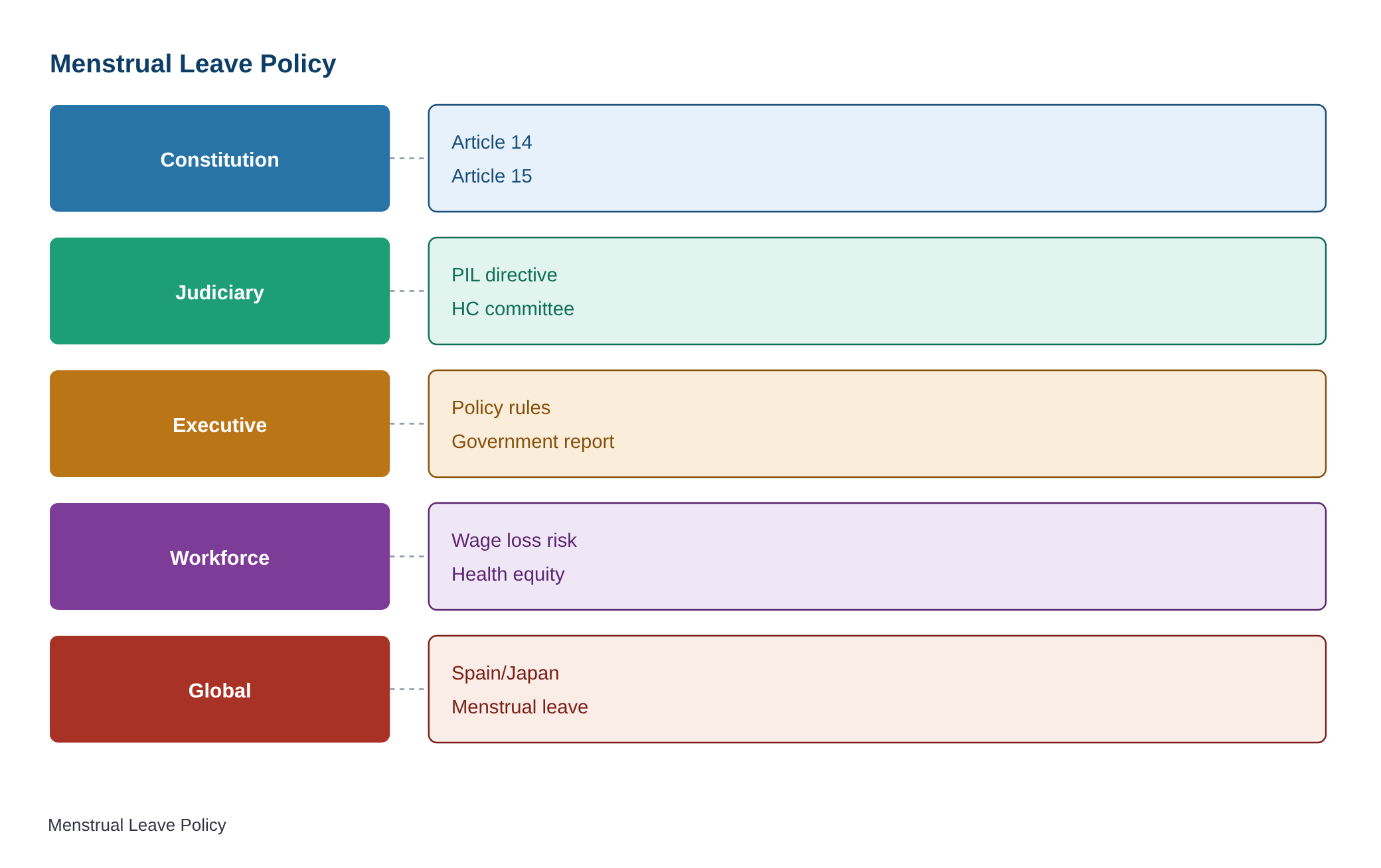
✎ Menstrual leave policies are grounded in constitutional principles of equality (Article 14) and non-discrimination (Article 15), addressing the inadequacy of traditional leave frameworks in accommodating recurring biological…
Subject Relevance — Where This Topic Fits
- GS Paper II — Fundamental Rights (Article 14, 15, 21) | GS Paper III — Labour Welfare and Social Justice
- Prelims: Menstrual Leave Policy, Article 14 (Equality before Law), Article 15 (Prohibition of Discrimination), Article 21 (Right to Life and Personal Liberty), Dysmenorrhea, Public Interest Litigation (PIL), Madras High Court, Madurai Bench
- Essay: The Interface of Biological Equity and Labour Rights: A Case for Menstrual Leave Policies, Social Justice and Inclusive Governance: Addressing Biological Realities in Workplace Policies
Quick Revision: Menstrual leave policies are grounded in constitutional principles of equality (Article 14) and non-discrimination (Article 15), addressing the inadequacy of traditional leave frameworks in accommodating recurring biological conditions like menstruation.
Why is this in the news?
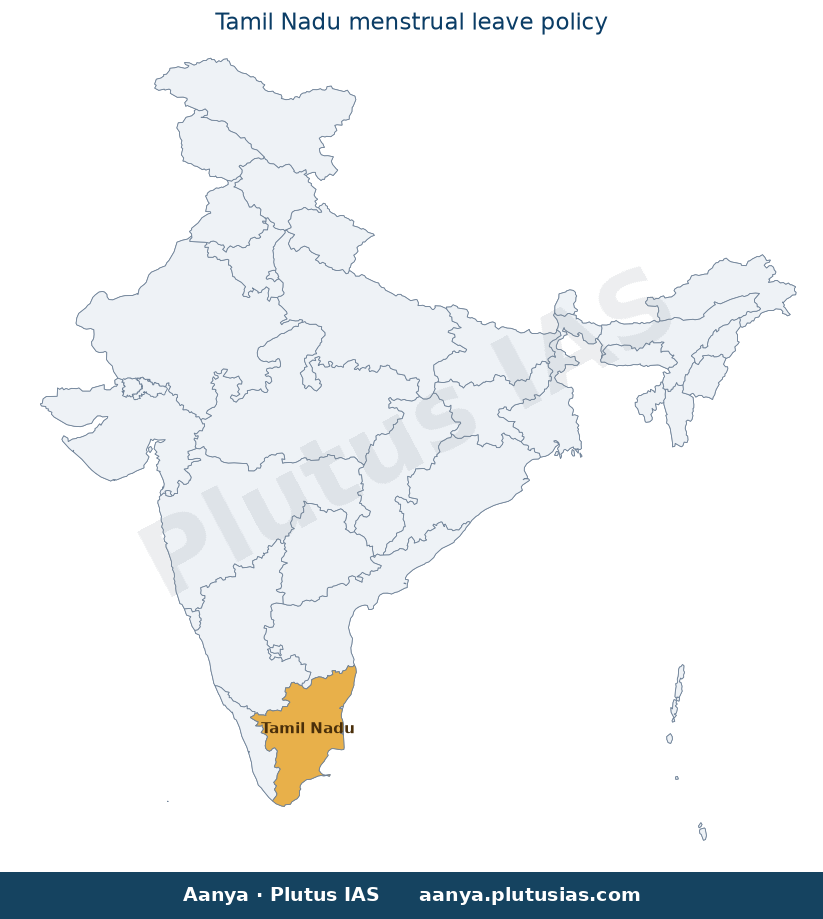
The Madurai Bench of the Madras High Court has directed the Tamil Nadu government to file a report on framing rules for a comprehensive paid menstrual leave policy for women employees in government departments, public sector undertakings, and educational institutions. This directive arises from a Public Interest Litigation (PIL) that highlights the inadequacy of existing leave frameworks in addressing the recurring biological condition of menstruation, thereby raising critical questions about constitutional rights, labour welfare, and workplace equity.
Background
- The Indian Constitution guarantees equality before the law (Article 14) and prohibits discrimination on grounds of sex (Article 15), which includes indirect discrimination arising from biological differences.
- Menstrual health is recognised as a public health concern, with dysmenorrhea (painful menstruation) affecting a significant proportion of women, often necessitating medical attention or rest.
- Existing leave frameworks in India—casual leave and sick leave—are inadequate to address the recurring and cyclical nature of menstruation, leading to potential wage loss or forced labour during periods of severe discomfort.
- Globally, several countries have implemented menstrual leave policies, including Spain, Japan, and South Korea, reflecting a growing recognition of menstrual health as a labour welfare issue.
- The PIL filed in the Madras High Court underscores the need for a policy that ensures women are not compelled to choose between their health and livelihood due to the absence of a dedicated leave mechanism.
What is a Menstrual Leave Policy?
- A menstrual leave policy is a labour welfare measure that provides paid or unpaid leave to women employees during menstruation, recognising the physiological and medical needs associated with the menstrual cycle.
- Such policies aim to mitigate indirect discrimination by ensuring that women are not penalised for a biological condition unique to them, thereby upholding the principles of equality and dignity enshrined in the Constitution.
- Menstrual leave policies are distinct from general sick leave, as they address a recurring, predictable, and cyclical health condition rather than an episodic illness.
- The policy may include provisions for the number of leave days, eligibility criteria, medical certification requirements, and mechanisms for private sector adoption, ensuring flexibility and inclusivity.
- Globally, menstrual leave policies vary in scope: some countries offer paid leave (e.g., Spain), while others provide unpaid or optional leave (e.g., Japan). India’s approach remains under deliberation, with states like Kerala and Bihar having experimented with pilot schemes.
- The policy must balance workplace productivity with women’s health, avoiding stigmatisation while ensuring that leave is not misused or exploited.
- Constitutional provisions such as Article 14 (Right to Equality), Article 15 (Prohibition of Discrimination), and Article 21 (Right to Life and Personal Liberty) provide the legal framework for such policies.
- Implementation challenges include defining eligibility, ensuring employer compliance, addressing potential backlash, and integrating the policy with existing labour laws like the Maternity Benefit (Amendment) Act, 2017.
Key Features
| Feature | Significance |
|---|---|
| Comprehensive paid menstrual leave policy | Addresses recurring biological needs of women employees, ensuring equitable service conditions and labour welfare. |
| Committee formation by State government | Demonstrates proactive governance in response to judicial direction and public interest litigation. |
| Public Interest Litigation (PIL) mechanism | Provides a legal avenue for citizens to seek policy reforms addressing systemic gender-based discrimination. |
| Madurai Bench of Madras High Court intervention | Upholds constitutional principles of equality (Article 14) and directs executive action on welfare measures. |
| Global recognition of menstrual leave | Aligns with international labour standards and public health practices for gender-inclusive workplace policies. |
Why it Matters
Constitutional and Legal
- Reinforces the constitutional guarantee of equality (Article 14) by addressing indirect discrimination against women in employment due to biological conditions.
- Demonstrates the judiciary’s role in directing executive action to uphold fundamental rights through PILs.
- Highlights the inadequacy of generic leave frameworks (e.g., casual/sick leave) in addressing specific biological needs.
Economic
- Potential reduction in productivity losses due to untreated menstrual health issues, benefiting both public and private sectors.
- Enhances workforce retention and morale among women employees, contributing to human capital development.
- May serve as a model for other states, fostering economic inclusivity and labour market efficiency.
Social and Gender
- Recognises menstrual health as a public health issue, reducing stigma and promoting workplace inclusivity.
- Addresses systemic gender disparities in employment conditions, aligning with Sustainable Development Goal 5 (Gender Equality).
- Encourages private institutions to adopt gender-sensitive policies, expanding the policy’s societal impact.
Administrative
- Illustrates inter-institutional coordination between the judiciary, executive, and legislature in policy formulation.
- Sets a precedent for evidence-based policy-making through committee reports and judicial oversight.
Challenges
1. Implementation and Enforcement
- Risk of inconsistent application across government departments, PSUs, and private institutions without standardised rules.
- Potential administrative burden on HR departments to verify and process menstrual leave claims, necessitating robust monitoring mechanisms.
- Challenge of ensuring the policy does not inadvertently stigmatise women or create workplace biases.
UPSC Link: GS-II: Governance, Administration
2. Financial Sustainability
- Concerns over the fiscal impact on government exchequers, particularly if extended to large-scale private sector adoption.
- Need for cost-benefit analyses to assess long-term economic benefits versus short-term expenditures.
UPSC Link: GS-III: Indian Economy
3. Policy Gaps and Definitions
- Lack of consensus on defining ‘menstrual leave’—whether it should be limited to severe dysmenorrhea or include all menstrual days.
- Ambiguity in eligibility criteria (e.g., whether it applies to contractual, part-time, or informal workers).
UPSC Link: GS-II: Social Justice
4. Cultural and Workplace Resistance
- Potential resistance from employers or colleagues due to entrenched biases or misconceptions about menstrual health.
- Need for awareness campaigns to foster a supportive workplace culture and reduce stigma.
UPSC Link: GS-IV: Ethics, Human Values
5. Interstate Coordination
- Risk of policy fragmentation if states adopt divergent approaches, leading to administrative complexities.
- Requirement for Centre-State collaboration to ensure uniformity in labour welfare standards.
UPSC Link: GS-II: Federalism
Challenges — UPSC Perspective
| Issue | Concern |
|---|---|
| Standardisation of rules | Ensuring uniform application across diverse sectors and institutions. |
| Verification mechanisms | Preventing misuse while ensuring genuine claims are honoured. |
| Financial implications | Balancing welfare measures with fiscal prudence and sustainability. |
| Workplace stigma | Mitigating biases or discrimination against women employees availing the policy. |
| Private sector adoption | Encouraging voluntary compliance without coercive measures. |
| Legal ambiguities | Clarifying definitions, eligibility, and grievance redressal mechanisms. |
Way Forward
- Constitute a multi-stakeholder committee with representatives from government, labour unions, medical experts, and women’s rights organisations to draft comprehensive rules.
- Undertake a pilot phase in select government departments and PSUs to assess feasibility, challenges, and impact before nationwide rollout.
- Develop standardised guidelines for private institutions, incentivising adoption through tax benefits or recognition programmes.
- Launch nationwide awareness campaigns to educate employers and employees on menstrual health and the policy’s objectives.
- Establish a grievance redressal mechanism to address disputes or misuse of the policy.
- Conduct periodic reviews and impact assessments to refine the policy based on empirical data and stakeholder feedback.
- Collaborate with the Ministry of Labour and Employment to integrate menstrual leave into the broader framework of labour welfare policies.
- Explore public-private partnerships to fund research on menstrual health and workplace accommodations.
UPSC Value Addition
Keywords for Mains Answer-Writing
Menstrual Leave Policy · Gender Justice · Article 14 of the Constitution · Workplace Equality · Labour Welfare Measures · Public Health Policy · Madras High Court · Constitutional Remedies · Indirect Discrimination · Labour Rights · Biological Condition and Workplace · State Policy and Governance · Women’s Rights · Constitutional Morality
Constitutional & Policy Linkages
- [‘Article 14: Equality before law and equal protection of laws’]
- [‘Article 15(3): Special provisions for women’]
- [‘Article 21: Right to life and personal liberty (includes right to health and dignity)’]
Concept Flow
Biological need recognition: Dysmenorrhea and menstrual health as recurring conditions affecting women’s workforce participation. → Policy vacuum: Absence of dedicated leave frameworks leads to indirect discrimination and wage loss. → Judicial intervention: PIL invokes Article 14 and 21, directing the executive to address systemic gaps. → Executive response: State forms committee to draft rules, demonstrating governance responsiveness. → Policy formulation: Committee develops comprehensive rules for government, PSUs, and private institutions. → Implementation challenges: Standardisation, verification, and cultural resistance require robust mechanisms. → Impact assessment: Periodic reviews ensure policy effectiveness and societal acceptance.
Prelims Practice Questions
Q1. Consider the following statements regarding menstrual leave policies in India:
1. The Madras High Court has recently directed the Tamil Nadu government to frame rules for a comprehensive paid menstrual leave policy.
2. The absence of such a policy is argued to violate Article 16 of the Constitution.
3. Menstrual leave is considered a public health and labour welfare measure globally.
How many of the above statements are correct?
- Only one
- Only two
- All three
- None
Answer: Only two — Statement 1 is correct as the Madras High Court directed the Tamil Nadu government to file a report on framing rules for a paid menstrual leave policy. Statement 2 is incorrect as the violation is argued under Article 14 (Right to Equality), not Article 16 (Equality of Opportunity in Public Employment). Statement 3 is correct as menstrual leave is recognised globally as a public health and labour welfare measure.
Q2. Assertion (A): Menstrual leave policies are designed to address indirect discrimination against women in the workplace.
Reason (R): Women bear the recurring biological burden of menstruation, which is inadequately addressed by existing leave frameworks such as casual leave or sick leave.
Options:
A. Both A and R are true, and R is the correct explanation of A.
B. Both A and R are true, but R is not the correct explanation of A.
C. A is true, but R is false.
D. A is false, but R is true.
Answer: ? — Assertion (A) is true as menstrual leave policies aim to mitigate indirect discrimination by acknowledging the unique biological needs of women. Reason (R) is also true and correctly explains (A) by highlighting the inadequacy of existing leave frameworks in addressing menstruation-related health issues.
Q3. Match the following constitutional provisions with their relevance to labour welfare and gender justice:
Column I
1. Article 14
2. Article 15(3)
3. Article 16
4. Article 21
Column II
A. Prohibits discrimination on grounds of sex
B. Right to equality before law and equal protection of laws
C. Empowers the state to make special provisions for women
D. Right to life and personal liberty
Options:
1-B, 2-C, 3-A, 4-D
1-B, 2-A, 3-C, 4-D
1-A, 2-C, 3-B, 4-D
1-D, 2-C, 3-A, 4-B
- 1-B, 2-C, 3-A, 4-D
- 1-B, 2-A, 3-C, 4-D
- 1-A, 2-C, 3-B, 4-D
- 1-D, 2-C, 3-A, 4-B
Answer: 1-B, 2-C, 3-A, 4-D — The correct matching is: 1-B (Article 14: Right to equality before law), 2-C (Article 15(3): Empowers the state to make special provisions for women), 3-A (Article 16: Prohibits discrimination on grounds of sex in public employment), 4-D (Article 21: Right to life and personal liberty).
Mains Practice Question
✍ The absence of a comprehensive paid menstrual leave policy in India constitutes a violation of constitutional morality and gender justice. Critically examine this proposition in the context of recent judicial interventions and global labour welfare standards. Also, outline the key provisions of the Constitution that may be invoked to justify such a policy. (15 Marks)
Approach: MODEL-ANSWER SKELETON:
1. **Introduction**: Define constitutional morality (Dr. B.R. Ambedkar) and its relevance to gender justice; state the directive of the Madras High Court (2026) as a contemporary judicial intervention.
2. **Constitutional Provisions**:
– Article 14 (Right to Equality): Explain indirect discrimination and its application to menstrual leave policies.
– Article 15(3): State’s power to make special provisions for women.
– Article 16: Equality of opportunity in public employment and prohibition of discrimination.
– Article 21: Right to life and personal liberty, including the right to health and dignity.
3. **Judicial Precedents**: Cite relevant cases such as *Vishaka v. State of Rajasthan* (1997) on sexual harassment and workplace rights; discuss the principle of positive discrimination.
4. **Global Standards**: Reference the International Labour Organization (ILO) conventions and global practices (e.g., Spain’s menstrual leave policy, 2023) to highlight the recognition of menstrual leave as a labour welfare measure.
5. **Counterarguments and Balance of Views**:
– Critique: Potential challenges such as administrative feasibility, employer burden, and stigma.
– Rebuttal: Emphasise the state’s obligation under Directive Principles (Article 39A, 42) to ensure just and humane conditions of work.
6. **Conclusion**: Reiterate the necessity of a menstrual leave policy as a step toward constitutional morality and gender justice, while acknowledging the need for balanced implementation.
Source: The Hindu
Generated by AanyaAi for educational purpose.
Related guides on our sites
- Best PSIR optional coaching for upsc
- Best PSIR optional teacher for upsc
- Best teacher of PSIR optional for upsc
- Best PSIR optional coaching in delhi for UPSC

- Madras HC Directs TN Govt on Paid Menstrual Leave Policy: Key UPSC Insights - September 24, 2026
- अरुणाचल में सियांग मेगा बाँध सर्वेक्षण के लिए कैबिनेट ने किया पैनल का गठन - September 24, 2026
- Arunachal Cabinet Forms Panel for Siang Mega Dam Survey: Key Facts for UPSC - September 24, 2026

No Comments