


08 Aug Madras HC Rules Caste Certificate Verification Permissible Post-Retirement
✎ The Madras High Court has ruled that verification of community certificates is permissible even after retirement, asserting that appointments obtained by fraud are void ab initio and retirement does not absolve foundational…
Subject Relevance — Where This Topic Fits
- GS Paper II — Governance, Constitution, Social Justice | GS Paper IV — Ethics, Integrity, and Aptitude
- Prelims: Community Certificates, Caste Verification, Madras High Court, Kumari Madhuri Patil case, Fraudulent Appointment, Superannuation
- Essay: The Ethical Imperative of Upholding Constitutional Principles in Public Service, Balancing Individual Rights with Societal Justice: The Role of the Judiciary
Quick Revision: The Madras High Court has ruled that verification of community certificates is permissible even after retirement, asserting that appointments obtained by fraud are void ab initio and retirement does not absolve foundational illegality.
Why is this in the news?
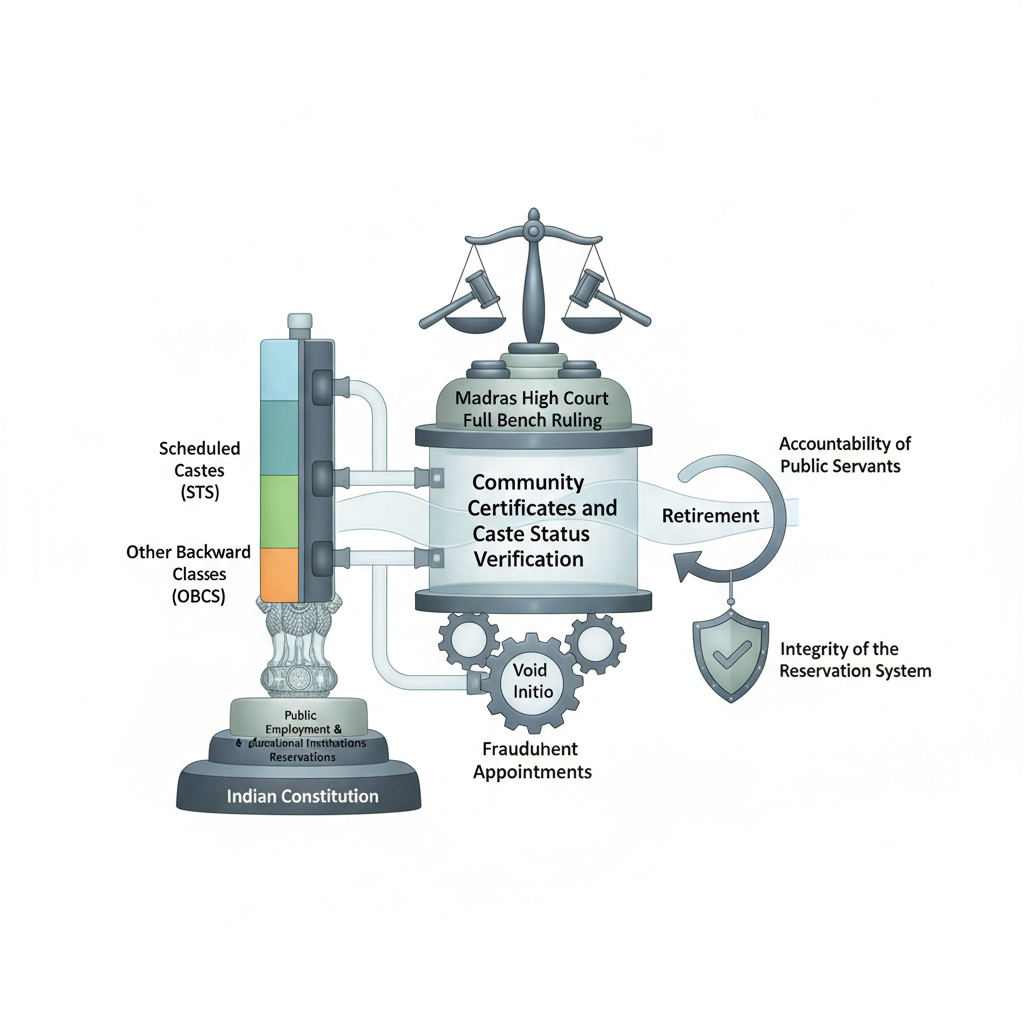
The Madras High Court’s Full Bench recently ruled that the verification of community certificates and caste status of government employees is legally permissible even after their retirement. This significant judgment clarifies conflicting decisions by coordinate benches and reinforces the principle that appointments obtained through fraudulent means are void ab initio, with retirement not absolving foundational illegality. The ruling emphasizes the continuous accountability of public servants regarding their entry into service and the integrity of the reservation system.
Background
- The Indian Constitution provides for reservations in public employment and educational institutions for Scheduled Castes (SCs), Scheduled Tribes (STs), and Other Backward Classes (OBCs) to address historical injustices and promote social equity.
- Community certificates are crucial documents issued by competent authorities to individuals belonging to these reserved categories, enabling them to avail themselves of the benefits of affirmative action policies.
- Instances of individuals securing public employment or other benefits by submitting fraudulent community certificates have been a persistent challenge, undermining the objectives of social justice and fair representation.
- The Supreme Court, in the landmark Kumari Madhuri Patil v. Commissioner, Tribal Development (1994) case, laid down a detailed procedure for the verification of community certificates, establishing State Level Scrutiny Committees and Vigilance Cells.
- Conflicting judicial pronouncements on whether verification proceedings could continue post-retirement necessitated a reference to a Full Bench of the Madras High Court to ensure legal clarity and consistency.
- The principle that ‘fraud vitiates everything’ is a fundamental tenet of law, implying that an act or transaction based on fraud is inherently void and without legal effect from its inception.
Significance of the Madras High Court Ruling on Community Certificate Verification
- The Full Bench unequivocally held that an appointment obtained by fraud is ‘ab initio void,’ meaning it is invalid from the very beginning, and retirement does not nullify this foundational illegality.
- It affirmed that retiral benefits flowing from a void entry into government service cannot be protected, thereby preventing individuals who secured employment fraudulently from retaining benefits.
- The court clarified that public employers and scrutiny committees possess the authority to verify the genuineness of community certificates irrespective of when the certificate was issued or when employment was secured (before or after 1995).
- The ruling reiterated that ‘fraud has no expiry date,’ emphasizing that procedural mechanisms established by the Supreme Court do not grant immunity to older deceptions.
- It mandated that a lawful verification process initiated prior to an employee’s retirement would not lapse upon superannuation and must be pursued to its logical conclusion, preventing dilatory tactics.
- To ensure fairness and efficiency, the court directed the Tamil Nadu government to strengthen State Level Scrutiny Committees and district-level vigilance committees with adequate manpower and anthropological experts.
- Public employers were directed to initiate and complete the verification process within the initial years of an employee’s service, rather than deferring it to the end of their career or post-retirement.
- In cases where inquiries are pursued post-retirement, the court stipulated that they must be conducted on a fast-track basis to balance constitutional integrity with fairness and prevent unnecessary harassment.
UPSC Value Addition
Keywords for Mains Answer-Writing
Community Certificate verification · Madras High Court Full Bench judgment · Caste certification scrutiny · Constitutional accountability in service verification · Supreme Court’s Kumari Madhuri Patil case (1994) · State Level Scrutiny Committee · Retirement and service fraud · Procedural fairness in caste verification · Article 14 and 16 of the Constitution · Anthropological verification in caste determination
Prelims Practice Questions
Q1. Consider the following statements regarding the verification of community certificates in India:
1. The Supreme Court in Kumari Madhuri Patil v. Addl. Commissioner, Tribal Development (1994) laid down a multi-point verification matrix for caste certificates.
2. The Madras High Court Full Bench (2026) ruled that verification of community certificates can be initiated even after an employee’s retirement.
3. The verification process must be completed within the initial years of an employee’s service as per the Madras High Court directions.
How many of the above statements are correct?
- Only one
- Only two
- All three
- None
Answer: All three — Statements 1 and 3 are correct. Statement 2 is correct as the Madras High Court Full Bench (2026) explicitly permitted verification post-retirement. The verification process must be initiated and completed early in service, as per the court’s directions.
Q2. Assertion (A): The Supreme Court’s verdict in Kumari Madhuri Patil (1994) provides immunity to older caste certificates issued before 1995.
Reason (R): The Madras High Court Full Bench (2026) clarified that fraud in caste certificates has no expiry date and can be investigated at any time.
In the context of the above statements, which of the following is correct?
- Both A and R are true, and R is the correct explanation of A.
- Both A and R are true, but R is not the correct explanation of A.
- A is true, but R is false.
- A is false, but R is true.
Answer: ? — Assertion (A) is false because the Supreme Court’s Kumari Madhuri Patil (1994) judgment does not grant immunity to older caste certificates. Reason (R) is true as the Madras High Court Full Bench (2026) explicitly stated that fraud has no expiry date and can be investigated regardless of when the certificate was issued.
Q3. Match the following provisions with their respective legal contexts:
Column I (Provision/Case)
A. Kumari Madhuri Patil v. Addl. Commissioner, Tribal Development (1994)
B. Article 14 of the Constitution of India
C. Article 16 of the Constitution of India
D. State Level Scrutiny Committee
Column II (Context)
1. Prohibits discrimination in public employment on grounds of religion, race, caste, sex, or place of birth
2. Establishes a multi-point verification matrix for caste certificates
3. Ensures equality before law and equal protection of laws
4. Empowered to verify the genuineness of community certificates in Tamil Nadu
- A-2, B-3, C-1, D-4; A-1, B-3, C-2, D-4; A-4, B-1, C-3, D-2; A-2, B-1, C-3, D-4
- answer_options_indexed_to_q_options_array_indexed_from_0_to_3
- answer_options_indexed_to_q_options_array_indexed_from_0_to_3
Answer: A-2, B-3, C-1, D-4; A-1, B-3, C-2, D-4; A-4, B-1, C-3, D-2; A-2, B-1, C-3, D-4 — A matches with 2 (Kumari Madhuri Patil case established the multi-point verification matrix). B matches with 3 (Article 14 ensures equality before law). C matches with 1 (Article 16 prohibits discrimination in public employment). D matches with 4 (State Level Scrutiny Committee verifies caste certificates).
Mains Practice Question
✍ The Madras High Court Full Bench (2026) has reinforced the principle that fraud in caste certificates has no expiry date and can be investigated even after an employee’s retirement. Critically examine the constitutional and legal foundations underlying this judgment, with particular reference to Articles 14, 16, and the Supreme Court’s directives in Kumari Madhuri Patil (1994). Also, discuss the implications of this judgment for administrative accountability and procedural fairness in public employment. (15 Marks)
Approach: MODEL-ANSWER SKELETON:
1. **Constitutional Foundations (4 Marks)**
– Article 14 (Right to Equality): Emphasise the principle of equality before law and equal protection of laws, and its application to caste-based discrimination.
– Article 16 (Equality of Opportunity in Public Employment): Highlight the prohibition of discrimination in public employment and the state’s duty to ensure fairness.
– Link to the judgment: The court’s stance aligns with the constitutional mandate to prevent fraudulent appointments that undermine these rights.
2. **Judicial Precedents and Legal Framework (5 Marks)**
– Kumari Madhuri Patil (1994): Discuss the Supreme Court’s multi-point verification matrix for caste certificates, including anthropological verification and documentary scrutiny.
– Full Bench Judgment (2026): Explain the court’s reasoning that fraud in caste certificates is a foundational illegality and does not lapse with retirement. Cite the court’s observation that procedural delays cannot defeat constitutional accountability.
– Contrast with earlier conflicting Division Bench rulings and the Full Bench’s resolution of the conflict.
3. **Administrative Accountability and Procedural Fairness (4 Marks)**
– Institutional Strengthening: Discuss the court’s directions to fortify the State Level Scrutiny Committee and district-level vigilance committees with anthropological experts and manpower.
– Timely Verification: Explain the court’s directive to initiate and complete verification within the initial years of service to prevent dilatory tactics.
– Balance between Fairness and Rigor: Critically examine the court’s approach to ensuring strict compliance with verification protocols while avoiding unnecessary harassment.
4. **Implications and Way Forward (2 Marks)**
– Impact on Public Employment: Discuss how this judgment strengthens the integrity of public service appointments and deters fraudulent caste claims.
– Broader Significance: Highlight the judgment’s role in upholding constitutional values and ensuring procedural fairness in governance.
Balance of Views:
– Supportive: The judgment reinforces constitutional accountability and deters fraud.
– Critical: Potential for misuse in politically motivated or frivolous investigations; need for safeguards against harassment.
Source: The Hindu
Generated by AanyaAi for educational purpose.

- आंध्र प्रदेश में चार नए पुलिस आयुक्तालयों को कैबिनेट की मंजूरी, जानिए क्या होंगे फायदे - September 23, 2026
- Andhra Pradesh to get 4 new Police Commissionerates: Key UPSC insights - September 23, 2026
- AI आधारित ‘HEADS’ से भारत में अवसाद जांच में क्रांति: जानिए कैसे होगा मदद - September 23, 2026

No Comments