


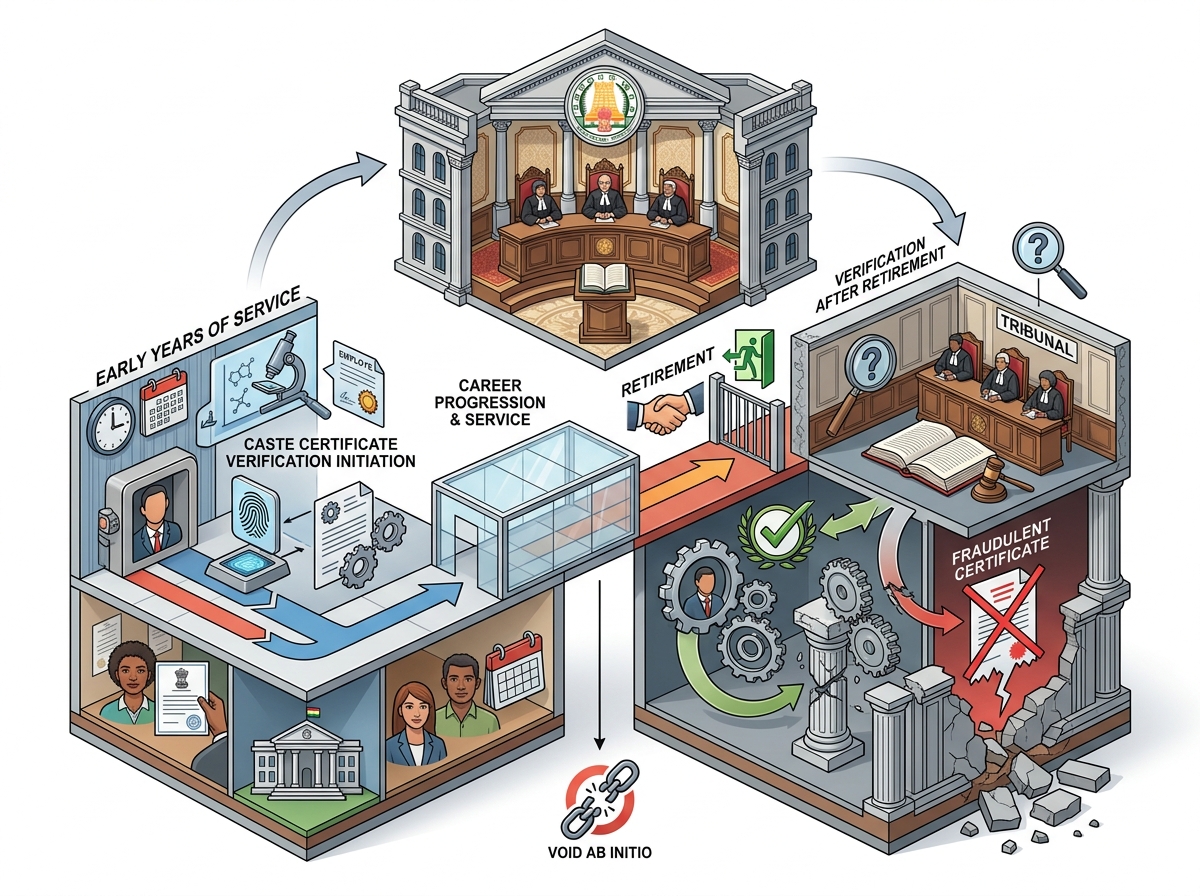
08 Aug Madras HC: Verification of community certificates can continue post-retirement
Full BenchCommunity certificatesGovernment employeesCaste certificate verificationVoid ab initio✎ Caste certificate verification is constitutionally mandated, procedurally rigorous (as per *Kumari Madhuri Patil*), and must be completed within the initial years of service; fraud vitiates appointments ab initio, and…
Subject Relevance — Where This Topic Fits
- GS Paper II — Constitutional and Legal Governance | GS Paper IV — Ethics, Integrity and Aptitude
- Prelims: Caste Certificate Verification, Kumari Madhuri Patil Case (1994), Article 14 (Equality), Article 16 (Equality of Opportunity), SC/ST (Prevention of Atrocities) Act, Government Scrutiny Committees, Anthropological Experts, Ab Initio Void Appointments, Retiral Benefits, Superannuation
- Essay: The tension between constitutional morality and procedural fairness in governance, The role of judicial oversight in upholding public trust in affirmative action
Quick Revision: Caste certificate verification is constitutionally mandated, procedurally rigorous (as per *Kumari Madhuri Patil*), and must be completed within the initial years of service; fraud vitiates appointments ab initio, and post-retirement verification is legally permissible to uphold systemic integrity.
Why is this in the news?
On 30 July 2026, a Full Bench of the Madras High Court, comprising Chief Justice Sushrut Arvind Dharmadhikari and Justices K. Kumaresh Babu and G. Arul Murugan, delivered a landmark judgment clarifying the legal permissibility of verifying the genuineness of community certificates of government employees even after their retirement. The ruling resolves conflicting interpretations by coordinate benches and reaffirms that appointments secured through fraud are void ab initio, irrespective of the timing of verification. The judgment also underscores the constitutional obligation of public employers to initiate caste certificate verification within the initial years of service, thereby preventing dilatory tactics and ensuring systemic accountability.
Background
- The issue of caste certificate verification has been a recurrent subject of judicial scrutiny due to widespread concerns about fraudulent claims of caste status to avail benefits under reservation policies.
- The Supreme Court’s landmark judgment in *Kumari Madhuri Patil v. Addl. Commissioner, Tribal Development* (1994) established a multi-point verification matrix to determine the genuineness of caste certificates, including field inquiries and anthropological evidence.
- Conflicting decisions by Division Benches of the Madras High Court created ambiguity regarding whether verification could proceed post-retirement, necessitating a Full Bench reference for authoritative clarification.
- The Tamil Nadu government had been criticised for systemic delays in verifying caste certificates, leading to backlogs and undermining the integrity of reservation policies.
- The judgment aligns with constitutional principles of equality (Article 14) and equality of opportunity (Article 16), as well as the broader mandate to prevent misuse of affirmative action schemes.
What is the legal framework governing caste certificate verification in India?
- Caste certificates are official documents issued by competent authorities to certify an individual’s caste status, enabling access to reservation benefits in education, employment, and political representation.
- *Kumari Madhuri Patil v. Addl. Commissioner, Tribal Development* (1994) is a seminal Supreme Court judgment that laid down a rigorous verification process, including field inquiries, cross-verification with caste records, and anthropological evidence to establish genuineness.
- The verification process is governed by the constitutional principles of equality (Article 14) and non-discrimination (Article 15), as well as the directive principles of state policy (Article 46), which mandate the state to promote the educational and economic interests of weaker sections.
- Government employees found to have secured appointments through fraudulent caste certificates are deemed to have made void appointments ab initio, meaning the appointment is treated as invalid from the outset, regardless of subsequent actions or retirements.
- The Supreme Court has consistently held that fraud vitiates all proceedings, and no statute of limitations or procedural lapse can confer immunity to such fraudulent acts.
- Public employers are statutorily obligated to verify caste certificates of employees within the initial years of service to prevent systemic misuse and ensure timely detection of fraud.
- The Madras High Court’s ruling reinforces that verification processes initiated before retirement cannot lapse upon superannuation, as the foundational illegality persists and retiral benefits derived from void appointments are not protected.
- The judgment also highlights the role of State Level Scrutiny Committees and district-level vigilance committees, which must be adequately staffed with anthropological experts to ensure rigorous and impartial verification.
Key Features
| Feature | Significance |
|---|---|
| Full Bench Verdict on Community Certificate Verification | Establishes that verification of caste certificates can be initiated or continued post-retirement, as fraud in appointment is void ab initio and does not lapse with retirement. |
| Continuation of Verification Post-Retirement | Ensures that verification processes initiated before retirement are not rendered infructuous, preventing misuse of procedural delays to evade accountability. |
| Empowerment of Scrutiny Committees | Directs strengthening of State and district-level scrutiny committees with anthropological experts to ensure rigorous multi-point verification as per Kumari Madhuri Patil (1994) guidelines. |
| Timely Verification During Service | Mandates that public employers initiate and complete verification of community certificates within the initial years of an employee’s service to avoid backlogs and ensure fairness. |
| Rejection of Immunity for Older Deceptions | Clarifies that the procedural mechanics established in Kumari Madhuri Patil (1994) do not grant immunity to older instances of fraud, reinforcing constitutional accountability. |
Why it Matters
Constitutional and Legal
- Upholds the principle that appointments obtained through fraud are void ab initio, thereby preserving the integrity of public service recruitment processes.
- Reinforces the constitutional mandate of equality and fairness by ensuring that no individual benefits from fraudulent caste certificates, regardless of the passage of time.
- Clarifies the legal position on the continuity of verification processes, preventing procedural delays from being exploited to subvert justice.
Administrative and Governance
- Strengthens institutional mechanisms for verifying caste certificates by mandating the fortification of scrutiny committees with adequate manpower and expertise.
- Promotes timely verification during an employee’s service, reducing systemic backlogs and ensuring compliance with Supreme Court directives.
- Enhances transparency and accountability in public employment by allowing verification processes to proceed without undue delays.
Social Justice
- Protects the rights of genuine beneficiaries of reservation policies by ensuring that fraudulent claims are identified and rectified, irrespective of the employee’s retirement status.
- Promotes fairness in public service by preventing individuals who secured appointments through fraud from retaining undue benefits post-retirement.
Challenges
1. Systemic Backlogs in Verification
- Existing delays in verification processes may hinder the timely completion of inquiries, particularly if scrutiny committees lack adequate manpower and resources.
- The requirement to fortify scrutiny committees with anthropological experts may face implementation challenges due to limited availability of such specialists.
UPSC Link: GS-II: Governance, Transparency & Accountability
2. Balancing Fairness and Rigor
- Ensuring that verification processes are conducted with due diligence while avoiding unnecessary harassment or prolonged delays that could undermine the rights of employees.
- Addressing potential resistance from employees or stakeholders who may perceive the verification process as punitive or intrusive.
UPSC Link: GS-II: Fundamental Rights & DPSP
3. Legal and Procedural Complexities
- Navigating the procedural mechanics established by the Supreme Court in Kumari Madhuri Patil (1994) while ensuring compliance with evolving legal standards.
- Addressing conflicts between the Full Bench’s ruling and prior Division Bench decisions to ensure consistency in judicial interpretation.
UPSC Link: GS-II: Judiciary, Legal Framework
4. Resource Allocation and Capacity Building
- Ensuring that public employers and scrutiny committees are adequately equipped to conduct thorough and timely verifications without compromising on quality.
- Addressing potential gaps in training and expertise among committee members to ensure accurate and unbiased verification.
UPSC Link: GS-II: Public Administration
5. Public Perception and Trust
- Maintaining public trust in the verification process by ensuring that it is perceived as fair, transparent, and free from political or extraneous influences.
- Addressing concerns about the potential misuse of verification processes for ulterior motives, such as targeting specific communities or individuals.
UPSC Link: GS-II: Social Justice & Empowerment
Challenges — UPSC Perspective
| Issue | Concern |
|---|---|
| Timely Completion of Verification | Delays in verification processes may lead to backlogs and undermine the purpose of the mandate. |
| Resource Constraints in Scrutiny Committees | Inadequate manpower and expertise may hinder the effective implementation of verification processes. |
| Balancing Fairness and Rigor | Ensuring that verification is thorough yet not perceived as punitive or harassing. |
| Legal Consistency | Resolving conflicts between Full Bench and prior Division Bench rulings to ensure uniformity in judicial interpretation. |
| Public Trust | Maintaining transparency and fairness to prevent perceptions of misuse or bias in the verification process. |
Way Forward
- Strengthen State and district-level scrutiny committees by recruiting additional anthropological experts and administrative staff to expedite verification processes.
- Implement a time-bound action plan for public employers to initiate and complete verification of community certificates within the initial years of an employee’s service.
- Conduct regular training programs for scrutiny committee members to ensure adherence to the multi-point verification matrix established by the Supreme Court in Kumari Madhuri Patil (1994).
- Establish a grievance redressal mechanism to address concerns raised by employees regarding the verification process, ensuring transparency and fairness.
- Monitor and review the progress of verification processes at regular intervals to identify and address systemic bottlenecks.
- Sensitize public employers and employees about the legal implications of fraudulent caste certificates and the importance of timely verification.
- Collaborate with academic institutions and research bodies to develop standardized methodologies for caste verification to enhance accuracy and reliability.
UPSC Value Addition
Keywords for Mains Answer-Writing
Madras High Court Full Bench verdict on community certificate verification · Caste verification post-retirement in government service · Supreme Court’s Kumari Madhuri Patil case (1994) on caste verification · Article 16 of the Constitution and reservation legitimacy · State-Level Scrutiny Committee and district vigilance committees · Constitutional accountability and procedural fairness in service matters · Apex Court directives on fraudulent appointments and retiral benefits · Anthropological expertise in caste verification · Foundational illegality and ab initio void appointments · Constitutional morality in administrative governance
Constitutional & Policy Linkages
- [‘Article 14: Equality before law and equal protection of laws’]
- [‘Article 16: Equality of opportunity in public employment’]
- [‘Article 341: Scheduled Castes’]
- [‘Article 342: Scheduled Tribes’]
Concept Flow
Appointment secured through fraudulent caste certificate → Void ab initio (illegal from inception) → Verification process initiated during service or post-retirement → No lapse upon superannuation → Scrutiny committees empowered to verify genuineness → Multi-point verification as per Kumari Madhuri Patil (1994) → Full Bench ruling clarifies legal position → Fraud has no expiry date; procedural delays cannot defeat accountability → Institutional strengthening of scrutiny committees → Adequate manpower and expertise for rigorous verification → Timely completion of verification → Within initial years of service to avoid backlogs → Constitutional integrity preserved → Fairness and transparency in public employment maintained
Prelims Practice Questions
Q1. Consider the following statements regarding the verification of community certificates in government service as per the Madras High Court Full Bench verdict:
1. Verification of caste status can be initiated even after the retirement of an employee.
2. The Supreme Court’s Kumari Madhuri Patil case (1994) mandates a multi-point verification matrix for caste certificates.
3. Retiral benefits are protected even if an appointment was obtained through fraudulent means.
4. The State-Level Scrutiny Committee is empowered to verify caste status irrespective of the year of issuance of the certificate.
How many of the above statements are correct?
- Only one
- Only two
- Only three
- All four
Answer: All four — Statements 1, 2, and 4 are correct as per the verdict. Statement 3 is incorrect because the court held that retiral benefits flowing from a void entry into government service cannot be protected if the appointment was obtained by fraud.
Q2. Assertion (A): The Madras High Court Full Bench ruled that fraud in obtaining a community certificate has no expiry date and can be investigated even after retirement.
Reason (R): The court held that an appointment obtained by fraud is ab initio void, and retirement does not absolve the foundational illegality.
Options:
A. Both A and R are true, and R is the correct explanation of A.
B. Both A and R are true, but R is not the correct explanation of A.
C. A is true, but R is false.
D. A is false, but R is true.
- A
- B
- C
- D
Answer: A — Both Assertion (A) and Reason (R) are true, and R correctly explains A as the court explicitly stated that fraud has no expiry date and appointments obtained by fraud are void ab initio.
Q3. Match the following provisions/principles with their correct descriptions:
Column I
1. Kumari Madhuri Patil case (1994)
2. Article 16 of the Constitution
3. State-Level Scrutiny Committee
4. Foundational illegality
Column II
A. Mandates a multi-point verification matrix for caste certificates
B. Prohibits discrimination in public employment on grounds of religion, race, caste, sex, or place of birth
C. Empowered to verify the genuineness of community certificates
D. Refers to the invalidity of an appointment secured through fraudulent means
- 1-A, 2-B, 3-C, 4-D
- 1-B, 2-A, 3-D, 4-C
- 1-C, 2-D, 3-A, 4-B
- 1-D, 2-C, 3-B, 4-A
Answer: 1-A, 2-B, 3-C, 4-D — 1-A (Kumari Madhuri Patil case established a multi-point verification matrix), 2-B (Article 16 prohibits discrimination in public employment), 3-C (State-Level Scrutiny Committee verifies caste certificates), 4-D (Foundational illegality refers to the invalidity of fraudulent appointments).
Mains Practice Question
✍ The Madras High Court Full Bench has recently held that verification of the genuineness of community certificates is legally permissible even after an employee’s retirement, and that such verification cannot be thwarted by procedural delays. Critically examine the constitutional and administrative implications of this verdict with reference to the Supreme Court’s directives in Kumari Madhuri Patil (1994) and the doctrine of foundational illegality. Also, discuss the measures required to ensure procedural fairness and constitutional accountability in such verifications. (15 Marks)
Approach: MODEL-ANSWER SKELETON:
1. **Constitutional Foundation**:
– Article 16 of the Constitution: Prohibition of discrimination in public employment.
– Kumari Madhuri Patil (1994): Supreme Court laid down a multi-point verification matrix for caste certificates to prevent misuse of reservation benefits.
– Foundational illegality: Appointments obtained through fraud are void ab initio (Madras HC verdict).
2. **Judicial Reasoning in the Verdict**:
– Fraud has no expiry date: The court rejected the argument that delays in verification post-retirement invalidate the process.
– Retiral benefits: Cannot be protected if the appointment itself is void due to fraud.
– Procedural fairness: The court directed that verifications must be initiated and completed within the initial years of service to avoid dilatory tactics.
3. **Administrative and Institutional Measures**:
– Strengthening State-Level Scrutiny Committees and district vigilance committees with anthropological experts.
– Ensuring rigid compliance with the multi-point verification matrix.
– Fast-tracking post-retirement verifications to avoid unnecessary harassment.
4. **Balancing Constitutional Integrity and Fairness**:
– The verdict upholds constitutional morality by preventing misuse of reservation benefits.
– Procedural safeguards must be in place to avoid arbitrary or malicious verifications.
– Role of the judiciary in ensuring that the rule of law prevails over procedural lapses.
5. **Contemporary Relevance**:
– The verdict aligns with the Supreme Court’s stance on maintaining the purity of public employment.
– It reinforces the need for transparency and accountability in administrative governance.
6. **Conclusion**:
– The verdict is a step toward ensuring that reservation benefits reach the intended beneficiaries.
– Institutional strengthening and procedural reforms are essential to prevent misuse and ensure fairness.
Source: The Hindu
Generated by AanyaAi for educational purpose.


No Comments