


20 Aug Maharashtra’s New Healthcare Bill 2026: Key Provisions for UPSC & State PCS
✎ The Maharashtra Clinical Establishments (Registration and Regulation) Bill, 2026, mandates transparent pricing, emergency care obligations, and patient rights but does not regulate hospital charges, relying instead on…
Subject Relevance — Where This Topic Fits
- GS Paper II — Governance, Transparency and Accountability in Public Services | GS Paper III — Health Sector Reforms, Regulatory Mechanisms and Consumer Protection
- Prelims: Clinical Establishments (Registration and Regulation) Act, 2010, Patient Rights Charter under Clinical Establishments Act, Golden Hour Protocol in Emergency Care, National Council for Clinical Establishments (NCCE), Ayushman Bharat Health Infrastructure Mission (ABHIM), National Medical Commission (NMC) Act, 2019, Consumer Protection Act, 2019, Right to Information (RTI) Act, 2005
- Essay: The Role of State Governance in Ensuring Affordable and Accessible Healthcare, Balancing Transparency and Autonomy in India’s Healthcare Regulatory Framework
Quick Revision: The Maharashtra Clinical Establishments (Registration and Regulation) Bill, 2026, mandates transparent pricing, emergency care obligations, and patient rights but does not regulate hospital charges, relying instead on transparency and standard-setting to improve healthcare governance.
Why is this in the news?
The Maharashtra Clinical Establishments (Registration and Regulation) Bill, 2026, introduced in the state Assembly on July 3, 2026, seeks to replace the outdated Maharashtra Nursing Homes Registration Act, 1949. The Bill introduces mandatory registration, minimum standards, patient rights, and transparency measures for hospitals, clinics, laboratories, and diagnostic centres across all recognised systems of medicine. While it mandates price transparency and emergency care obligations, it notably refrains from regulating hospital charges, drawing scrutiny from health rights groups regarding patient protections and grievance redressal mechanisms.
Background
- The existing regulatory framework for clinical establishments in Maharashtra is governed by the Maharashtra Nursing Homes Registration Act, 1949, which has remained largely unchanged for 77 years and is widely regarded as outdated and inadequate for contemporary healthcare governance.
- The need for a comprehensive regulatory framework has been under discussion for over a decade, with the COVID-19 pandemic further exposing gaps in private healthcare regulation, including price transparency, emergency care standards, and patient rights enforcement.
- Maharashtra had previously introduced certain patient protections in 2021, but these were limited in scope and enforcement.
What is the Maharashtra Clinical Establishments (Registration and Regulation) Bill, 2026?
- The Bill seeks to replace the Maharashtra Nursing Homes Registration Act, 1949, by introducing a modern regulatory framework for all clinical establishments, including hospitals, clinics, laboratories, diagnostic centres, and maternity homes under all recognised systems of medicine (allopathy, Ayurveda, Homoeopathy, Siddha, and Unani).
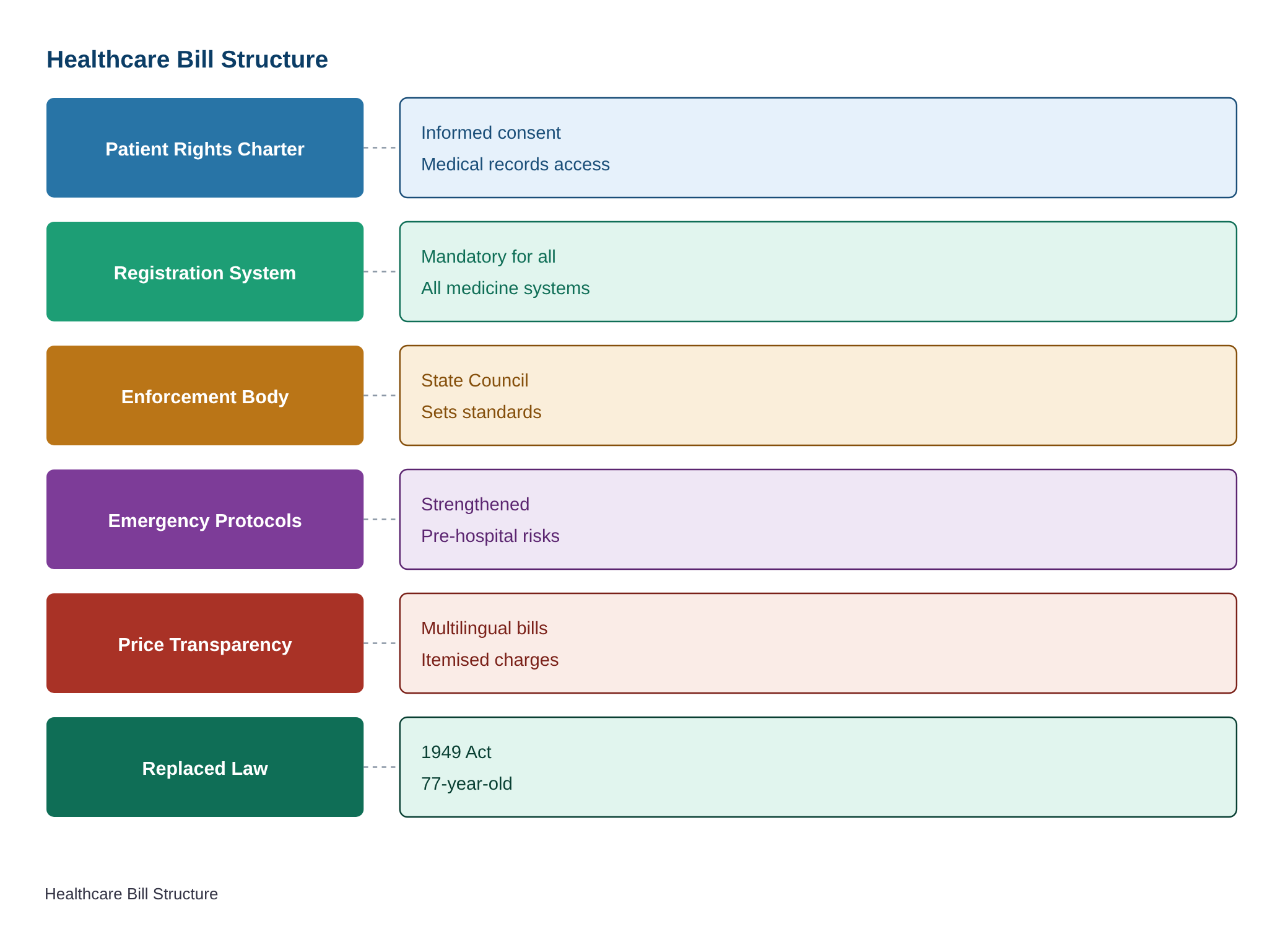
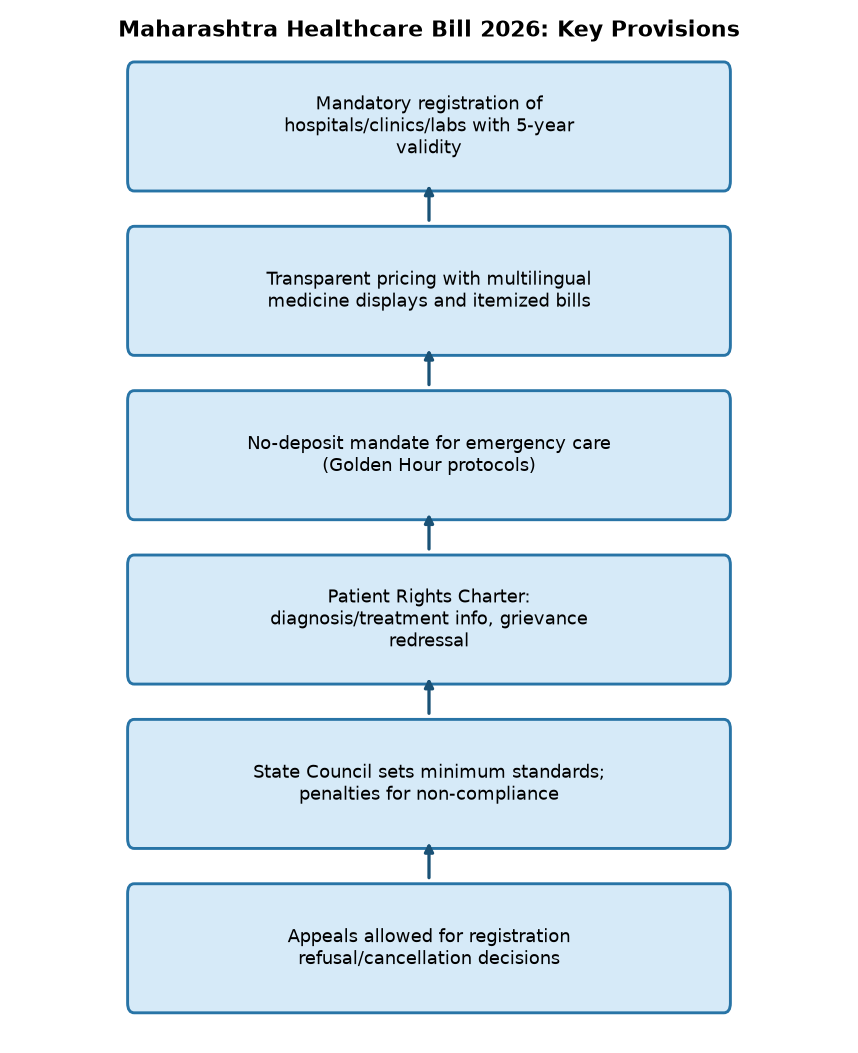
- Mandatory registration is proposed for all clinical establishments, with a two-tier system comprising provisional and permanent registration, valid for five years, subject to compliance with prescribed standards for infrastructure, staffing, services, records, and reporting.
- The Bill establishes the Maharashtra State Council for Clinical Establishments to set minimum standards, classify establishments, and oversee compliance, with powers to inspect, impose penalties, and cancel registrations for non-compliance.
- Patient rights are strengthened through a Patient Rights Charter, which includes the right to information on diagnosis, treatment, and estimated costs; access to medical records; informed consent; a second opinion; privacy; dignity; and non-discrimination.
- Emergency care obligations are reinforced, requiring hospitals to stabilise emergency patients and provide basic life support regardless of payment capacity, with adherence to ‘Golden Hour’ protocols before referral where necessary.
- Price transparency is mandated, requiring hospitals to display rates in Marathi, Hindi, and English, publish them online, and provide itemised bills, but the Bill does not prescribe standard or maximum rates for services.
- Grievance redressal mechanisms are introduced, allowing patients to appeal against decisions such as refusal, non-renewal, or cancellation of registration, though health rights groups have raised concerns over the adequacy of these provisions.
- The Bill does not regulate hospital charges but focuses on transparency, consumer protection, and minimum standards, reflecting a governance approach that prioritises accountability over price control.
Key Features
| Feature | Significance |
|---|---|
| Mandatory registration for clinical establishments | Ensures compliance with minimum standards for infrastructure, staffing, and services, replacing the outdated 1949 Act. |
| Display of multilingual price lists | Enhances transparency by mandating rates in Marathi, Hindi, and English, preventing arbitrary pricing. |
| Itemised billing requirement | Reduces financial exploitation by providing detailed cost breakdowns to patients. |
| No-deposit mandate for emergency care | Protects vulnerable patients by ensuring stabilisation and basic life support regardless of payment capacity. |
| Golden Hour protocols for referrals | Mandates pre-referral stabilisation to reduce mortality and morbidity in emergency cases. |
Why it Matters
Public Health Governance
- Establishes a Maharashtra State Council for Clinical Establishments to set and enforce minimum standards across allopathic, Ayurveda, Homoeopathy, Siddha, and Unani systems.
- Replaces a 77-year-old colonial-era law, aligning with contemporary healthcare needs and technological advancements.
Patient Rights and Safety
- Codifies a Patient Rights Charter, including informed consent, access to medical records, and protection against discrimination.
- Strengthens emergency care protocols to mitigate risks during critical pre-hospital phases.
Economic Implications
- Promotes price transparency without imposing direct price controls, balancing market dynamics with consumer protection.
- Reduces out-of-pocket expenditure by preventing overcharging through mandatory rate displays and itemised billing.
Challenges
1. Lack of Price Regulation
- Health rights groups highlight that the Bill does not cap or standardise hospital charges, leaving patients vulnerable to market-driven pricing.
- Transparency alone may not prevent exploitative pricing in high-demand services like diagnostics or ICU care.
UPSC Link: GS2: Health Services – Regulatory Frameworks
2. Grievance Redressal Mechanism
- Concerns over the effectiveness of the proposed grievance redressal system, particularly for disputes over billing or malpractice.
- Ambiguity in the authority responsible for enforcement and penalties may dilute accountability.
UPSC Link: GS2: Administrative Reforms – Dispute Resolution
3. Omission of 2021 Patient Protections
- Criticism that certain patient rights introduced in 2021 amendments (e.g., specific protections against refusal of care) are not retained.
- Risk of regulatory gaps in emergency care and consent protocols.
UPSC Link: GS2: Health – Patient Rights
4. Implementation and Compliance
- Mandatory registration and classification may impose administrative burdens on small clinics and diagnostic centres.
- Lack of clarity on the transition period from the 1949 Act to the new Bill’s enforcement.
UPSC Link: GS2: Governance – Regulatory Compliance
5. Data Privacy and Security
- Itemised billing and medical records access raise concerns about unauthorised data sharing or breaches.
- Need for robust data protection measures under the proposed framework.
UPSC Link: GS2: Health – Digital Health Records
Challenges — UPSC Perspective
| Issue | Concern |
|---|---|
| Price transparency without regulation | Patients may still face high or variable costs despite displayed rates. |
| Weak grievance redressal | No clear mechanism for addressing billing disputes or malpractice complaints. |
| Omission of 2021 protections | Loss of specific patient rights introduced in prior amendments. |
| Implementation lag | Delayed enforcement due to administrative and compliance challenges. |
| Data privacy risks | Itemised billing and records access may compromise patient confidentiality. |
Way Forward
- Constitute the Maharashtra State Council for Clinical Establishments with multi-stakeholder representation for standard-setting.
- Develop a robust grievance redressal portal with timelines for resolution and penalties for non-compliance.
- Integrate the Bill with existing digital health initiatives (e.g., Ayushman Bharat Digital Mission) for seamless record-keeping.
- Conduct periodic audits of registered establishments to ensure adherence to standards and pricing transparency.
- Launch public awareness campaigns to educate patients on their rights and the complaint redressal process.
- Collaborate with professional medical councils (MCI, CCIM, etc.) to align clinical standards with national benchmarks.
- Establish a transition task force to address operational challenges during the shift from the 1949 Act to the new framework.
UPSC Value Addition
Keywords for Mains Answer-Writing
Maharashtra Clinical Establishments (Registration and Regulation) Bill, 2026 · Patient Rights Charter · Healthcare regulation in India · Clinical establishments registration · Emergency medical care obligations · Transparency in healthcare pricing · Minimum standards for hospitals · Golden Hour protocols · Public health governance · Healthcare legislation and policy · Health rights and grievance redressal · Ayush systems in clinical establishments
Concept Flow
Outdated colonial-era law (1949 Act) fails to address modern healthcare needs and patient rights. → Maharashtra introduces the Clinical Establishments (Registration and Regulation) Bill, 2026, to replace the archaic framework. → Mandatory registration and classification ensure minimum standards for infrastructure, staffing, and services. → Patient Rights Charter codifies informed consent, transparency, and emergency care protocols. → Price transparency measures (multilingual displays, itemised bills) reduce financial exploitation but lack price controls. → Enforcement mechanisms (inspections, penalties) aim to ensure compliance but face challenges in grievance redressal. → Long-term impact: Improved healthcare governance, patient safety, and trust in the private sector.
Prelims Practice Questions
Q1. Consider the following statements regarding the Maharashtra Clinical Establishments (Registration and Regulation) Bill, 2026:
1. The Bill mandates hospitals to stabilise emergency patients regardless of their ability to pay.
2. The Bill prescribes maximum rates for hospital services to control charges.
3. The Bill requires all clinical establishments to display rates in Marathi, Hindi, and English.
4. The Bill establishes a Maharashtra State Council for Clinical Establishments to set minimum standards.
How many of the above statements are correct?
- Only one
- Only two
- Only three
- All
Answer: All — Statements 1, 3, and 4 are correct. Statement 2 is incorrect as the Bill does not regulate or prescribe maximum rates for hospital services; it only mandates transparency in pricing.
Q2. Assertion (A): The Maharashtra Clinical Establishments (Registration and Regulation) Bill, 2026, replaces the Maharashtra Nursing Homes Registration Act, 1949.
Reason (R): The 1949 Act is outdated and does not cover modern diagnostic services like MRI and PET scans.
Options:
A. Both A and R are true, and R is the correct explanation of A.
B. Both A and R are true, but R is not the correct explanation of A.
C. A is true, but R is false.
D. A is false, but R is true.
Answer: ? — Both the Assertion (A) and Reason (R) are true. The 1949 Act is indeed outdated and does not cover modern diagnostic services, which the new Bill seeks to regulate. The Bill replaces the 1949 Act to address these gaps.
Q3. Match the following provisions of the Maharashtra Clinical Establishments (Registration and Regulation) Bill, 2026 with their correct descriptions:
Column I (Provision) | Column II (Description)
1. Patient Rights Charter | A. Mandates hospitals to stabilise emergency patients and provide basic life support.
2. Golden Hour protocols | B. Requires hospitals to display rates in Marathi, Hindi, and English.
3. Transparency in pricing | C. Ensures patients receive information on diagnosis, treatment, and estimated costs.
4. Emergency care obligations | D. Mandates referral protocols for critical patients within a specific timeframe.
Options:
A. 1-C, 2-D, 3-B, 4-A
B. 1-A, 2-B, 3-C, 4-D
C. 1-D, 2-C, 3-B, 4-A
D. 1-B, 2-A, 3-D, 4-C
Answer: ? — The correct matches are: 1-C (Patient Rights Charter ensures information on diagnosis, treatment, and costs), 2-D (Golden Hour protocols mandate referral within a specific timeframe), 3-B (Transparency in pricing requires display of rates in three languages), and 4-A (Emergency care obligations require stabilisation of patients regardless of payment ability).
Mains Practice Question
✍ Critically examine the key provisions of the Maharashtra Clinical Establishments (Registration and Regulation) Bill, 2026, and analyse its potential impact on healthcare governance and patient rights in the state. Also, discuss the limitations of the Bill in addressing concerns such as price regulation and grievance redressal. (15 Marks)
Approach: MODEL-ANSWER SKELETON:
1. Introduction (2 marks):
– Context: Need for a modern healthcare law in Maharashtra (outdated 1949 Act, gaps in regulation, and lessons from the COVID-19 pandemic).
– Purpose of the Bill: To regulate clinical establishments, set minimum standards, and strengthen patient rights.
2. Key Provisions (5 marks):
– Mandatory registration and classification of clinical establishments (hospitals, clinics, labs, nursing homes) under the Maharashtra State Council for Clinical Establishments.
– Minimum standards for infrastructure, staff, records, and reporting; provisional and permanent registration with a 5-year validity.
– Patient Rights Charter: Right to information (diagnosis, treatment, estimated costs), access to medical records, informed consent, second opinion, privacy, dignity, and non-discrimination.
– Emergency care obligations: Stabilisation of patients and provision of basic life support regardless of payment ability; adherence to Golden Hour protocols.
– Transparency in pricing: Display of rates in Marathi, Hindi, and English; itemised bills; prohibition on charging more than displayed rates.
3. Strengths and Governance Impact (4 marks):
– Strengthens regulatory oversight and accountability through mandatory registration, inspections, and penalties.
– Enhances patient rights and transparency, aligning with global best practices (e.g., WHO patient safety guidelines).
– Addresses gaps in the 1949 Act by including modern diagnostic services (MRI, PET scans) and Ayush systems.
– Establishes a framework for grievance redressal, though mechanisms remain unspecified.
4. Limitations and Concerns (3 marks):
– No price regulation: The Bill focuses on transparency but does not prescribe maximum or standard rates, leaving patients vulnerable to high costs.
– Ambiguity in grievance redressal: Concerns raised by health rights groups about the effectiveness of the redressal mechanism and omissions of certain patient protections introduced in 2021.
– Implementation challenges: Requires robust institutional capacity for inspections, monitoring, and enforcement.
5. Conclusion (1 mark):
– The Bill is a significant step toward modernising healthcare regulation in Maharashtra but requires complementary measures for price control and grievance redressal to fully protect patient rights and ensure equitable access to care.
Source: The Indian Express
Generated by AanyaAi for educational purpose.

- Gurugram’s groundwater extraction exceeds limit by 212%; HC seeks ban - October 4, 2026
- स्वतंत्रता सेनानी श्यामजी कृष्ण वर्मा की जन्म जयंती पर पीएम का श्रद्धांजलि - October 4, 2026
- KWML’s Feasibility Reports for Water Metro in 18 Cities: UPSC & PCS Insights - October 3, 2026

No Comments