


13 Nov Manipur Violence Inquiry Panel: 7th Extension, May 20 Deadline
✎ Commissions of Inquiry, established under the 1952 Act, investigate matters of public importance, with their findings serving as recommendations to the government.
Subject Relevance — Where This Topic Fits
- GS Paper II — Governance, Constitution, Polity, Social Justice | GS Paper III — Internal Security
- Prelims: Commission of Inquiry Act, 1952, Manipur violence, Ethnic conflict, Scheduled Tribe status, Judicial commissions
- Essay: Ethnic Conflicts and National Integration, Role of Governance in Maintaining Social Harmony
Quick Revision: Commissions of Inquiry, established under the 1952 Act, investigate matters of public importance, with their findings serving as recommendations to the government.
Why is this in the news?
The Union Government has granted a seventh extension, until May 20, 2027, to the Commission of Inquiry investigating the 2023 Manipur ethnic violence. This extension underscores the complexity and protracted nature of the inquiry into the events that led to significant loss of life and displacement in the northeastern state.
Background
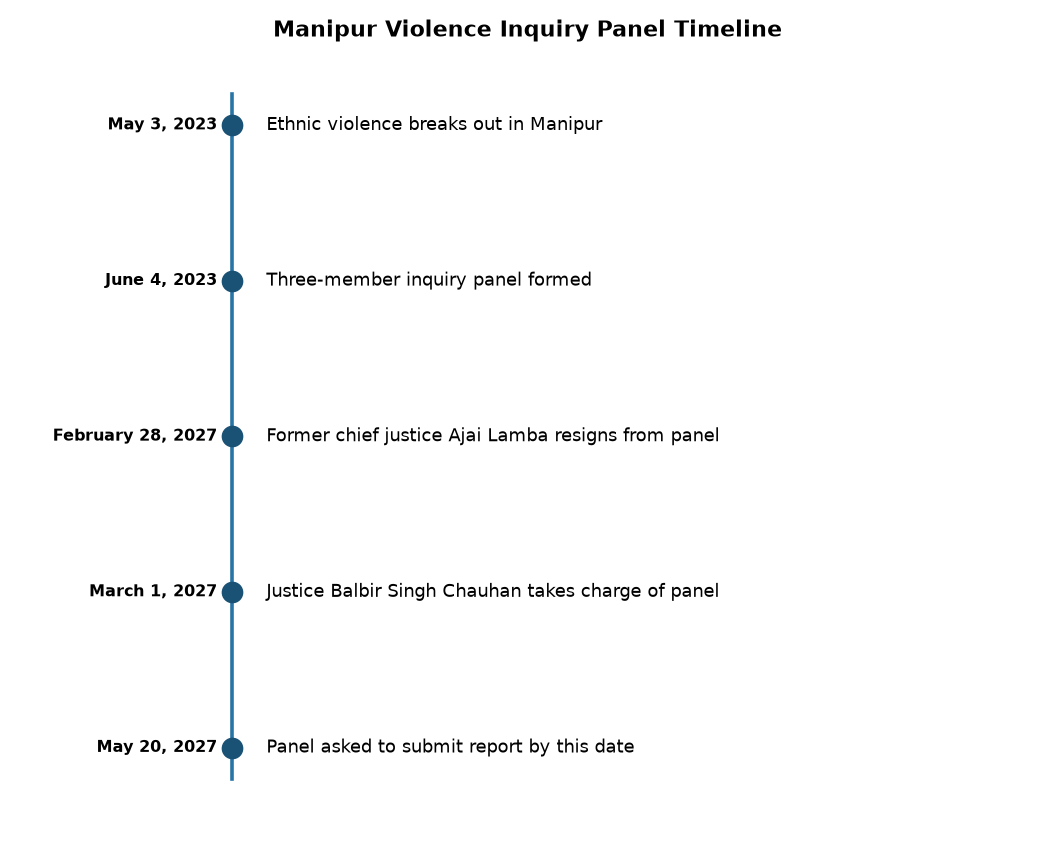
- Ethnic violence erupted in Manipur on May 3, 2023, following a ‘Tribal Solidarity March’ organised in the hill districts.
- The march was a protest against the demand by the Meitei community for Scheduled Tribe (ST) status.
- The violence resulted in over 260 fatalities and widespread destruction of property, rendering many residents homeless.
- Prior tensions included the eviction of Kuki villagers from reserve forest land, which had led to smaller agitations.
- The Centre constituted a three-member Commission of Inquiry on June 4, 2023, following recommendations from the Manipur government, citing the public importance of the matter.
Commissions of Inquiry in India
- Commissions of Inquiry in India are established under the Commissions of Inquiry Act, 1952.
- This Act empowers the appropriate government (Central or State) to appoint a Commission of Inquiry for investigating any definite matter of public importance.
- The Commission is typically composed of a judge or a panel of judges, or other experts, depending on the nature of the inquiry.
- Its primary function is to gather facts, examine evidence, and submit a report to the government with findings and recommendations.
- Commissions of Inquiry possess powers similar to a civil court under the Code of Civil Procedure, 1908, including summoning witnesses and compelling the production of documents.
- The findings of a Commission of Inquiry are generally recommendatory in nature and are not binding on the government, though they carry significant moral and political weight.
- The scope of inquiry for the Manipur panel includes ascertaining the sequence of events, facts relating to the violence, lapses or dereliction of duty by authorities, and the adequacy of administrative measures taken.
- It also assesses complaints or allegations submitted by individuals or associations affected by the violence.
Key Features
| Feature | Significance |
|---|---|
| Commission of Inquiry | A statutory body constituted under the Commissions of Inquiry Act, 1952, to investigate matters of public importance. |
| Composition | Typically comprises a sitting or retired judge of the Supreme Court or a High Court, along with other members possessing relevant expertise. |
| Mandate | To ascertain facts, sequence of events, identify lapses, assess administrative responses, and recommend measures to prevent recurrence. |
| Extension of Tenure | Indicates the complexity and extensive nature of the investigation, requiring additional time for thorough inquiry and report submission. |
| Reporting Mechanism | Submits its findings and recommendations to the Central Government, which may then table the report in Parliament. |
Why it Matters
Governance and Accountability
- The establishment and functioning of a Commission of Inquiry underscore the government’s commitment to investigating incidents of public disorder and ensuring accountability.
- It provides a formal mechanism for an impartial assessment of events, identifying systemic failures and individual dereliction of duty.
Rule of Law and Justice
- Such inquiries are crucial for upholding the rule of law by investigating breaches of peace and human rights violations.
- The findings can inform policy changes and legal reforms to prevent future occurrences of violence and ensure justice for victims.
Social Cohesion and Conflict Resolution
- Inquiries into ethnic violence aim to understand the root causes and contributing factors, which is essential for developing effective strategies for conflict resolution and fostering social harmony.
- The process can help in rebuilding trust among communities and with state institutions.
Public Trust and Transparency
- The constitution of an inquiry commission, especially with judicial oversight, enhances public trust in the government’s efforts to address sensitive issues.
- Transparency in the inquiry process, even if the report is not immediately public, contributes to democratic accountability.
Challenges
1. Prolonged Inquiry Process
- Frequent extensions can lead to delays in justice delivery and erode public confidence in the efficacy of the inquiry.
- The prolonged nature may also impact the availability and reliability of evidence over time.
UPSC Link: Governance; Social Justice
2. Implementation of Recommendations
- The effectiveness of an inquiry commission largely depends on the government’s willingness and capacity to implement its recommendations.
- Lack of political will or administrative inertia can render the inquiry’s efforts futile.
UPSC Link: Governance; Public Administration
3. Restoration of Peace and Rehabilitation
- While the inquiry focuses on past events, the immediate challenge remains the restoration of lasting peace and rehabilitation of affected populations.
- Addressing the underlying socio-economic and political grievances is critical for long-term stability.
UPSC Link: Internal Security; Social Issues
4. Inter-Community Trust Deficit
- Ethnic violence often leaves deep scars and a significant trust deficit between communities.
- The inquiry’s findings, if not handled sensitively, could inadvertently exacerbate tensions rather than mitigate them.
UPSC Link: Social Justice; Internal Security
Challenges — UPSC Perspective
| Issue | Concern |
|---|---|
| Extended Tenure of Inquiry Commission | Potential for erosion of public confidence due to delays in delivering findings and recommendations. |
| Nature of Ethnic Violence | Deep-rooted socio-economic and political factors often complicate conflict resolution and reconciliation efforts. |
| Accountability of Authorities | Ensuring impartial assessment of potential lapses or dereliction of duty by state actors during the violence. |
| Rehabilitation and Resettlement | Addressing the needs of displaced persons and rebuilding damaged infrastructure and livelihoods post-violence. |
| Preventing Recurrence | Developing and implementing effective strategies to address underlying causes and prevent future outbreaks of violence. |
Way Forward
- Expeditious submission and transparent dissemination of the inquiry commission’s report to foster public trust.
- Formulation of a comprehensive action plan by the government to implement the recommendations of the inquiry commission.
- Prioritization of rehabilitation and resettlement efforts for all affected individuals, ensuring access to basic amenities and livelihood support.
- Initiation of community-level dialogues and peace-building initiatives to bridge divides and foster inter-community harmony.
- Strengthening of intelligence gathering and early warning systems to pre-empt and effectively manage potential conflict situations.
- Review and reform of administrative and security protocols to enhance responsiveness and accountability during civil disturbances.
- Addressing the underlying socio-economic and political grievances that contribute to ethnic tensions through inclusive development policies.
UPSC Value Addition
Keywords for Mains Answer-Writing
Commissions of Inquiry Act 1952 · Ethnic violence · Internal security challenges · Rule of law · Accountability of authorities · Administrative measures · Scheduled Tribe status · Inter-community relations · Conflict resolution mechanisms · Government notifications
Constitutional & Policy Linkages
- Article 21: Right to Life and Personal Liberty
- Article 355: Duty of the Union to protect States
- Seventh Schedule: Public order (State List), Criminal law (Concurrent List)
Concept Flow
Ethnic violence erupts in Manipur over land and ST status issues. → Central Government constitutes a Commission of Inquiry. → Commission investigates events, lapses, and administrative responses. → Commission’s tenure extended multiple times due to complexity. → Commission to submit report with findings and recommendations. → Government to consider report for policy and accountability measures.
Prelims Practice Questions
Q1. Consider the following statements regarding Commissions of Inquiry in India:
1. A Commission of Inquiry can be constituted by the Central or State Government under the Commissions of Inquiry Act, 1952.
2. The findings of a Commission of Inquiry are binding on the government.
3. A retired Supreme Court judge can be appointed as the head of a Commission of Inquiry.
How many of the above statements are correct?
- Only one
- Only two
- Only three
- None
Answer: Only two — Statement 1 is correct: Both Central and State Governments have the power to constitute Commissions of Inquiry under the Act. Statement 2 is incorrect: The findings of a Commission of Inquiry are generally advisory and not legally binding on the government, though they carry significant moral and political weight. Statement 3 is correct: Retired judges of the Supreme Court or High Courts are frequently appointed to head such commissions, ensuring impartiality and judicial expertise.
Q2. Which of the following provisions of the Indian Constitution primarily deals with the administration of Scheduled Areas and Scheduled Tribes?
- Fifth Schedule
- Sixth Schedule
- Seventh Schedule
- Eighth Schedule
Answer: Fifth Schedule — The Fifth Schedule of the Constitution deals with the administration and control of Scheduled Areas and Scheduled Tribes in any state except the four states of Assam, Meghalaya, Tripura, and Mizoram. The Sixth Schedule deals with the administration of tribal areas in these four northeastern states. The Seventh Schedule deals with the distribution of powers between the Union and States, and the Eighth Schedule lists the official languages of India.
Mains Practice Question
✍ Critically examine the role and effectiveness of Commissions of Inquiry in addressing instances of large-scale public disorder and ensuring accountability. Discuss with reference to the recent extensions granted to the Manipur violence inquiry panel. (15 Marks)
Approach: MODEL-ANSWER SKELETON:
1. Introduction: Briefly define Commissions of Inquiry and their statutory basis (Commissions of Inquiry Act, 1952). Mention their purpose in investigating matters of public importance.
2. Role of Commissions of Inquiry:
– Fact-finding and truth ascertainment.
– Identifying causes and consequences of events (e.g., ethnic violence).
– Assessing administrative lapses or dereliction of duty.
– Recommending remedial measures and policy changes.
– Restoring public confidence and promoting transparency.
3. Effectiveness and Challenges:
– Advisory nature of recommendations (not legally binding).
– Delays in submission of reports (e.g., Manipur panel’s multiple extensions).
– Implementation of recommendations by the government.
– Potential for political influence or perceived lack of independence.
– Resource constraints and logistical challenges.
– Public perception and trust in the inquiry process.
4. Reference to Manipur Violence Inquiry Panel:
– Context of the 2023 ethnic violence and its impact.
– Constitution of the three-member panel, initial and current heads.
– Multiple extensions granted, raising questions about timely resolution and justice.
– Scope of the inquiry: sequence of events, administrative adequacy, complaints.
– Implications of delays on victim rehabilitation and reconciliation efforts.
5. Conclusion: Summarize the dual nature of Commissions of Inquiry as vital tools for governance and accountability, while acknowledging the need for timely, independent, and effective functioning to maintain public trust and achieve their intended objectives.
Source: orissapost.com
Generated by AanyaAi for educational purpose.
Related guides on our sites
- Current affairs for upsc 2026
- Best PSIR optional coaching for upsc
- Best economics optional coaching for upsc
- Best PSIR optional teacher for upsc

- Manipur Violence Inquiry Panel: 7th Extension, May 20 Deadline - November 13, 2026
- कूनो के चीते राजस्थान में: बाघ-तेंदुए के साथ नए संघर्ष की चुनौती - November 13, 2026
- Kuno Cheetahs in Rajasthan: UPSC Environment Analysis - November 13, 2026

No Comments