


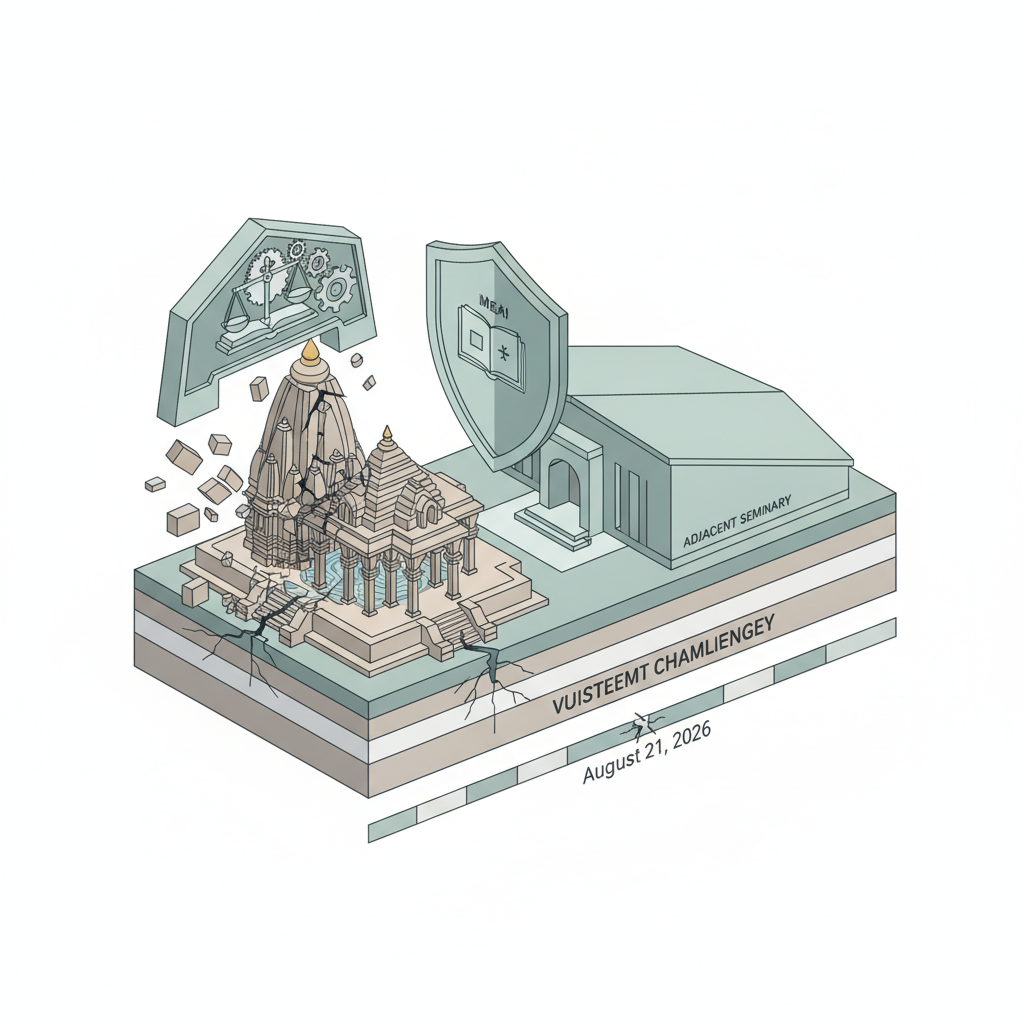
03 Sep MEA Slams Pakistan Over Demolition of 100-Year-Old Hindu Temple
✎ The protection of minority rights and places of worship is a fundamental obligation under international law, including the ICCPR and UDHR, and requires states to ensure prompt investigations, accountability, and restoration of…
Subject Relevance — Where This Topic Fits
- GS Paper II — International Relations — India and its Neighbourhood | GS Paper II — International Relations — International Law and Human Rights | GS Paper II — International Relations — Role of External Affairs Ministry
- Prelims: Ministry of External Affairs (MEA), Article 25 of the Constitution of India, Universal Declaration of Human Rights (UDHR) Article 18, International Covenant on Civil and Political Rights (ICCPR) Article 18, UN Declaration on the Rights of Persons Belonging to National or Ethnic, Religious and Linguistic Minorities, Vulnerability of minorities in South Asia, Religious freedom, Places of worship, Minority rights, South Asian Association for Regional Cooperation (SAARC) Charter on Human Rights
- Essay: Religious freedom as a cornerstone of democratic societies, The moral and legal imperative to protect minority rights in pluralistic nations
Quick Revision: The protection of minority rights and places of worship is a fundamental obligation under international law, including the ICCPR and UDHR, and requires states to ensure prompt investigations, accountability, and restoration of desecrated sites.
Why is this in the news?
The Ministry of External Affairs (MEA) of India recently condemned the demolition of a century-old Hindu temple in Siraj village, Narowal, Pakistan, citing the vulnerability of religious minorities and violations of their fundamental rights. This incident, along with prior demolitions of minority places of worship in Pakistan, underscores systemic challenges in safeguarding minority rights and places of worship in the region, prompting India to call for prompt, transparent investigations and accountability under international human rights frameworks.
Background
- The demolition of the century-old Hindu temple in Siraj village, Narowal, Pakistan, occurred on August 21, 2026, allegedly to make way for the expansion of an adjacent seminary, raising concerns about the protection of minority religious sites.
- This incident follows the demolition of the 125-year-old Gurdwara Sri Guru Singh Sabha Sahib in Farooqabad, Pakistan, in June 2026, which was carried out without legal clearance or court order, highlighting a pattern of disregard for minority places of worship.
- Pakistan is a signatory to multiple international human rights instruments, including the International Covenant on Civil and Political Rights (ICCPR) and the UN Declaration on the Rights of Persons Belonging to National or Ethnic, Religious and Linguistic Minorities, which obligate it to protect the rights of minorities, including their religious freedoms and cultural heritage.
- India has consistently raised concerns about the treatment of minorities in Pakistan, particularly Hindus, Sikhs, Christians, and Ahmadiyya Muslims, at bilateral and multilateral forums, including the United Nations Human Rights Council.
- The issue of minority rights in Pakistan has been a recurring theme in India-Pakistan relations, often discussed in the context of cross-border religious and cultural heritage, and the need for mutual respect and protection of such sites.
- The demolition of minority places of worship in Pakistan has been attributed to factors such as encroachment by religious institutions, lack of legal protections, and systemic apathy toward minority communities, as highlighted by minority rights groups and local media.
What are the legal and institutional frameworks for the protection of minority rights and places of worship?
- The **Constitution of India** guarantees religious freedom under **Article 25**, which protects the freedom of conscience and the right to freely profess, practice, and propagate religion, subject to public order, morality, and health. This provision is a cornerstone of India’s commitment to protecting minority rights.
- The **Universal Declaration of Human Rights (UDHR)**, adopted by the United Nations in 1948, enshrines the right to freedom of thought, conscience, and religion under **Article 18**, which applies universally and is binding as customary international law.
- The **International Covenant on Civil and Political Rights (ICCPR)**, adopted in 1966 and ratified by Pakistan in 2010, obligates state parties to respect and ensure the rights of minorities, including their religious freedoms and cultural heritage, under **Article 27**. This covenant is a key legal instrument for addressing violations of minority rights.
- The **UN Declaration on the Rights of Persons Belonging to National or Ethnic, Religious and Linguistic Minorities (1992)** provides a normative framework for the protection of minority rights, including the right to maintain and develop their cultural, religious, and linguistic identity.
- The **Protection of Human Rights Act, 1993** in India establishes the **National Human Rights Commission (NHRC)** and **State Human Rights Commissions (SHRCs)** to monitor and protect human rights, including those of minorities, through inquiries, recommendations, and advocacy.
- International law also recognizes the **duty of states to prevent and punish violations of religious freedom**, including the destruction of places of worship, under frameworks such as the **Rabat Plan of Action (2013)**, which prohibits attacks on cultural and religious heritage during conflicts.
- The **UN Special Rapporteur on Freedom of Religion or Belief** plays a critical role in monitoring and reporting on violations of religious freedom globally, including the destruction of minority places of worship, and advocating for corrective measures.
Key Features
| Feature | Significance |
|---|---|
| Demolition of century-old Hindu temple in Siraj, Narowal, Pakistan | Highlights the vulnerability of minority religious sites in Pakistan, particularly Hindu temples, raising concerns about state protection obligations under international human rights law. |
| MEA’s official condemnation and call for investigation | Demonstrates India’s diplomatic stance on the protection of religious minorities abroad, aligning with its foreign policy emphasis on human rights and minority welfare. |
| Failure of local authorities to prevent demolition | Indicates systemic gaps in Pakistan’s enforcement of laws protecting minority religious sites, despite constitutional guarantees of religious freedom. |
| Pattern of demolitions of minority religious sites in Pakistan | Reinforces concerns about the erosion of cultural heritage and religious freedom for minorities, with recent incidents involving Sikh and Hindu places of worship. |
| Role of minority rights groups in reporting and advocacy | Underscores the importance of civil society in monitoring and addressing violations of minority rights, particularly in contexts where state accountability is weak. |
Why it Matters
Diplomatic and International Relations
- India’s condemnation reflects its commitment to advocating for the rights of minorities abroad, a key aspect of its foreign policy discourse on human rights and religious freedom.
- The incident underscores the broader issue of minority rights in South Asia, where religious and ethnic minorities often face systemic discrimination and marginalisation.
- The MEA’s call for a prompt and transparent investigation aligns with international norms on the protection of religious sites, as outlined in instruments like the UN Declaration on the Elimination of All Forms of Intolerance and of Discrimination Based on Religion or Belief.
Human Rights and Minority Protection
- The demolition of a century-old temple highlights the persistent challenges faced by minority communities in Pakistan, particularly Hindus, in exercising their right to religious freedom and cultural preservation.
- The incident raises questions about Pakistan’s compliance with its constitutional obligations and international commitments to protect minority rights, including the right to maintain and restore places of worship.
- The vulnerability of minority religious sites in Pakistan reflects a broader pattern of discrimination and exclusion, which has implications for social cohesion and interfaith harmony in the region.
Cultural Heritage and Historical Memory
- The destruction of a century-old temple represents a loss of tangible cultural heritage, erasing historical narratives and architectural traditions associated with minority communities.
- Such incidents contribute to the erosion of collective memory and identity for minority groups, particularly in regions where their presence has been historically significant.
- The failure to protect these sites undermines efforts to preserve cultural diversity and promote inclusive heritage conservation policies.
Legal and Institutional Accountability
- The lack of legal clearance or court order for the demolition of the temple and other minority religious sites raises concerns about the rule of law and the protection of property rights for minorities.
- The incident highlights the need for robust institutional mechanisms to investigate and address violations of minority rights, including the restoration of desecrated religious sites.
- The role of minority rights groups in reporting and advocating for accountability underscores the importance of civil society in holding governments accountable for protecting minority rights.
Challenges
1. Protection of Minority Religious Sites
- Systemic failure of state authorities to prevent the demolition of minority religious sites despite constitutional guarantees of religious freedom.
- Lack of transparent and prompt investigations into such incidents, leading to impunity for perpetrators.
- Inadequate legal and institutional frameworks to enforce protections for minority religious sites, including delays in restoration and compensation.
- Erosion of trust among minority communities due to repeated violations of their rights and cultural heritage.
UPSC Link: GS II: Fundamental Rights – Article 25-28
2. Enforcement of International Human Rights Norms
- Challenges in ensuring compliance with international human rights instruments, such as the UN Declaration on the Elimination of All Forms of Intolerance and of Discrimination Based on Religion or Belief.
- Difficulty in holding non-state actors accountable for violations of minority rights, particularly in cases where state institutions are complicit or ineffective.
- Limited leverage of external actors, such as India, in compelling state action to protect minority rights without exacerbating bilateral tensions.
UPSC Link: GS II: International Organisations – UN Human Rights Council
3. Cultural Heritage Preservation
- Loss of tangible cultural heritage due to the destruction of religious sites, erasing historical and architectural legacies of minority communities.
- Inadequate policies for the preservation and restoration of minority religious sites, including funding and technical support.
- Challenges in balancing development projects with the preservation of cultural heritage, particularly in cases where minority sites are demolished for infrastructure expansion.
UPSC Link: GS I: Indian Culture – Salient Features of Indian Society
4. Civil Society and Minority Advocacy
- Limited capacity of minority rights groups to monitor and address violations due to resource constraints and political pressures.
- Need for stronger alliances between domestic and international civil society organisations to advocate for minority rights and hold governments accountable.
- Challenges in ensuring the safety and security of minority rights activists who face threats or harassment for their advocacy work.
UPSC Link: GS II: Role of Civil Society in Governance
5. Bilateral Relations and Diplomatic Constraints
- Balancing diplomatic engagement with advocacy for minority rights without undermining bilateral relations or triggering accusations of interference.
- Limited tools for external actors to influence domestic policies in Pakistan regarding minority rights, particularly in the absence of strong multilateral pressure.
- Potential for bilateral tensions to escalate when issues of minority rights are framed as part of broader geopolitical disputes.
UPSC Link: GS II: India’s Neighbourhood Policy
Challenges — UPSC Perspective
| Issue | Concern |
|---|---|
| Failure to protect minority religious sites | Systemic gaps in state enforcement of constitutional guarantees, leading to impunity and erosion of trust among minorities. |
| Lack of transparent investigations | Delays and opacity in legal processes undermine accountability and perpetuate violations of minority rights. |
| Erosion of cultural heritage | Destruction of century-old religious sites erases historical narratives and architectural traditions tied to minority communities. |
| Inadequate legal frameworks | Weak enforcement of laws protecting minority religious sites, including delays in restoration and compensation. |
| Civil society constraints | Limited capacity of minority rights groups to monitor and address violations due to resource constraints and political pressures. |
| Diplomatic constraints | Balancing advocacy for minority rights with bilateral relations without triggering escalation or accusations of interference. |
Way Forward
- Strengthen diplomatic engagement with Pakistan to advocate for the protection of minority religious sites, emphasising compliance with constitutional and international obligations.
- Encourage the United Nations and other international bodies to monitor and report on the status of minority rights in Pakistan, including the preservation of religious sites.
- Support civil society organisations in Pakistan working on minority rights through funding, capacity-building, and advocacy networks.
- Promote bilateral and multilateral dialogues on cultural heritage preservation, including the restoration of desecrated religious sites.
- Advocate for the adoption of national policies in Pakistan that explicitly protect minority religious sites and provide legal recourse for violations.
- Encourage the media to highlight incidents of minority rights violations to foster public awareness and pressure governments to act.
- Explore partnerships with international heritage conservation organisations to document and restore endangered minority religious sites.
- Promote interfaith dialogues to foster social cohesion and mutual understanding, reducing the likelihood of communal tensions.
UPSC Value Addition
Keywords for Mains Answer-Writing
Minority rights protection · Freedom of religion · Constitutional guarantees for minorities · Religious freedom in South Asia · Minority institutions in India · Cross-border minority rights · Protection of cultural heritage · International Covenant on Civil and Political Rights (ICCPR) · UN Declaration on the Rights of Persons Belonging to National or Ethnic, Religious and Linguistic Minorities · India-Pakistan bilateral relations · Religious minorities in Pakistan · Constitutional provisions for minority rights in India · Role of Ministry of External Affairs (MEA) · Freedom of religion under Article 25 of the Indian Constitution · Global standards for minority rights
Constitutional & Policy Linkages
- [‘Article 25 (Freedom of Religion)’, ‘Guarantees freedom to practise, profess, and propagate religion, including the right to maintain religious institutions.’]
- [‘Article 26 (Religious Freedom)’, ‘Protects the right of religious denominations to manage their own affairs, including the maintenance of religious sites.’]
- [‘Article 29 (Cultural and Educational Rights)’, ‘Safeguards the rights of minorities to conserve their distinct culture and educational institutions.’]
- [‘Article 30 (Right of Minorities to Establish Institutions)’, ‘Ensures minorities have the right to establish and administer educational and cultural institutions.’]
Concept Flow
Incident of temple demolition in Pakistan → MEA condemnation and call for investigation → Highlights vulnerability of minority religious sites → Raises questions about Pakistan’s compliance with constitutional and international obligations → Underscores systemic gaps in enforcement and accountability → Calls for diplomatic, legal, and civil society interventions to address the issue.
Prelims Practice Questions
Q1. Consider the following statements regarding the protection of minority rights in India:
1. Article 25 of the Indian Constitution guarantees the freedom of conscience and the right to freely profess, practise, and propagate religion.
2. Article 26 of the Indian Constitution provides for the right of religious denominations to manage their own affairs in matters of religion.
3. The National Commission for Minorities (NCM) is a statutory body established under the National Commission for Minorities Act, 1992.
4. The Supreme Court of India, in the case of T.M.A. Pai Foundation v. State of Karnataka (2002), held that minority educational institutions have the right to admit students of their choice.
How many of the above statements are correct?
- Only one
- Only two
- Only three
- All
Answer: All — Statements 1, 2, and 3 are correct. Statement 4 is incorrect as the Supreme Court, in T.M.A. Pai Foundation v. State of Karnataka (2002), held that minority educational institutions have the right to admit students of their choice, but this right is subject to regulatory measures for ensuring educational standards and social justice.
Q2. Assertion (A): The Indian Constitution, under Article 29, protects the interests of minorities by granting them the right to conserve their distinct language, script, or culture.
Reason (R): Article 30 of the Indian Constitution guarantees the right of minorities to establish and administer educational institutions of their choice.
In the context of the above statements, which of the following is correct?
- Both A and R are true, and R is the correct explanation of A.
- Both A and R are true, but R is not the correct explanation of A.
- A is true, but R is false.
- A is false, but R is true.
Answer: A is true, but R is false. — Both assertions are true, but Reason (R) does not explain Assertion (A). Article 29 protects the cultural and educational rights of minorities, while Article 30 grants them the right to establish and administer educational institutions.
Q3. Match the following international instruments with their respective provisions related to minority rights:
Column I (Instrument) | Column II (Provision)
1. International Covenant on Civil and Political Rights (ICCPR) | A. Right to self-determination
2. UN Declaration on the Rights of Persons Belonging to National or Ethnic, Religious and Linguistic Minorities | B. Protection against discrimination
3. Convention on the Rights of the Child (CRC) | C. Rights of children belonging to minorities
4. Universal Declaration of Human Rights (UDHR) | D. Freedom of thought, conscience, and religion
Select the correct match:
- 1-D, 2-A, 3-C, 4-B
- 1-B, 2-A, 3-C, 4-D
- 1-D, 2-B, 3-A, 4-C
- 1-A, 2-D, 3-B, 4-C
Answer: 1-B, 2-A, 3-C, 4-D — 1-D (ICCPR Article 18 guarantees freedom of thought, conscience, and religion), 2-A (UN Declaration Article 1 guarantees the right to self-determination), 3-C (CRC Article 30 protects the rights of children belonging to minorities), 4-B (UDHR Article 2 protects against discrimination).
Mains Practice Question
✍ The demolition of religious places of worship in neighbouring countries, such as the reported demolition of a century-old Hindu temple in Pakistan, raises critical questions about the global commitment to protecting the rights of minorities. Critically examine the constitutional and international legal frameworks that safeguard minority rights, with particular reference to India’s obligations and diplomatic responses. (15 Marks)
Approach: MODEL-ANSWER SKELETON:
1. **Constitutional Framework in India**:
– Article 25: Freedom of conscience and religion (scope and limitations).
– Article 26: Right of religious denominations to manage their own affairs.
– Article 29: Protection of interests of minorities (language, script, culture).
– Article 30: Right of minorities to establish and administer educational institutions.
– Role of the Supreme Court in interpreting these provisions (e.g., T.M.A. Pai Foundation v. State of Karnataka, 2002; Kerala Education Bill, 1957).
2. **International Legal Frameworks**:
– International Covenant on Civil and Political Rights (ICCPR), Article 27: Rights of persons belonging to minorities.
– UN Declaration on the Rights of Persons Belonging to National or Ethnic, Religious and Linguistic Minorities (1992): Key provisions.
– Universal Declaration of Human Rights (UDHR), Article 2: Non-discrimination.
– Convention on the Rights of the Child (CRC), Article 30: Rights of children belonging to minorities.
3. **India’s Obligations and Diplomatic Responses**:
– India’s ratification of ICCPR and its commitment to protecting minority rights.
– Role of the Ministry of External Affairs (MEA) in condemning violations of minority rights in neighbouring countries.
– Bilateral and multilateral engagements to promote minority rights (e.g., SAARC conventions, UN Human Rights Council).
4. **Challenges and Gaps**:
– Enforcement mechanisms in international law (e.g., lack of binding nature of declarations).
– Domestic challenges in India (e.g., communal tensions, legal ambiguities).
– Case studies of minority rights violations in South Asia (e.g., demolition of temples, gurdwaras).
5. **Conclusion**:
– Balance between sovereignty and international human rights obligations.
– Need for stronger enforcement mechanisms and diplomatic pressure.
– Role of civil society and international organisations in monitoring and reporting violations.
Source: orissapost.com
Generated by AanyaAi for educational purpose.
Related guides on our sites
- Current affairs for upsc 2026
- How to prepare for GS paper 1 for UPSC CSE mains exam
- Best UPSC coaching for IFOS exam
- Best mentorship programme for upsc

- तेलंगाना का नया एयरोस्पेस और रक्षा नीति 2.0: UPSC के लिए महत्वपूर्ण जानकारी - October 24, 2026
- Agricultural Biological Resources ABS Benefits ₹1.04 Crore for Biodiversity - October 24, 2026
- ‘इंडिया केम-2026’ मुंबई में संपन्न: वैश्विक रसायन केंद्र बनने की ओर भारत - October 24, 2026

No Comments