


10 Aug Mines and Minerals Amendment Bill 2026: Key Provisions for UPSC & PCS
✎ The Mines and Minerals (Development and Regulation) Amendment Bill, 2026, aims to transform India’s mineral sector by introducing auction-based allocation, offshore exploration, environmental safeguards, and a Mineral Security…
Subject Relevance — Where This Topic Fits
- GS Paper II — Governance, Transparency and Accountability | GS Paper III — Indian Economy and Issues Relating to Planning, Mobilisation of Resources, Growth, Development and Employment | GS Paper III — Infrastructure: Energy, Ports, Roads, Airports, Railways and Human Resources | GS Paper III — Conservation, Environmental Pollution and Degradation, Environmental Impact Assessment
- Prelims: Critical Mineral Strategy, National Mineral Policy 2019, Auction-based mineral allocation, District Mineral Foundation (DMF), Offshore mineral exploration, Environmental Impact Assessment (EIA) 2006, National Mineral Exploration Policy (NMEP), Atmanirbhar Bharat in critical minerals
- Essay: India’s quest for resource sovereignty: Balancing growth, equity and sustainability in mineral governance, The role of technology and policy in unlocking India’s mineral potential for a green transition
Quick Revision: The Mines and Minerals (Development and Regulation) Amendment Bill, 2026, aims to transform India’s mineral sector by introducing auction-based allocation, offshore exploration, environmental safeguards, and a Mineral Security Fund to ensure sustainable, transparent, and strategic mineral governance.
Why is this in the news?
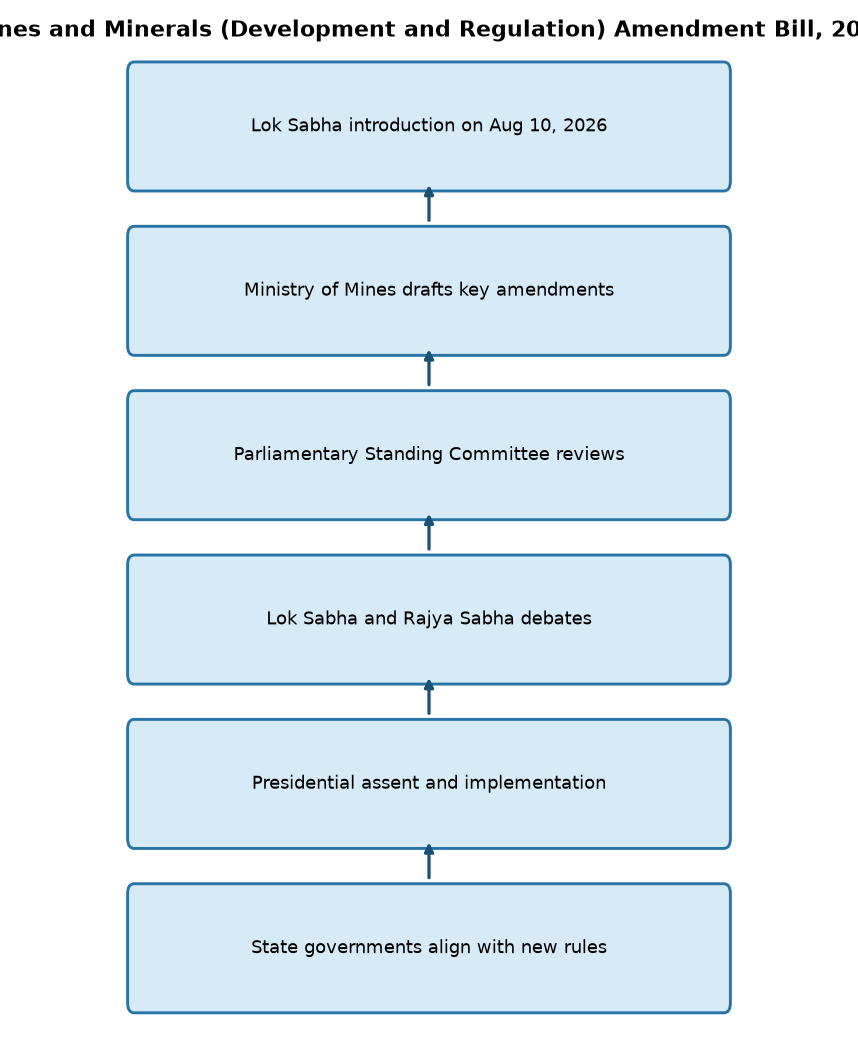
The Mines and Minerals (Development and Regulation) Amendment Bill, 2026, introduced in the Lok Sabha on August 10, 2026, represents a pivotal legislative effort to reform India’s mineral sector governance. It seeks to address longstanding structural bottlenecks, enhance transparency in mineral allocation, integrate environmental safeguards, and promote domestic value addition in critical minerals—key imperatives for India’s industrialisation, energy transition, and strategic autonomy. The Bill assumes significance in the context of global supply chain disruptions, rising demand for critical minerals, and India’s commitment to sustainable development goals.
Background
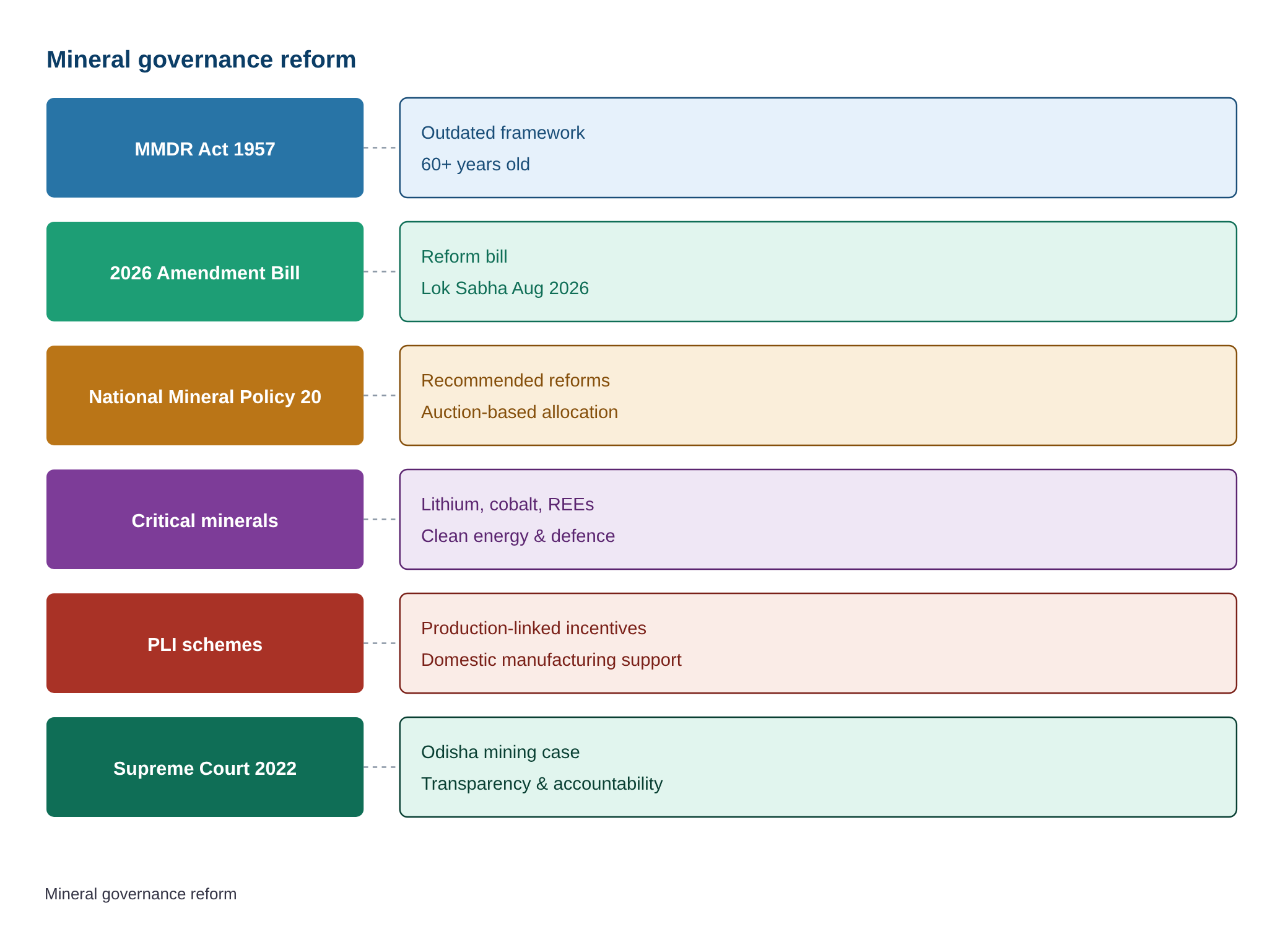
- The Mines and Minerals (Development and Regulation) Act, 1957 (MMDR Act) has governed India’s mineral sector for over six decades, but its provisions have become outdated in the face of evolving economic, environmental, and geopolitical realities.
- The National Mineral Policy, 2019, recommended comprehensive reforms to streamline mineral governance, including auction-based allocation, enhanced local value addition, and integration of environmental and social considerations.
- India’s mineral sector contributes approximately 1.5% to GDP but holds significant untapped potential, particularly in critical minerals such as lithium, cobalt, rare earth elements, and graphite, essential for clean energy technologies and defence applications.
- The global shift towards green energy and digital technologies has intensified demand for critical minerals, with India aiming to secure its supply chains to support domestic manufacturing under initiatives like the Production-Linked Incentive (PLI) schemes.
- Recent judicial interventions, such as the Supreme Court’s 2022 judgment in the Odisha mining lease case, have underscored the need for transparent and accountable mineral governance to prevent illegal mining and environmental degradation.
- India’s commitment to the Paris Agreement and Sustainable Development Goals (SDGs) necessitates a regulatory framework that balances mineral extraction with environmental sustainability and community welfare.
What is the Mines and Minerals (Development and Regulation) Amendment Bill, 2026?
- The Bill seeks to amend the Mines and Minerals (Development and Regulation) Act, 1957, to modernise India’s mineral governance framework by introducing provisions for auction-based mineral allocation, enhancing transparency, and integrating environmental and social safeguards.
- It proposes the establishment of a National Mineral Exploration and Development Authority to streamline mineral exploration, assessment, and sustainable utilisation, ensuring data-driven decision-making and reducing regulatory delays.
- The Bill introduces provisions for offshore mineral exploration and mining, aligning with India’s maritime interests and expanding the resource base beyond terrestrial deposits, particularly for deep-sea minerals like polymetallic nodules.
- It mandates the creation of a Mineral Security Fund to finance research, development, and adoption of advanced mining technologies, as well as to support local communities affected by mineral extraction through the District Mineral Foundation (DMF).
- The Bill strengthens environmental governance by mandating comprehensive Environmental Impact Assessments (EIAs) and Social Impact Assessments (SIAs) for all mineral projects, with stricter penalties for non-compliance and illegal mining activities.
- It introduces a framework for the auction of mineral blocks with transparent bidding processes, ensuring fair market value realisation and reducing discretionary allocations that have historically led to corruption and inefficiencies.
- The Bill includes provisions for the development of mineral-based industries through backward and forward linkages, promoting domestic value addition and reducing import dependence on critical minerals.
- It aligns with India’s strategic autonomy goals by prioritising the extraction and processing of critical minerals essential for defence, renewable energy, and high-tech industries, reducing vulnerability to global supply chain disruptions.
Key Features
| Feature | Significance |
|---|---|
| Introduction of composite licences for exploration and mining | Facilitates integrated operations, reducing procedural duplication and enhancing ease of doing business in the mineral sector. |
| Streamlining of auction processes for critical minerals | Aims to expedite allocation, ensuring timely availability for domestic industries and strategic reserves. |
| Enhanced role of State Governments in mineral administration | Increases fiscal autonomy and regulatory flexibility for states, aligning with the spirit of cooperative federalism. |
| Mandatory adoption of sustainable mining practices | Introduces stricter environmental compliance and rehabilitation obligations for leaseholders. |
| Digitalisation of mineral concession management | Promotes transparency through online portals for applications, approvals, and monitoring of mining activities. |
Why it Matters
Economic
- Boosts domestic mineral production, reducing import dependency for critical minerals like lithium, cobalt, and rare earth elements essential for green energy and defence technologies.
- Enhances investment attractiveness of India’s mining sector through simplified regulatory frameworks and composite licences.
- Potential to generate employment in mineral-rich states, particularly in tribal and rural areas through formalised mining operations.
Strategic
- Supports India’s self-reliance goals under the Atmanirbhar Bharat initiative by securing critical mineral supply chains.
- Strengthens India’s position in global mineral markets, particularly in the context of the Global Mineral Security Partnership (GMSP).
- Facilitates the development of a robust mineral inventory to meet the demands of high-tech industries and defence manufacturing.
Environmental
- Introduces mandatory environmental impact assessments and rehabilitation plans, aligning with India’s Nationally Determined Contributions (NDCs) under the Paris Agreement.
- Promotes the adoption of green mining technologies to mitigate ecological degradation in mineral-rich regions.
- Encourages corporate social responsibility (CSR) initiatives in mining-affected communities for sustainable livelihoods.
Governance
- Enhances transparency in mineral concession management through digital platforms, reducing discretionary powers and corruption risks.
- Empowers State Governments with greater regulatory and fiscal autonomy in mineral administration, fostering cooperative federalism.
- Establishes a more accountable and responsive regulatory regime for mineral development.
Challenges
1. Environmental Degradation and Rehabilitation
- Risk of inadequate enforcement of environmental safeguards due to weak institutional capacity in state pollution control boards.
- Potential for large-scale ecological damage in biodiversity-rich mineral belts, particularly in central and eastern India.
- Challenge of balancing rapid mineral extraction with long-term environmental sustainability and community rights.
UPSC Link: GS3 Environment & Disaster Management
2. Regulatory and Administrative Bottlenecks
- Possible delays in the transition to digitalised concession management due to legacy systems and lack of technical expertise in state agencies.
- Risk of inter-state disputes over mineral-bearing areas, particularly in overlapping jurisdictions.
- Challenge of harmonising state-level mineral policies with the central framework to avoid regulatory conflicts.
UPSC Link: GS2 Governance & Federalism
3. Social and Tribal Displacement
- Threat of forced displacement of indigenous communities without adequate compensation or resettlement, violating FRA 2006 provisions.
- Risk of exacerbating socio-economic inequalities in mineral-rich tribal regions due to unequal benefit-sharing mechanisms.
- Challenge of ensuring Free, Prior, and Informed Consent (FPIC) in line with international standards and constitutional provisions.
UPSC Link: GS1 Tribal Issues & Land Reforms
4. Economic Viability and Market Risks
- Potential for over-exploitation of minerals leading to resource depletion and long-term economic instability in mining-dependent regions.
- Risk of market volatility affecting the profitability of mineral extraction, particularly for critical minerals with fluctuating global demand.
- Challenge of ensuring fair pricing and equitable revenue distribution between state governments and local communities.
UPSC Link: GS3 Indian Economy & Resource Management
5. Technological and Infrastructure Gaps
- Inadequate adoption of advanced mining technologies in India, leading to inefficiencies and higher environmental costs.
- Limited infrastructure for mineral processing and logistics, particularly in remote and hilly mineral belts.
- Challenge of integrating small-scale miners into the formal economy to ensure compliance with environmental and labour standards.
UPSC Link: GS3 Science & Technology in Mining
Challenges — UPSC Perspective
| Issue | Concern |
|---|---|
| Environmental compliance | Weak enforcement of rehabilitation and ecological safeguards in mining leases. |
| State-centre coordination | Potential conflicts between state mineral policies and central regulatory frameworks. |
| Tribal rights and displacement | Risk of violation of Forest Rights Act, 2006 and inadequate FPIC processes. |
| Market volatility | Fluctuating global prices for critical minerals affecting domestic production viability. |
| Technological lag | Limited adoption of modern mining technologies leading to inefficiencies and higher costs. |
| Infrastructure deficits | Poor connectivity and processing facilities in mineral-rich but remote regions. |
Way Forward
- Constitute a multi-stakeholder task force comprising central and state agencies, industry representatives, and civil society to oversee the implementation of the Act and address regulatory bottlenecks.
- Strengthen the capacity of state pollution control boards and district administration through targeted training programmes on environmental safeguards and rehabilitation protocols.
- Mandate the integration of digital platforms for mineral concession management with existing land records (e.g., Bhu-Naksha) to ensure transparency and reduce disputes.
- Formulate state-specific mineral policies in consultation with local communities, ensuring alignment with the Panchayats (Extension to Scheduled Areas) Act, 1996 and FRA 2006.
- Establish a dedicated fund for the rehabilitation of mining-affected areas, financed through a levy on mineral revenues, to support afforestation, water conservation, and livelihood restoration.
- Promote research and development in green mining technologies through partnerships with IITs, CSIR, and international agencies to reduce environmental footprints.
- Develop a national mineral inventory database in collaboration with the Geological Survey of India to guide auction processes and long-term planning.
- Conduct periodic audits of mining leases to assess compliance with environmental, social, and economic obligations, with penalties for non-compliance.
UPSC Value Addition
Keywords for Mains Answer-Writing
Mines and Minerals (Development and Regulation) Amendment Bill 2026 · critical mineral security · mineral auction regime · state sovereignty over minor minerals · National Mineral Exploration Policy · PM Gati Shakti · resource nationalism · sustainable mining · mineral concession rules · mineral beneficiation · Atmanirbhar Bharat in critical minerals · UNCLOS and deep-sea mining · mineral auction transparency · mineral royalty regime · mineral supply chain resilience
Constitutional & Policy Linkages
- Article 246: Distribution of legislative powers between Union and States under the Seventh Schedule.
- Article 297: Ownership and control of mineral resources vested in the Union.
- Fifth Schedule: Provisions for administration and control of Scheduled Areas and tribal rights.
- Seventh Schedule: Entry 54 (Union List) and Entry 23 (State List) on regulation of mines and minerals.
Concept Flow
Introduction of composite licences for exploration and mining → Simplification of regulatory processes → Enhanced ease of doing business in mineral sector. → Streamlining of auction processes for critical minerals → Expedited allocation of mineral blocks → Increased domestic production and reduced import dependency. → Enhanced role of State Governments → Greater fiscal autonomy and regulatory flexibility → Alignment with cooperative federalism principles. → Mandatory sustainable mining practices → Stricter environmental compliance and rehabilitation obligations → Alignment with NDCs under Paris Agreement. → Digitalisation of mineral concession management → Transparent online portals for applications and monitoring → Reduction in discretionary powers and corruption risks. → Balancing economic growth with environmental and social safeguards → Potential for regulatory conflicts and displacement → Need for multi-stakeholder governance and capacity building.
Prelims Practice Questions
Q1. Consider the following statements regarding the Mines and Minerals (Development and Regulation) Amendment Bill, 2026:
1. The Bill seeks to introduce a uniform auction regime for all minerals, including minor minerals.
2. It proposes to empower the Central Government to reserve any mine for a public sector undertaking.
3. The Bill mandates the State Governments to compulsorily auction all mineral concessions.
4. It includes provisions for the auction of offshore mineral blocks in India’s Exclusive Economic Zone.
How many of the above statements are correct?
- Only one
- Only two
- Only three
- All four
Answer: Only three — Statements 1 and 2 are correct as the Bill aims for a uniform auction regime and empowers the Centre to reserve mines for PSUs. Statement 3 is incorrect because States are not mandated to compulsorily auction all mineral concessions. Statement 4 is correct as the Bill includes provisions for offshore mineral blocks.
Q2. Assertion (A): The Mines and Minerals (Development and Regulation) Amendment Bill, 2026 seeks to enhance transparency in mineral auctions by introducing a single-window clearance mechanism.
Reason (R): The Bill proposes to replace the existing royalty regime with a revenue-sharing model for all minerals.
In the context of the above two statements, which of the following is correct?
- Both A and R are true, and R is the correct explanation of A.
- Both A and R are true, but R is NOT the correct explanation of A.
- A is true, but R is false.
- A is false, but R is true.
Answer: A is true, but R is false. — Assertion (A) is true as the Bill aims to introduce a single-window clearance mechanism for transparency. Reason (R) is true but does not directly explain A, as the Bill does not propose to replace the royalty regime with a revenue-sharing model for all minerals.
Q3. Match the following mineral-related policies with their respective objectives:
Column I (Policy/Initiative) | Column II (Objective)
1. National Mineral Exploration Policy (NMEP) | A. Promote sustainable mining practices and reduce environmental impact
2. PM Gati Shakti | B. Enhance mineral exploration and resource assessment
3. Mineral Beneficiation Policy | C. Integrate mineral transport infrastructure with logistics networks
4. Sustainable Mining Framework | D. Increase value addition to raw minerals through processing
Select the correct match:
- 1-B, 2-C, 3-D, 4-A
- 1-A, 2-B, 3-C, 4-D
- 1-D, 2-A, 3-B, 4-C
- 1-C, 2-D, 3-A, 4-B
Answer: 1-B, 2-C, 3-D, 4-A — 1-B: NMEP aims to enhance mineral exploration and resource assessment. 2-C: PM Gati Shakti integrates mineral transport infrastructure with logistics networks. 3-D: Mineral Beneficiation Policy focuses on increasing value addition to raw minerals. 4-A: Sustainable Mining Framework promotes sustainable mining practices and reduces environmental impact.
Mains Practice Question
✍ The Mines and Minerals (Development and Regulation) Amendment Bill, 2026 represents a paradigm shift in India’s mineral governance framework. Critically analyse the Bill’s provisions in the context of India’s critical mineral security, federalism, and environmental sustainability. Also, examine the potential implications for the Atmanirbhar Bharat initiative in critical minerals. (15 Marks)
Approach: MODEL-ANSWER SKELETON:
1. **Introduction**: Contextualise the Bill within India’s mineral security challenges, citing recent reports (e.g., NITI Aayog’s ‘Critical Minerals for India’s Energy Transition’) and the global shift toward resource nationalism.
2. **Key Provisions**:
– Uniform auction regime for all minerals (major and minor), including offshore blocks in the EEZ.
– Empowerment of the Central Government to reserve mines for PSUs and introduce a single-window clearance mechanism.
– Provisions for mineral beneficiation and value addition, aligning with the PM Gati Shakti initiative.
– Potential amendments to the royalty regime (e.g., revenue-sharing model for critical minerals).
3. **Critical Analysis**:
– **Federalism**: Assess the tension between Centre’s push for uniformity and State’s constitutional rights over minor minerals (Article 246 read with State List). Reference the Sarkaria Commission and Punchhi Commission recommendations on Centre-State relations.
– **Environmental Sustainability**: Evaluate the Bill’s alignment with the Forest (Conservation) Act, 1980, and the Environment Protection Act, 1986. Discuss the lack of explicit provisions for environmental impact assessments in the Bill.
– **Critical Mineral Security**: Link the Bill to India’s reliance on imports (e.g., lithium, cobalt) and the need for domestic supply chains. Reference the ‘Critical Minerals Mission’ and India’s participation in the Mineral Security Partnership (MSP).
4. **Atmanirbhar Bharat Implications**:
– Discuss how the Bill supports domestic mineral processing (e.g., Gujarat’s lithium beneficiation plants) and reduces import dependence.
– Highlight challenges: land acquisition, regulatory delays, and technological gaps in beneficiation.
5. **Conclusion**: Weigh the Bill’s potential to enhance mineral security against its federal and environmental trade-offs. Suggest amendments (e.g., mandatory environmental clearances, State-level consultations) to balance interests.
Source: PRS Legislative Research
Generated by AanyaAi for educational purpose.

- Gurugram’s groundwater extraction exceeds limit by 212%; HC seeks ban - October 4, 2026
- स्वतंत्रता सेनानी श्यामजी कृष्ण वर्मा की जन्म जयंती पर पीएम का श्रद्धांजलि - October 4, 2026
- KWML’s Feasibility Reports for Water Metro in 18 Cities: UPSC & PCS Insights - October 3, 2026

No Comments