


07 Jan Mission 100% Electrification: Transforming Indian Railways into a Green Mobility Powerhouse
This article covers “Daily Current Affairs” and From Mission 100% Electrification: Transforming Indian Railways into a Green Mobility Powerhouse
SYLLABUS MAPPING
GS-3- Infrastructure- Mission 100% Electrification: Transforming Indian Railways into a Green Mobility Powerhouse
FOR PRELIMS
What are the major challenges in achieving 100% railway electrification in India?
FOR MAINS
What is Mission 100% Electrification of Indian Railways? Why is it important for India?
Why in the News?
Indian Railways is in the news for achieving about 99.2% electrification of its rail network by November 2025 under Mission 100% Electrification. This milestone marks a historic transition from diesel-based traction to an almost fully electrified railway system, placing India among the most extensively electrified rail networks globally. The achievement reflects India’s push toward cleaner mobility, energy security, cost-efficient transport, and climate-friendly infrastructure development.
Historical Evolution: A Century-Long Journey
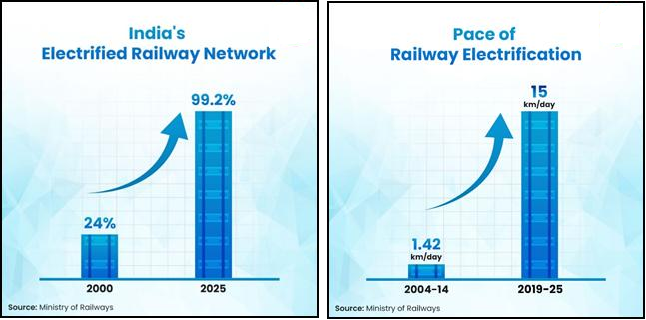
India’s railway electrification journey began in 1925, when the first electric train ran between Bombay VT and Kurla Harbour using a 1500 V DC system. At the time of Independence, electrification was limited to just 388 Route Kilometres (RKMs), with steam and diesel locomotives dominating operations. Progress remained gradual for decades. However, the last decade witnessed a decisive acceleration, driven by climate concerns, rising fuel costs, and modernization goals. Electrification pace increased dramatically—from 1.42 km/day (2004–2014) to over 15 km/day between 2019 and 2025. By November 2025, 69,427 RKMs had been electrified, with nearly 46,900 RKMs completed since 2014, marking the fastest expansion in railway electrification globally.
Current Status: Wiring the Final Miles
With 99.2% of the 70,001 RKM Broad Gauge network electrified, Indian Railways stands at the threshold of full electrification.
25 States/UTs have achieved 100% electrification
Only 5 states have residual sections, totaling just 574 RKM (0.8%)
This near-universal coverage ensures uniform operational efficiency and eliminates dependence on diesel traction across most routes.
Current Status: Wiring the Final Miles
With 99.2% of the 70,001 RKM Broad Gauge network electrified, Indian Railways stands at the threshold of full electrification.
- 25 States/UTs have achieved 100% electrification
- Only 5 states have residual sections, totaling just 574 RKM (0.8%)
Why Railway Electrification Matters
| Aspect | Explanation |
|---|---|
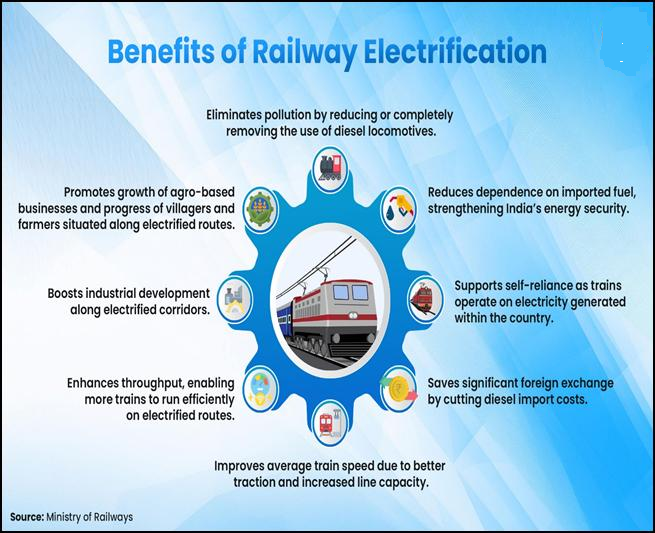
| Environmental Sustainability | Electric traction significantly reduces carbon emissions, air pollution, and noise levels. Electrification aligns with India’s commitments under the Paris Agreement, supporting climate mitigation and sustainable transport goals. |
| Energy Security | Electric trains reduce dependence on imported fossil fuels. By shifting traction energy demand to electricity—especially renewable sources—Indian Railways enhances national energy resilience. |
| Economic Efficiency | Electric traction is about 70% cheaper than diesel traction, lowering operating costs, improving financial sustainability, and freeing resources for service upgrades. |
| Operational Efficiency | Electrified routes enable higher speeds, faster acceleration, lower maintenance costs, and greater hauling capacity, thereby improving punctuality and freight efficiency. |
| Inclusive Regional Development | Electrification improves connectivity in remote and backward regions, supporting industrial corridors, rural markets, and regional integration. |
Global Benchmarking: India in Perspective
According to the International Union of Railways (UIC), June 2025:
| Country | Electrification (%) |
|---|---|
| Switzerland | 100% |
| China | 82% |
| Spain | 67% |
| Japan | 64% |
| France | 60% |
| Russia | 52% |
| United Kingdom | 39% |
With 99.2% electrification, India ranks among the world’s most electrified railway networks, reflecting scale, speed, and strategic intent unmatched by most large economies.
Railways on Solar Power: Driving Green Mobility
Solar Capacity Growth
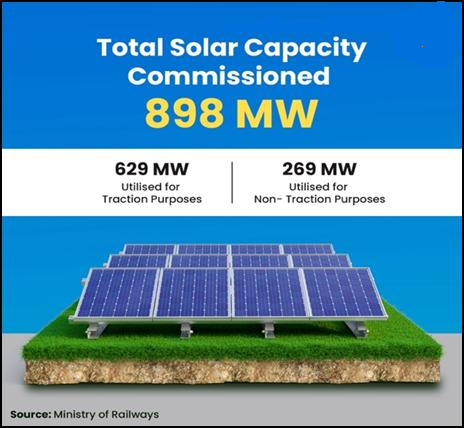
1. Solar capacity increased from 3.68 MW (2014) to 898 MW (Nov 2025)
2. Installed across 2,626 railway stations
Energy Utilisation
1. 629 MW (70%) used for traction power
2. 269 MW used for non-traction needs (stations, workshops, offices, quarters)
Technological Innovations Driving Electrification
Indian Railways has adopted modern engineering solutions to speed up and standardize electrification:
1. Cylindrical Mechanised Foundations
Replaced manual excavation
Faster installation of OHE foundations
Improved safety and consistency
2. Automatic Wiring Trains
Simultaneous installation of catenary and contact wires
Precise tension control
Significant reduction in project timelines
Governance and Policy Dimensions
Mission 100% Electrification demonstrates:
1. Strong political commitment
2. Mission-mode execution
3. Centralised planning with decentralised implementation
4. Alignment of infrastructure, energy, and climate policies
It also supports broader national initiatives such as Net Zero by 2070, National Rail Plan, and Sustainable Development Goals (SDGs).
Challenges Ahead
1. Rising Power Demand with Traffic Growth: As passenger and freight traffic increases, the electricity requirement for traction will rise sharply, creating pressure on power procurement and distribution systems.
2. Renewable Energy Integration into Traction: Integrating intermittent renewable sources like solar and wind into round-the-clock traction supply remains technically complex and requires balancing mechanisms.
3. Modernisation of Substations and Grid Connectivity: Many traction substations and transmission links need upgrading to handle higher loads, improve reliability, and reduce transmission losses.
4. Reliability in Difficult Terrain and Climate: Maintaining uninterrupted electric traction in hilly areas, flood-prone regions, deserts, and extreme weather conditions poses operational challenges.
5. Dependence on State Power Utilities: Variations in power quality, tariffs, and availability across states can affect traction reliability and operating costs.
6. Maintenance and Skilled Manpower Requirements: Electrified networks require continuous maintenance and a skilled technical workforce to manage OHE, substations, and power systems.
Way Forward
1. Completion of Residual Electrification: Fast-track electrification of the remaining broad-gauge sections to achieve 100% coverage and operational uniformity across the network.
2. Expansion of Renewable Energy Procurement: Increase direct procurement of solar and wind power through captive plants and power purchase agreements to ensure clean and affordable traction energy.
3. Deployment of Energy Storage Solutions: Adopt battery energy storage systems and other storage technologies to manage renewable intermittency and peak traction demand.
4. Adoption of Smart Grid Technologies: Implement smart substations, real-time monitoring, and digital energy management systems to improve efficiency and reliability.
5. Enhancing Regenerative Braking and Efficiency: Maximise the use of regenerative braking to recover energy during train deceleration, reducing overall power consumption.
6. Integration with Future Rail Projects: Align electrification with high-speed rail, dedicated freight corridors, and semi-high-speed trains to support future traffic growth and economic development.
Conclusion
Mission 100% Electrification is more than an infrastructure milestone—it is a national movement redefining the energy and mobility landscape of India. By transforming a diesel-dependent system into a largely electrified, renewable-powered network, Indian Railways has set a global benchmark in sustainable transport. Each newly electrified route represents not just progress on steel tracks, but a commitment to cleaner air, lower costs, and faster, more reliable journeys. As India completes the final miles, railway electrification stands as a powerful symbol of how infrastructure can drive aspiration, sustainability, and inclusive growth together.
link: Best ias coaching in delhi
Q. Mission 100% Electrification marks a major transformation in Indian Railways. Discuss its significance for sustainable transport, energy security, and economic efficiency. Also highlight the challenges ahead and the way forward.
(250 words)

- RBI’s Shrinking Real-Rate Cushion Amid Rising Inflation and Strong Demand - September 21, 2026
- India’s NGOs at a New Funding Crossroads - September 21, 2026
- Deep-Sea Discovery, Environmental Responsibility - September 19, 2026

No Comments