


27 Feb Mission Amrit Sarovar
This article covers “Daily Current Affairs” and Topic details of Mission Amrit Sarovar.
SYLLABUS MAPPING:
GS-3-Environment-Mission Amrit Sarovar
FOR PRELIMS
What is Mission Amrit Sarovar? Govt Initiatives to Combat Water Scarcity: Bhujal Yojana, PMKSY etc.
FOR MAINS
Why in the news?
Mission Amrit Sarovar, launched in April 2022, aims to construct or rejuvenate 75 ponds in each district, totalling 50,000 across India. By January 2025, over 68,000 Sarovars have been completed, improving water availability and promoting long-term environmental sustainability. Phase II will focus on water availability, community participation, and strengthening climate resilience. The mission is supported by various government schemes and public contributions, emphasizing collaboration for lasting ecological benefits.
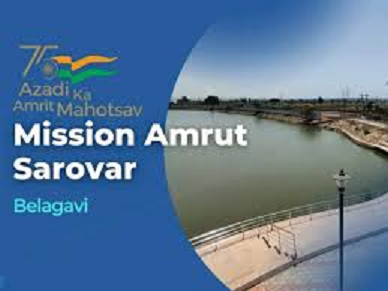
What is Mission Amrit Sarovar?
Mission Amrit Sarovar is a government initiative launched on April 24, 2022, as part of India’s Azadi Ka Amrit Mahotsav celebrations, marking the 75th year of independence. The mission aims to rejuvenate and construct Amrit Sarovars (water bodies) across rural India to address water scarcity, promote water sustainability, and improve ecological balance.
Objectives of Mission:
1. Rejuvenate and Construct Water Bodies: The mission focuses on constructing and rejuvenating at least 75 Amrit Sarovars (ponds or water bodies) in each district across India, targeting 50,000 Amrit Sarovars nationwide.
2. Ensure Water Availability: To overcome water scarcity and improve water availability in rural areas, providing a sustainable source of water for drinking, agriculture, and other local needs.
3. Promote Ecological Sustainability: Improve the ecological health of water bodies by restoring their productive utility and promoting biodiversity.
4. Empower Local Communities: Encourage community participation and engagement in water conservation and management through local bodies like Gram Sabhas and Panchayats, ensuring that development is community-driven.
5. Leverage Technology and Collaboration: Utilize geospatial data and technology (with technical support from BISAG-N) for site identification, planning, and monitoring of the water bodies. The mission works through collaboration among multiple government departments, technical partners, and local communities.
6. Improve Livelihoods: By enhancing water availability, the mission aims to support agricultural productivity, enhance livelihoods, and contribute to rural development.
7. Achieve Long-term Water Security: Strengthen the resilience of rural areas against water-related challenges and foster sustainable water management practices that will benefit future generations.
Key achievements of Mission
1. Exceeding Targets: The initial target of constructing or rejuvenating 50,000 Amrit Sarovars was successfully achieved. As of January 2025, over 68,000 Amrit Sarovars have been completed, surpassing the original goal.
2. Wide Geographical Coverage: 81,000 Amrit Sarovars have been identified across the country, and work has started in over 81,000 locations, leading to a significant impact on rural water security.
3. Community Engagement: The initiative has emphasized community participation through Gram Sabhas and Panchayats, enabling local people to directly contribute to the planning and execution of water body projects.
4. Resource Mobilization: The mission has leveraged existing financial resources from schemes like Mahatma Gandhi NREGS, PMKSY, 15th Finance Commission grants, and other state-specific initiatives, enabling cost-effective and broad-based implementation.
5. Technological Integration: The use of geospatial data and technology through technical partner BISAG-N has enhanced the identification, planning, and monitoring of water bodies, ensuring accuracy and efficiency in the mission’s execution.
6. Environmental and Ecological Benefits: Over 66,000 Amrit Sarovars constructed or rejuvenated have contributed to restoring the ecological balance of water bodies, improving biodiversity, and enhancing groundwater recharge.
Significance of mission Amrit Sarovar
1. Addressing Water Scarcity: India faces a severe water crisis, especially in rural areas. Mission Amrit Sarovar directly targets this challenge by creating sustainable water sources ensuring availability for drinking, irrigation, and other essential needs.
2. Long-Term Water Security: The mission ensures the sustainability of water resources by focusing on both the creation and rejuvenation of water bodies, fostering long-term water security and resilience against climate change.
3. Improved Agricultural Productivity: Access to water helps improve agricultural productivity in rural areas, benefiting farmers and their livelihoods, especially in water-scarce regions.
4. Promoting Ecological Restoration: By restoring water bodies, the mission contributes to biodiversity conservation, helps maintain the natural habitat, and supports wildlife ecosystems.
5. Empowering Communities: The involvement of local communities in the mission fosters ownership and empowerment, ensuring that the water bodies are effectively maintained and managed in the long run.
Factors contributing to Water Scarcity in India
1. Climate Change: Erratic rainfall patterns due to climate change result in droughts, floods, and uneven water distribution across regions, exacerbating water shortages in many areas.
2. Over-extraction of Groundwater: Excessive groundwater extraction for agriculture, drinking, and industrial use has led to falling groundwater levels, particularly in regions reliant on wells and borewells.
3. Rapid Urbanization: Urban expansion has resulted in reduced water catchment areas, contamination of water sources, and increased pressure on existing water resources.
4. Pollution of Water Sources: Industrial waste, sewage, and agricultural runoff containing harmful chemicals and pesticides pollute rivers, lakes, and groundwater, reducing the availability of clean water.
5. Inefficient Water Management: Lack of proper water conservation techniques, inefficient irrigation practices, and poor maintenance of existing water bodies contribute significantly to water scarcity.
6. Population Growth: Increased population puts pressure on available water resources, leading to overconsumption and competition for water across domestic, agricultural, and industrial sectors.
7. Water-Intensive Agriculture: Traditional farming practices in India are often highly water-intensive, using inefficient irrigation methods like flood irrigation, which depletes available water resources.
Conclusion
Mission Amrit Sarovar has emerged as a vital initiative in addressing India’s growing water scarcity and ecological challenges. Launched in April 2022, the mission aimed to rejuvenate and construct Amrit Sarovars (water bodies) across rural India, targeting a nationwide network of 50,000 water bodies. By January 2025, the mission has surpassed expectations, with over 68,000 Amrit Sarovars already completed, showing a remarkable impact on water availability and community participation.
Download Plutus IAS Current Affairs (Eng) 27th Feb 2025
Prelims Questions:
Q. With reference to Mission Amrit Sarovar, consider the following statements:
1. The mission was launched on August 15, 2022, as part of the Azadi Ka Amrit Mahotsav celebrations.
2. The mission was launched on August 15, 2022, as part of the Azadi Ka Amrit Mahotsav celebrations.
3. This mission is implemented by Earth sciences
How many of the above-given statements are correct?
A. Only one
B. Only two
C. All three
D. None
Answer: B
Mains Questions:
(250 words, 15 marks)

- RBI’s Shrinking Real-Rate Cushion Amid Rising Inflation and Strong Demand - September 21, 2026
- India’s NGOs at a New Funding Crossroads - September 21, 2026
- Deep-Sea Discovery, Environmental Responsibility - September 19, 2026

No Comments