


13 Aug Mission Mausam: UPSC’s Key Initiative for Weather & Climate Resilience 2026
Weather satellitesEarly warning systemsClimate forecasting modelsDisaster preparedness toolsMeteorological sensors✎ Mission Mausam is India’s flagship initiative to upgrade weather and climate forecasting capabilities using advanced observation systems, high-performance computing, AI/ML, and impact-based early warnings to enhance disaster…
Subject Relevance — Where This Topic Fits
- GS Paper III — Science and Technology (Applications in Governance) | GS Paper III — Disaster Management | GS Paper III — Environment and Climate Change
- Prelims: Mission Mausam, Earth System Observation, Numerical Weather Prediction, High-Performance Computing (HPC), Impact-based Forecasting, Doppler Weather Radar, AI/ML in Meteorology, Cyclone Warning System
- Essay: Climate Resilience and Governance: The Role of Technology in Mitigating Disaster Risks, India’s Path to a Weather-Ready Nation: Balancing Technology, Policy, and Public Welfare
Quick Revision: Mission Mausam is India’s flagship initiative to upgrade weather and climate forecasting capabilities using advanced observation systems, high-performance computing, AI/ML, and impact-based early warnings to enhance disaster resilience and sector-specific decision-making.
Why is this in the news?
The Union Cabinet approved Mission Mausam in 2024 as a central sector scheme under the Ministry of Earth Sciences to enhance India’s weather and climate forecasting capabilities. Launched by the Prime Minister in January 2025, the mission aims to strengthen early warning systems for high-impact weather events and provide seamless weather and climate services, thereby improving climate resilience and disaster preparedness across sectors. With a budget allocation of ₹2,000 crore for 2024-25 and 2025-26, and an estimated outlay of ₹1,342.29 crore for 2026-27, Mission Mausam represents a transformative step in leveraging advanced technologies for meteorological governance in India.
Background
- The Ministry of Earth Sciences (MoES) is the nodal agency responsible for providing weather, climate, and ocean-related services in India, including early warnings for cyclones, floods, and heatwaves.
- India’s vulnerability to high-impact weather events—such as cyclones, heavy rainfall, thunderstorms, and heatwaves—necessitates robust forecasting and early warning systems to mitigate socio-economic losses.
- The India Meteorological Department (IMD), an autonomous body under MoES, has been the primary institution for weather forecasting and climate services since its establishment in 1875.
- Historically, India’s weather monitoring infrastructure has relied on conventional observation systems, including surface observatories, upper-air measurements, and limited radar coverage, which often lacked the spatial and temporal resolution required for precise forecasting.
- The need for advanced meteorological infrastructure was underscored by the increasing frequency and intensity of extreme weather events, exacerbated by climate change, as highlighted in reports by the Intergovernmental Panel on Climate Change (IPCC).
- Mission Mausam aligns with global initiatives such as the World Meteorological Organization’s (WMO) Global Framework for Climate Services (GFCS) and the Sendai Framework for Disaster Risk Reduction (2015–2030).
What is Mission Mausam?
- The mission seeks to enhance Earth system observation and forecasting systems to improve the accuracy, timeliness, and spatial resolution of weather and climate predictions, particularly for high-impact events like cyclones, heavy rainfall, thunderstorms, and heatwaves.
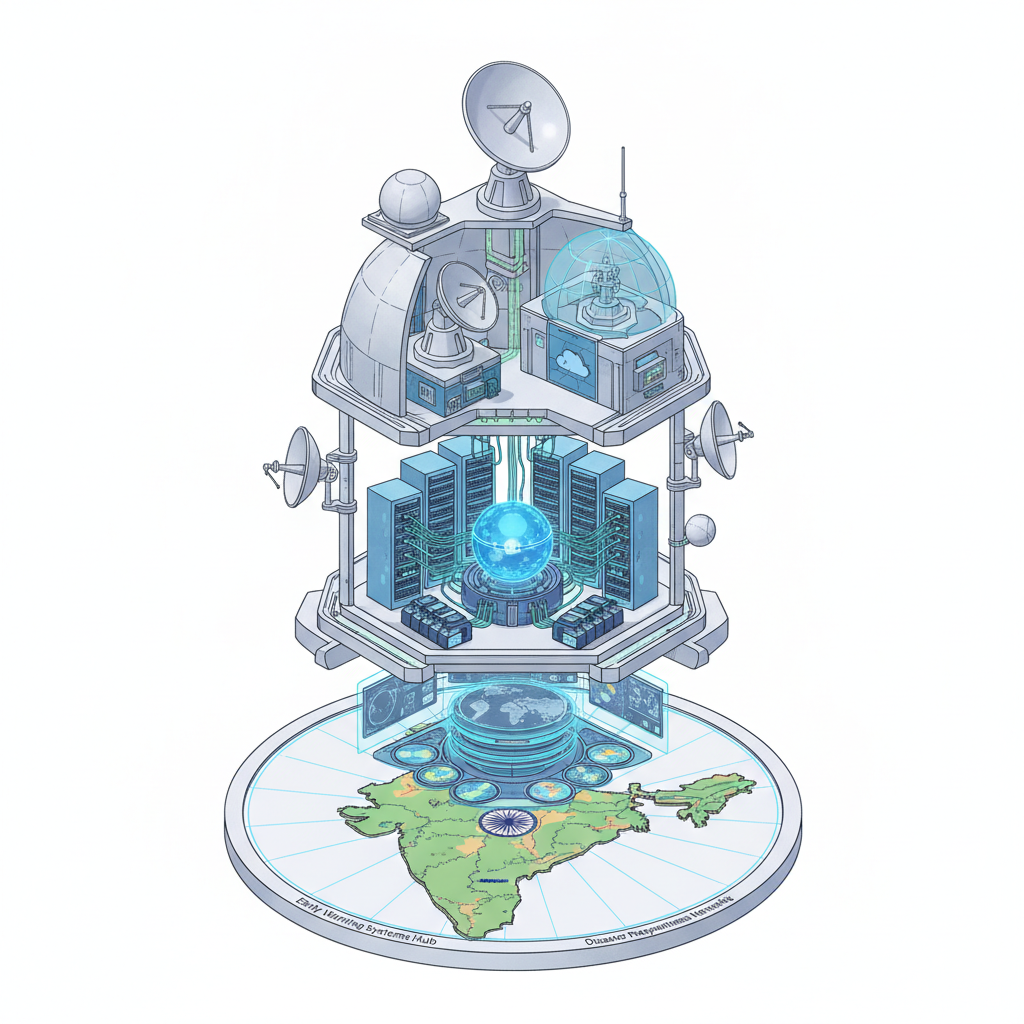
- Key technological interventions include the deployment of next-generation Doppler weather radars, wind profilers, advanced satellite payloads, and high-performance computing (HPC) systems to enable high-resolution numerical weather prediction (NWP) and coupled Earth system modeling.
- The mission integrates advanced data assimilation techniques, AI/ML algorithms, and hybrid physics-AI models to refine forecasting accuracy and develop impact-based early warnings tailored to sector-specific needs (e.g., agriculture, aviation, fisheries, and urban planning).
- The mission emphasizes capacity building through research collaborations, training programs, and institutional partnerships to strengthen India’s meteorological and climate science ecosystem.
- By 2031, Mission Mausam aims to establish a seamless, end-to-end weather and climate service delivery system, integrating observation, modeling, forecasting, and dissemination infrastructure to support disaster resilience and sustainable development.
- The mission’s governance structure includes multi-stakeholder coordination among MoES, IMD, Indian Space Research Organisation (ISRO), Council of Scientific and Industrial Research (CSIR), and academic institutions to ensure technological and operational synergy.
Key Features
| Feature | Significance |
|---|---|
| High-resolution atmospheric observations | Enhances temporal and spatial sampling for precise weather monitoring, particularly for high-impact events like cyclones and urban floods. |
| Next-generation Doppler weather radars and wind profilers | Improves detection and tracking of severe weather systems, enabling timely early warnings. |
| Advanced satellite payloads with remote-sensing technologies | Facilitates comprehensive Earth system observations, including surface, oceanic, and atmospheric parameters. |
| High-performance computing (HPC) systems | Enables numerical weather prediction models with higher resolution and faster data assimilation for accurate forecasts. |
| AI/ML integration in forecasting | Enhances predictive accuracy through hybrid physics-AI models and data-driven methodologies for localized weather predictions. |
Why it Matters
Economic
- Reduces agricultural losses by providing precise agro-meteorological advisories for crop planning and irrigation scheduling.
- Enhances maritime safety and coastal livelihoods through improved marine weather forecasts and early warnings.
- Minimises aviation disruptions by enabling accurate predictions of fog, thunderstorms, and other hazardous conditions.
Strategic
- Strengthens disaster preparedness and climate resilience by improving early warning systems for cyclones, heatwaves, and urban flooding.
- Supports national security through better meteorological intelligence for defence operations and border management.
- Enhances regional cooperation in South Asia by sharing advanced weather data and forecasting models.
Scientific
- Advances Earth system modelling by integrating AI/ML and high-resolution data assimilation techniques.
- Promotes indigenous development of weather monitoring technologies, reducing dependence on foreign systems.
- Fosters interdisciplinary research in meteorology, oceanography, and climate science.
Social
- Improves public safety by delivering actionable early warnings for high-impact weather events.
- Enables informed decision-making for vulnerable communities, particularly in disaster-prone regions.
- Supports urban planning and infrastructure development through climate-sensitive design.
Challenges
1. Technological Integration
- Ensuring seamless integration of AI/ML with traditional physics-based models for improved forecast accuracy.
- Developing robust data assimilation techniques to handle high-resolution observational data.
- Maintaining and upgrading HPC infrastructure to support real-time data processing and modelling.
UPSC Link: GS-III: Science & Tech
2. Data Quality and Coverage
- Addressing gaps in observational networks, particularly in remote and oceanic regions.
- Enhancing the reliability of satellite and radar data for accurate weather predictions.
- Standardising data formats and protocols for interoperability across national and international agencies.
UPSC Link: GS-III: Disaster Management
3. Institutional Coordination
- Facilitating collaboration among central, state, and local agencies for effective early warning dissemination.
- Ensuring alignment of mission objectives with regional and global meteorological frameworks.
- Training and capacity-building for meteorological personnel and end-users.
UPSC Link: GS-II: Governance
4. Resource Allocation
- Balancing budgetary allocations for technology acquisition, infrastructure, and human resource development.
- Ensuring sustainable funding for long-term maintenance and upgrades of monitoring systems.
- Prioritising investments in high-impact regions and sectors.
UPSC Link: GS-III: Economic Development
5. Public Awareness and Behavioural Change
- Disseminating actionable early warnings through multi-channel platforms for maximum reach.
- Educating communities on interpreting and responding to weather advisories.
- Building trust in forecast accuracy to encourage proactive disaster preparedness.
UPSC Link: GS-IV: Ethics & Governance
Challenges — UPSC Perspective
| Issue | Concern |
|---|---|
| Data gaps in remote regions | Limited coverage of observational networks in Himalayan and oceanic areas. |
| AI model interpretability | Ensuring transparency and reliability of AI-driven forecasting systems. |
| Inter-agency coordination | Fragmented dissemination of early warnings across central and state agencies. |
| Budget sustainability | Long-term funding challenges for maintenance and upgrades of infrastructure. |
| Public trust in forecasts | Addressing skepticism and misinterpretation of weather advisories. |
Way Forward
- Accelerate deployment of next-generation Doppler radars and wind profilers in high-risk zones.
- Develop standardized protocols for data assimilation and model integration across agencies.
- Establish a dedicated HPC facility for real-time weather modelling and AI/ML applications.
- Enhance public outreach through mobile applications and community-based early warning systems.
- Strengthen international collaborations for data sharing and capacity-building in meteorology.
- Invest in indigenous R&D for advanced remote-sensing technologies and satellite payloads.
- Conduct regular drills and simulations to test the efficacy of early warning dissemination systems.
- Integrate climate projections into long-term infrastructure planning and disaster risk reduction strategies.
UPSC Value Addition
Keywords for Mains Answer-Writing
Mission Mausam · Earth System Observation · High-Impact Weather Events · Early Warning Systems · Numerical Weather Prediction · AI/ML in Meteorology · Disaster Resilience · Climate Services · Atmospheric Modelling · Remote Sensing Technologies · High-Performance Computing · Impact-Based Forecasting · Atmospheric Composition Monitoring · Coupled Earth System Models · Decision Support Systems
Concept Flow
High-impact weather events → Need for accurate early warnings → Mission Mausam’s objectives → Deployment of advanced monitoring systems → Integration of AI/ML and HPC → Improved forecast accuracy → Timely dissemination of advisories → Enhanced disaster preparedness and climate resilience.
Prelims Practice Questions
Q1. Consider the following statements regarding Mission Mausam:
1. It is a centrally sponsored scheme under the Ministry of Earth Sciences.
2. The mission aims to enhance early warning systems for high-impact weather events.
3. It includes the deployment of next-generation Doppler weather radars and advanced satellites.
4. The mission focuses solely on improving weather forecasting without addressing climate services.
How many of the above statements are correct?
- Only one
- Only two
- Only three
- All four
Answer: Only three — Statements 1, 2, and 3 are correct as Mission Mausam is a centrally sponsored scheme under the Ministry of Earth Sciences, aims to enhance early warning systems, and includes deployment of advanced technologies. Statement 4 is incorrect as the mission also focuses on climate services.
Q2. Which of the following is NOT a component of Mission Mausam’s implementation strategy for 2026-31?
- A. ObservALL
- B. Develop
- C. Weather MOD
- D. Green Revolution
Answer: D. Green Revolution — ‘Green Revolution’ is unrelated to Mission Mausam’s implementation strategy, which includes components like ObservALL, Develop, Weather MOD, AtComp, Frontier, and Neat.
Q3. Assertion (A): Mission Mausam aims to strengthen weather forecasting and early warning systems through advanced observation, modelling, and computational techniques.
Reason (R): The mission includes the use of AI/ML and high-performance computing for numerical weather prediction and coupled Earth system models.
Options:
A. Both A and R are true, and R is the correct explanation of A.
B. Both A and R are true, but R is NOT the correct explanation of A.
C. A is true, but R is false.
D. A is false, but R is true.
Answer: ? — Both Assertion (A) and Reason (R) are true, and R correctly explains A as Mission Mausam’s objectives include strengthening forecasting and early warning systems through advanced techniques like AI/ML and high-performance computing.
Mains Practice Question
✍ Mission Mausam, launched by the Government of India, seeks to transform India into a ‘weather-ready and climate-conscious nation’. Critically examine the mission’s objectives, key interventions, and their significance for disaster resilience and socio-economic sectors. Also, analyse how the integration of advanced technologies like AI/ML and high-performance computing can enhance the accuracy and timeliness of weather forecasts. (15 Marks)
Approach: MODEL-ANSWER SKELETON:
1. **Introduction (2 Marks)**
– Define Mission Mausam: A centrally sponsored scheme under the Ministry of Earth Sciences to strengthen weather forecasting, early warning systems, and climate services.
– Objective: Transform India into a ‘weather-ready and climate-conscious nation’ with enhanced disaster resilience.
2. **Key Objectives of Mission Mausam (3 Marks)**
– Strengthen Earth system observation and forecasting systems.
– Improve early warning systems for high-impact weather events (e.g., cyclones, heavy rainfall, heatwaves).
– Enhance seamless weather and climate services for sectors like agriculture, aviation, and fisheries.
– Develop advanced numerical weather prediction models and coupled Earth system models.
– Deploy next-generation Doppler weather radars, wind profilers, and advanced satellite payloads.
– Integrate AI/ML and high-performance computing (HPC) for data assimilation and model improvements.
3. **Key Interventions (4 Marks)**
– **Observation Systems:** Modernize surface, upper-air, radar, satellite, lightning, aviation, marine, and oceanic observation networks.
– **Modelling and Forecasting:** Develop high-resolution numerical weather prediction models, coupled Earth system models, and ensemble forecasting systems.
– **Technology Integration:** Utilize AI/ML and hybrid physics-AI techniques for weather forecasting, post-processing, and location-specific meteorological information.
– **Computational Infrastructure:** Implement high-performance computing (HPC) for advanced modelling, data assimilation, and AI/ML applications.
– **Early Warning and Dissemination:** Strengthen impact-based forecasting, decision support systems, and multi-channel dissemination platforms for timely and actionable warnings.
4. **Significance for Disaster Resilience and Socio-Economic Sectors (3 Marks)**
– **Disaster Resilience:** Improve accuracy, spatial resolution, and lead time of forecasts for high-impact events, reducing loss of life and property.
– **Agriculture:** Provide better agrometeorological advisories for crop planning, irrigation, and risk mitigation.
– **Aviation:** Enhance safety through improved forecasts for fog, thunderstorms, and other hazardous conditions.
– **Fisheries:** Support safe fishing operations and coastal livelihoods with accurate marine weather forecasts and early warnings.
– **Urban Planning:** Mitigate urban flooding and heatwaves through location-specific weather and climate information.
5. **Role of Advanced Technologies (3 Marks)**
– **AI/ML:** Enhance data assimilation, model improvements, and post-processing of forecasts for higher accuracy and granularity.
– **High-Performance Computing (HPC):** Enable complex simulations, ensemble forecasting, and real-time data processing for timely and reliable forecasts.
– **Remote Sensing:** Improve observation coverage and accuracy through advanced satellite and ground-based remote sensing technologies.
6. **Conclusion (2 Marks)**
– Mission Mausam represents a paradigm shift in India’s approach to weather forecasting and climate services.
– Its success depends on sustained funding, capacity building, and collaboration between institutions.
– The mission aligns with global best practices and India’s commitments under international frameworks like the Sendai Framework for Disaster Risk Reduction.
Source: PIB (Press Information Bureau)
Generated by AanyaAi for educational purpose.

- Gurugram’s groundwater extraction exceeds limit by 212%; HC seeks ban - October 4, 2026
- स्वतंत्रता सेनानी श्यामजी कृष्ण वर्मा की जन्म जयंती पर पीएम का श्रद्धांजलि - October 4, 2026
- KWML’s Feasibility Reports for Water Metro in 18 Cities: UPSC & PCS Insights - October 3, 2026

No Comments