


31 Oct Model Youth Gram Sabha: Transforming Classrooms into Microcosms of Democracy
This article covers “Daily Current Affairs” and Model Youth Gram Sabha: Transforming Classrooms into Microcosms of Democracy
SYLLABUS MAPPING
GS- 2– Governance, Polity, Social Justice – Model Youth Gram Sabha: Transforming Classrooms into Microcosms of Democracy
FOR PRELIMS
What is the importance of experiential learning in the Model Youth Gram Sabha?
FOR MAINS
What are the expected outcomes of the Model Youth Gram Sabha initiative in promoting participatory governance?
Why in the News?
The Government of India has emphasized the need to enhance youth participation in Gram Sabhas to strengthen grassroots democracy and accelerate the vision of Viksit Bharat@2047. With over 6.64 lakh villages forming the backbone of India’s democracy, efforts are being made to promote youth awareness, leadership, and engagement in local governance. Initiatives under the Ministry of Panchayati Raj aim to make Gram Sabhas more inclusive, transparent, and participatory by encouraging young citizens to actively contribute to community development and decision-making processes.
What are JNVs and EMRSs?
Jawahar Navodaya Vidyalayas (JNVs) are the residential schools established under the National Policy on Education (1986) that aim to bring out the best of rural talent. They are established to provide quality modern education, including cultural, environmental, and physical development, to talented rural children irrespective of their socio-economic background.
Eklavya Model Residential Schools (EMRSs) have been set up to provide quality upper primary, secondary, and senior secondary level education to Scheduled Tribes (ST) students in remote areas to enable them to access the best opportunities in education and to bring them at par with the general population
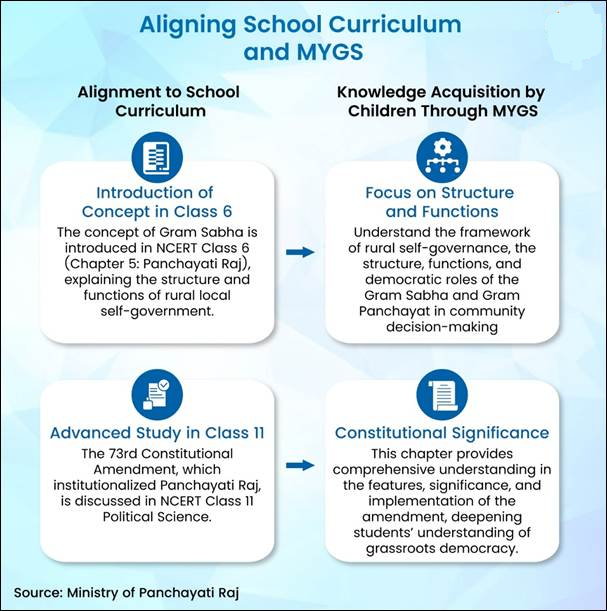
The 73rd Constitutional Amendment laid the groundwork for a three-tier Panchayati Raj system, empowering governance at the village, block, and district levels. By encouraging young minds to understand and engage with this framework, especially through initiatives like the Model Youth Gram Sabha, the Ministry envisions creating an informed and empowered generation that values democratic participation, constitutional ideals, and collective progress.
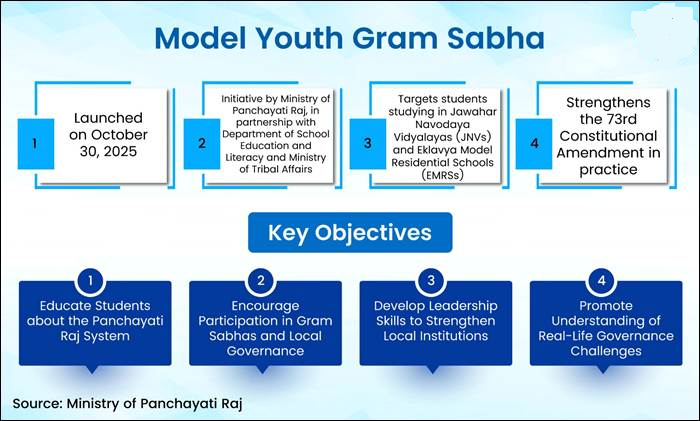 The Model Youth Gram Sabha initiative aligns with the National Education Policy (NEP) 2020, which emphasizes nurturing respect for Fundamental Duties, Constitutional values, and a strong sense of national belonging. It aims to prepare youth to be responsible, skilled, and compassionate citizens, fostering pride in being Indian while promoting human rights, sustainability, and global well-being.
Objectives
The Model Youth Gram Sabha (MYGS) aims to familiarize students with the structure and functioning of Panchayati Raj Institutions (PRIs) through participatory and experiential learning. It focuses on developing essential civic and leadership skills such as public speaking, critical thinking, teamwork, and consensus-building, while nurturing the values of inclusion, accountability, and transparency. By engaging youth in deliberating real community issues, the initiative seeks to build informed, responsible, and proactive citizens who contribute meaningfully to democratic and developmental processes.
Key Objectives:
Educate Students about the Panchayati Raj System: Introduce students to the three-tier Panchayati Raj framework established through the 73rd Constitutional Amendment and its role in local governance.
Encourage Participation: Motivate students to actively engage in Gram Sabhas and grassroots democratic processes.
Develop Leadership Skills: Foster a sense of responsibility, initiative, and leadership among youth to strengthen PRIs.
Promote Understanding of Local Issues: Provide a platform for students to discuss, analyze, and propose solutions to real-life governance and developmental challenges at the grassroots level.
Vision
The vision of the Model Youth Gram Sabha is “to nurture empowered, responsible, and empathetic young citizens who actively participate in democratic processes and contribute to sustainable and inclusive national development.”
Core Vision Goals:
Foster active and informed citizenship among youth rooted in constitutional values and democratic principles.
Instil values of inclusivity, consensus-building, justice, and equity, empowering students to become socially responsible individuals.
Develop essential life skills such as leadership, participation, communication, and critical thinking.
Enhance awareness about local governance systems and Localized Sustainable Development Goals (LSDGs).
Empower youth to contribute to national integration, social harmony, and inclusive development through active community engagement.
Characteristics of a Model Youth Gram Sabha
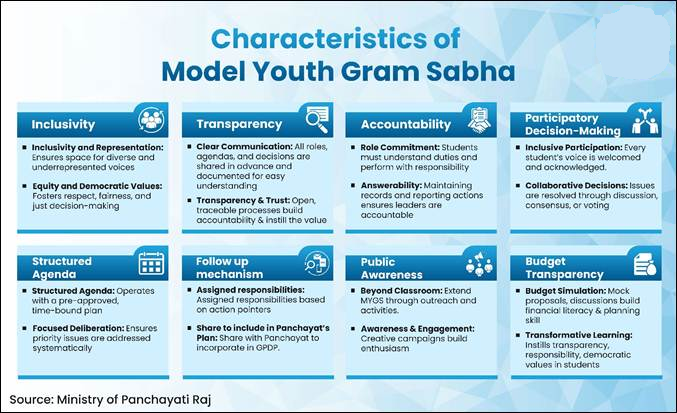
Conducting a Model Gram Sabha / Gram Panchayat Meeting
The Model Gram Sabha activity provides students with a hands-on experience of grassroots democracy by simulating the functioning of a real Gram Sabha or Gram Panchayat meeting.
During the activity, students take on various roles to mirror actual local governance structures. Some are assigned as Sarpanch, Ward Members, or Presidents, while others act as members of Standing Committees, Panchayat functionaries (such as Secretary, Panchayat Development Officer, or Sahayak), and frontline workers (like ASHA, Anganwadi Worker, or Rojgar Sahayak). Additionally, groups of students represent different social and economic segments of the Gram Panchayat, voicing community-specific concerns and suggestions.
Meeting Process:
Preparation: Before the meeting, students prepare by circulating the agenda, issuing notices at least ten days in advance, and ensuring widespread awareness within the school or community.
Proceedings: The meeting begins with introductions by the Sarpanch, followed by presentations on previous resolutions, ongoing works, and new proposals. The agenda includes discussions on developmental priorities, financial planning, and resource mobilization.
Financial Deliberations: Students review the budget, assess available funds, estimate proposed works, and identify funding gaps, brainstorming innovative methods for local revenue generation.
Decision-Making: After debates and discussions, voting takes place on key proposals. The Sarpanch summarizes the resolutions, and the Minute Recorder formally documents the decisions.
Implementation Approach
A pilot Model Gram Sabha/Gram Panchayat was conducted in selected JNVs and EMRSs in March-April 2025. A format was provided, covering end to end process of conducting these meetings, along with the structure of Model Gram Sabha/Gram Panchayat. The above structure was also made available in the form of a short video for better understanding.
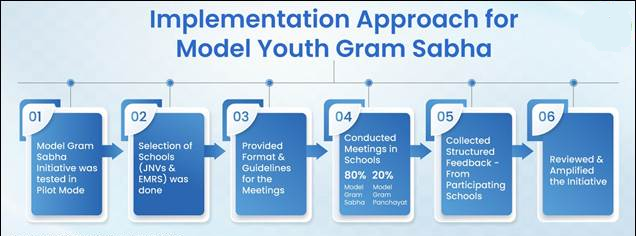
The Model Youth Gram Sabha and Model Gram Panchayat meetings have been successfully rolled out across schools to promote youth engagement in local governance. Around 80% of the schools organized Model Gram Sabha meetings, while 20% conducted Model Gram Panchayat meetings. Following these sessions, structured feedback was collected from participating schools to assess outcomes and refine the Standard Operating Protocol (SOP) for wider replication and improvement.
The initiative is progressing in a phased and structured manner as per the defined timeline:
July 2025: Identification of participating schools across various regions.
July–August 2025: Orientation programmes were held for 200 master trainers and teachers to prepare them for conducting the Model Gram Sabha activities.
August–September 2025: Mock Gram Sabha sessions were conducted in selected schools, such as Baghpat (Uttar Pradesh) and Alwar (Rajasthan), to provide students with hands-on experience in grassroots governance.
October–November 2025: Regional competitions are being organized across five regions, leading to the selection of ten finalist teams — five from Jawahar Navodaya Vidyalayas (JNVs) and five from Eklavya Model Residential Schools (EMRSs).
December 2025: The initiative will conclude with a National Competition, where the top three teams among the ten finalists will be felicitated for their excellence in demonstrating democratic participation and leadership.
Model Youth Gram Sabha (MYGS) Module
The Model Youth Gram Sabha Module acts as a comprehensive framework to bring the vision of participatory democracy into practice within schools. It ensures effective, engaging, and high-quality youth-led Gram Sabha implementation by equipping educators and students with structured guidance, facilitation tools, and evaluation mechanisms.
1. National Level Master Trainer (NLMT) Guide: Provides a detailed understanding of Gram Sabha processes and clearly defines the roles and responsibilities of facilitators. Integrates the MLJP principles to ensure meaningful and joyful learning.
Offers step-by-step facilitation tools to help trainers conduct sessions effectively and interactively.
2. Facilitation of Training Module for Teachers: A simplified, pictorial, and user-friendly guide designed to make learning participatory and engaging. Helps teachers introduce students to democracy, leadership, and life skills while preparing them for active MYGS participation. Includes preparation plans and activity checklists to ensure smooth organization and execution of the event.
3. Evaluation Framework: A user-friendly assessment tool to evaluate the effectiveness and impact of MYGS activities. Measures performance through pre-event, during-event, and post-event indicators.Recognizes schools demonstrating innovation and excellence in implementing the MYGS initiative.
Expected Outcomes
The following outcomes are envisaged from the initiative, aimed at nurturing democratic values and youth participation in local governance:
Promoting Participation: To encourage students to actively engage in local governance and understand democratic processes at the grassroots level.
Fostering Young Leadership: To inspire youth to take up leadership roles in local bodies and contribute meaningfully to their communities.
Empowering Youth Voices: To provide a platform for students to express their views on local issues, promoting informed discussions and solutions.
Encouragement for young individuals to actively participate in decision-making processes within their Gram Panchayats.
Conclusion
The Model Gram Sabha will play a vital role in shaping the vision and responsibilities of young minds toward participatory governance. By fostering awareness, leadership, and engagement, this initiative aims to bridge the gap between youth and local governance, ensuring that the next generation is well-equipped to contribute to India’s democratic and developmental journey.
Prelims question:
Q. With reference to the Model Youth Gram Sabha (MYGS) initiative, consider the following statements:
1. It aims to promote youth participation in Gram Sabhas and Panchayati Raj Institutions through experiential learning.
2. The initiative is being implemented in Jawahar Navodaya Vidyalayas (JNVs) and Eklavya Model Residential Schools (EMRSs).
3. It is implemented under the Ministry of Education.
Which of the statements given above is/are correct?
(a) 1 and 2 only
(b) 2 and 3 only
(c) 1 only
(d) 1, 2 and 3
Answer: A
Mains Question:
Q. Discuss the significance of the Model Youth Gram Sabha initiative in strengthening grassroots democracy and promoting youth engagement in local governance.
(250 words)

- Before New Taxes, Make Every Rupee Count: Fiscal Discipline and Outcome-Based Governance in Tamil Nadu - August 20, 2026
- A Palestinian State as the Foundation for Regional Peace - August 20, 2026
- A Vision for an Inclusive Bangladesh: Democracy, Minority Rights and India’s Neighbourhood - August 19, 2026

No Comments