


29 Jan Modernising India’s Statistical System: Aligning Economic Measurement with a Transforming Economy
This article covers “Daily Current Affairs” and From Modernising India’s Statistical System: Aligning Economic Measurement with a Transforming Economy
SYLLABUS MAPPING
GS-3- Economics- Modernising India’s Statistical System: Aligning Economic Measurement with a Transforming Economy
FOR PRELIMS
Why is India updating its statistical system?
FOR MAINS
Why is India revising the base years of major economic indicators like GDP, CPI and IIP?
Why in the News?
India’s statistical system is undergoing a comprehensive modernisation to capture the realities of a fast-changing economy. Since the last base year revision in 2011–12, the Indian economy has witnessed profound structural shifts—rapid expansion of the services sector, increasing formalisation under the Goods and Services Tax (GST), growing digitalisation of business models, and changes in consumption and production patterns. These transformations have generated demand for more timely indicators, finer geographic granularity, and improved measurement of the informal and services sectors. In response, the Government of India has initiated a series of coordinated reforms aimed at strengthening the quality, credibility, relevance, and accessibility of official statistics. These reforms span base year revisions of major indices, improvements in sectoral measurement, labour market statistics reforms, technological upgrades in survey methods, and enhanced data dissemination and transparency.
National Accounts Base Year Revision
Need for Periodic Base Year Updates
Periodic base year revisions are essential to ensure that GDP and other macroeconomic indices reflect the current structure of the economy and prevailing relative prices. Over time, economic structures evolve due to technological change, sectoral shifts, and changes in consumer behaviour. Rebasing allows the incorporation of new data sources, updated methodologies, and improved coverage of emerging sectors. Further, base year revisions facilitate alignment with international best practices recommended by institutions such as the UN Statistical Commission, ensuring methodological soundness and global comparability, particularly in areas such as the digital economy and supply-use tables.
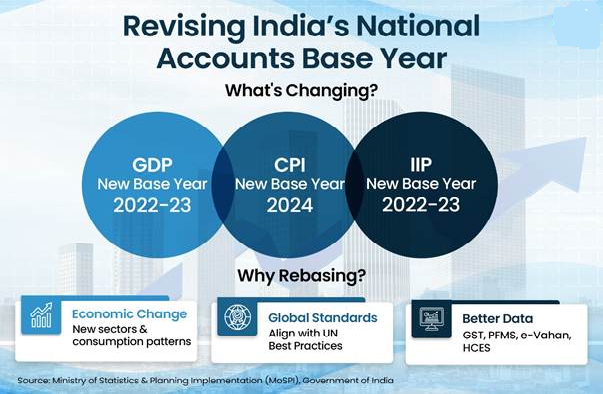
Revision of GDP Base Year (2011–12 to 2022–23)
One of the most significant reforms is the revision of the GDP base year from 2011–12 to 2022–23. Over the past decade, India’s economy has transformed substantially, with the emergence of new industries such as renewable energy and digital services, alongside shifts in investment patterns and productivity.
The revision enables better capture of the true contribution of fast-growing sectors and technological advancements. Extensive digitisation has also unlocked rich administrative data sources—such as GST data, PFMS, and e-Vahan—which are now being integrated into national accounts to improve accuracy and granularity.
Rationale for Selecting 2022–23
The year 2022–23 was chosen as the new base year as it represents the most recent “normal” year following the disruptions caused by the COVID-19 pandemic during 2019–21. GDP will continue to be compiled using the production/income and expenditure approaches, though with methodological refinements in both nominal and real estimates.
Revision of Consumer Price Index (CPI) Base Year
The Consumer Price Index (CPI), a key indicator of inflation, is being revised with a new base year of 2024. The revision draws upon data from the Household Consumption Expenditure Survey (HCES) 2023–24, enabling an updated consumption basket and expenditure weights for rural and urban areas. This revision aims to improve the relevance and accuracy of inflation measurement, enhance methodological transparency, and strengthen the basis for monetary and fiscal policymaking.
Process and Institutional Oversight
The CPI revision process commenced in early 2023 under the guidance of an Expert Group comprising representatives from RBI, government ministries, academia, and international organisations such as the IMF and World Bank. It involved a structured, multi-stage process including sample verification, price collection, and stakeholder consultations.
Revision of Index of Industrial Production (IIP)
The Index of Industrial Production (IIP), a key monthly indicator of industrial activity and an important input for estimating manufacturing GVA, is also being rebased to 2022–23. The revision seeks to update sectoral coverage, revise item weights, improve factory representation, and adopt enhanced methodologies, ensuring consistency with the revised National Accounts.
Timeline for Release of New Series
The Ministry of Statistics and Programme Implementation (MoSPI) has announced a clear rollout schedule:
GDP (Base 2022–23): 27 February 2026
CPI (Base 2024): 12 February 2026
IIP (Base 2022–23): 28 May 2026
These releases are expected to enhance confidence in official statistics and improve economic policymaking, monetary management, and business planning.
Improving Measurement of Informal and Services Sectors
Annual Survey of Unincorporated Sector Enterprises (ASUSE)
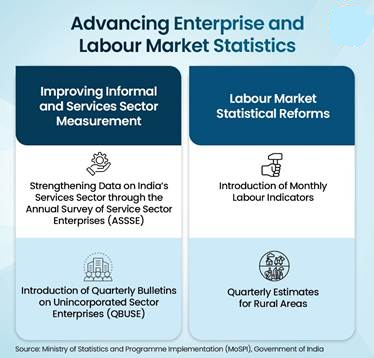
ASUSE captures data on unincorporated non-agricultural enterprises, a major source of employment and local entrepreneurship. To address data gaps in the incorporated services sector, the NSO conducted a pilot Annual Survey of Service Sector Enterprises (ASSSE), focusing on indicators such as GVA, capital formation, and employment.
Quarterly Bulletins on Unincorporated Sector Enterprises (QBUSE)
From 2025, QBUSE has been introduced to provide quarterly estimates on scale, composition, and employment, improving the timeliness of data while complementing annual ASUSE reports.
Labour Market Statistics Reform (PLFS)
The Periodic Labour Force Survey (PLFS) has undergone major reforms in 2025 to enhance frequency and granularity:
Monthly national-level labour indicators introduced from January 2025
Quarterly rural coverage added alongside urban estimates
Select state-level estimates enabled
Cross-Cutting Data Reforms: Granularity and Digitalisation
District as a Statistical Unit
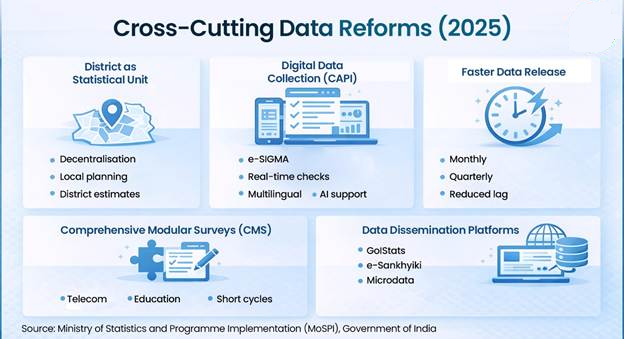
From January 2025, districts have been adopted as the basic statistical stratum in NSS surveys, enabling district-level estimates for ASUSE and PLFS and supporting decentralised, evidence-based planning.
Digital Data Collection
Surveys are now conducted using CAPI through the e-SIGMA platform, featuring real-time validation, multilingual support, and AI-enabled chatbots. This has significantly improved data quality and reduced publication lags:
Annual results: 90–120 days
Quarterly results: 45–60 days
Monthly results: 15–30 days
Modern Data Dissemination Platforms
Data accessibility has been enhanced through platforms such as:
GoIStats Mobile App (June 2025)
e-Sankhyiki Portal (June 2024) with over 136 million records
Revamped Microdata Portal (2025), developed with World Bank support
Conclusion
India’s recent statistical reforms represent a decisive shift towards a more responsive, credible, and policy-relevant statistical system. By updating base years, strengthening sectoral measurement, reforming labour statistics, and embracing digital and granular data practices, the Government has aligned official statistics with the evolving structure of the economy. Together with improved transparency and stakeholder engagement, these reforms reinforce trust in official data and provide a robust foundation for evidence-based policymaking in a complex and dynamic economic environment.
Best ias coaching in delhi Best ias coaching in chandigarh
Prelims question:
Q. With reference to recent reforms in India’s statistical system, consider the following statements:
1.The GDP base year is being revised from 2011–12 to 2022–23 to better capture structural changes such as digitalisation and expansion of services.
2. The revised Consumer Price Index (CPI) will use 2024 as the new base year, drawing weights from the Household Consumption Expenditure Survey (HCES) 2023–24.
3. The Index of Industrial Production (IIP) will be rebased to 2022–23 and released before the revised GDP series.
Which of the statements given above is/are correct?
(a) 1 and 2 only
(b) 2 and 3 only
(c) 1 only
(d) 1, 2 and 3
Answer: A
Q. Discuss the significance of recent reforms in India’s statistical system in improving the quality and policy relevance of economic data.
(250 words)

- Europe’s AI Rules May Become India’s Opportunity - August 14, 2026
- Transparency as the Foundation of Trust in Medicine - August 14, 2026
- A Timely Reset for the Food Security Act: From Foodgrain Security to Nutrition Security - August 13, 2026

No Comments