


01 Sep Modi-Xi Handshake at SCO Summit: Key Takeaways for UPSC & State PCS
✎ The Shanghai Cooperation Organisation (SCO) is a Eurasian political, economic, and security alliance founded in 2001, with India as a full member since 2017, aimed at fostering regional stability, counter-terrorism cooperation…
Subject Relevance — Where This Topic Fits
- GS Paper II — International Relations — Bilateral, Regional and Global Groupings and Agreements involving India and/or affecting India’s interests | GS Paper II — International Relations — Effect of Policies and Politics of Developed and Developing Countries on India’s interests
- Prelims: Shanghai Cooperation Organisation (SCO), Bishkek Declaration, Regional Anti-Terrorism Structure (RATS), Connect Central Asia Policy, Eurasian Economic Union (EAEU), Chabahar Port, INSTC, SCO Council of Heads of State
- Essay: Multilateralism and the Quest for Global Peace: The Role of Regional Organisations, India’s Foreign Policy: Balancing Strategic Autonomy and Multilateral Engagement
Quick Revision: The Shanghai Cooperation Organisation (SCO) is a Eurasian political, economic, and security alliance founded in 2001, with India as a full member since 2017, aimed at fostering regional stability, counter-terrorism cooperation, and economic integration.
Why is this in the news?
The 26th Shanghai Cooperation Organisation (SCO) Summit held in Bishkek, Kyrgyzstan, marked a significant diplomatic engagement for India, as Prime Minister Narendra Modi participated in high-level discussions with key global leaders, including Chinese President Xi Jinping. The bilateral interaction between Modi and Xi, following their last meeting at the 2025 SCO Summit in Tianjin, underscored the evolving dynamics of India-China relations within the multilateral framework of the SCO. India’s participation in the summit is strategically important given the organisation’s expanding agenda, which now includes counter-terrorism, regional connectivity, and economic cooperation. The summit also provided an opportunity for India to reaffirm its commitment to the SCO’s core objectives while advancing its vision for a secure, connected, and prosperous region.
Background
- The Shanghai Cooperation Organisation (SCO) was established in 2001 in Shanghai, China, as a permanent intergovernmental international organisation, succeeding the Shanghai Five grouping formed in 1996.
- India became a full member of the SCO in 2017, following its accession to the organisation alongside Pakistan, marking a significant expansion of the grouping’s geographical and strategic footprint.
- The SCO’s primary objectives include promoting mutual trust and neighbourliness among member states, enhancing cooperation in political, economic, trade, scientific, technological, and cultural domains, and maintaining regional peace, security, and stability.
- The SCO has evolved into a key platform for addressing non-traditional security challenges such as terrorism, separatism, extremism, and drug trafficking through its Regional Anti-Terrorism Structure (RATS), headquartered in Tashkent, Uzbekistan.
- India’s engagement with Central Asia has intensified in recent years, driven by the ‘Connect Central Asia’ policy, which aims to strengthen economic, cultural, and strategic ties with the region.
- The SCO Summit in Bishkek occurred against the backdrop of global geopolitical shifts, including the Ukraine conflict, evolving US-China dynamics, and India’s strategic positioning in the Indo-Pacific and Eurasia.
What is the Shanghai Cooperation Organisation (SCO)?
- The Shanghai Cooperation Organisation (SCO) is a permanent intergovernmental international organisation founded on 15 June 2001 in Shanghai, China, by the leaders of China, Kazakhstan, Kyrgyzstan, Russia, Tajikistan, and Uzbekistan.
- The SCO was established to promote mutual trust, good-neighbourly relations, and cooperation among member states in political, economic, trade, scientific, technological, and cultural spheres.
- The organisation’s core objectives include maintaining regional peace, security, and stability, combating terrorism, separatism, and extremism, and fostering regional connectivity and economic integration.
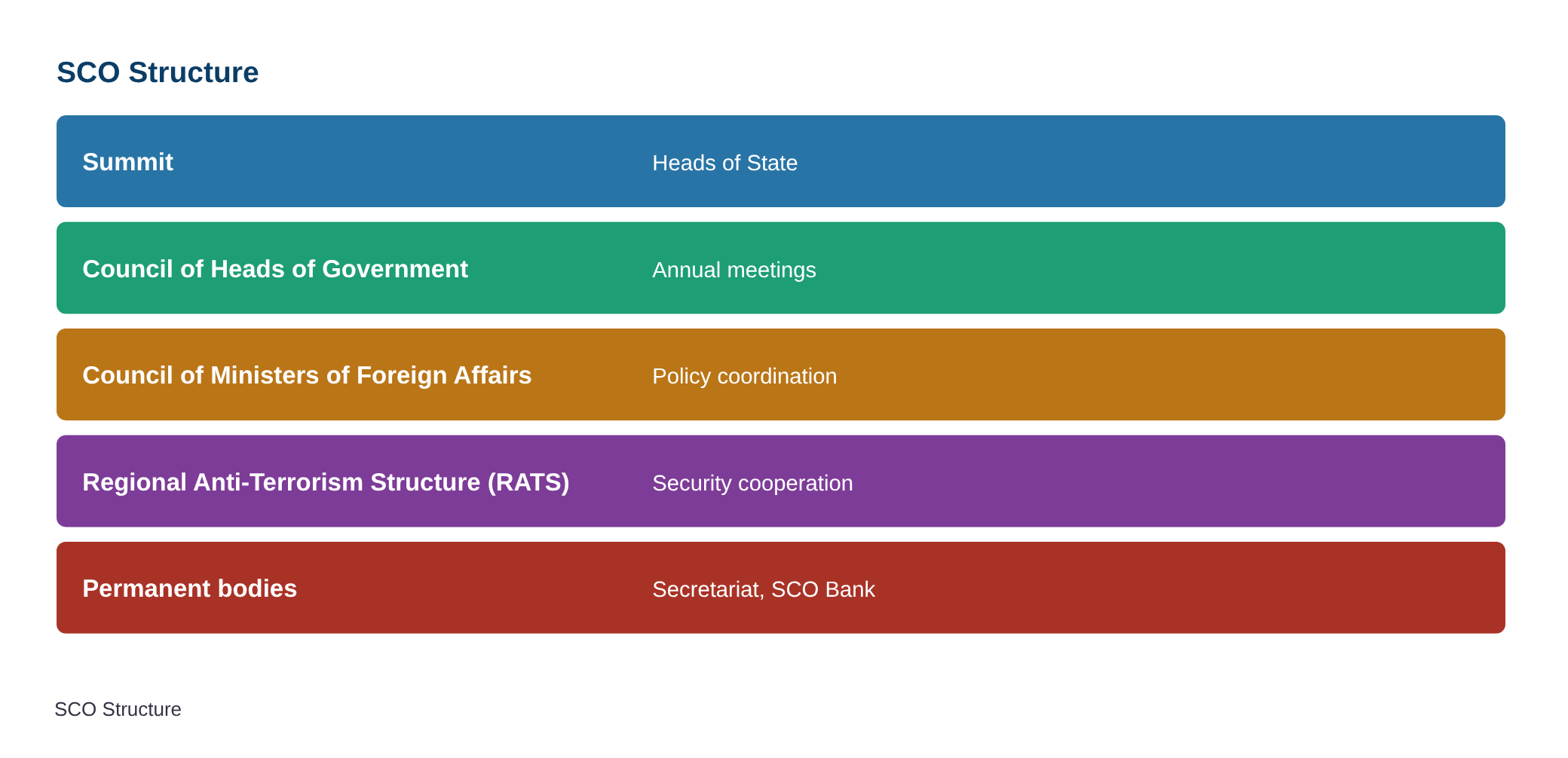
- The SCO operates through several key institutions, including the Council of Heads of State (supreme decision-making body), Council of Heads of Government, Council of Foreign Ministers, and the Regional Anti-Terrorism Structure (RATS), which coordinates counter-terrorism efforts among member states.
- The SCO has expanded its membership over time, with India and Pakistan joining as full members in 2017, bringing the total number of member states to ten.
- The SCO’s economic cooperation framework includes initiatives such as the SCO Development Strategy towards 2035 and the SCO Business Council, aimed at promoting trade, investment, and infrastructure development among member states.
- The organisation serves as a platform for high-level diplomatic engagements, with annual summits providing opportunities for leaders to discuss regional and global challenges, including climate change, energy security, and digital transformation.
Key Features
| Feature | Significance |
|---|---|
| SCO Summit in Bishkek | A multilateral platform for dialogue among member states on security, economic cooperation, and cultural exchanges in Eurasia. |
| Bilateral Handshake and Interaction | Symbolic gesture of diplomatic engagement between India and China, reflecting efforts to manage bilateral relations amid historical tensions. |
| PM Modi’s Regional Vision: Security, Connectivity, Opportunity | Outlines India’s strategic priorities within the SCO framework, aligning with broader foreign policy objectives in Central Asia. |
| Indian Diaspora Engagement in Kyrgyzstan | Highlights the role of diaspora communities in fostering soft power and cultural diplomacy. |
| World Nomad Games Opening Ceremony | Showcases cultural diplomacy and people-to-people ties, enhancing India’s engagement in Central Asian cultural initiatives. |
Why it Matters
Geopolitical Dynamics
- The SCO serves as a critical forum for India to balance its strategic interests amid great-power competition, particularly with China and Russia.
- The handshake between PM Modi and President Xi underscores the necessity of maintaining diplomatic channels despite unresolved border disputes.
- Central Asia’s strategic importance for India’s energy security, connectivity projects, and counter-terrorism efforts is amplified through SCO membership.
- The SCO’s expansion to include Iran as a full member further enhances its geopolitical weight in West and South Asia.
India’s Strategic Outreach in Central Asia
- India’s participation in the SCO aligns with its ‘Act East’ and ‘Connect Central Asia’ policies, aiming to strengthen economic and security ties.
- The region’s proximity to Afghanistan makes it pivotal for India’s counter-terrorism and counter-extremism strategies.
- Connectivity initiatives, such as the International North-South Transport Corridor (INSTC), gain prominence within the SCO framework.
- India’s engagement in cultural and educational exchanges, including the World Nomad Games, reinforces long-term diplomatic goodwill.
Multilateral Diplomacy and Global Governance
- The SCO’s focus on non-traditional security threats, such as terrorism and cybercrime, provides a platform for India to advocate for global governance reforms.
- India’s role in the SCO complements its engagement in other multilateral forums like BRICS and the G20, enhancing its diplomatic leverage.
- The organisation’s emphasis on regional stability and economic integration offers India an opportunity to project itself as a responsible stakeholder.
Challenges
1. Border Disputes and Bilateral Tensions
- The unresolved India-China border issue remains a structural challenge to sustained diplomatic engagement within the SCO.
- Historical mistrust and geopolitical competition necessitate cautious diplomacy to prevent escalation of tensions.
- The SCO’s consensus-based decision-making can be undermined by bilateral disputes among member states.
UPSC Link: GS II: India-China Relations
2. Counter-Terrorism and Extremism
- The SCO’s Regional Anti-Terrorist Structure (RATS) faces challenges in effectively addressing cross-border terrorism, particularly from Afghanistan.
- Member states’ differing priorities and capabilities in counter-terrorism cooperation complicate unified action.
- The rise of extremist ideologies in Central Asia poses a long-term security threat to the region.
UPSC Link: GS III: Counter-Terrorism Initiatives
3. Economic Integration and Connectivity
- Geopolitical rivalries, such as between India and Pakistan, hinder seamless connectivity projects within the SCO framework.
- Infrastructure gaps and bureaucratic hurdles in Central Asia impede the realisation of economic integration goals.
- Competition from China’s Belt and Road Initiative (BRI) poses challenges to India’s alternative connectivity proposals.
UPSC Link: GS II: Regional Connectivity Projects
4. Balancing Strategic Alliances
- India must navigate its relationships with both Russia and China, whose strategic interests often diverge in Central Asia.
- The SCO’s evolving role raises questions about India’s alignment with other member states, particularly in the context of global power shifts.
- Ensuring that the SCO remains a platform for mutual benefit rather than a tool for great-power competition is a persistent challenge.
UPSC Link: GS II: India’s Foreign Policy
5. Climate Change and Resource Security
- Central Asia’s vulnerability to climate change, including water scarcity and desertification, poses risks to regional stability.
- Competition for water and energy resources among SCO member states could exacerbate existing tensions.
- India’s energy security is linked to the stability of Central Asian energy supplies, requiring proactive diplomatic engagement.
UPSC Link: GS III: Climate Change and Resource Diplomacy
Challenges — UPSC Perspective
| Issue | Concern |
|---|---|
| Border Disputes | Structural obstacle to sustained bilateral cooperation within the SCO. |
| Counter-Terrorism Gaps | Inconsistent enforcement of anti-terrorism measures among member states. |
| Economic Rivalries | Competition between connectivity initiatives hinders regional integration. |
| Strategic Alignment | Divergent national interests complicate consensus-based decision-making. |
| Climate Vulnerability | Environmental degradation threatens long-term regional stability. |
| Diaspora Integration | Ensuring the welfare of Indian diaspora communities in SCO member states. |
Way Forward
- Strengthen India’s engagement in the SCO’s Regional Anti-Terrorist Structure (RATS) to enhance counter-terrorism cooperation.
- Promote connectivity projects under the International North-South Transport Corridor (INSTC) to diversify trade routes and reduce dependency on China’s BRI.
- Leverage cultural diplomacy, including participation in events like the World Nomad Games, to deepen people-to-people ties in Central Asia.
- Advocate for reforms in the SCO’s decision-making process to ensure greater inclusivity and transparency.
- Enhance economic partnerships with Central Asian states through targeted investment in energy, agriculture, and technology sectors.
- Collaborate with SCO member states to address climate change and water security challenges through joint initiatives.
- Utilise the SCO platform to advocate for a rules-based international order, aligning with India’s stance on global governance reforms.
- Establish a dedicated mechanism for regular consultations with Central Asian states to address bilateral and regional concerns.
UPSC Value Addition
Keywords for Mains Answer-Writing
Shanghai Cooperation Organisation (SCO) · Bishkek Declaration · Regional security architecture · Counter-terrorism cooperation · Connectivity initiatives · India-China bilateral engagement · Central Asia policy · SCO Summit 2026 · Multilateral diplomacy · Geopolitical stability · Non-traditional security threats · SCO’s institutional framework · India’s foreign policy priorities · Regional connectivity projects
Concept Flow
Historical border disputes between India and China → Limited trust in bilateral relations → Necessity of multilateral engagement (SCO) for diplomatic stability → Participation in SCO Summit as a platform for dialogue → Symbolic handshake and interaction → Reinforcement of India’s regional vision (Security, Connectivity, Opportunity) → Integration into SCO’s broader agenda on counter-terrorism and economic integration → Long-term goal of fostering regional stability and mutual benefit.
Prelims Practice Questions
Q1. Consider the following statements regarding the Shanghai Cooperation Organisation (SCO):
1. The SCO was established in 2001 with the signing of the Shanghai Convention.
2. India and Pakistan became full members of the SCO in 2017.
3. The SCO Secretariat is headquartered in Beijing, China.
4. The SCO has a permanent military structure known as the Regional Anti-Terrorist Structure (RATS).
How many of the above statements are correct?
- Only one
- Only two
- Only three
- All four
Answer: All four — Statement 1 is incorrect: the SCO was established in 2001 with the signing of the Shanghai Convention, but it was preceded by the Shanghai Five (1996). Statements 2, 3, and 4 are correct. India and Pakistan joined as full members in 2017, the Secretariat is in Beijing, and RATS is a permanent body.
Q2. Assertion (A): The Shanghai Cooperation Organisation (SCO) primarily focuses on economic cooperation among member states.
Reason (R): The SCO was founded to promote regional stability and counter-terrorism through the Regional Anti-Terrorist Structure (RATS).
Options:
A. Both A and R are true, and R is the correct explanation of A.
B. Both A and R are true, but R is not the correct explanation of A.
C. A is true, but R is false.
D. A is false, but R is true.
Answer: ? — The SCO’s primary focus is on regional security, counter-terrorism, and stability, not economic cooperation. The RATS is a key institutional mechanism for counter-terrorism. Thus, A is false, but R is true.
Q3. Match the following institutions with their respective headquarters:
Column I (Institution) | Column II (Headquarters)
1. SCO Secretariat | A. Tashkent
2. Regional Anti-Terrorist Structure (RATS) | B. Beijing
3. Asian Infrastructure Investment Bank (AIIB) | C. Shanghai
4. New Development Bank (NDB) | D. Shanghai
Options:
1-B, 2-A, 3-D, 4-C
1-B, 2-A, 3-C, 4-D
1-D, 2-A, 3-B, 4-C
1-B, 2-C, 3-A, 4-D
- 1-B, 2-A, 3-D, 4-C
- 1-B, 2-A, 3-C, 4-D
- 1-D, 2-A, 3-B, 4-C
- 1-B, 2-C, 3-A, 4-D
Answer: 1-B, 2-A, 3-D, 4-C — The SCO Secretariat is in Beijing, RATS is in Tashkent, the AIIB is in Shanghai, and the NDB is in Shanghai. The correct match is 1-B, 2-A, 3-D, 4-C.
Mains Practice Question
✍ The Shanghai Cooperation Organisation (SCO) Summit in Bishkek, 2026, underscores the evolving regional security and connectivity architecture in Eurasia. In this context, critically examine the role of the SCO in addressing non-traditional security threats such as terrorism, separatism, and extremism. (15 Marks)
Approach: MODEL-ANSWER SKELETON:
1. **Introduction**: Define the SCO and its institutional framework (Shanghai Convention 2001, membership expansion, SCO Charter). Highlight its dual focus on security and economic cooperation.
2. **Non-traditional security threats in the SCO region**: Define terrorism, separatism, and extremism; cite recent incidents (e.g., Afghanistan spillover, Central Asian instability) to ground the discussion.
3. **SCO’s institutional mechanisms**:
– **Regional Anti-Terrorist Structure (RATS)**: Mandate, operational role, and limitations (e.g., lack of binding enforcement mechanisms).
– **SCO’s legal instruments**: Shanghai Convention on Combating Terrorism, Separatism, and Extremism (2001), and its protocols.
– **Intelligence-sharing and joint exercises**: Examples like ‘Peace Mission’ military drills.
4. **Challenges and limitations**:
– **Sovereignty concerns**: Member states’ reluctance to cede authority to RATS.
– **Divergent national interests**: Example of India-China bilateral tensions affecting SCO cohesion.
– **Implementation gaps**: Lack of a unified counter-terrorism strategy; reliance on bilateral arrangements.
5. **Comparative perspective**: Contrast SCO’s approach with other regional bodies (e.g., ASEAN’s counter-terrorism centre, UNSC resolutions).
6. **India’s role**: India’s participation in SCO, its focus on connectivity (Chabahar, INSTC), and balancing strategic autonomy with regional cooperation.
7. **Conclusion**: Assess whether the SCO has succeeded in mitigating non-traditional threats, and propose reforms (e.g., stronger RATS mandate, binding agreements).
Source: orissapost.com
Generated by AanyaAi for educational purpose.
Related guides on our sites
- Current affairs for upsc 2026
- Best PSIR optional coaching for upsc
- Best PSIR optional teacher for upsc
- Best teacher of PSIR optional for upsc

- India-Australia AUSTRAHIND 2026 Exercise: Key Highlights for UPSC & State PCS - October 22, 2026
- एससीओ बैठक में भारत का आतंकवाद विरोध: क्षेत्रीय सहयोग पर जोर - October 22, 2026
- SEC Directs Strict SC Order Compliance for Andhra ULB Polls - October 22, 2026

No Comments