


08 Aug MP Urges Karnataka CM to Extend Crop Insurance Premium Deadline for Farmers
✎ The Weather-Based Crop Insurance Scheme (WBCIS) is a parametric insurance product under PMFBY that provides payouts based on weather indices, ensuring timely compensation to farmers for weather-related crop losses.
Subject Relevance — Where This Topic Fits
- GS Paper III — Agriculture | GS Paper III — Issues related to Direct and Indirect Farm Subsidies and Minimum Support Prices
- Prelims: Pradhan Mantri Fasal Bima Yojana (PMFBY), Weather-based Crop Insurance Scheme (WBCIS), Minimum Support Price (MSP), Agricultural Insurance Company of India (AIC), Kisan Credit Card (KCC), Common Service Centres (CSC), Cooperative Societies in Agriculture
- Essay: Agrarian distress in India: Causes and Solutions, Role of Technology in Agricultural Transformation
Quick Revision: The Weather-Based Crop Insurance Scheme (WBCIS) is a parametric insurance product under PMFBY that provides payouts based on weather indices, ensuring timely compensation to farmers for weather-related crop losses.
Why is this in the news?
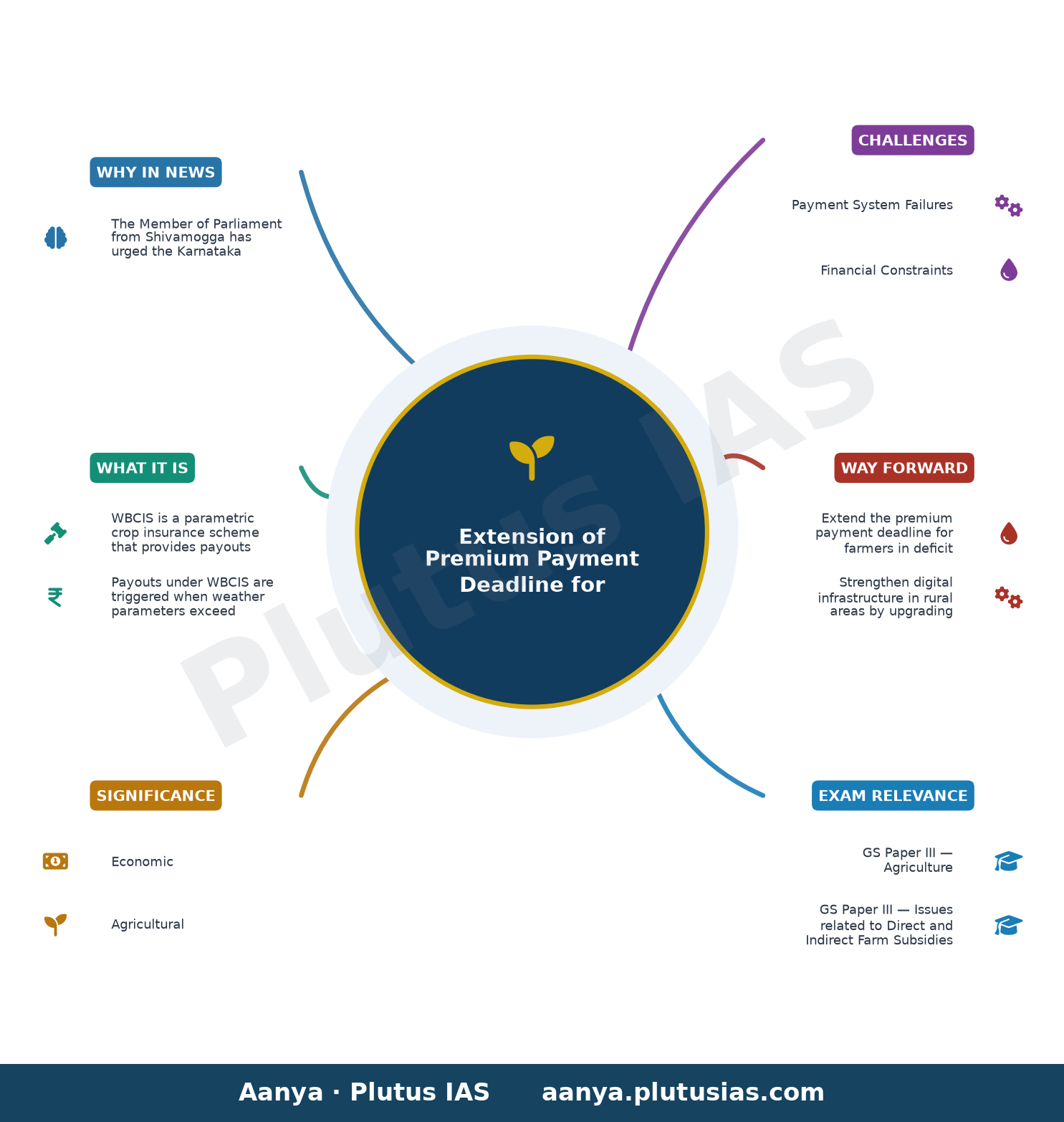
The Member of Parliament from Shivamogga has urged the Karnataka Chief Minister to extend the deadline for farmers to pay premiums under the Weather-Based Crop Insurance Scheme (WBCIS), citing financial constraints, technical glitches, and significant rainfall deficits in the region. This highlights the operational challenges in implementing agricultural insurance schemes and the need for timely interventions to safeguard farmer interests.
Background
- The Weather-Based Crop Insurance Scheme (WBCIS) is a parametric insurance product that provides coverage against adverse weather events such as excess rainfall, deficit rainfall, temperature variations, and humidity, which directly impact crop yields.
- WBCIS is implemented under the Pradhan Mantri Fasal Bima Yojana (PMFBY), a central government scheme to provide financial support to farmers in the event of crop failure due to natural calamities.
- The scheme covers both food crops (e.g., cereals, pulses) and horticultural crops (e.g., areca, pepper, ginger, mango), with premiums subsidised by the central and state governments.
- In Karnataka, the premium payment deadline for WBCIS was set for July 31, 2026, but many farmers faced difficulties due to financial constraints and technical issues in payment portals.
- The state recorded an average rainfall deficit of 34% during the monsoon, with Shivamogga district witnessing a 44% deficit, exacerbating the need for timely insurance coverage.
- Earlier, farmers could pay premiums through Common Service Centres (CSCs), but this option was discontinued in the current season, leading to reliance on banks and cooperative societies, which faced server and technical issues.
What is the Weather-Based Crop Insurance Scheme (WBCIS)?
- WBCIS is a parametric crop insurance scheme that provides payouts based on predefined weather indices (e.g., rainfall, temperature) rather than actual crop loss assessment, ensuring faster claim settlements.
- Payouts under WBCIS are triggered when weather parameters exceed predefined thresholds (e.g., deficit rainfall below a specified level), ensuring timely compensation to farmers.
- WBCIS covers a wide range of crops, including cereals, pulses, oilseeds, and horticultural crops such as areca, pepper, ginger, and mango, which are critical to Karnataka’s agricultural economy.
- The scheme aims to reduce the financial burden on farmers by providing a safety net against weather-related risks, thereby encouraging investment in agricultural productivity.
- WBCIS operates on a ‘unit area approach,’ where each village or cluster of villages is treated as a unit for insurance purposes, ensuring broader coverage and reducing administrative costs.
Key Features
| Feature | Significance |
|---|---|
| Weather-based Crop Insurance Scheme (WBCIS) | Provides financial protection to farmers against adverse weather events (e.g., deficit rainfall) by compensating for yield losses in notified crops. |
| Premium Payment Mechanism | Farmers must pay premiums to enrol in the scheme; delays or defaults result in loss of coverage, exacerbating financial vulnerability. |
| Inclusion of Horticultural Crops | Expands insurance coverage to high-value crops like areca, pepper, ginger, and mango, addressing risks in diverse agricultural sectors. |
| Payment Channels | Shift from Common Service Centres to cooperative societies/banks introduced logistical and technical barriers, disproportionately affecting small farmers. |
| Deadline Extension Request | Urgent appeal to extend premium payment deadline to mitigate financial strain on farmers amid monsoon deficits and payment system failures. |
Why it Matters
Economic
- Mitigates income volatility for farmers by compensating for weather-induced crop losses, thereby stabilising rural economies and reducing debt burdens.
- Prevents distress sales of assets or migration by providing a safety net during climatic adversities, particularly in deficit rainfall scenarios.
- Supports horticultural sectors, which are capital-intensive and vulnerable to climate shocks, ensuring long-term agricultural productivity and export potential.
Agricultural
- Enhances resilience of Indian agriculture to climate variability by integrating weather parameters into risk assessment and payout mechanisms.
- Encourages adoption of high-risk, high-reward crops by insuring against weather-related failures, diversifying cropping patterns and income sources.
- Reduces the reliance on ad-hoc relief measures by institutionalising risk transfer through insurance, improving predictability for farmers.
Administrative
- Highlights systemic gaps in implementation, such as payment channel transitions and technical failures, which undermine scheme accessibility and efficacy.
- Exposes the need for robust digital infrastructure in rural areas to ensure seamless premium payments and claim settlements.
- Demonstrates the role of elected representatives in addressing grassroots implementation challenges through inter-departmental coordination.
Social
- Protects marginalised farmers, who are most vulnerable to climate shocks due to limited resources and access to credit or alternative livelihoods.
- Prevents deepening of rural-urban inequalities by safeguarding farm incomes and sustaining local economies during climatic crises.
Challenges
1. Payment System Failures
- Transition from Common Service Centres to cooperative societies/banks created logistical hurdles, particularly for small and marginal farmers.
- Technical issues in banking/cooperative systems, such as server downtimes or lack of digital literacy, delayed premium payments.
- Exclusion of farmers without access to formal banking channels, exacerbating inequities in insurance coverage.
UPSC Link: GS-III: Agricultural Marketing
2. Financial Constraints
- Monsoon deficit (34% average, 44% in Shivamogga) reduced farm incomes, limiting farmers’ ability to pay premiums within deadlines.
- High premium rates for horticultural crops deter small farmers from enrolment, despite the higher risk profile of these crops.
- Lack of awareness or financial literacy among farmers regarding premium subsidies or payment processes.
UPSC Link: GS-III: Agricultural Finance
3. Climatic Vulnerability
- Increasing frequency of extreme weather events (e.g., deficit rainfall) challenges the actuarial viability of weather-based insurance models.
- Delayed monsoons or erratic rainfall patterns complicate the calculation of premiums and payouts, leading to disputes or under-compensation.
- Limited historical weather data in some regions hampers accurate risk assessment and premium pricing.
UPSC Link: GS-III: Disaster Management
4. Governance and Implementation
- Inadequate monitoring of payment deadlines and grievance redressal mechanisms, leading to last-minute crises like the current premium payment bottleneck.
- Fragmented coordination between state agencies, banks, and cooperative societies, causing inefficiencies in scheme delivery.
- Lack of real-time data integration between weather stations and insurance providers, delaying claim settlements.
UPSC Link: GS-II: Centre-State Relations
5. Farmer Awareness and Trust
- Low penetration of insurance schemes due to scepticism about payout timeliness or adequacy, particularly after past experiences of delayed compensation.
- Insufficient outreach programmes to educate farmers on the benefits, eligibility, and procedural aspects of weather-based insurance.
- Perception of insurance as an additional burden rather than a protective mechanism, especially among resource-constrained farmers.
UPSC Link: GS-III: Agricultural Extension Services
Challenges — UPSC Perspective
| Issue | Concern |
|---|---|
| Payment Channel Transition | Disrupted access to premium payment mechanisms for small farmers, leading to exclusion. |
| Technical Infrastructure | Server failures and digital literacy gaps in rural areas hinder timely premium payments. |
| Monsoon Deficit | Severe rainfall shortages reduce farm incomes, making premium payments unaffordable for farmers. |
| Horticultural Crop Risks | High-value crops face unique vulnerabilities, yet premium structures may not reflect their risk profiles. |
| Deadline Rigidity | Fixed payment deadlines fail to account for systemic delays or farmer hardships, risking loss of coverage. |
| Awareness Gaps | Farmers lack information on premium subsidies, payment processes, or claim procedures, reducing scheme uptake. |
Government Initiatives — Must-Memorise for Prelims
- Weather-based Crop Insurance Scheme (WBCIS)
Way Forward
- Extend the premium payment deadline for farmers in deficit rainfall districts, with provisions for staggered or partial payments based on financial capacity.
- Strengthen digital infrastructure in rural areas by upgrading banking/cooperative society systems and providing training for farmers on online payment processes.
- Reintroduce multiple payment channels, including Common Service Centres, to ensure accessibility for farmers without formal banking access.
- Conduct targeted awareness campaigns in local languages to educate farmers on the benefits, eligibility, and procedural aspects of weather-based insurance.
- Rationalise premium rates for horticultural crops based on regional risk assessments, with subsidies for small and marginal farmers.
- Improve real-time data integration between meteorological departments and insurance providers to expedite claim settlements and payouts.
- Establish a grievance redressal mechanism with dedicated helplines or local committees to address farmer complaints and delays.
- Pilot a ‘pay-as-you-go’ premium model in high-risk districts, allowing farmers to pay premiums post-harvest based on actual income.
UPSC Value Addition
Keywords for Mains Answer-Writing
Weather-based Crop Insurance Scheme (WBCIS) · Pradhan Mantri Fasal Bima Yojana (PMFBY) · Agricultural insurance mechanisms · Monsoon rainfall deficit · Farmers’ financial constraints · Premium payment deadlines · Cooperative societies and banks · Agricultural risk mitigation · Climate-resilient agriculture · Agricultural credit and subsidies · Horticultural crop insurance · Agricultural extension services · Government-farmer interface · Agricultural policy reforms
Concept Flow
Monsoon deficit (34% average, 44% in Shivamogga) → Reduced farm incomes → Farmers unable to pay premiums → Loss of insurance coverage → Increased financial vulnerability. → Transition to cooperative societies/banks as payment channels → Technical failures and logistical barriers → Delayed premium payments → Exclusion of small farmers from scheme. → Inclusion of horticultural crops in insurance scheme → Higher premium rates → Financial strain on small farmers → Low uptake despite high risk. → Fixed deadline for premium payment (July 31) → Rigid enforcement → Loss of coverage for farmers facing systemic delays → Urgent appeal for deadline extension. → Weather-based insurance scheme → Compensation for yield losses → Stabilisation of rural incomes → Prevention of distress migration or asset sales. → Implementation challenges → Need for administrative reforms → Coordination between state agencies, banks, and cooperative societies → Improved scheme delivery. → Financial constraints and climatic vulnerability → Long-term need for premium subsidies and risk-based pricing → Sustainable agricultural insurance model.
Prelims Practice Questions
Q1. Consider the following statements regarding the Weather-based Crop Insurance Scheme (WBCIS):
1. It is a sub-scheme under the Pradhan Mantri Fasal Bima Yojana (PMFBY).
2. The premium payment deadline for farmers is uniformly fixed across all states.
3. The scheme covers only staple food crops like rice and wheat.
4. Payment of premium can be made through Common Service Centres (CSCs).
How many of the above statements are correct?
- Only one
- Only two
- Only three
- All
Answer: Only three — Statements 1 and 4 are correct. WBCIS is indeed a sub-scheme under PMFBY, and premiums could earlier be paid through CSCs. Statement 2 is incorrect as deadlines vary by state and district. Statement 3 is incorrect as the scheme also covers horticultural crops like areca, pepper, ginger, and mango.
Q2. Assertion (A): The Weather-based Crop Insurance Scheme (WBCIS) exclusively relies on rainfall data for claim settlements.
Reason (R): The scheme uses weather parameters such as rainfall, temperature, and humidity to assess crop losses and trigger payouts.
Options:
A. Both A and R are true, and R is the correct explanation of A.
B. Both A and R are true, but R is not the correct explanation of A.
C. A is true, but R is false.
D. A is false, but R is true.
Answer: ? — Assertion (A) is false because WBCIS does not rely exclusively on rainfall data; it uses multiple weather parameters including temperature and humidity. Reason (R) is true as it correctly describes the multi-parameter approach of the scheme.
Q3. Match the following pairs related to agricultural insurance schemes in India:
Column I (Scheme) Column II (Feature)
A. Pradhan Mantri Fasal Bima Yojana (PMFBY) 1. Weather-based insurance for horticultural crops
B. Weather-based Crop Insurance Scheme (WBCIS) 2. Subsidised premium for all farmers
C. National Agricultural Insurance Scheme (NAIS) 3. Area-based approach for claim settlements
D. Crop Insurance Scheme (CIS) 4. Voluntary participation for farmers
Options:
A. A-2, B-1, C-3, D-4
B. A-1, B-2, C-3, D-4
C. A-4, B-1, C-2, D-3
D. A-2, B-4, C-1, D-3
Answer: ? — Correct matches are: A-2 (PMFBY provides subsidised premiums), B-1 (WBCIS is weather-based and covers horticultural crops), C-3 (NAIS follows an area-based approach), and D-4 (CIS was a voluntary scheme).
Mains Practice Question
✍ The Weather-based Crop Insurance Scheme (WBCIS) represents a paradigm shift in agricultural risk mitigation by leveraging technology and weather data. Critically examine the efficacy of WBCIS in addressing the challenges faced by Indian farmers, particularly in the context of increasing climate variability and financial constraints. Also, assess the administrative and operational bottlenecks that have emerged in its implementation. (15 Marks)
Approach: MODEL-ANSWER SKELETON:
1. **Introduction (2 marks)**
– Define WBCIS and its linkage to PMFBY.
– State its objective: to provide financial support to farmers in the event of crop loss due to adverse weather conditions.
– Highlight its significance in the context of climate change and increasing monsoon variability.
2. **Efficacy of WBCIS (6 marks)**
– **Advantages:**
– Use of weather parameters (rainfall, temperature, humidity) for objective claim assessment.
– Coverage of horticultural crops (areca, pepper, ginger, mango) beyond staple crops.
– Reduction in moral hazard and adverse selection compared to traditional insurance models.
– Integration with digital platforms for transparency and efficiency.
– **Limitations:**
– Exclusion of small and marginal farmers due to premium affordability issues.
– Delayed claim settlements and bureaucratic hurdles in verification.
– Inadequate awareness and outreach among farmers, leading to low participation.
– Over-reliance on weather data without accounting for local agronomic practices.
3. **Challenges in Implementation (5 marks)**
– **Administrative Bottlenecks:**
– Complexity in data collection and validation of weather parameters.
– Lack of coordination between meteorological departments, banks, and cooperative societies.
– Server and technical issues in premium payment portals, as highlighted in the Shivamogga case.
– **Operational Bottlenecks:**
– Restriction of premium payment channels to cooperative societies and banks, excluding CSCs.
– Financial constraints faced by farmers, exacerbated by monsoon deficits (e.g., 34% deficit in Karnataka).
– Inadequate grievance redressal mechanisms for delayed or rejected claims.
4. **Way Forward (2 marks)**
– Strengthen digital infrastructure for seamless premium payments and claim settlements.
– Expand awareness campaigns to enhance farmer participation.
– Introduce flexible premium payment deadlines in response to regional climatic variations.
– Integrate WBCIS with other agricultural schemes (e.g., PM-KISAN, soil health cards) for holistic risk management.
Source: The Hindu
Generated by AanyaAi for educational purpose.

- UPSC Civil Services (Main) Examination 2026 — Mechanical Engineering Optional Paper I: Question Paper | Plutus IAS - September 24, 2026
- सुप्रीम कोर्ट ने टीएमसी नाम और चुनाव चिह्न विवाद पर चुनाव आयोग से समयसीमा मांगी, 28 सितंबर को सुनवाई - September 24, 2026
- UPSC Civil Services (Main) Examination 2026 — Chemistry Optional Paper I: Questions with Model Answers | Plutus IAS - September 24, 2026

No Comments