


19 Aug MPC Meeting August 2026: Repo Rate Unchanged at 5.25% – UPSC Analysis
✎ The Monetary Policy Committee (MPC) retains the repo rate at 5.25% and maintains a neutral stance to balance inflation control and economic growth amidst global uncertainties.
Subject Relevance — Where This Topic Fits
- GS Paper III — Indian Economy: Issues relating to planning, mobilization of resources, growth, development and employment; Inclusive growth and issues arising from it; Government Budgeting; Monetary Policy
- Prelims: Monetary Policy Committee (MPC), Repo Rate, Standing Deposit Facility (SDF), Marginal Standing Facility (MSF), Bank Rate, Liquidity Adjustment Facility (LAF), Neutral Stance, Inflation Targeting, Consumer Price Index (CPI), GDP Growth Projections
- Essay: The Role of Monetary Policy in Achieving Macroeconomic Stability, Challenges in Balancing Growth and Inflation in Emerging Economies
Quick Revision: The Monetary Policy Committee (MPC) retains the repo rate at 5.25% and maintains a neutral stance to balance inflation control and economic growth amidst global uncertainties.
Why is this in the news?
The Reserve Bank of India’s Monetary Policy Committee (MPC) released the minutes of its 62nd meeting held from August 3 to 5, 2026, detailing its unanimous decision to maintain the repo rate at 5.25%, retain the neutral stance, and assess the evolving global and domestic macroeconomic conditions. This decision, grounded in a comprehensive review of inflation dynamics, growth prospects, and financial market volatility, underscores the MPC’s commitment to maintaining price stability while supporting economic resilience amidst global uncertainties.
Background
- The Monetary Policy Committee (MPC) was constituted under Section 45ZB of the Reserve Bank of India Act, 1934, to determine the policy interest rate required to achieve the inflation target set by the Government of India in consultation with the Reserve Bank of India.
- The MPC operates under a statutory framework that mandates it to publish the minutes of its meetings, including individual member statements, within 14 days of the meeting, as per Section 45ZL of the RBI Act, 1934.
- The MPC’s decision-making process is guided by the flexible inflation targeting framework, which aims to maintain consumer price inflation (CPI) within a target range of 2% to 6%, with a medium-term target of 4% ± 2%.
- Global economic conditions in 2026 have been marked by heightened volatility, driven by geopolitical tensions, persistent inflationary pressures, and shifts in monetary policy stances among major central banks.
- India’s economic resilience in the face of global headwinds has been attributed to robust domestic demand, strong services sector performance, and improved financial sector metrics.
- The RBI’s monetary policy decisions are critical in shaping liquidity conditions, credit growth, and inflation expectations, thereby influencing investment, consumption, and overall economic activity.
What is the Monetary Policy Committee (MPC)?
- The Monetary Policy Committee (MPC) is a statutory body established under Section 45ZB of the Reserve Bank of India Act, 1934, to determine the policy interest rate required to achieve the inflation target.
- The MPC’s primary objective is to maintain price stability while keeping in mind the objective of growth, as per the flexible inflation targeting framework adopted by India.
- The MPC meets at least four times a year and publishes its decisions, including the minutes of its meetings, to ensure transparency and accountability in monetary policy formulation.
- The MPC’s decisions are binding on the Reserve Bank of India, and its resolutions are published in accordance with Section 45ZL of the RBI Act, 1934.
- The MPC’s mandate includes assessing macroeconomic developments, projecting inflation and growth, and formulating monetary policy stance to align with the inflation target.
- The MPC’s decisions are based on a majority vote, with the Governor having a casting vote in case of a tie.
- The MPC’s operations are guided by the Monetary Policy Framework Agreement, which outlines the inflation target, the process for determining the policy rate, and the accountability mechanisms for the RBI.
Key Features
| Feature | Significance |
|---|---|
| Policy Repo Rate Unchanged at 5.25% | Maintains cost of borrowing for banks, influencing retail lending rates and economic activity. |
| Neutral Monetary Stance | Balances growth and inflation objectives without explicit tightening or easing bias. |
| Unanimous Decision | Demonstrates consensus among MPC members on policy direction despite global uncertainties. |
| Macroeconomic Projections Review | Incorporates updated staff assessments and stakeholder inputs for informed policy calibration. |
| Detailed Risk Assessment | Evaluates downside risks from global conflicts, oil price volatility, and inflation expectations. |
Why it Matters
Monetary Policy Transmission
- Ensures stability in financial markets by anchoring inflation expectations through transparent policy signalling.
- Influences credit availability and cost, thereby affecting investment and consumption cycles in the economy.
- Supports the Reserve Bank’s objective of maintaining price stability while fostering growth.
Global Economic Context
- Highlights the impact of geopolitical tensions (e.g., West Asia conflict) on commodity prices and inflation dynamics.
- Demonstrates the transmission of global financial conditions (e.g., US dollar strength, AI-driven equity volatility) to domestic markets.
- Underscores the need for calibrated policy responses amid shifting international monetary policy stances.
Domestic Economic Resilience
- Reinforces India’s macroeconomic stability despite adverse global conditions, as reflected in high-frequency indicators.
- Signals confidence in domestic demand and supply-side adjustments to mitigate external shocks.
- Provides a conducive environment for sustained growth, particularly in sectors reliant on credit.
Institutional Transparency
- Adherence to Section 45ZL of the RBI Act, 1934, ensures accountability and public scrutiny of MPC decisions.
- Minutes publication fosters market predictability and reduces uncertainty in policy expectations.
- Enhances credibility of the MPC as an independent monetary authority.
Challenges
1. Sticky Inflation Expectations
- Persistent inflationary pressures may erode purchasing power and disrupt consumption patterns.
- Global supply chain disruptions and geopolitical conflicts exacerbate domestic price pressures.
- Risk of second-round effects where wage-price spirals become entrenched.
UPSC Link: GS III: Inflation & Price Stability
2. Geopolitical Risks and Commodity Price Volatility
- Conflict in West Asia disrupts oil supplies, impacting energy costs and inflation trajectories.
- Volatile oil prices pose challenges for fiscal and monetary policy calibration.
- Exposure to global commodity markets necessitates strategic stockpiling and diversification.
UPSC Link: GS II: International Relations
3. Global Monetary Policy Divergence
- Divergent central bank policies (e.g., US Fed hikes vs. others maintaining status quo) create capital flow volatility.
- Appreciation of the US dollar may strain emerging market currencies and debt servicing costs.
- Risk of sudden shifts in global liquidity conditions affecting domestic financial markets.
UPSC Link: GS III: Capital Flows & Exchange Rates
4. Domestic Growth-Inflation Trade-off
- Balancing growth support with inflation control remains a persistent challenge for policymakers.
- Structural rigidities in supply chains may limit the effectiveness of monetary policy alone.
- Need for complementary fiscal and structural reforms to enhance policy efficacy.
UPSC Link: GS III: Economic Growth & Inflation
5. Financial Market Volatility
- Equity market swings driven by AI-related stock repricing reflect investor sentiment shifts.
- Bond market volatility may complicate debt management and fiscal consolidation efforts.
- Risk of spillover effects from global financial conditions to domestic asset classes.
UPSC Link: GS III: Financial Markets
Challenges — UPSC Perspective
| Issue | Concern |
|---|---|
| Inflation Persistence | Risk of entrenched price pressures undermining macroeconomic stability. |
| Geopolitical Instability | Disruptions in energy supplies and trade routes affecting domestic prices. |
| Global Policy Divergence | Capital flow volatility and currency depreciation pressures. |
| Growth-Inflation Trade-off | Balancing short-term stimulus with long-term price stability objectives. |
| Financial Market Volatility | Potential spillovers from global equity and bond market fluctuations. |
| Supply Chain Rigidities | Structural bottlenecks limiting the efficacy of monetary policy. |
Way Forward
- Monitor global commodity price trends, particularly oil, and assess their impact on domestic inflation.
- Enhance coordination between monetary, fiscal, and structural policies to address supply-side constraints.
- Strengthen domestic supply chains to reduce vulnerability to external shocks.
- Maintain vigilance on capital flows and exchange rate movements to mitigate financial stability risks.
- Continue publishing detailed MPC minutes to enhance transparency and market predictability.
- Leverage high-frequency indicators to fine-tune policy responses in real-time.
- Promote financial literacy to anchor inflation expectations and reduce second-round effects.
- Explore calibrated measures to support credit growth in sectors critical for employment generation.
UPSC Value Addition
Keywords for Mains Answer-Writing
Monetary Policy Committee · Repo Rate · Liquidity Adjustment Facility · Neutral Monetary Stance · Reserve Bank of India Act, 1934 · Inflation Targeting · Macroeconomic Projections · Section 45ZB · Section 45ZL · Global Inflation Dynamics · Domestic Economic Resilience · Policy Repo Rate · Standing Deposit Facility · Marginal Standing Facility · Bank Rate
Concept Flow
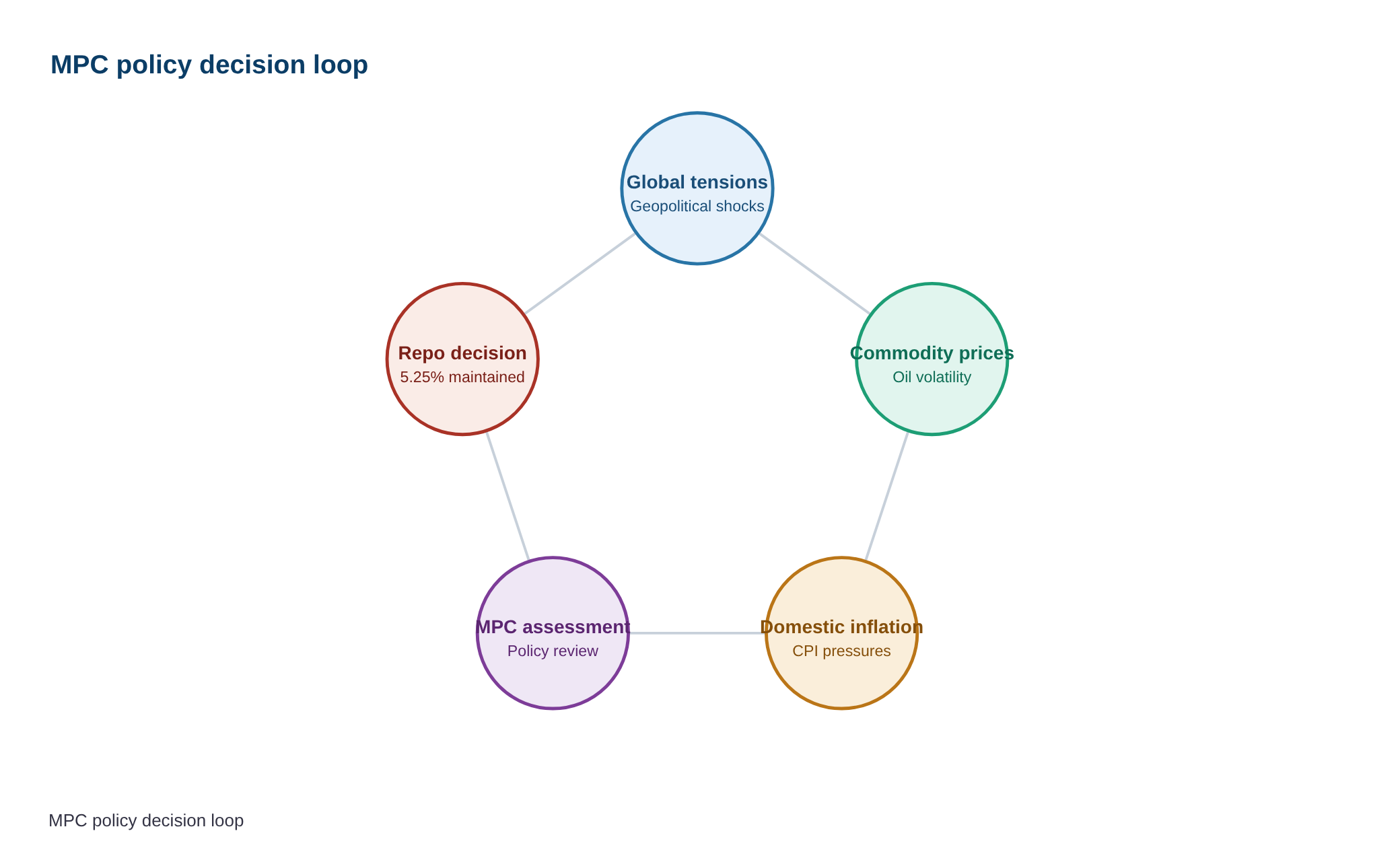
Global geopolitical tensions (e.g., West Asia conflict) → Commodity price volatility (oil) → Domestic inflation pressures → MPC policy assessment → Decision to maintain neutral stance and unchanged repo rate → Transmission to credit markets and economic activity → Impact on growth and inflation dynamics
Prelims Practice Questions
Q1. Consider the following statements regarding the Monetary Policy Committee (MPC) of the Reserve Bank of India:
1. The MPC is constituted under Section 45ZB of the Reserve Bank of India Act, 1934.
2. The MPC publishes the minutes of its meetings on the fourteenth day after every meeting as per Section 45ZL of the Act.
3. The MPC is chaired by the Finance Secretary of the Government of India.
4. The MPC decides the policy repo rate and the stance of monetary policy.
How many of the above statements are correct?
- Only one
- Only two
- Only three
- All four
Answer: Only three — Statements 1, 2, and 4 are correct. Statement 3 is incorrect as the MPC is chaired by the Governor of the Reserve Bank of India, not the Finance Secretary.
Q2. Assertion (A): The Reserve Bank of India (RBI) maintains the policy repo rate under the Liquidity Adjustment Facility (LAF) to regulate liquidity in the banking system.
Reason (R): The Standing Deposit Facility (SDF) rate is always set 0.25 percentage points higher than the policy repo rate to ensure a floor for short-term interest rates.
Options:
A. Both A and R are true, and R is the correct explanation of A.
B. Both A and R are true, but R is not the correct explanation of A.
C. A is true, but R is false.
D. A is false, but R is true.
Answer: ? — Assertion (A) is true as the policy repo rate under LAF is a key instrument for liquidity management. Reason (R) is false because the SDF rate is set 0.25 percentage points *lower* than the repo rate, not higher, to provide a floor for rates.
Q3. Match the following instruments of the Reserve Bank of India with their respective rates as decided by the Monetary Policy Committee (as per the August 2026 meeting):
Column I (Instrument) | Column II (Rate)
———————————————–|——————
1. Policy Repo Rate | A. 5.50 per cent
2. Standing Deposit Facility (SDF) Rate | B. 5.25 per cent
3. Marginal Standing Facility (MSF) Rate | C. 5.00 per cent
4. Bank Rate | D. 5.50 per cent
- 1-B, 2-C, 3-A, 4-A
- 1-B, 2-C, 3-D, 4-A
- 1-A, 2-C, 3-B, 4-D
- 1-C, 2-B, 3-A, 4-D
Answer: 1-B, 2-C, 3-D, 4-A — The correct pairing is: Policy Repo Rate (5.25%), SDF Rate (5.00%), MSF Rate (5.50%), and Bank Rate (5.50%).
Mains Practice Question
✍ The Monetary Policy Committee (MPC) of the Reserve Bank of India (RBI) decided to maintain a neutral stance and keep the policy repo rate unchanged in its August 2026 meeting. Critically examine the rationale behind this decision, with reference to the global and domestic macroeconomic context. Also, analyse the implications of this stance for inflation targeting and economic growth in India. (15 Marks)
Approach: A full answer must cover the following dimensions:
1. **Institutional Framework**:
– Role and composition of the MPC under Section 45ZB of the RBI Act, 1934.
– Mandate of the MPC: inflation targeting (Section 45ZI) and growth considerations.
2. **Global Context (2026)**:
– Persisting inflation concerns, volatile oil prices, and geopolitical conflicts (e.g., West Asia).
– Hawkish stance of major central banks (e.g., Federal Reserve) and its impact on global liquidity.
– Market volatility and its transmission to emerging economies.
3. **Domestic Context**:
– Resilience of the Indian economy amidst global headwinds.
– High-frequency indicators (e.g., PMI, IIP, inflation trends) and their role in policy decisions.
– Inflation projections and risks (e.g., food inflation, sticky core inflation).
4. **Neutral Stance and Policy Rates**:
– Definition and implications of a neutral monetary stance.
– Significance of the policy repo rate (5.25%), SDF rate (5.00%), MSF rate (5.50%), and Bank Rate (5.50%).
– Transmission mechanism of policy rates to lending rates and economic activity.
5. **Inflation Targeting and Growth Trade-offs**:
– RBI’s inflation target (4% ± 2%) and its statutory basis (Section 45ZI).
– Balancing inflation control with growth support in a neutral stance.
– Potential risks: inflation persistence vs. growth slowdown.
6. **Implications for Stakeholders**:
– Impact on households (borrowing costs, savings).
– Impact on businesses (investment, credit availability).
– Impact on financial markets (bond yields, equity markets).
7. **Conclusion**:
– Weigh the risks and justify the MPC’s decision in the context of evolving macroeconomic conditions.
– Highlight the need for data-driven, forward-looking policy adjustments.
Source: RBI
Generated by AanyaAi for educational purpose.

- Gurugram’s groundwater extraction exceeds limit by 212%; HC seeks ban - October 4, 2026
- स्वतंत्रता सेनानी श्यामजी कृष्ण वर्मा की जन्म जयंती पर पीएम का श्रद्धांजलि - October 4, 2026
- KWML’s Feasibility Reports for Water Metro in 18 Cities: UPSC & PCS Insights - October 3, 2026

No Comments