


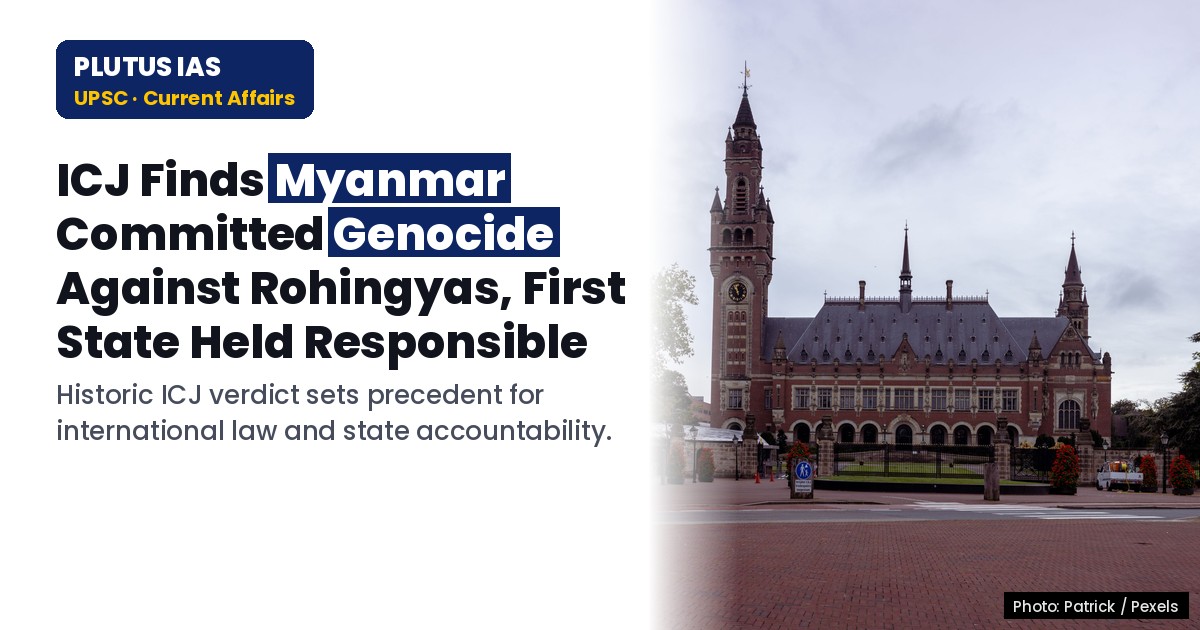
25 Nov Myanmar Genocide Verdict: ICJ Holds State Accountable
✎ The ICJ's verdict on Myanmar establishes a precedent for direct state responsibility in genocide, marking a significant development in international law concerning accountability for grave international crimes.
Subject Relevance — Where This Topic Fits
- GS Paper II — International Relations: International institutions, treaties and agreements, and their mandates; Bilateral, regional and global groupings and agreements involving India and/or affecting India’s interests; Effect of policies and politics of developed and developing countries on India’s interests, Indian diaspora. | GS Paper II — Polity and Governance: Important aspects of governance, transparency and accountability, e-governance applications, models, successes, limitations, and potential; citizens charters, transparency & accountability and institutional and other measures.
- Prelims: International Court of Justice (ICJ), Genocide Convention (1948), Rohingya ethnic group, Rakhine State, Nuremberg Trials, Crimes Against Humanity, War Crimes, Crimes Against Peace
- Essay: The evolving landscape of international law and the principle of state accountability for grave international crimes., The role of international judicial bodies in upholding human rights and preventing atrocities.
Quick Revision: The ICJ’s verdict on Myanmar establishes a precedent for direct state responsibility in genocide, marking a significant development in international law concerning accountability for grave international crimes.
Why is this in the news?
The International Court of Justice (ICJ) recently delivered a landmark verdict, finding the Republic of the Union of Myanmar directly responsible for committing genocide against the Rohingya ethnic group in its northern Rakhine State. This judgment is historically significant as it marks the first instance where a sovereign State has been held accountable for the crime of genocide, distinguishing it from previous cases that focused primarily on individual criminal responsibility.
Background
- The term ‘genocide’ was coined by Polish-Jewish lawyer Raphael Lemkin in 1944 to describe systematic atrocities.
- The Convention on the Prevention and Punishment of the Crime of Genocide was adopted by the UN General Assembly in 1948, defining genocide and establishing it as an international crime.
- Post-World War II, the Nuremberg and Tokyo Tribunals prosecuted individuals for ‘high crimes’ such as Crimes Against Peace, War Crimes, and Crimes Against Humanity, but did not hold states directly responsible.
- For decades, international legal opinion, influenced by the Nuremberg Principles, largely maintained that only individuals, not abstract entities like states, could commit international crimes.
- The ICJ’s jurisdiction under the 1948 Genocide Convention allows it to consider breaches of the convention by states as ‘crimes under international law’.
- The current verdict represents a significant evolution in international jurisprudence, extending accountability for genocide beyond individuals to the state itself.
What is the International Court of Justice (ICJ)?
- The International Court of Justice (ICJ) is the principal judicial organ of the United Nations, established in June 1945 by the Charter of the United Nations and began work in April 1946.
- It is based at the Peace Palace in The Hague, Netherlands.
- The ICJ settles legal disputes between states and gives advisory opinions on legal questions referred to it by authorized United Nations organs and specialized agencies.
- It consists of 15 judges elected for nine-year terms by the United Nations General Assembly and the Security Council.
- The Court’s jurisdiction is twofold: contentious cases between states and advisory proceedings.
- Only states may be parties in contentious cases before the ICJ; individuals, non-governmental organizations, federal states, and self-determination movements are excluded.
- Its judgments are binding on the parties concerned and are without appeal, although they can be subject to interpretation or revision.
- The ICJ’s official working languages are English and French.
Key Features
| Feature | Significance |
|---|---|
| State Responsibility for Genocide | Myanmar is the first sovereign State directly held accountable for genocide by the International Court of Justice (ICJ), marking a pivotal development in international law. |
| 1948 Genocide Convention | This verdict enforces the Convention on the Prevention and Punishment of the Crime of Genocide, adopted by the UN General Assembly, which defines genocide and grants the ICJ jurisdiction over breaches. |
| Distinction from Individual Responsibility | Historically, international law focused on individual criminal responsibility (e.g., Nuremberg Trials). This judgment extends accountability to the State itself, addressing the systemic nature of genocide. |
| Jurisprudence Evolution | The ruling builds upon and significantly advances the jurisprudence established by post-World War II tribunals and subsequent international courts, broadening the scope of international legal accountability. |
| Precedent for Future Cases | The Myanmar verdict sets a crucial precedent, potentially influencing other pending ICJ cases concerning alleged State-sponsored atrocities, including the case related to Israel’s actions in Palestine. |
Why it Matters
Legal Significance
- Establishes a precedent for holding sovereign States directly responsible for the crime of genocide under international law, moving beyond individual criminal accountability.
- Strengthens the enforcement mechanism of the 1948 Convention on the Prevention and Punishment of the Crime of Genocide, affirming its binding nature on signatory States.
- Clarifies and expands the interpretation of ‘crimes under international law’ by explicitly including State actions, thereby refining international legal jurisprudence.
Humanitarian Significance
- Offers a measure of justice and recognition for victims of genocide, such as the Rohingya ethnic group, by formally acknowledging the atrocities committed against them.
- Reinforces the international community’s commitment to preventing and punishing genocide, potentially deterring future State-sponsored atrocities.
- Highlights the imperative for States to protect vulnerable populations within their borders and adhere to international human rights and humanitarian law.
Geopolitical Significance
- Impacts the international standing and diplomatic relations of the implicated State, potentially leading to increased scrutiny, sanctions, or isolation.
- Influences the dynamics of international relations by demonstrating that even sovereign States are subject to international legal oversight for grave crimes.
- Sets a benchmark for how international courts address complex cases involving State sovereignty, human rights, and the principle of non-intervention.
Challenges
1. Enforcement of ICJ Judgments
- The ICJ lacks direct enforcement mechanisms; compliance often relies on the political will of the State and the pressure exerted by the United Nations Security Council (UNSC).
- Permanent members of the UNSC possess veto power, which can impede enforcement actions against States with strong geopolitical allies.
UPSC Link: International Institutions; International Law
2. Sovereignty vs. International Law
- The principle of State sovereignty often conflicts with the jurisdiction of international courts, as States may resist external interference in their internal affairs.
- Balancing the imperative to prevent mass atrocities with the respect for national sovereignty remains a persistent challenge in international relations.
UPSC Link: International Relations; Sovereignty
3. Defining and Proving Genocidal Intent
- Proving ‘genocidal intent’ — the specific intent to destroy, in whole or in part, a national, ethnical, racial, or religious group — is legally complex and often difficult.
- Evidence collection in conflict zones can be challenging, and legal standards require a high burden of proof for such grave accusations.
UPSC Link: International Law; Human Rights
4. Political Will and Selective Justice
- The willingness of States to pursue or support genocide cases can be influenced by geopolitical interests, leading to perceptions of selective justice.
- Powerful States may evade accountability more easily than less powerful ones, undermining the universality and impartiality of international law.
UPSC Link: International Ethics; Global Governance
Challenges — UPSC Perspective
| Issue | Concern |
|---|---|
| State Compliance | Ensuring that a sovereign State, especially one with a non-democratic regime, adheres to an ICJ ruling, particularly when it involves acknowledging grave crimes. |
| Political Obstacles | Potential for geopolitical considerations and the use of veto power by permanent members of the UNSC to obstruct enforcement or further action against the implicated State. |
| Reparations and Accountability | Implementing effective reparations for victims and holding specific individuals accountable within the State apparatus, given the State-level finding. |
| Precedent Application | The challenge of consistently applying this precedent to other complex international disputes without accusations of bias or political motivation. |
| Resource Mobilisation | Mobilising international resources and political will to support long-term humanitarian aid, rehabilitation, and justice mechanisms for affected populations. |
Way Forward
- Strengthen the enforcement mechanisms of international courts by fostering greater political will among UN member states to uphold judgments.
- Promote universal ratification and adherence to the 1948 Genocide Convention and other international human rights treaties.
- Develop robust early warning systems and preventive diplomacy initiatives to identify and address potential genocidal acts before they escalate.
- Enhance international cooperation in evidence gathering and prosecution of individuals responsible for orchestrating State-sponsored atrocities.
- Support capacity building in national legal systems to investigate and prosecute international crimes, reducing reliance solely on international tribunals.
- Advocate for reforms within the UN Security Council to mitigate the impact of the veto power in cases involving mass atrocities and human rights violations.
- Establish comprehensive victim support and reparation programmes, ensuring that justice extends beyond legal pronouncements to tangible relief for affected communities.
UPSC Value Addition
Keywords for Mains Answer-Writing
International Court of Justice (ICJ) · Genocide Convention 1948 · Crime of Genocide · State Responsibility · Individual Criminal Responsibility · Nuremberg Principles · Rakhine State · Rohingya · International Criminal Law · Crimes Against Humanity · War Crimes · Crimes Against Peace
Concept Flow
Raphael Lemkin coins ‘genocide’ (1944) → UN General Assembly adopts Genocide Convention (1948) → Convention grants ICJ jurisdiction over State breaches → ICJ finds Myanmar committed genocide (2026) → Myanmar becomes first State held responsible for genocide → Precedent set for future ICJ cases (e.g., Israel)
Prelims Practice Questions
Q1. Consider the following statements regarding the International Court of Justice (ICJ) and international criminal law:
1. The ICJ is the principal judicial organ of the United Nations.
2. The 1948 Convention on the Prevention and Punishment of the Crime of Genocide primarily established individual criminal responsibility for genocide.
3. The Nuremberg Trials prosecuted individuals, not states, for international crimes.
How many of the above statements are correct?
- Only one
- Only two
- Only three
- None
Answer: Only two — Statement 1 is correct: The ICJ is indeed the principal judicial organ of the UN. Statement 2 is incorrect: While the convention defines genocide, the concept of individual criminal responsibility was primarily codified through the London Charter and subsequent tribunals, not the 1948 convention itself which also addressed state responsibility. Statement 3 is correct: The Nuremberg Trials focused on individual accountability for Nazi officials.
Q2. Which of the following international legal instruments or principles first codified the concept of ‘Crimes Against Peace’, ‘War Crimes’, and ‘Crimes Against Humanity’?
- The Rome Statute of the International Criminal Court
- The 1948 Genocide Convention
- The 1945 London Charter for the International Military Tribunal at Nuremberg
- The Universal Declaration of Human Rights
Answer: The 1945 London Charter for the International Military Tribunal at Nuremberg — The 1945 London Charter for the International Military Tribunal at Nuremberg explicitly listed and codified ‘Crimes Against Peace’, ‘War Crimes’, and ‘Crimes Against Humanity’ as categories of international crimes for which individuals could be prosecuted.
Mains Practice Question
✍ The recent International Court of Justice (ICJ) verdict holding a State directly responsible for genocide marks a significant evolution in international law. Critically examine the implications of this judgment for the principle of State responsibility in international criminal law, contrasting it with the historical emphasis on individual criminal responsibility. (15 Marks)
Approach: MODEL-ANSWER SKELETON:
1. **Introduction**: Briefly introduce the ICJ’s recent verdict on Myanmar concerning the Rohingya, highlighting its significance as the first direct attribution of genocide to a State.
2. **Historical Context of Individual Criminal Responsibility**: Discuss the origins of individual criminal responsibility, citing:
* Nuremberg Trials (1945) and Tokyo Tribunal, which prosecuted individuals.
* London Charter (1945) codifying ‘Crimes Against Peace’, ‘War Crimes’, and ‘Crimes Against Humanity’.
* Nuremberg Principles, particularly the first principle stating ‘Crimes against international law are committed by men, not by abstract entities’.
* Adolf Eichmann’s trial (1961) and its legal reasoning.
3. **Evolution towards State Responsibility**: Explain how the 1948 Convention on the Prevention and Punishment of the Crime of Genocide provided the ICJ with jurisdictional authority over State breaches, even if the legal opinion on direct State criminal responsibility remained unsettled.
4. **Significance of the Myanmar Verdict**: Elaborate on why this verdict is a landmark:
* It directly attributes the ‘crime of genocide’ to a sovereign State, moving beyond individual accountability.
* It strengthens the enforcement mechanism of the Genocide Convention.
* It sets a precedent for future cases involving State-sponsored atrocities.
5. **Implications for International Law**: Discuss broader implications:
* Potential for increased accountability of States for grave international crimes.
* Challenges in enforcement and implementation against sovereign States.
* Impact on ongoing or future ICJ cases (e.g., Israel’s case mentioned in the news).
* Reinforcement of the principle that States cannot act with impunity when committing international crimes.
6. **Conclusion**: Summarize the transformative nature of the verdict, emphasizing its role in evolving international criminal law and the pursuit of justice for victims of State-perpetrated atrocities, while acknowledging potential challenges.
Source: The Indian Express
Generated by AanyaAi for educational purpose.
Related guides on our sites
- Current affairs for upsc 2026
- Best PSIR optional coaching for upsc
- Best Law optional coaching for upsc
- Best PSIR optional teacher for upsc

- Myanmar Genocide Verdict: ICJ Holds State Accountable - November 25, 2026
- नदी तल रेत खनन पर SC पैनल की रोक, बांधों से रेत निकालने का प्रस्ताव - November 25, 2026
- ICJ Rohingya Verdict: Myanmar Guilty of Genocide - November 25, 2026

No Comments