


28 Oct Nari Shakti and the New India: Building an Inclusive Workforce for Viksit Bharat
This article covers “Daily Current Affairs” and Nari Shakti and the New India: Building an Inclusive Workforce for Viksit Bharat
SYLLABUS MAPPING:
GS- II –Social Justice- Nari Shakti and the New India: Building an Inclusive Workforce for Viksit Bharat
FOR PRELIMS
What challenges continue to hinder women’s full participation in India’s workforce?
FOR MAINS
What are the key government initiatives aimed at promoting women’s employment and entrepreneurship?
Why in the News?
India is witnessing a historic rise in women’s workforce participation, marking a transformative phase in its journey toward Viksit Bharat@2047. The Female Labour Force Participation Rate (LFPR) has surged from 23.3% in 2017-18 to 41.7% in 2023-24, driven by inclusive policies, empowerment initiatives, and gender-sensitive reforms. Government schemes like PMMY, Stand-Up India, PMKVY, and Mission Shakti, along with strong legal frameworks such as the Maternity Benefit Act and Sexual Harassment Act, are creating an enabling ecosystem for women to contribute as equal partners in India’s economic growth.
Nari Shakti at the Heart of Viksit Bharat
Imagine a nation where every woman, from rural artisan to urban innovator, steps into the workforce not as a participant, but as a powerhouse driving economic transformation. This is the promise of Viksit Bharat, that envisions a developed India by 2047, centring women’s economic inclusion and empowering them through education, skills, safety, and entrepreneurship to unleash Nari Shakti for national growth.
One of the key pillars of achieving Viksit Bharat is ensuring at least 70 percent workforce participation by women, making them equal stakeholders in India’s growth story.
Advancing Women’s Workforce Participation
India has witnessed a remarkable increase in the female workforce participation rate. Women employment rate nearly doubled between 2017-18 to 2023-24. Data from the Ministry of Labour and Employment states that female Labour Force Participation Rate (LFPR) increased from 23.3% in 2017-18 to 41.7% in 2023-24.
Worker Population Ratio (WPR) for women aged 15 years and above rose from 22% in 2017-18 to 40.3% in 2023-24, LFPR increased from 23.3% to 41.7%.
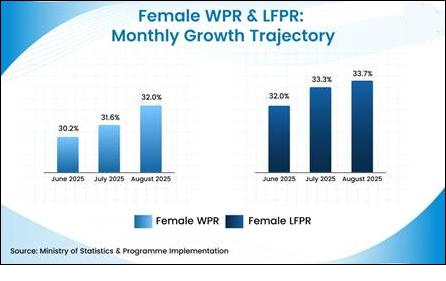
More recently, Female WPR rose to 32.0% in August 2025 from 31.6% in July 2025 and 30.2% in June 2025, and Female LFPR increased to 33.7% in August 2025 from 33.3% in July 2025 and 32.0% in June 2025.
India’s Rise in Women’s Workforce Participation Across BRICS
Over the past decade, India has recorded the sharpest rise in women’s labor force participation among BRICS nations, as per World Bank data. Between 2015 and 2024, India’s female labour force participation rate grew by over 23%, while Brazil, China, and Russia saw stagnation or declines, and South Africa only modest gains.
This surge reflects India’s growing emphasis on women’s economic inclusion, driven by policies that expand access to skills, credit, and formal employment. Initiatives such as Beti Bachao Beti Padhao, Pradhan Mantri Mudra Yojana (PMMY), Deendayal Antyodaya Yojana–NRLM, and Stand-Up India have empowered women through entrepreneurship, financial inclusion, and self-employment. India’s decade-long momentum positions it as a model of inclusive growth within BRICS, showing how targeted policy focus can transform women’s empowerment into a national growth driver.
Legal Framework for Women’s Workplace Empowerment
India’s labour laws ensure protection, equality, and welfare for women workers through several key provisions:
Maternity Benefit Act, 1961 (Amended 2017):
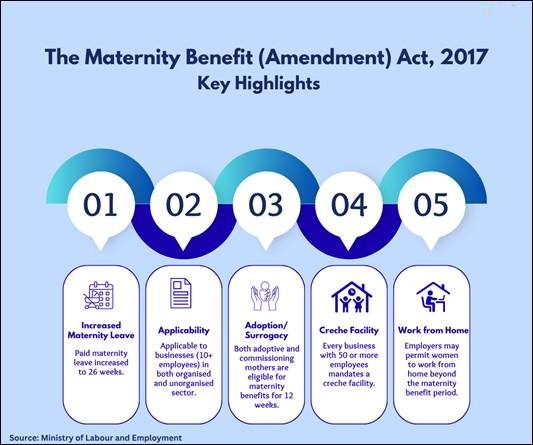
Extends paid maternity leave from 12 to 26 weeks and mandates crèche facilities for establishments with 50 or more employees. It also covers adoptive and surrogate mothers, encouraging continuity in women’s careers and supporting work-life balance.
These reforms, combined with expanding digital and economic opportunities, reflect India’s progress toward a gender-inclusive labour market where women increasingly participate not just as workers, but as contributors to sustainable economic growth.
According to the BRICS Women’s Development Report 2025, India stands out for its generous paid maternity leave provisions, offering 182 days—the second longest in the group, behind only Iran’s 270 days. This exceeds durations in other BRICS nations, such as Brazil, South Africa, and Ethiopia (120 days each), Egypt and Indonesia (90 days each), and the UAE (60 days). The report emphasizes India’s position as a leader in fostering family-friendly workplaces to enhance women’s retention and participation.
Legal Framework for Women’s Workplace Empowerment
1. Maternity Benefit Act, 1961 (Amended 2017): Extends paid maternity leave from 12 to 26 weeks, mandates crèche facilities for establishments with 50 or more employees, and covers adoptive and surrogate mothers. The Act supports women’s continued workforce participation and ensures a better work-life balance.
2. Sexual Harassment of Women at Workplace (Prevention, Prohibition and Redressal) Act, 2013: Commonly known as the POSH Act, it safeguards women from workplace harassment and promotes a culture of dignity and safety. It mandates the establishment of Internal Complaints Committees (ICCs) within organisations to handle complaints in a fair and confidential manner, and Local Complaints Committees (LCCs) at the district level for smaller establishments or cases involving employers. The law has been instrumental in fostering safer workspaces, thereby indirectly encouraging higher female labour participation.
3. Equal Remuneration Act, 1976: Ensures the principle of “equal pay for equal work”, prohibiting gender-based wage discrimination and promoting fairness and opportunity in employment. According to the BRICS Women’s Development Report 2025, India ranks 120th globally in gender pay equity (2024 data), showing gradual improvement and narrowing of the pay gap compared to peers like Brazil and South Africa, though still trailing China and the UAE.
4. Code on Social Security, 2020: Expands maternity, health, and social security benefits to all categories of workers, including those in the unorganised and gig economy. It also extends Employees’ State Insurance coverage to plantation workers, providing crucial protection to women in tea and coffee estates.
5. Occupational Safety, Health and Working Conditions Code, 2020: Focuses on a safe and gender-sensitive workplace, mandating annual health checkups, night-shift safety measures, and transport facilities for women working at night. It also requires crèche facilities in establishments with more than 50 employees, ensuring childcare support and workplace inclusivity.
Workplace Inclusivity in the Government Sector
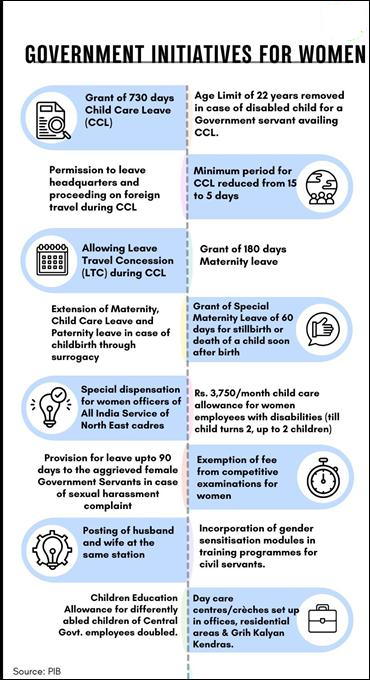
The Government has undertaken various women-centric initiatives to promote inclusivity in the workplace, workplace wellness and holistic wellbeing of female employees in Government service. These, measures, among other things include:
Empowering Women through Skills and Employment
| Scheme | Ministry/Department | Key Achievements |
|---|---|---|
| Pradhan Mantri Kaushal Vikas Yojana (PMKVY) | Ministry of Skill Development & Entrepreneurship (MSDE) | Provides industry-relevant skill training; 45% of beneficiaries are women, enhancing employability and income potential. |
| Pradhan Mantri Mudra Yojana (PMMY) | Ministry of Finance | Funds micro and small enterprises; over 68% of account holders are women, boosting women-led entrepreneurship across India. |
| Stand-Up India | Ministry of Finance | Supports SC, ST, and women entrepreneurs; as of March 2025, over 2.01 lakh women-owned accounts have been sanctioned. |
| Start-Up India | Ministry of Commerce & Industry | Promotes innovation and start-up culture; over 75,000 women-led start-ups have emerged under the initiative. |
| WISE-KIRAN Programme | Department of Science & Technology | Encourages women’s participation and leadership in STEM fields, offering research and innovation support. |
| NAVYA Programme (Nurturing Aspirations through Vocational Training for Young Adolescent Girls) | Ministry of Women & Child Development / MSDE | Trains girls aged 16–18 years in sectors like digital marketing, cybersecurity, and includes modules on communication, safety, and financial literacy. |
Enabling Ecosystems for Working Women
SHe-Box (Sexual Harassment electronic Box): Launched by the Ministry of Women and Child Development (MWCD), the SHe-Box portal facilitates the effective implementation of the Sexual Harassment of Women at Workplace (Prevention, Prohibition, and Redressal) Act, 2013. It serves as an online complaint management and monitoring system, providing a centralized repository of data on Internal Committees (ICs) and Local Committees (LCs) across public and private organisations. Each workplace designates a Nodal Officer to ensure real-time data updates and accountability in complaint redressal, promoting transparency and safety in the workplace.
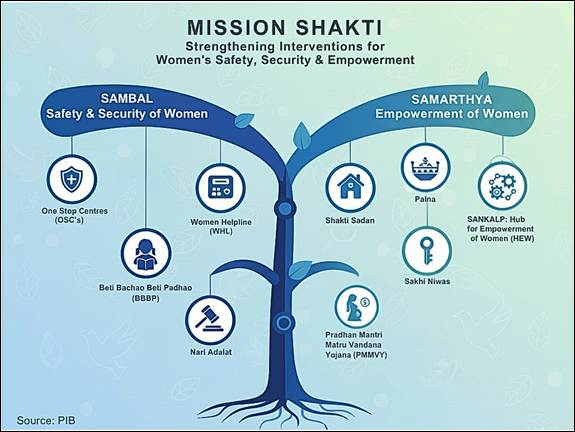
Mission Shakti: Implemented by MWCD in April 2024, Mission Shakti aims to strengthen interventions for women’s safety, security, and empowerment. It provides short- and long-term support services to all women, especially those from vulnerable and marginalised groups, ensuring care, protection, and access to information for holistic development. The Mission operates through two verticals — ‘Sambal’ for safety and security, and ‘Samarthya’ for empowerment and capacity building.
Conclusion
Over the past decade, India has witnessed a remarkable transformation in women’s workforce participation. Through reforms, skill development, maternity benefits, and initiatives like Mission Shakti, the government has built a strong foundation for inclusive and supportive workplaces. The steady rise in women joining the labour force and leading enterprises marks a new era where Nari Shakti drives national growth. From rural entrepreneurs to corporate leaders, women are reshaping India’s economic and social landscape. As India advances towards Viksit Bharat@2047, empowering women at work remains not just a goal but a pillar of national progress, unlocking the potential of half the population for a stronger, equitable, and globally competitive India.
Prelims question:
Q. Consider the following government initiatives:
1. Pradhan Mantri Mudra Yojana (PMMY)
2. Stand-Up India Scheme
3. Mission Shakti
4. SHe-Box Portal
Which of the above are aimed at promoting women’s empowerment and participation in the workforce?
(a) 1 and 2 only
(b) 1, 2 and 3 only
(c) 2, 3 and 4 only
(d) 1, 2, 3 and 4
Answer: D
Mains Question:
Q. Discuss the recent trends in India’s female labour force participation and the role of government schemes and legal frameworks in empowering women in the workforce.
(250 words)

- Before New Taxes, Make Every Rupee Count: Fiscal Discipline and Outcome-Based Governance in Tamil Nadu - August 20, 2026
- A Palestinian State as the Foundation for Regional Peace - August 20, 2026
- A Vision for an Inclusive Bangladesh: Democracy, Minority Rights and India’s Neighbourhood - August 19, 2026

No Comments