


03 Nov National Conference on Handlooms & Handicrafts 2025: Charting a Future for India’s Craft Economy
This article covers “Daily Current Affairs” and From National Conference on Handlooms & Handicrafts 2025: Charting a Future for India’s Craft Economy
SYLLABUS MAPPING
GS- 3- Indian Economy- National Conference on Handlooms & Handicrafts 2025: Charting a Future for India’s Craft Economy”
FOR PRELIMS
What is the aim of the National Conference on Handlooms and Handicrafts 2025?
FOR MAINS
What are the major challenges faced by India’s handloom and handicraft sectors?
Why in the News?
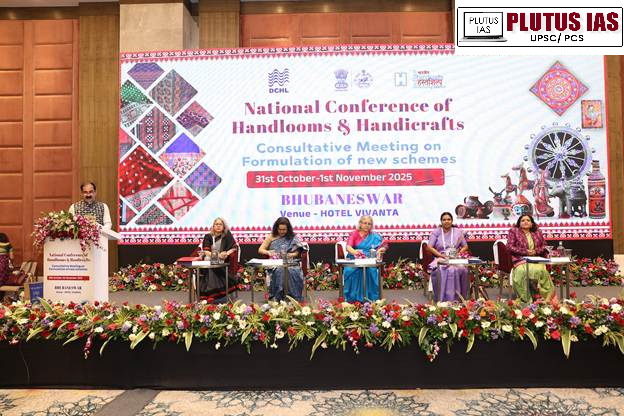
The National Conference on Handlooms & Handicrafts is being held in Bhubaneswar, Odisha from 31st October to 1st November, 2025. The event aims to bring together policymakers, artisans, and industry stakeholders to discuss the future roadmap of India’s handloom and handicraft sectors.
Significance of the Sector
1. Economic Value: In FY 2024–25, handicrafts exports stood at US$ 192 million, while handloom exports reached US$ 3.8 billion, reflecting growing global demand for handmade and sustainable products.
2. Employment Generation: The sector is the second largest source of rural employment after agriculture, providing livelihood to over 3.5 million workers, of whom 72% are women (as per the 4th All India Handloom Census, 2019–20).
3. Global Dominance: India contributes nearly 95% of the world’s handwoven fabric, making it a global leader in handmade textiles.
Major Hubs and Products
1. Key Centres: Surat, Varanasi, Agra, Lucknow, Hyderabad, Chennai, and Mumbai are major handloom and handicraft hubs.
2. Regional Focus: The North-Eastern region, especially Assam, has a high concentration of handloom households.
3. Major Products: Home textiles, carpets, rugs, handmade woollen products, wooden crafts, and hand-printed fabrics.
4. Top Export Destinations: The United States, UAE, Netherlands, France, and the United Kingdom.
Growth Drivers
1. Rising global demand for eco-friendly and culturally rich products.
2. Government support through financial assistance, marketing platforms, and skill upgradation.
3. Expanding online and international markets through e-commerce and trade fairs.
4. Sustainability focus aligning with global trends in ethical and green fashion.
Government Initiatives
1. National Handloom Development Program (NHDP): Provides support for raw materials, design innovation, technology upgradation, and marketing.
2. National Handicrafts Development Program (NHDP): Focuses on end-to-end development of artisans through cluster-based interventions, skill training, and market access.
3. Pradhan Mantri Vishwakarma Kaushal Samman (PM-VIKAS): Aims to enhance product quality, scale, and market reach of traditional craftsmen.
4. Weaver MUDRA Scheme: Offers concessional loans to handloom weavers for working capital and technology enhancement.
5. SAMARTH Scheme: Focuses on skill development and capacity building of weavers and artisans.
6. Comprehensive Handicrafts Cluster Development Scheme: Provides technical support and common infrastructure to strengthen artisan clusters.
7. Marketing Support Initiatives: Establishment of Urban Haats, exhibitions, and trade fairs. National Handloom Day celebrated on 7th August every year to promote “Swadeshi spirit” and acknowledge weavers’ contribution.
National Conference on Handlooms & Handicrafts (2025)
Organized by: Development Commissioner (Handlooms & Handicrafts), Ministry of Textiles.
Aim: To provide a common platform for dialogue, collaboration, and policy convergence among all stakeholders.
Twin Objectives:
1. To understand opportunities and challenges of India’s handmade sector.
2. To deliberate on the upcoming new scheme for holistic development of the sector.
Challenges
1. Competition from machine-made products and imported goods.
2. Limited access to formal credit and marketing channels.
3. Inadequate design innovation and low adoption of modern technology.
4. Declining interest among younger generations in traditional crafts.
5. Need for branding and geographical indication (GI) promotion.
Way Forward
1. Policy Convergence: Integrating schemes for textiles, MSME, and rural development.
2. Technology and Design Innovation: Leveraging digital tools and AI-based design platforms.
3. Global Branding: Promoting Indian crafts through “Made in India” labels and global exhibitions.
4. Skill Enhancement: Expanding training under SAMARTH and PM-VIKAS to promote entrepreneurship.
5. Sustainable Production: Encouraging use of organic raw materials and natural dyes.
6. Cluster-Based Development: Strengthening local artisan clusters for better market linkage and infrastructure.
Conclusion
India’s handloom and handicraft sectors represent not only economic value but also cultural identity and sustainability. The upcoming National Conference at Bhubaneswar provides an opportunity to reimagine these traditional industries for a modern, global, and inclusive economy. By merging heritage with innovation, India can reinforce its position as the world’s craft capital while ensuring dignified livelihoods for millions of artisans.
Prelims question:
Q. Which of the following statements about India’s Handloom and Handicraft sectors is/are correct?
1. India contributes nearly 95% of the world’s handwoven fabric.
2. The National Handloom Day is celebrated on 7th August every year.
3. The Pradhan Mantri Vishwakarma Kaushal Samman (PM-VIKAS) scheme aims to support digital literacy among rural youth.
Select the correct answer using the code below:
(a) 1 and 2 only
(b) 2 and 3 only
(c) 1 and 3 only
(d) 1, 2, and 3
Answer: A
Mains Question:
Q. India’s Handloom and Handicraft sectors not only represent economic potential but also embody cultural heritage and sustainability. Discuss the major challenges faced by these sectors and suggest measures to enhance their global competitiveness.
(250 words)

- Europe’s AI Rules May Become India’s Opportunity - August 14, 2026
- Transparency as the Foundation of Trust in Medicine - August 14, 2026
- A Timely Reset for the Food Security Act: From Foodgrain Security to Nutrition Security - August 13, 2026

No Comments