


23 Dec National Consumer Day 2025: India’s Shift from Consumer Welfare to Digital Consumer Justice
This article covers “Daily Current Affairs” and From National Consumer Day 2025: India’s Shift from Consumer Welfare to Digital Consumer Justice
SYLLABUS MAPPING
GS-2 – Governance- National Consumer Day 2025: India’s Shift from Consumer Welfare to Digital Consumer Justice
FOR PRELIMS
What is National Consumer Day?
FOR MAINS
What is the role of the Central Consumer Protection Authority (CCPA)?
Why in the News?
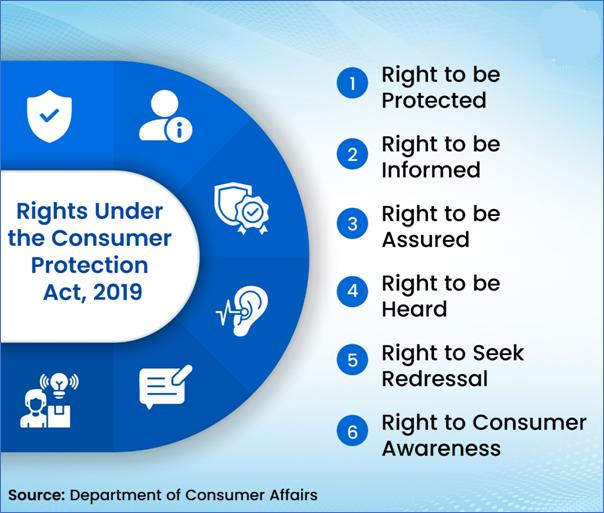
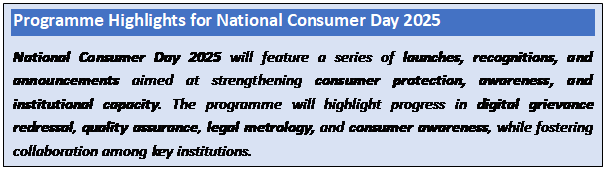
National Consumer Day is observed annually in India on 24 December to reaffirm the importance of consumer rights and the institutional mechanisms that protect them. The day commemorates the Presidential assent to the Consumer Protection Act, 1986, which for the first time formally recognised consumer rights in India. These rights include the right to safety, information, choice, being heard, redressal, and consumer awareness, forming the foundation of a fair and transparent marketplace. In 2025, National Consumer Day is guided by the theme “Efficient and Speedy Disposal through Digital Justice”, reflecting India’s growing emphasis on technology-enabled, accessible, and time-bound consumer grievance redressal.
Reimagining Consumer Protection: From Welfare to Digital Justice
Evolution of Consumer Law in India
The enactment of the Consumer Protection Act, 2019, which came into force on 20 July 2020, marked a paradigm shift in India’s consumer protection framework. Replacing the 1986 Act, the new law reflects the realities of a digital, platform-driven economy and strengthens accountability in commercial transactions.
The Act seeks to:
Promote informed consumer choice
Prevent unfair trade practices
Ensure speedy and effective grievance redressal
Enhance marketplace transparency
Institutional Architecture of Consumer Justice
Three-Tier Consumer Dispute Redressal Mechanism
The Consumer Protection Act, 2019 establishes a three-tier quasi-judicial system:
1. District Consumer Disputes Redressal Commission
– Jurisdiction up to ₹50 lakh
2. State Consumer Disputes Redressal Commission
– Jurisdiction from ₹50 lakh to ₹2 crore
3. National Consumer Disputes Redressal Commission (NCDRC)
– Jurisdiction above ₹2 crore
While District and State Commissions are constituted by State Governments with Central approval, the NCDRC is established by the Central Government. These bodies do not replace civil courts but provide an alternative, consumer-friendly dispute resolution mechanism.
Performance Highlight (2025):
In July 2025, 10 States and the NCDRC recorded disposal rates exceeding 100%, indicating faster resolution of cases than new filings—an important indicator of institutional efficiency.
Central Consumer Protection Authority (CCPA): Guardian of Collective Consumer Rights
Established on 24 July 2020, the Central Consumer Protection Authority (CCPA) acts as a market regulator with a focus on collective consumer welfare.
Key Functions:
1. Protection and enforcement of consumer rights
2. Prevention of unfair trade practices
3. Regulation of misleading advertisements
4. Action against manufacturers, endorsers, and publishers
5. Recall of unsafe goods and services
6. Levying penalties and initiating prosecution
Consumer Welfare Fund: Strengthening Grassroots Consumer Awareness
| Aspect | Details |
|---|---|
| Name of Fund | Consumer Welfare Fund (CWF) |
| Objective | To promote consumer awareness and strengthen consumer organisations across India |
| Focus Areas | Consumer education, advocacy, research, and awareness campaigns |
| Coverage | Pan-India (States and Union Territories) |
| Funding Pattern (General States/UTs) | 75:25 (Centre : State) |
| Funding Pattern (Special Category States & select UTs) | 90:10 (Centre : State/UT) |
| FY 2024–25 Release (as on 31.12.2024) | ₹38.68 crore released |
| Beneficiaries | State governments, UT administrations, consumer organisations |
| Significance | Extends consumer protection beyond courts by strengthening grassroots-level awareness and empowerment |
Digital Transformation of Consumer Justice
| Aspect | Details |
|---|---|
| Initiative Name | e-Jagriti: Unified Digital Consumer Justice Platform |
| Launch Date | 1 January 2025 |
| Objective | Digital transformation of consumer grievance redressal and faster delivery of consumer justice |
| Integrated Legacy Systems | OCMS, e-Daakhil, CONFONET, NCDRC CMS |
| Nature of Platform | Single, unified digital interface for end-to-end consumer dispute management |
| Key Features | Online complaint filing; virtual hearings; case tracking & automated alerts; secure digital payments via Bharat Kosh & PayGov |
| Inclusivity & Accessibility | Multilingual interface; chatbot support; voice-to-text facility; accessibility features for senior citizens and persons with disabilities |
| Users Covered | Domestic consumers and NRIs |
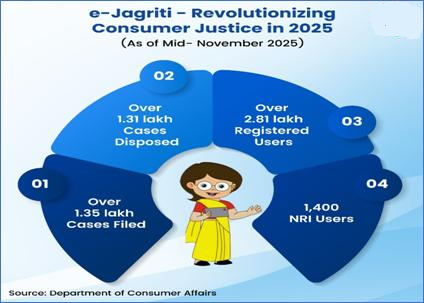
| Impact in 2025 | 1.35 lakh cases filed; 1.31 lakh cases disposed |
| Registered Users (2025) | 2.81 lakh users, including about 1,400 NRIs |
| Performance Outcome | Disposal rates exceeded filings in several months, indicating improved efficiency |
| Illustrative Case | Tripura case: Consumer awarded over ₹1.67 lakh compensation within 5 months for long-pending service deficiency |
| Overall Significance | Demonstrates how digital governance can ensure speedy, accessible, and citizen-centric consumer justice |
Mains Question:
Q. Discuss this statement in the context of recent legislative, institutional, and technological reforms, including e-Jagriti, the Central Consumer Protection Authority, and AI-enabled oversight mechanisms.
(250 words)

- RBI’s Shrinking Real-Rate Cushion Amid Rising Inflation and Strong Demand - September 21, 2026
- India’s NGOs at a New Funding Crossroads - September 21, 2026
- Deep-Sea Discovery, Environmental Responsibility - September 19, 2026

No Comments