


24 Jan National Girl Child Day 2026: Empowering Girls for Women-Led Development and Viksit Bharat @2047
This article covers “Daily Current Affairs” and From National Girl Child Day 2026: Empowering Girls for Women-Led Development and Viksit Bharat @2047
SYLLABUS MAPPING
GS- 1-Indian Society & Social Issues- National Girl Child Day 2026: Empowering Girls for Women-Led Development and Viksit Bharat @2047
FOR PRELIMS
What is National Girl Child Day?
FOR MAINS
What is Mission Shakti? Mention its key components.
Why in the News?
National Girl Child Day was observed across India on 24 January, with the Ministry of Women and Child Development (MWCD) and allied institutions organising awareness campaigns, outreach programmes, and policy-focused discussions to reaffirm the country’s commitment to gender equality and girls’ empowerment. The day gained renewed significance in the context of the government’s emphasis on women-led development and the long-term vision of Viksit Bharat @2047, highlighting the role of educated, healthy, and empowered girls as key drivers of India’s demographic dividend, economic growth, and inclusive governance.
Advocating the Empowerment of Girls
Despite notable progress, girls in India continue to face structural and social challenges such as gender bias, female foeticide, skewed child sex ratio, child marriage, nutritional deprivation, barriers to education, and threats to safety and health. National Girl Child Day provides an opportunity to confront these inequalities and to promote a collective shift in societal attitudes—towards valuing girls as equal, capable, and indispensable contributors to nation-building.
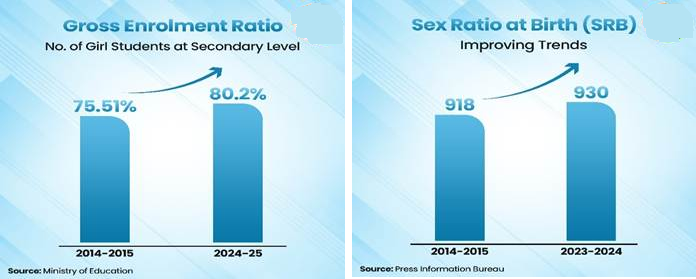
Key focus areas of contemporary girl-child empowerment include access to quality education, skill development, digital inclusion, participation in STEM fields, mental and physical health, freedom from violence, and leadership opportunities. Sustained policy interventions have yielded measurable outcomes. The Sex Ratio at Birth (SRB) has improved from around 918 in 2014–15 to 930 in 2023–24, reflecting the impact of targeted behavioural change campaigns.
Educational participation has also strengthened. The Gross Enrolment Ratio (GER) for girls at the secondary level (Classes IX–X) rose from 75.51% in 2014–15 to 78.0% in 2023–24, further improving to 80.2% in 2024–25. These gains underscore the positive influence of initiatives such as Beti Bachao Beti Padhao and Samagra Shiksha, even as challenges of retention and transition persist.
Key Government Initiatives and Achievements
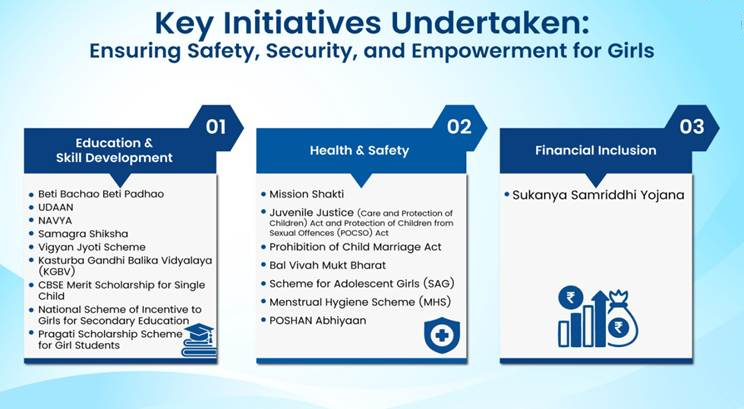
India’s approach to empowering the girl child is anchored in a comprehensive policy framework combining protection, education, health, skill development, and financial inclusion. Many of these interventions are integrated under Mission Shakti, the flagship umbrella scheme for women’s empowerment.
Mission Shakti
Launched by the Ministry of Women and Child Development in 2022 (effective from 1 April 2022) for the 15th Finance Commission period (2021–26), Mission Shakti consolidates efforts for women’s safety, security, and empowerment through two sub-schemes:
1. Sambal: focusing on safety and security through One Stop Centres, Women Helpline, Beti Bachao Beti Padhao, and Nari Adalats.
2. Samarthya: focusing on empowerment through schemes such as Pradhan Mantri Matru Vandana Yojana, Palna, Shakti Sadan, Sakhi Niwas, and SANKALP hubs.
Education and Skill Development: Laying the Foundation of Empowerment
Education remains the most transformative instrument for gender equity. India has made significant investments to bridge gender gaps, improve learning outcomes, and expand girls’ access to higher education and emerging fields. During 2024–25, girl students enrolled from foundational to secondary stages numbered over 11.93 crore, while 97.5% of schools reported functional girls’ toilets—an essential factor for retention.
1. Samagra Shiksha: Launched in 2018, Samagra Shiksha integrates school education from pre-school to Class XII, aligning with NEP 2020. It addresses gender and social disparities through targeted interventions such as separate toilets for girls, gender-sensitive pedagogy, stipends for children with special needs, teacher sensitisation, vocational exposure, and foundational literacy and numeracy.
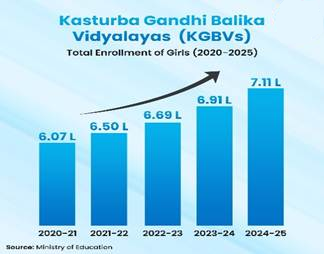
2. Kasturba Gandhi Balika Vidyalaya (KGBV): KGBVs provide residential education for girls aged 10–18 years from marginalised communities in educationally backward blocks. Upgraded under Samagra Shiksha, they ensure continuity from elementary to higher secondary education, reducing dropout risks.
3. Beti Bachao Beti Padhao (BBBP): Launched in 2015, BBBP has completed a decade of implementation in 2025. Now expanded nationwide and integrated under Mission Shakti (Sambal), the scheme focuses on preventing gender-biased sex selection, ensuring survival and protection, and promoting education. It has played a critical role in improving SRB, girls’ enrolment, healthcare access, and community-level behavioural change.
Promoting Girls in STEM and Higher Education
Initiatives such as UDAAN, Vigyan Jyoti, NAVYA, and supernumerary seats for women in IITs and NITs have significantly improved female participation in STEM. Women now constitute 43% of STEM enrolments, among the highest globally. Female enrolment in higher education increased from 1.57 crore in 2014–15 to 2.18 crore in 2022–23, while the Female GER rose from 22.9 to 30.2. Female Ph.D. enrolment grew by over 135% during the same period, reflecting deepening academic participation. Scholarship schemes such as AICTE PRAGATI, UGC-NET JRF, and the National Scholarship for Postgraduate Studies have further expanded access to advanced education for girls.
Ensuring Safety, Health, and Dignity
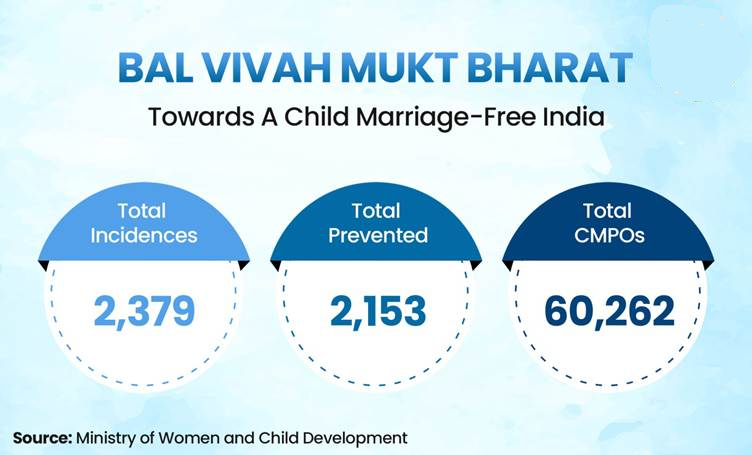
A secure environment is foundational to empowerment. Strong legal frameworks such as the Juvenile Justice Act, 2015, POCSO Act, 2012, and the Prohibition of Child Marriage Act, 2006 provide statutory protection against abuse, exploitation, and early marriage. The Bal Vivah Mukt Bharat campaign, launched in November 2024, aims to eliminate child marriage through awareness, enforcement, and community mobilisation, aligning with SDG 5.3. Health and nutrition initiatives such as the Scheme for Adolescent Girls (SAG), Menstrual Hygiene Scheme, POSHAN Abhiyaan, and Mission Vatsalya address nutrition, anaemia, menstrual health, child protection, and psychosocial support, ensuring a life-cycle approach to girl-child wellbeing.
Financial Inclusion for a Secure Future
Economic empowerment is strengthened through savings and investment schemes tailored for girls. The Sukanya Samriddhi Yojana (SSY), launched in 2015, has emerged as a flagship instrument for long-term financial security. With over 4.2 crore accounts opened by November 2024, SSY reflects growing societal commitment to girls’ education, independence, and future stability.
Conclusion
National Girl Child Day 2026 is not merely a symbolic observance—it is a reaffirmation of India’s resolve to build an equitable, inclusive, and progressive society. Through sustained policy interventions, legal safeguards, educational reforms, health initiatives, and community participation, measurable gains have been achieved in the survival, education, and empowerment of girls. As India advances towards Viksit Bharat @2047, empowering every girl child remains central to unlocking the nation’s full potential. With continued commitment from government, civil society, and communities, India is steadily shaping a future where every girl is valued, protected, and empowered to realise her aspirations as an equal partner in nation-building.
Best ias coaching in delhi Best ias coaching in chandigarh
Prelims question:
Q. Consider the following statements regarding National Girl Child Day and related initiatives in India:
1. National Girl Child Day is observed annually on 24 January and was initiated by the Ministry of Women and Child Development in 2008.
2. Mission Shakti is an umbrella scheme that integrates interventions for women’s safety, security, and empowerment during the 15th Finance Commission period.
3. Beti Bachao Beti Padhao focuses exclusively on improving girls’ access to higher education and STEM fields.
4. Sukanya Samriddhi Yojana is aimed at promoting long-term financial security for the girl child through dedicated savings instruments.
Which of the statements given above are correct?
(a) 1, 2 and 4 only
(b) 1 and 3 only
(c) 2 and 4 only
(d) 1, 2, 3 and 4
Answer: A
Q. National Girl Child Day reflects India’s evolving commitment towards women-led development. Discuss the challenges faced by the girl child in India and critically examine the role of government initiatives in promoting her education, safety, health, and empowerment
(250 words)

- RBI’s Shrinking Real-Rate Cushion Amid Rising Inflation and Strong Demand - September 21, 2026
- India’s NGOs at a New Funding Crossroads - September 21, 2026
- Deep-Sea Discovery, Environmental Responsibility - September 19, 2026

No Comments